Page 260 of 402
Downloaded from www.Manualslib.com manuals search engine What to Use
Refkr to the Mainteriance Schedule to determine- what
kind
of lubricant to use., See “Remmmended Fluids and
Lubricants” in the Index.
Four- Wheel Drive
Most lubricant checks in this section also apply to
four-wheel-drive vehicles. However, they have
two additional systems that need lubrication.
Transfer Case
When to Check Lubricant
Refer to the Maintenance Schedule to determine how
often to check the lubricant.
See “Periodic Maintenance
Inspections” in the Index.
How to Check Lubrimnt
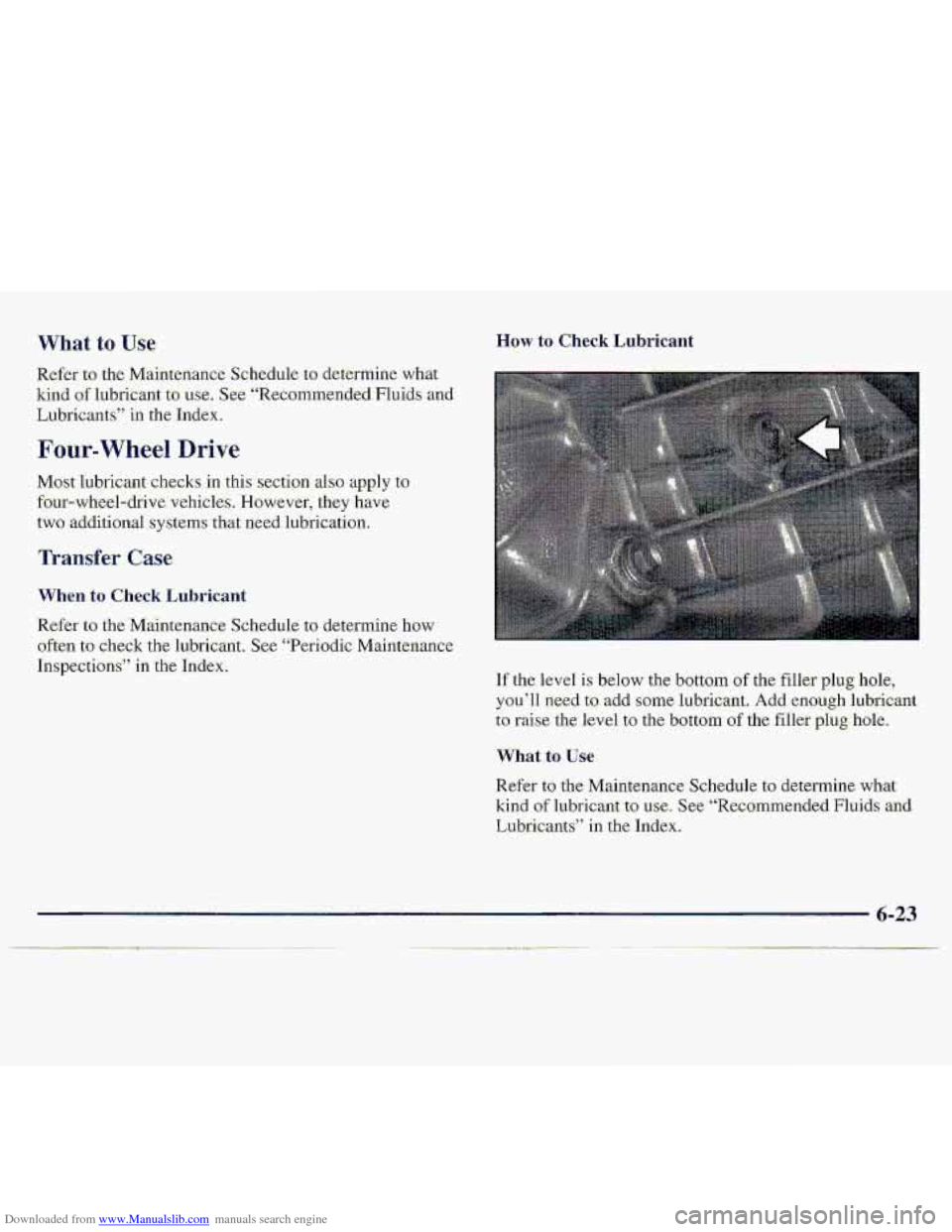
If the level is below the bottom of the. filler plug hole,
you’ll need to add some lubricant. Add enough lubricant
to raise the level to the bottom of the filler plug hole.
What to Use
Refer to the Maintenance Schedule to determine what
kind
of lubrican-t-to use. See “Recommended Fluids and
Lubricants” in the Index.
Page 261 of 402
Downloaded from www.Manualslib.com manuals search engine Front Axle
When to Check and Change Lubricant
Referto the Maitltenance Schedule -to determine haw
often to check the lubricant and when to change it. See
“Scheduled Maintenance S-ervic-es” in the Index.
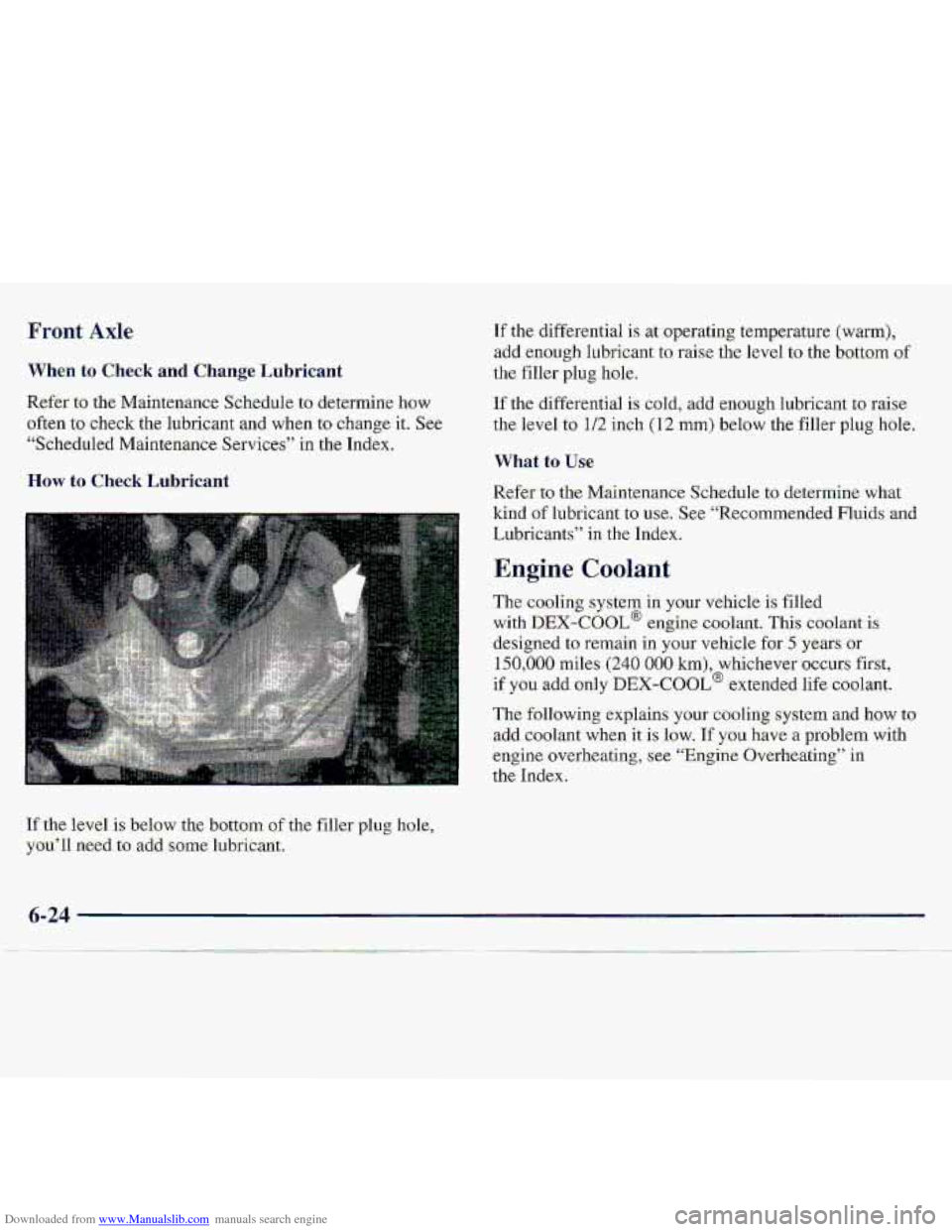
HOW to Check Lubricant
If the 1ev.el is below -the bottom of the filler plug hole,
youfll need to add some lubricant.
If the differential is at aperating temperature (warm),
add enough lubricant to ,raise the level to the bottom of
the filler plug hole,
If the differe.ntia1 is. cold, add enough lubricant to raise-
the level
to 1/2 inch ( 12 mm) below the filler plug hole.
What to Use
Refer to the Maintenance Schedule to determirie what
kind
of lubricant to use. See “Recommended Fluids and
Lubricants” in the Index.
Engine C,oolant
The cooling system in your vehicle is filled
with
DEX-COOL@ engine coolant. This coolant is
designed to remain in your vehicle for:5 year$ or
150,000 miles (240 000 km), whicheveroccurs first,
if you add only DEX-COOL@ extended life coolant.
The fdIowing explains
your .coaling system and how to
add coolant when
it is-10~~ If YQU have a problem with
engine overheating,
see “Engine Overheating’’ in
the Index.
6-24
Page 268 of 402
Downloaded from www.Manualslib.com manuals search engine Brakes
Brake Fluid
I
i
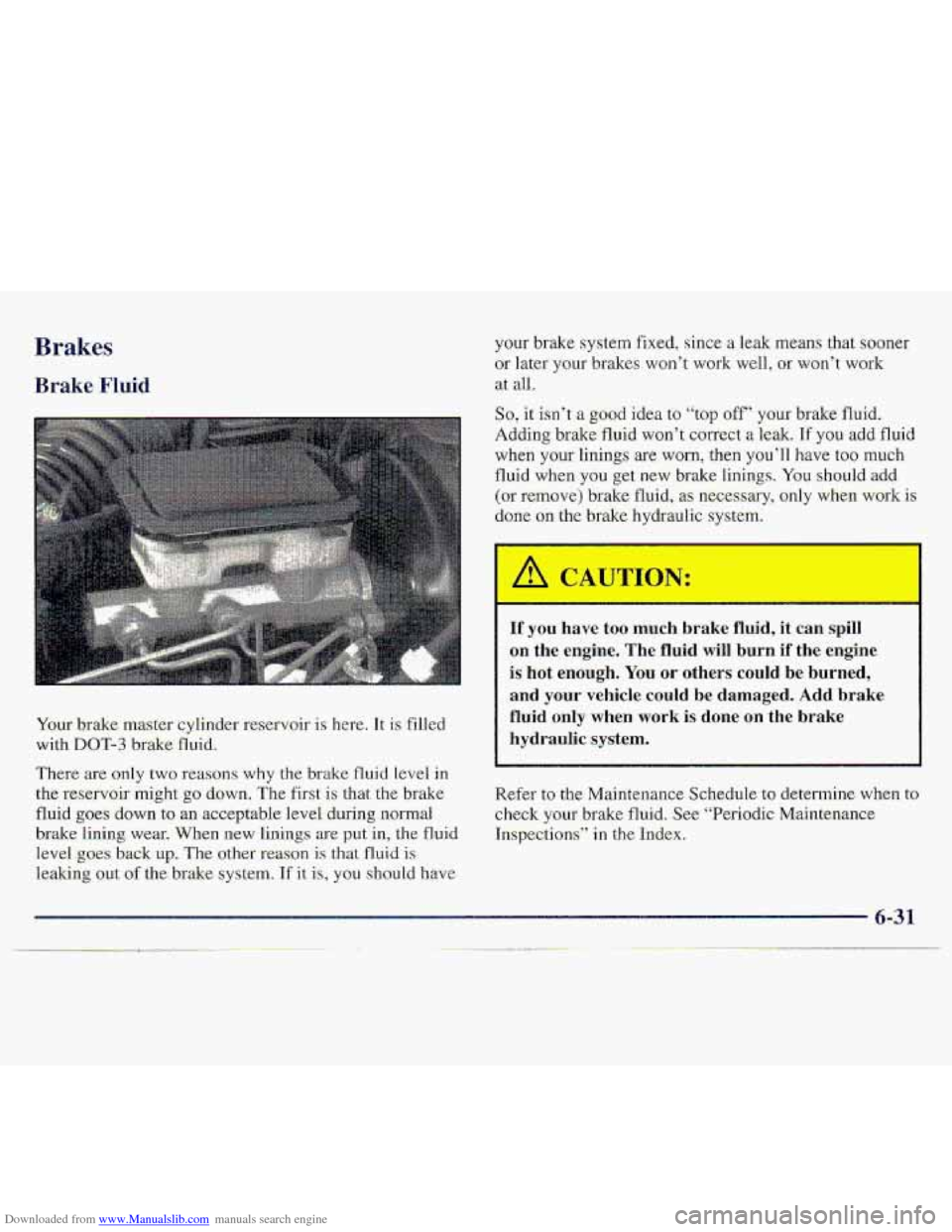
Your brake master cylinder reservoir is ha-e. It is filled
with DOT-3 brake fluid.
There .are only tw.0 reasons why the brake fluid level in
the reservoir might go down. The first is that, the brak.e
fluid goes. down to an acceptable level. :during normal
brake lining wear. When new lin-ings are put-in, the fluid
level goes back up. The other leason is that fluid is
leaking o.ut of the’brake system. If it is, you should lwve
your brake system fixed, since a leak means that so.oner
or later your brakes won’t work. well, or won’t work
at all.
So, it isn’t a good idea to “top off’ your brczke fl.uid.
Adding brake fluid won’t correct :a leak. If-you add fluid
when your linings are. worn: then you’ll have too snucl.1
fluid when you. get new brake linings. You should add
(or remove) b1-ake fluid, as necessary, only when work is
done on the brake hydraulic system.
I
If you have too much brake fluid, it can spin
on the engine. The .fluid will burn if the- engine.
is hot enough. You or others could be burned,
and your vehicle could be damaged. Add brake
fluid only when work is done on the brake
hydraulic @em.
Refel‘ to the Maintenance Schedule to determine when t.o
check your brake fluid. See “Periodic M.aintenance
Tnspection-s’”
in the Index.
Page 271 of 402
Downloaded from www.Manualslib.com manuals search engine Some driving conditions or cljrnates may cause-a brake
squeal when. the brakes are first app1ie.d or li,ghtly
;ipplied. This; does.laot mean something is- wrong with
your brakes,
Propeiiy torqued wheel nuts axnecessary to h:elp
prevent. brake pulsation. When tirm are rotated, inspect
-brake pads for wear and evenly ‘torque wheel nuts in the
-proper sequence to GM specifications.
You rea dnm brakes. don’t’h-ave wear irdicators, but- if
you ever hear a rex brake rubbing noise, have the rear
-brake- linings inspected. Also, the .rear brake drums should
be removed and inspected each time the tit-& are removed
-for rotatimar
changing, When you have the &ant brakes
replaced, have the rear bp&m inspected, too,
.Brake linings should alw-ays be replaced as complete
axle -sets.
See, “Brake System I-nspection” ixl Section 7 of this manual
under Part C “Pexiodic Maintenance Inspections.”
.Brake P.edaL Travel
S-ee your dealer if the brake pedal does .not return to
normal hei-ht,, or if there is a rapid increase in pedal
,travel. This cau1.d I be a sign :qf brake troubk,
Brake Adjustment
Every time you make a brace s~op, your disc brakes
adjust for wear.
If your brake pedal goes down farthcr than normal., your
rear drum brakes may need-:adjustrnent. Adjust them by
backing up and firmly applying the brakes a few times.
Replacing B:rake System Pats
6-34
Page 279 of 402
Downloaded from www.Manualslib.com manuals search engine -Windshield Wiper Blade .Replacement
See “Normal Maintenance Replacement Pqrt.s” in the
Inde-x for the proper type of replacement blade.
I NOTICE:
Use care when -removing-or installing a blade
assernb-ly. ,Accidental bumping can cause the arm
to fall back and strike the windshield.
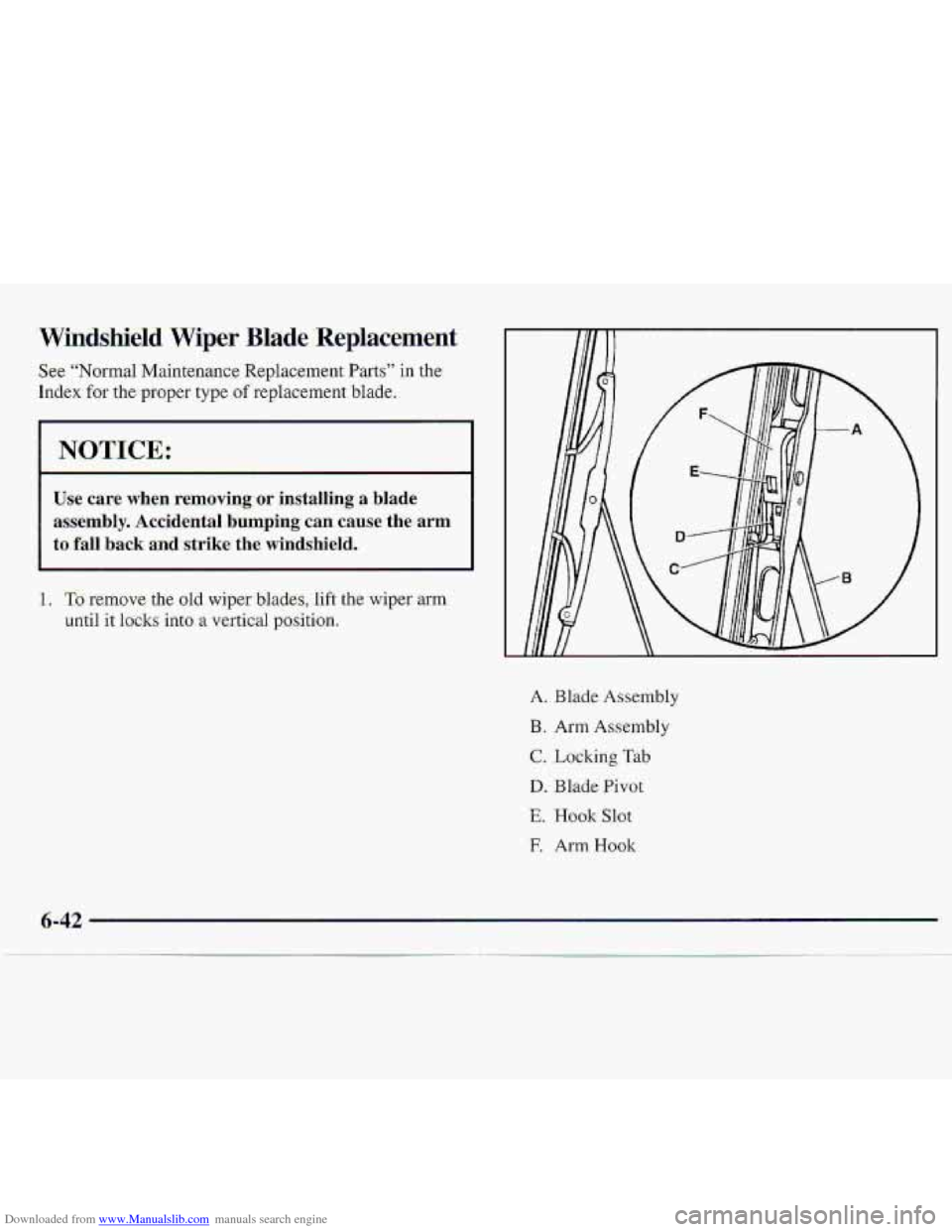
1.. To remove the old wiper blades;, lift the wiper arm
until it
1o.ck.s into a vertical position.
A. Bl.ad-e Asse.mbly
B. Arm Assembly
C. Locking Tab
D. Blade Pivot
E. Hook S.10t
E Arm Hook
6-42
Page 283 of 402
Downloaded from www.Manualslib.com manuals search engine Tire Inspection and Rotation
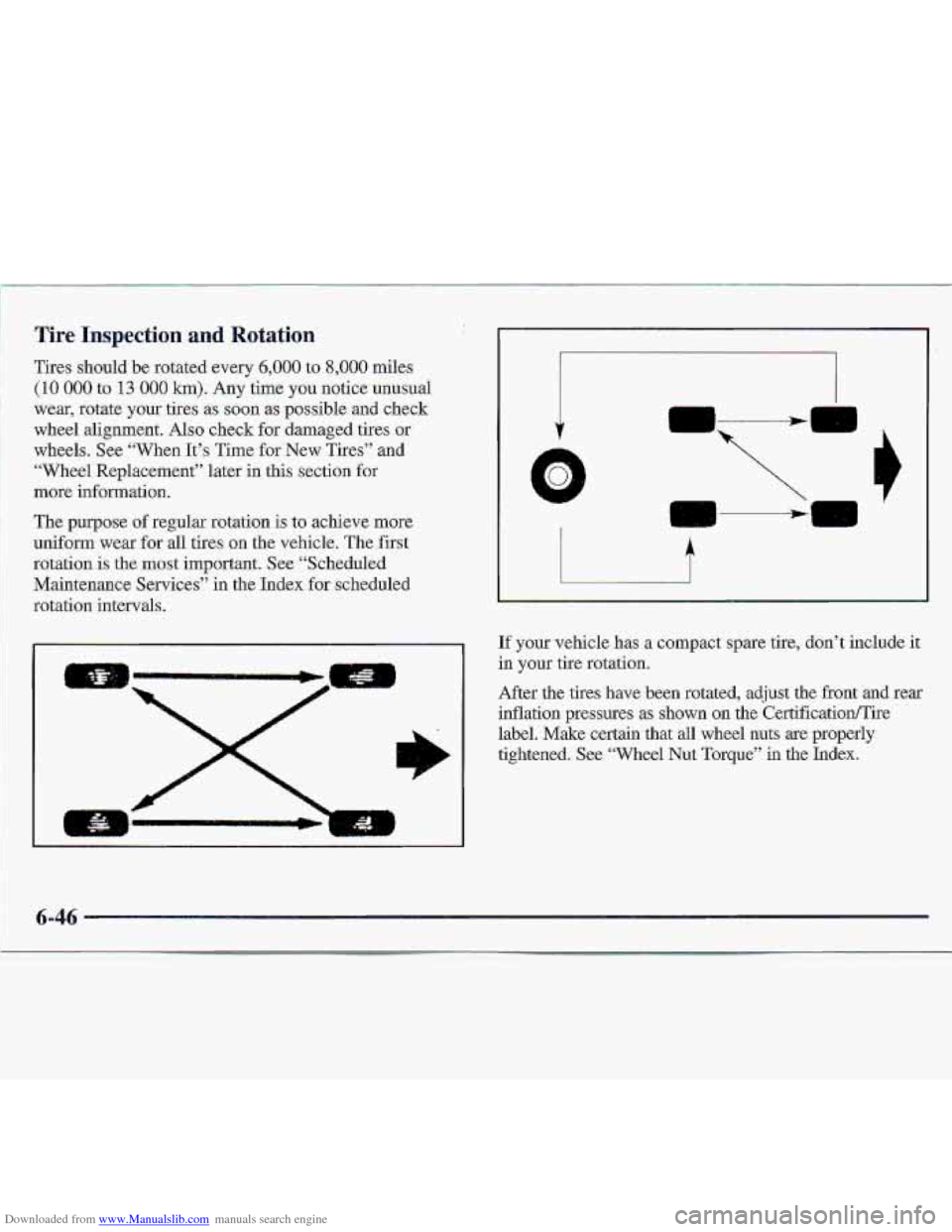
Tires should be rotated every 6,000 to 8,000 miles
(10 QOO. to 13 0.00 km). Any time you notice unusual
wear, rotate your tires
as soon as possible and check
wheel alignment. Also check for damaged tires or
wheels. See “When
It’s Time for New Tires” and
“Wheel Replacement” later in this section for
more information.
The purpose
of regular rotation. is to achieve more
uniform wear for
all tires on the vehicle. The first
rotation is the mast important. See “Scheduled
Maintenance Services”
in the Index for scheduled
rotation intervals.
If your vehicle has a compact spare tire, don’t include it
in your tire rotation.
After the tires have bea rotated, adjust the front
and rear
inflation. pressures
as shown on the Certificatioflire
label. Make certain that all wheel nuts
are. properly
tightened. See “Wheel Nut Torque” in the Index.
6-46 ,,,. .. -~I
Page 310 of 402
Downloaded from www.Manualslib.com manuals search engine Section 7 Maintenance Schedule
This section COV~TS the mainten-awe required. for your vehicle. Your vehicle ;ntxxts-tBese services to retain its safety,
dep.enclability and emission .control performance.
7-2
7-4
7-5
7 -5
7.-6
7 -6
Ilztroducitisn
Part A.: Scheduled Maintenmee Services
Short Trip/City
Defiiiition
Shmt TTip/City Intervals
Long, T~ip/Highway Definition
.Long Trip/Highway Intervals
7 -7
7-37
7-58
7-60
7-63
Short Trip/City Maintenance Schedule
Long. Trip/Highway Maintenance Schedule
Part C: Pefiodh5Maintenmc.e Inspectibas
Part D: Ret-ommended Fluids
and Lubricants
Part E: Maintenance Recard
74
Page 311 of 402
Downloaded from www.Manualslib.com manuals search engine I IMPORTANT: I
KEEP ENGINE OIL
AT THE PROPER
LEVEL AND CHANGE AS
RECOMMENDED
Protection
Plan
Introduction
Your Vehicle and the Environment
Proper vehicle maintenance not only helps to keep your
vehidle
in- gpad worbg condition, but also. helps the
environment.
All recommended maintenance procedures
are important. Improper vehicle maintenance
oan even
affect the
quality of the air we breathe. Improper fluid
levels or the wrong tire inflation can increase the level
af emissions from your vehicle. To help protect our
environment, and to keep your vehicle'in good
condition,
please maintain your vehicle properly.
7-2