Page 64 of 402
Downloaded from www.Manualslib.com manuals search engine Automatic Transmission Operation
Your automatic transmission may have a shift lever
located
on the console between the seats or on the
steering column.
There are several different positions for your shift lever.
If your vehicle is equipped with a column shift lever,
it
features an electronic shift position indicator within the
instrument cluster. This display must be powered
anytime the shift lever is capable of being moved out
of
the PARK (P) position. This means that if your key is in
the
OFF position, but not locked, there will be a small
current drain
on your battery which could discharge
your battery over a period of time.
If you need to leave
your key in the ignition
in the OFF position for an
extended period, it is recommended that you disconnect
the battery cable from the battery
to prevent discharging
your battery.
PARK (P): This locks your rear wheels. It’s the best
position to use when you start your engine because your
vehicle can’t move easily.
Lf! C A TION:
It is dangerous to get out of your vehicle if the
shift lever is not fully in
PARK (P) with the
parking brake
firmly set. Your vehicle can roll.
Don’t leave your vehicle when the engine is
running unless you have to.
If you have left the
engine running, the vehicle can move suddenly.
You or others could be injured.
To be sure your
vehicle won’t move, even when you’re on fairly
level ground, always set your parking brake and
move the shift lever to
PARK (P).
If you have four-wheel drive, your vehicle
will be free to roll
-- even if your shift lever
is in
PARK (P) -- if your transfer case is in
NEUTRAL (N). So, be sure the transfer case is in
a drive gear, two-wheel high (2HI) or four-wheel
high (4HI) or four-wheel low (4LO)
-- not in
NEUTRAL (N). See “Shifting Into PARK (P)” in
the Index.
If you’re pulling a trailer, see “Towing
a Trailer’’ in the Index.
2-17
Page 97 of 402
Downloaded from www.Manualslib.com manuals search engine Illuminated Visor Vanity Mirror Accessory Power Outlets
(If Equipped) (If Equipped)
If y.ou have accessory power outlets, you can plug-in
auxiliary electrical equipment. The acc'essary power
outlets are located below the cigarette lighter. Just pull
down
from the: top of the door and follow the proper
installatian instructions
that are included with any
e1ectric.al equipment you install.
These circuits
are protected by a fBSe .. and. have
maximum current levels.
NOTICE:
When using the accessory power outlets,
maximum electrical load must
not .exceed
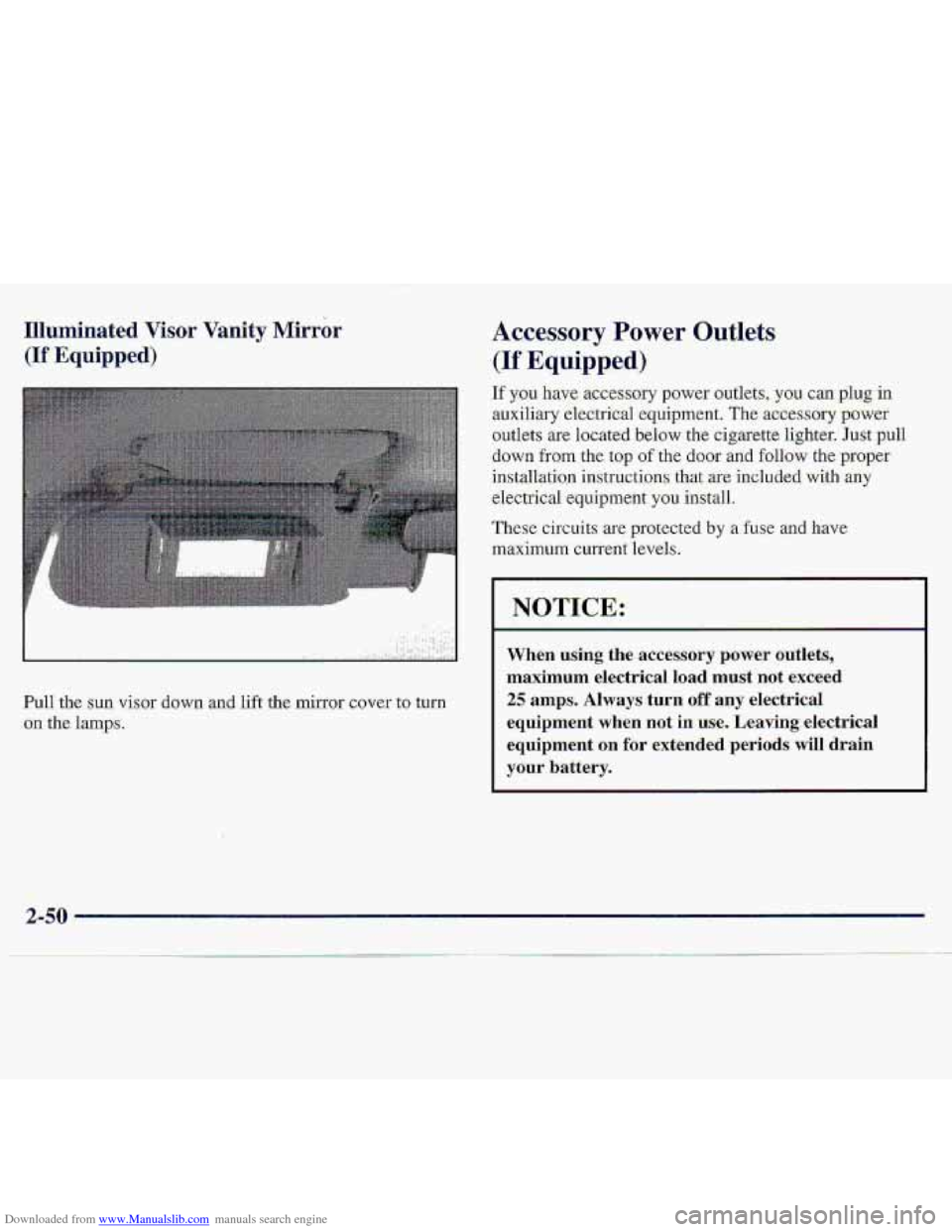
Pull the sun vkor down and lift the mirror cover to turn 25 amps. Always turn off any electrical
on the lamps. equipment when not in use. Leaving electrical
equipm-ent
on far extended periods will drain
your battery.
Page 104 of 402
Downloaded from www.Manualslib.com manuals search engine Voltmeter Gage
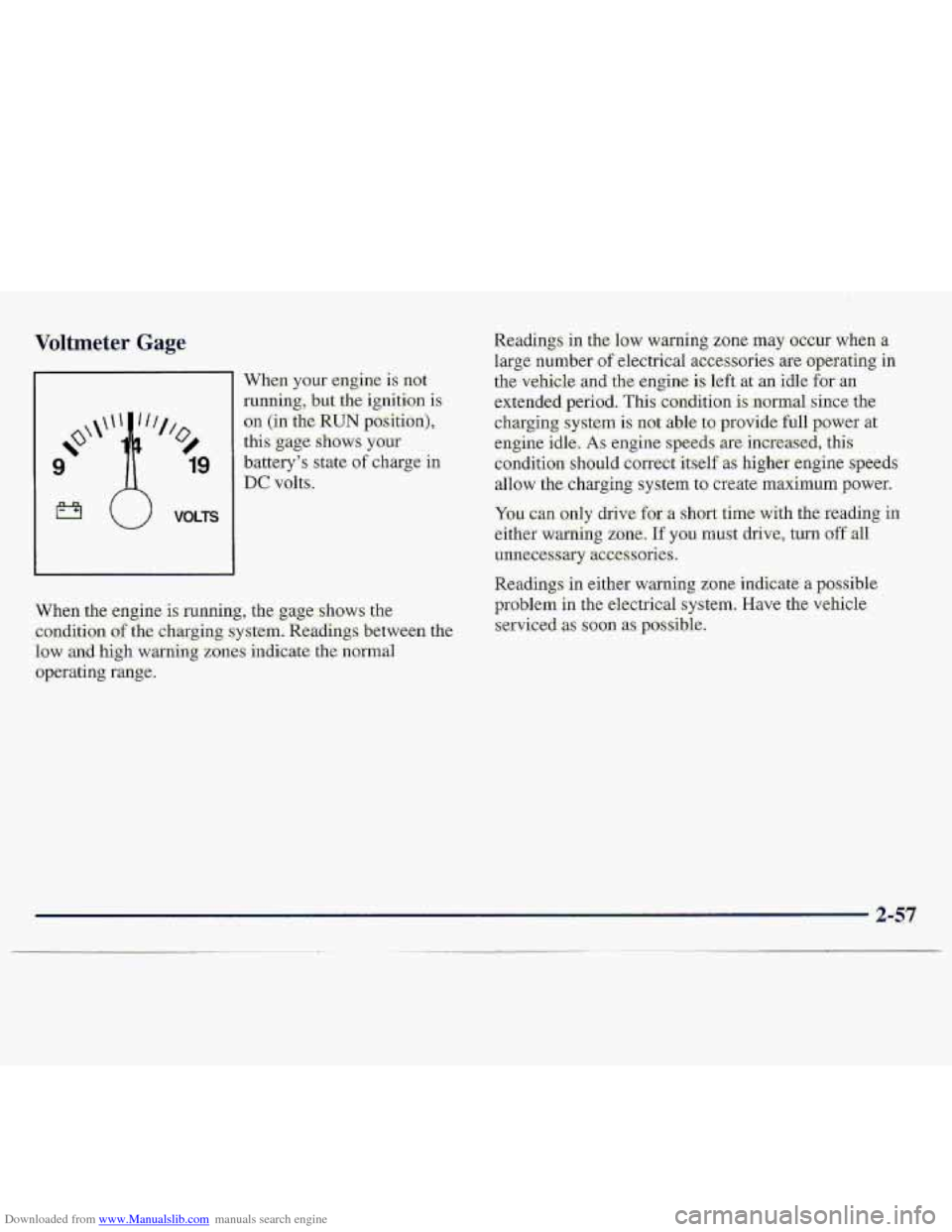
When your engine is not
runqjng, bllt the ignition is
on (in the.RUN position),
this gage shows your
battery's state of charge-in
DC volts.
Reading.s
in either warning zone indicate a pdss.ible
problem- in
the electrical :system. Have the whick
s;erviced .as som as. possible.
Page 130 of 402
Downloaded from www.Manualslib.com manuals search engine THEFTLOCK is designed to distlourage theft -of .yo-ur
radio.. It works by wing a secret cod9. to disable all m&o
functions whenever batrery power is- removed.
The .THEFTLOCK feature for the radio may be used.. or
igrrared. If igriofed,. the system plays. normally -and ~e
:radio is not ptected by'the featufe, If THEFTLO'CM is
activated, your radio will no.t operate if-stolen.
When THEFTLOCK-is 8c.tivated;the-radio will display
L0.C to in.&cate a 1ocked:conditian anytime battery
power
is re;lnoved. If YOU^ battery loses powerfor any
rewon, you must unlock the radio with the seem code
before it will op-erare.
The instructions which follow ,explain how to enter. your
secfe't code to activate the THEFTLOCK system. It is
recommended that. you read through all niad s,teps
befure starting the procedure.
Page 132 of 402
Downloaded from www.Manualslib.com manuals search engine Disabling the Theft-Deterrent Feat-ure
Enter yoor secret-code as follows; pause no mor'e than
15 seconds between steps:
1. Turn the ignition to ACCESSORY or RUN.
2. Turn the. radio off.
3. Piess the 1 and 4 buttons together. Hold them aown
4. Press MNand 000 will appear cm the display.
5. PPess MNagain tu make the last two digits agree
.until
SEC shows--ox~ the display.
with your
Code.
6. Press I3.R to make the €irst one or two di@ zgree
with;yGur codei
7. Press AM-FM af1e.r yau have confirmed that the
code matches
the secret code you have written down.
The display will show ---j indicating that the radio is
no longer secured.
If the wde.. entered is .incorre.ct, SEC will appear on the
display.
The rad.io will remain secured until the correct
code is
entered.
-When battery power is removed and later app1ie:d to a
J secure.d radio, the radia won't. turn sind LOC will
appearon the-display.
To:unlock a secured radio, see "Unlrxking the
Theft-Det-errent Feature After a Power Loss" earlier i.n
this section.
ff" Stereo
FM. ste.ere.0 will give. you the best sound. B.ut FM signals
will reach only about 10 to 40 miles (16. to 65 km). Tall
buildings or:hills
can inte?fere with FM signals, causing.
the
sound to: dome and. go.
AM
The range for most AM stations is greater than fm FM,
especially at n.ight. The longer rangc, however, can
c&e stxioris to intwfeit-with each other. AM can pick
up noise from things like storms and pawer lines. Try
reducing
the treble-@ reduce this noise- if you ever get it.
Tips About Your Au,dio System
Hearing -damage from loud noise is almos1 undet.ectabk
until
it is too late, Your hearing. can .adapt to higher
volumes
of sound. Sound that seems normal c8n be loud
and harmful to your hearing. Take. precautions by
adjusting-the volume cuntrol, on your radio to a safe
sound lwei before your hearing adapts to it.
3-19
Page 179 of 402
Downloaded from www.Manualslib.com manuals search engine Snow can trap exhaust gases under yo.ur vehicle.
This.can cause
deadly CO (carbon rncmoxide) gas
to get: inside. CO could overcome you and kill
you.
'You can't .see it or smell it, so you might not
know it is in your vehicle. Clear away snow from
aruund the. base of your vehicle, especially any
that
is blocking your exhaust pipe. And check
around again
from time to time- to be.sure snow
doesn't col1ect:there.
Open a window just a, little on the side of the
vehicle that% away
froin the wind. This will help
keep
CO out.
Run your engine o111y as long as you h~ust. This s&veS-
fu.eL When you run the engine, make it g.-a little faster
than just idle. That is, push. the, accelerator..slightIy. This
uses less fuel far the heat that .you get and it keeps- the.
battery
charg.ed. You willl neecia well-charged battery 'to
restart the vehicle, and possibly for signaling later an
with. your headamps.. Let the heatex run for a while.
Then,. shut the-engine off and dose the window almost
all the way to' p&erve the heat. Start the e.ngine again
and repe.at
.this only when you feel ceally qxkbmfortable
from the cold. But. do it as little as possible, Preserve the
fuel as- long- as you can. To help keep warm, you can get
out of the vehicle. and do some .faidy vlgorous -exercises
every half how os so until help comes.
Page 200 of 402
Downloaded from www.Manualslib.com manuals search engine Jump S t-arting.
If your battery has run clown, you m.ay want to use
another vehic1.e and some jumper cables to start your
vehicle,
But p1eas.e use the-folluwing steps to do
it safely.
NOTICE:
Ignoring these steps could result in costly damage
to your vehicle that wouldnlt
b.e covered by
your ww-ranty.
Do not try to Start your vehicle by pushing or
pulling it. This could damage your vehicle, even if
you have. a m-mual transdssion. And if you have I
an automatic transmis;sion, it: won’t start that way.
Batteries can hurt you. They can be dangerous
because:
They contain.acid that can burn you.
They contain gas that can explode or ignite.
They corit&iu enough electricity to
If you don’t follow- these -steps exactly,-’some or all
of-these things-
can hurt you.
burn you.
1. Check the other ve-hicle. 1.t must.have a 12-volt
battery with a neg,ative ground system.
I NOTICE:
I€ the other system isn’t a l2-volt .systein with .a
negative ground, both vehicles, can role d-amaged.: I
Page 202 of 402
Downloaded from www.Manualslib.com manuals search engine 4. Open the hoods and locate the batteries. Find
the positive
(+) and negative (-) terminals on
each battery.
Using a match near .a battery can cause battery
gas to explode. People have been hurt doing this,
and some have been blinded. Use a flashiight
if
you need more light.
Be sure the battery has enough water.
You don’t
need to add water
to the Delco Freedom@ battery
installed
in every new GM vehicle. But if a
battery has filler caps, be sure the right amount
of fluid is there. .If it is‘low, add water to take care
of that fist, If you don’t, explosive gas could
be present.
Battery
fluid contains acid that can burn you.
Don’t get it on you. If you accidentally get it in
your eyes or on your skin, flush the place with
water and get medical help immediately.
5. Check that the jumper cables don’t have loose or
missing insulation.
If they do, you could. get a shock.
The-vehicles could be damaged too.
Before you connect the cables, here are some- basic
things
you should know. Positive (+> will ga
to positive (+) and negative (-) will go to a
metal engine
part. Don’t connect positive (+) to
negative
(-) or you’ll get a short that would damage
the battery and maybe other parts too.
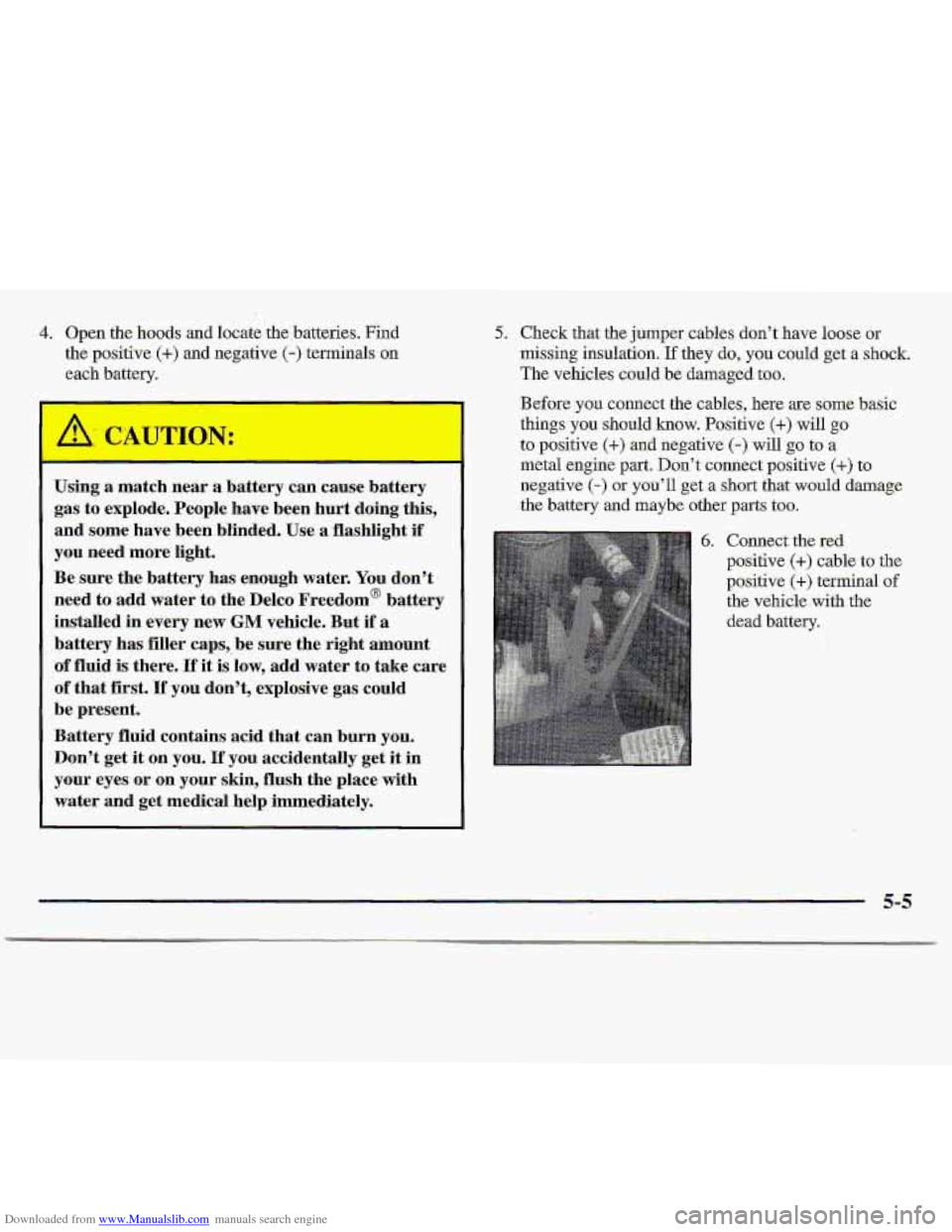
6. Connect the red
positive
(+) cable to the
positive
(+) terminal of
the vehicle with the
dead btittery.