1997 CHEVROLET MONTE CARLO instrument panel
[x] Cancel search: instrument panelPage 99 of 358
Downloaded from www.Manualslib.com manuals search engine Ashtrays and Lighter
The center front ashtray may be on the instrument panel
or on the console.
To remove the instrument panel
ashtray, open
it, push down on the locking tab and pull
out the ashtray.
For the console ashtray, open the lid and lift out the
ashtray using the snuffer.
Your vehicle may have a rear ashtray.
It is located within
a small door at the rear
of your console or rear of your
front seat storage armrest. Push
on the right side of the
door. The ashtray will then rotate to the right for usage.
You can only access the ashtray by pushing on the door’s
right side.
To remove the ashtray, push down on the
snuffer located in the middle of the ashtray and lift
it out.
I NOTICE:
Don’t put papers and other things that burn into
your ashtrays.
If you do, cigarettes or other
smoking materials could set them on fire,
causing damage.
To use the lighter, just push it in all the way and let go.
When it’s ready, it will pop back by itself.
I NOTICE:
Don’t hold a cigarette lighter in with your hand
while
it is heating. If you do, it won’t be able to
back away from the heating element when
it’s
ready. That can make it overheat, damaging the
lighter
and the heating element.
Sun Visors
To block out glare, you can swing down the visors. You
can also move them from side to side.
Page 103 of 358
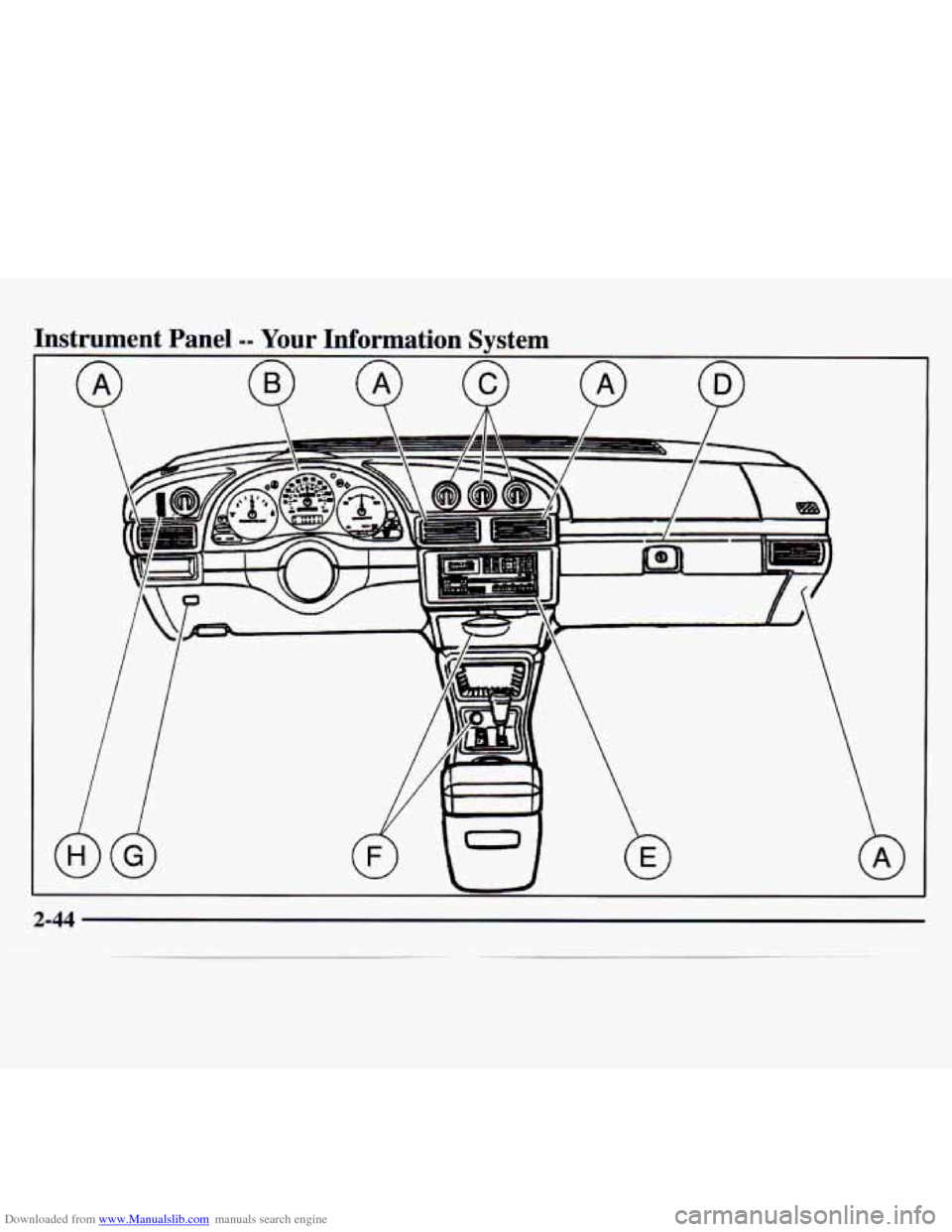
Downloaded from www.Manualslib.com manuals search engine Instrument Panel -- Your Information System Y
Page 105 of 358
Downloaded from www.Manualslib.com manuals search engine Instrument Panel Cluster
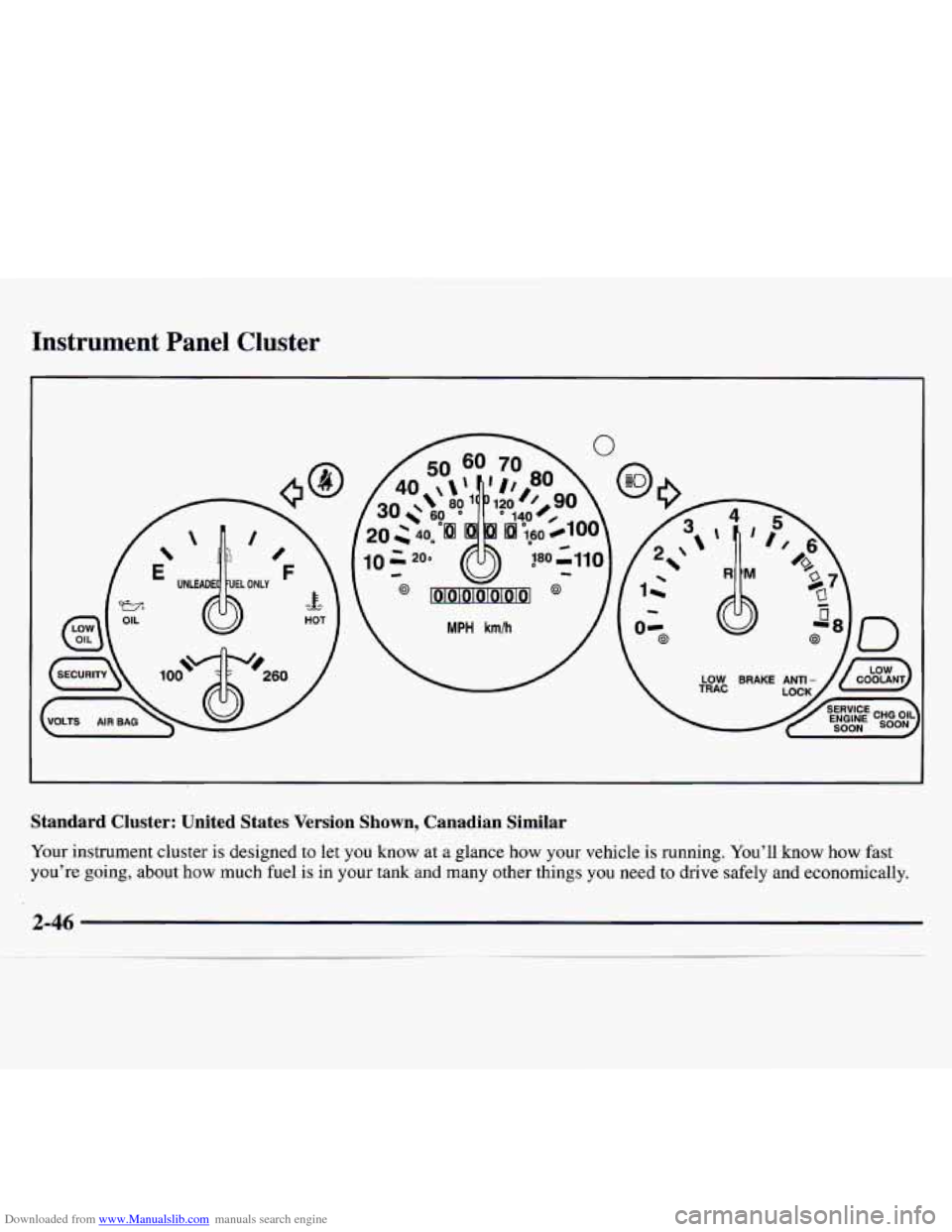
Standard Cluster: United States Version Shown, Canadian Similar
Your instrument cluster is designed to let you know at a glance how your vehicle is running. You’ll know how fast
you’re going,
about how much fuel is in your tank and manv other things you need to drive safely and economically.
2-46
Page 108 of 358
Downloaded from www.Manualslib.com manuals search engine Air Bag Readiness Light
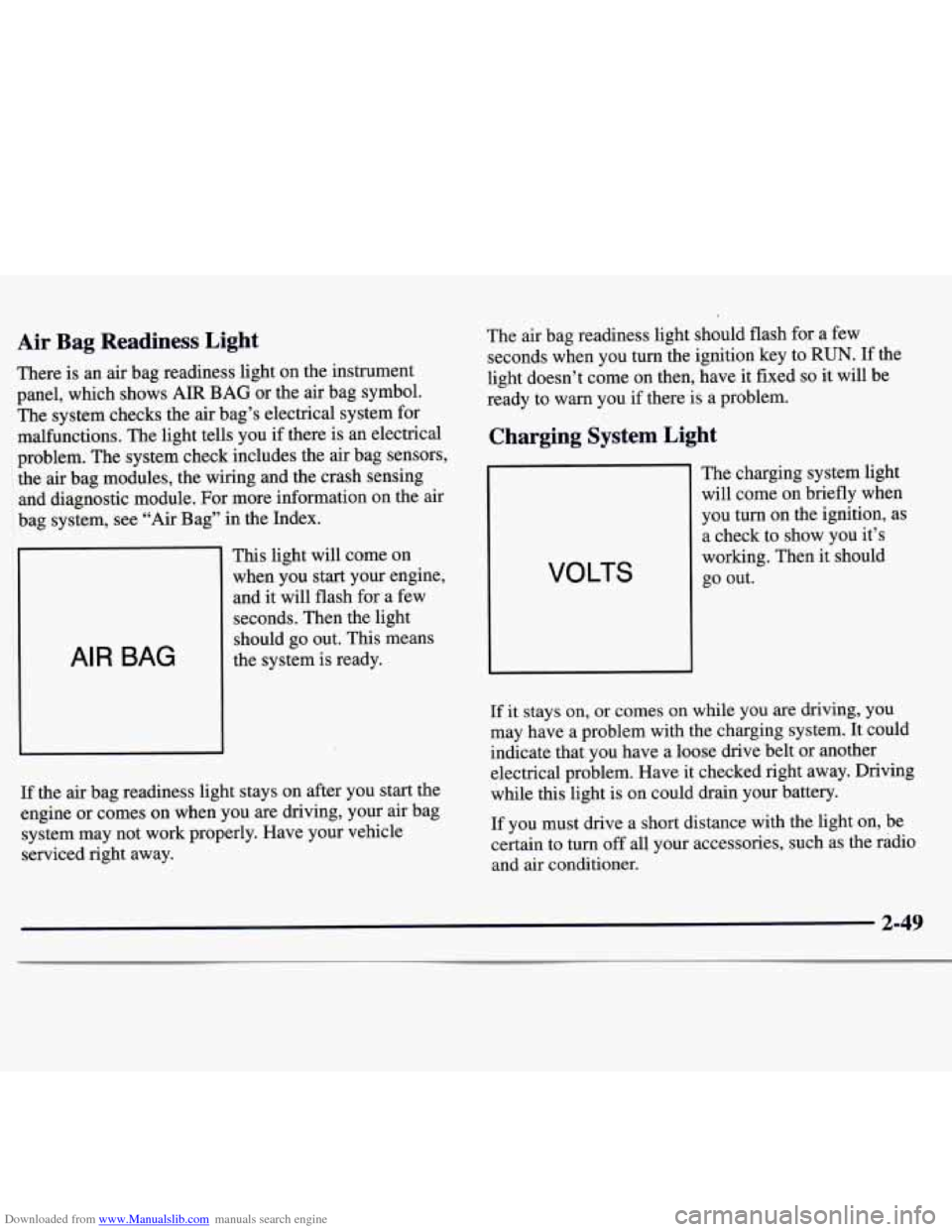
There is an air bag readiness light on the instrument
panel, which shows AIR
BAG or the air bag symbol.
The system checks the air bag’s electrical system for
malfunctions. The light tells you
if there is an electrical
problem. The system check includes the air bag sensors,
the air bag modules, the wiring and the crash sensing
and diagnostic module. For more information on the air
~ bag system, see “Air Bag” in the Index.
AIR BAG
This light will come on
when you start your engine,
and it will flash for a few
seconds. Then the light
should go out. This means
the system is ready. The
air bag readiness light should flash for a few
seconds when you turn the ignition key to RUN.
If the
light doesn’t come on then, have it fixed
so it will be
ready to warn you if there is a problem.
Charging System Light
If the air bag readiness light stays on after you start the
engine or comes on when you are driving, your air bag
system may not work properly. Have your vehicle
serviced right away.
VOLTS
The charging system light
will come on briefly when
you turn on the ignition, as
a check to show you it’s
working. Then it should
go out.
If
it stays on, or comes on while you are driving, you
may have a problem with the charging system. It could
indicate that you have a loose drive ‘belt or another
electrical problem. Have it checked right away. Driving
while this light is on could drain your battery.
If you must drive a short distance with the light on, be
certain to turn
off all your accessories, such as the radio
and air conditioner.
2-49
Page 122 of 358
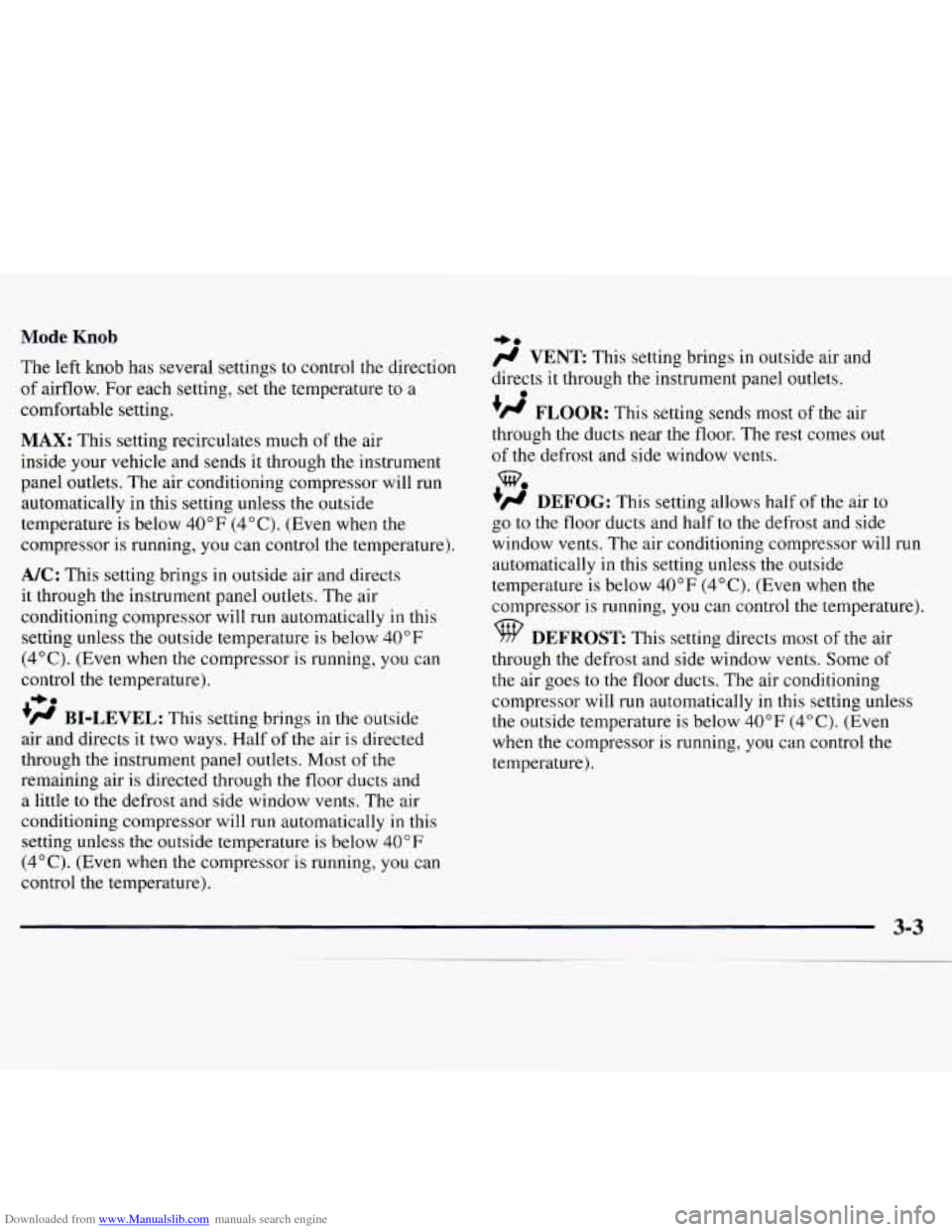
Downloaded from www.Manualslib.com manuals search engine Mode Knob
The left knob has several settings to control the direction
of airflow. For each setting,
set the temperature to a
comfortable setting.
MAX: This setting recirculates much of the air
inside your vehicle and sends it through the instrument
panel outlets. The air conditioning compressor will run
automatically in this setting unless the outside
temperature is below 40°F (4°C). (Even when
the
compressor is running, you can control the temperature).
A/C: This setting brings in outside air and directs
it through the instrument panel outlets. The air
conditioning compressor will run automatically
in this
setting unless the outside temperature is below 40°F
(4°C). (Even when the compressor is running, you can
control the temperature).
+' BI-LEVEL: This setting brings in the outside
air and directs it two ways. Half of
the air is directed
through the instrument panel outlets. Most
of the
remaining air is directed through
the floor ducts and
a little to the defrost and side window
vents. The air
conditioning compressor will run automatically
in this
setting unless
the outside temperature is below 40°F
(4°C). (Even when the compressor is running, you can
control the temperature).
+e +e
/J VENT This
setting brings in outside air and
directs
it through the instrument panel outlets.
'# FLOOR: This setting sends most of the air
through the ducts near the floor. The rest comes out
of
the defrost and side window vents.
$/J DEFOG: This setting allows half of the air to
go to the floor ducts and half to the defrost and side
window vents.
The air conditioning compressor will run
automatically
in this setting unless the outside
temperature is below 40°F (4°C). (Even when the
compressor is running, you can control the temperature).
DEFROST This setting directs most of the air
through the defrost and side window vents. Some of
the air goes to the floor ducts. The air conditioning
compressor
will run automatically in this setting unless
the outside temperature is below 40°F
(4°C). (Even
when the compressor is running, you can control the
temperature).
0
we
3-3
Page 175 of 358

Downloaded from www.Manualslib.com manuals search engine Turn Signals When Towing a Trailer
When you tow a trailer, your vehicle may need a
different turn signal flasher and/or extra wiring. Check
with your Chevrolet dealer. The green arrows on your
instrument panel will flash whenever you signal a turn
or lane change. Properly hooked up, the trailer lamps
will also flash, telling other drivers you’re about to turn,
change lanes or stop.
When towing a trailer, the green arrows on your
instrument panel will flash for turns even
if the bulbs on
the trailer are burned out. Thus, you may think drivers
behind you are seeing your signal when they are not. It’s
important to check occasionally to be sure the trailer
bulbs
are still working.
Driving On Grades
Reduce speed and shift to a lower gear before you start
down a long or steep downgrade. If you don’t shift
down, you might have to use your brakes
so much that
they would get hot and no longer work well.
On a long uphill grade, shift down and reduce your
speed
to around 45 mph (70 km/h) to reduce the
possibility of engine and transaxle overheating.
If you are towing a trailer, you may want to drive in
DRIVE
(D) instead of AUTOMATIC OVERDRIVE (0)
(or, as you need to, a lower gear),
Parking on Hills
You really should not park your vehicle, with a trailer
attached, on a hill. If something
goes wrong, your rig
could start to move. People can be injured, and both
your vehicle and the trailer can be damaged.
But if you ever have to park your
rig on a hill, here’s
how to do it:
1.
2.
3.
4.
5.
Apply your regular brakes, but don’t shift into
PARK
(P) yet.
Have someone place chocks under the trailer wheels.
When the wheel chocks are in place, release the
regular brakes until the chocks absorb the load.
Reapply the regular brakes. Then apply your parking
brake, and then shift to PARK
(P).
Release the regular brakes.
Page 190 of 358

Downloaded from www.Manualslib.com manuals search engine Engine Overheating
You will find a coolant temperature gage and the
warning light about a hot engine on your instrument
panel. See “Engine Coolant Temperature Gage” and
“Engine Coolant Temperature Warning Light” in the
Index.
You also have a LOW COOLANT light on your
instrument panel. See “Low Coolant Light” in the Index.
If Steam Is Coming From Your Engine
L
Steam from an overheated engine can burn you
badly, even
if you just open the hood. Stay away
from the engine if you see or hear steam coming
from it. Just turn it
off and get everyone away
from the vehicle until it cools down. Wait until
there
is no sign of steam or coolant before you
open the hood.
If you keep driving when your engine is
overheated, the liquids in it can catch fire. You or
others could be badly burned. Stop your engine
if
it overheats, and pet out of the vehicle until the
engine is cool.
NOTICE:
If your engine catches fire because you keep
driving with no coolant, your vehicle can be
badly damaged. The costly repairs would not be
covered by your warranty.
Page 218 of 358

Downloaded from www.Manualslib.com manuals search engine Adding Equipment to the Outside of
Your Vehicle
Things you might add to the outside of your vehicle can
affect the airflow around it. This may cause wind noise
and affect windshield washer performance. Check with
your Chevrolet dealer before adding equipment to the
outside of your vehicle.
Fuel
Use regular unleaded gasoline rated at 87 octane or
higher. At a minimum, it should meet specifications
ASTM D4814 in the United States and CGSB 3.5-M93
in Canada. Improved gasoline specifications have been
developed
by the American Automobile Manufacturers
Association (AAMA) for better vehicle performance
and engine protection. Gasolines meeting the AAMA
specification could provide improved driveability and
emission control system protection compared to
other gasolines.
Be sure the posted octane is at least
87. If the octane is
less than 87, you may get a heavy knocking noise when
you drive. If it’s bad enough, it can damage your engine.
If you’re using fuel rated at
87 octane or higher and you
hear heavy knocking, your engine needs service. But
don’t worry
if you hear a little pinging noise when
you’re accelerating or driving up a hill. That’s normal, and you don’t
have to buy a higher octane fuel to get rid
of pinging. It’s the heavy, constant knock that means
you have a problem.
If your vehicle is certified to meet California Emission
Standards (indicated
on the underhood tune-up label), it
is designed to operate
on fuels that meet California
specifications. If such fuels
are not available in states
adopting California emissions standards, your vehicle will operate satisfactorily on
fuels meeting federal
specifications, but emission control system performance
may be affected. The malfunction indicator lamp on
your instrument panel may turn on and/or your vehicle
may fail a smog-check
test. If this occurs, return to your
authorized Chevrolet dealer for diagnosis to determine
the cause of failure. In the event it is determined that the
cause
of the condition is the type of fuels used, repairs
may not
be covered by your warranty.
Some gasolines that are not reformulated for low
emissions contain an octane-enhancing additive called
methylcyclopentadienyl manganese tricarbonyl (MMT);
ask your service station operator whether or not his fuel
contains MMT. General Motors does not recommend the
use of such gasolines. If fuels containing MMT are used,
spark plug life may be reduced and your emission
control system performance may be affected. The
malfunction indicator lamp on your instrument panel