1997 CHEVROLET CORVETTE belt
[x] Cancel search: beltPage 181 of 356
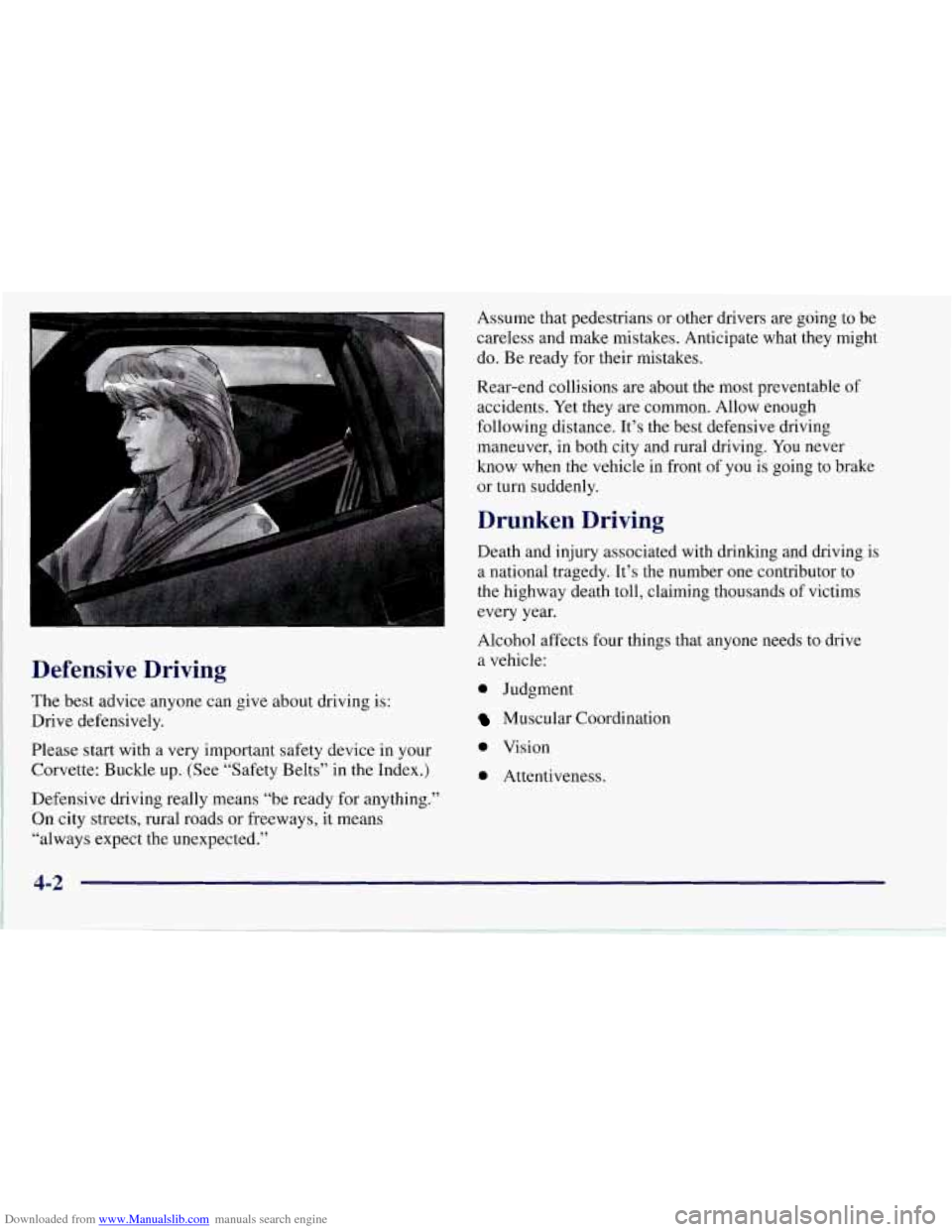
Downloaded from www.Manualslib.com manuals search engine Defensive Driving
The best advice anyone can give about driving is:
Drive defensively.
Please start with a very important safety device in your
Corvette: Buckle up. (See “Safety Belts” in the Index.) Assume that pedestrians
or other drivers are going to be
careless and make mistakes. Anticipate what they might
do. Be ready for their mistakes.
Rear-end collisions are about the most preventable
of
accidents. Yet they are common. Allow enough
following distance. It’s the best defensive driving
maneuver, in both city and rural driving. You never
know when the vehicle in front
of you is going to brake
or turn suddenly.
Drunken Driving
I Death and injury associated with drinking and driving is
a national tragedy. It’s the number one contributor to
the highway death toll, claiming thousands
of victims
every year.
Alcohol affects four things that anyone needs to drive
a vehicle:
0 Judgment
Muscular Coordination
0 Vision
0 Attentiveness.
Defensive driving really means “be ready for anything.”
On city streets, rural roads or freeways, it means
“always expect the unexpected.”
4-2
Page 191 of 356
Downloaded from www.Manualslib.com manuals search engine If you need to reduce your speed as you approach a
curve,
do it before you enter the curve, while your front
wheels
are straight ahead.
Try to adjust your speed so you can “drive” through the
curve. Maintain a reasonable, steady speed. Wait to
accelerate until you
are out of the curve, and then
accelerate gently into the straightaway.
Steering in Emergencies
There are times when steering can be more effective
than braking. For example, you come over a hill and
find
a truck stopped in your lane, or a car suddenly pulls
out from nowhere, or a child darts out from between
parked cars and stops right in front of you. You can
avoid
these problems by braking -- if you can stop
in time. But sometimes you can’t; there isn’t room.
That’s the time for evasive action
-- steering around
the problem.
Your Corvette can perform very well in emergencies like
these. First apply your brakes. (See “Braking in
Emergencies” earlier in this section.) It
is better to
remove as much speed as you can from a possible
collision. Then steer around the problem, to the left or
right depending on
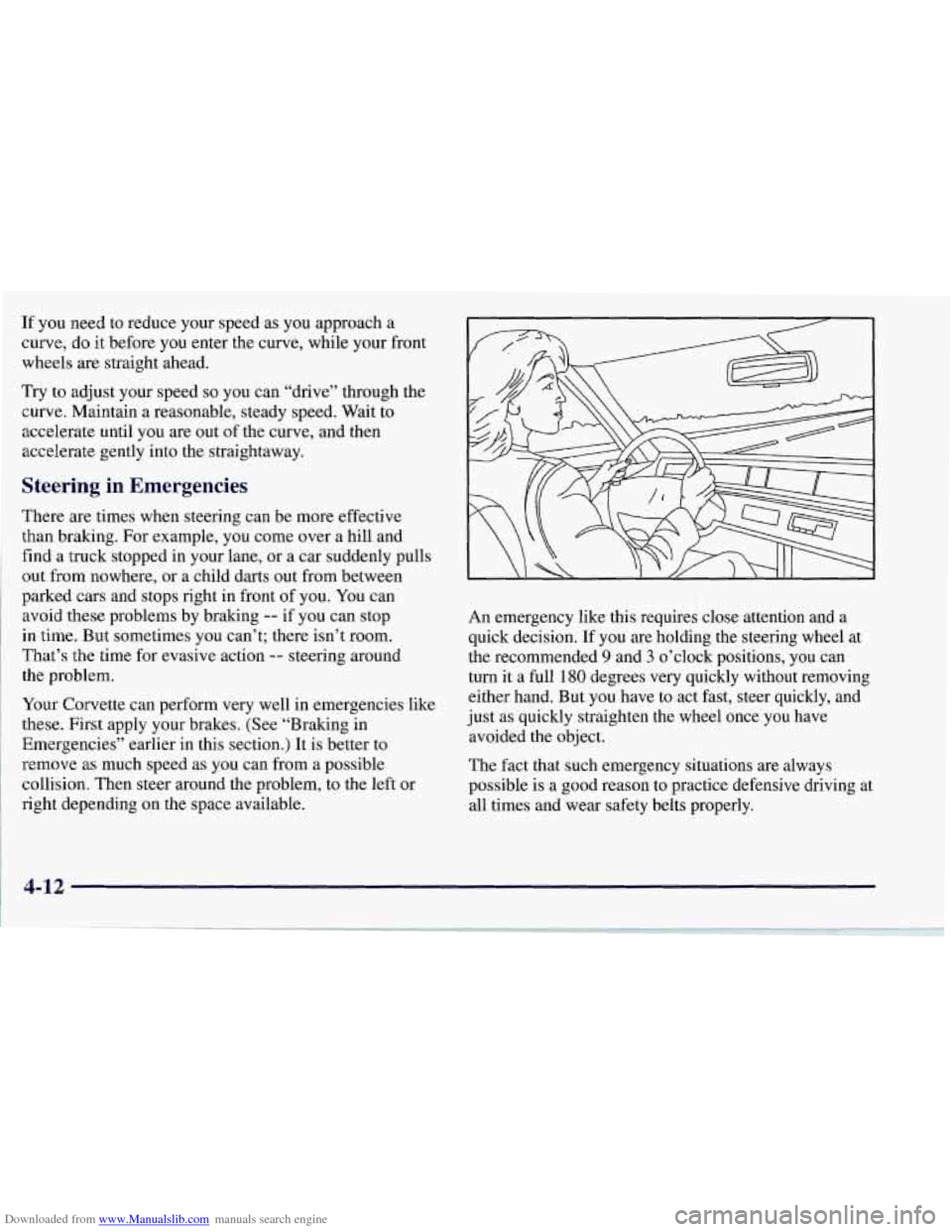
the space available. An emergency like this
requires close attention and a
quick decision.
If you are holding the steering wheel at
the recommended
9 and 3 o’clock positions, you can
turn it a full
180 degrees very quickly without removing
either hand. But you have to act fast, steer quickly, and
just as quickly straighten the wheel once you have
avoided the object.
The fact that such emergency situations are always
possible is a good reason to practice defensive driving at
all times and wear safety belts properly.
Page 236 of 356
Downloaded from www.Manualslib.com manuals search engine e Section 6 Service and Appearance Care
Here you will find information about the care of your Corvette. This section begins with service and fuel information,
and then it shows how to check important fluid and lubricant levels. There is also technical information about your
vehicle, and a part devoted to its appearance care.
6-2 Service 6-3 Fuel
6-5 Fuels in Foreign Countries
6-5 Filling Your Tank
6- 8 Checking Things Under the Hood
6-1 1 Engine Oil
6-16 Air Cleaner
6-18 Automatic Transmission Fluid
6- 19 Manual Transmission Fluid
6-20 Hydraulic Clutch
6-22 Engine Coolant
6-26 Surge Tank Pressure Cap
6-26 Power Steering Fluid
6-22 Rear Axle
6-26
Thermostat
6-27 Windshield Washer Fluid
6-
29 Brakes
6-32 Battery 6-33
6-33
6-37
6-40
6-5
1
6-5 1
6-54
6-55
6-56
6-57
6-57 6-59
6- 60
6- 60
6-6 1
6-69
6-69 6-7
1
Bulb Replacement
Halogen Bulbs
Windshield Wiper Blade Replacement
Tires Appearance Care
Cleaning the Inside of Your Corvette
Care of Safety Belts
Cleaning the Outside of Your Corvette
Aluminum Wheels
Tires Underbody Maintenance
Appearance Care Materials
Vehicle Identification Number (VIN)
Service Parts Identification Label
Electrical System
Replacement Bulbs Capacities and Specifications
Air Conditioning Refrigerants
6-1
Page 281 of 356
Downloaded from www.Manualslib.com manuals search engine If you ever replace your tires with those not having a
TPC Spec number, make sure they are the same size,
load range, speed rating and construction type (bias,
bias-belted or radial) as your original tires.
I CAJTION:
Mixing tires could cause you to lose control while
driving.
If you mix tires of different sizes (other
than those originally installed on your Corvette)
or types (radial and bias-belted tires), the vehicle
may not handle properly, and you could have a
crash. Using tires of different sizes (other than
those originally installed on your Corvette) may
also cause damage to your vehicle. Be sure to use
the correct size and type tires on all four wheels.
Uniform Tire Quality Grading
The following information relates to the system
developed by the United States National Highway
Traffic Safety Administration, which grades tires by
treadwear, traction and temperature performance. (This
applies only to vehicles sold in the United States.) The
grades are molded on the sidewalls of most passenger
car tires. The Uniform Tire Quality Grading system does
not apply to deep tread, winter-type snow tires,
space-saver or temporary use spare tires, tires with
nominal rim diameters
of 10 to 12 inches (25 to 30 cm),
or to some limited-production tires.
While the tires available on General Motors passenger
cars and light trucks may vary with respect to these
grades, they must also conform to Federal safety
requirements and additional General Motors Tire
Performance Criteria
(TPC) standards.
If
you feel that winter tires are needed, see “Extended
Mobility Tires” in the Index.
Page 289 of 356
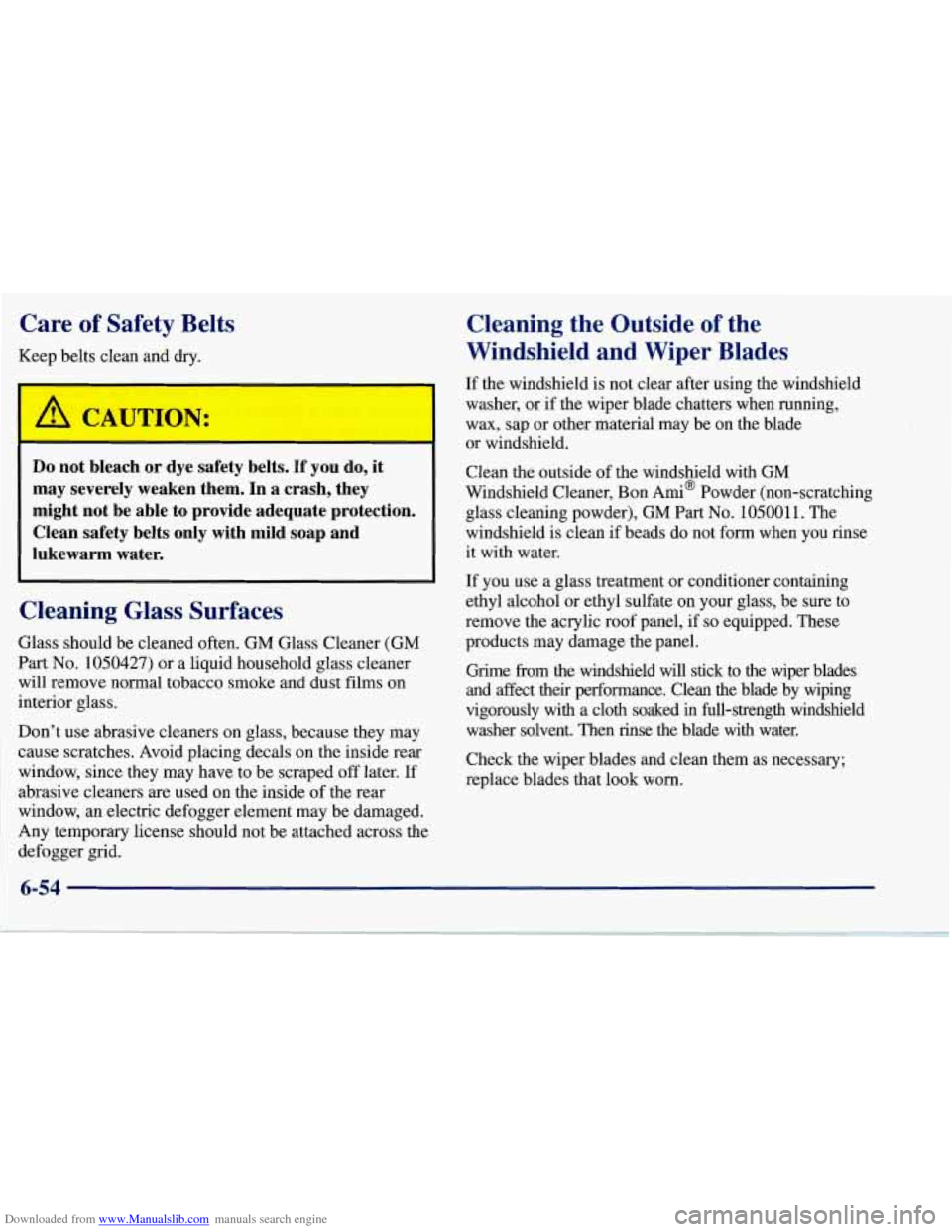
Downloaded from www.Manualslib.com manuals search engine Care of Safety Belts
Keep belts clean and dry.
Do not bleach or dye safety belts. If you do, it
may severely weaken them. In a crash, they
might not
be able to provide adequate protection.
Clean safety belts only with mild soap and
lukewarm water.
Cleaning Glass Surfaces
Glass should be cleaned often. GM Glass Cleaner (GM
Part No. 1050427) or a liquid household glass cleaner
will remove normal tobacco smoke and dust films on
interior glass.
Don’t use abrasive cleaners on glass, because they may
cause scratches. Avoid placing decals on the inside rear
window, since they may have to be scraped
off later. If
abrasive cleaners are used on the inside of
the rear
window, an electric defogger element may be damaged.
Any temporary license should not be attached across the defogger grid.
Cleaning the Outside of the
Windshield and Wiper Blades
If the windshield is not clear after using the windshield
washer, or if the wiper blade chatters when running,
wax, sap or other material may be on the blade
or windshield.
Clean the outside of the windshield with GM
Windshield Cleaner, Bon
Ami@ Powder (non-scratching
glass cleaning powder), GM
Part No. 1050011. The
windshield is clean if beads do not form when you rinse
it with water.
If you use a glass treatment or conditioner containing
ethyl alcohol or ethyl sulfate on your glass, be sure to
remove the acrylic roof panel, if
so equipped. These
products may damage the panel.
Grime
horn the windshield will stick to the wiper blades
and affect their performance. Clean the blade by wiping
vigorously with a cloth
soaked in full-strength windshield
washer solvent. Then rinse the blade
with water.
Check the wiper blades and clean them as necessary;
replace blades that look worn.
Page 305 of 356
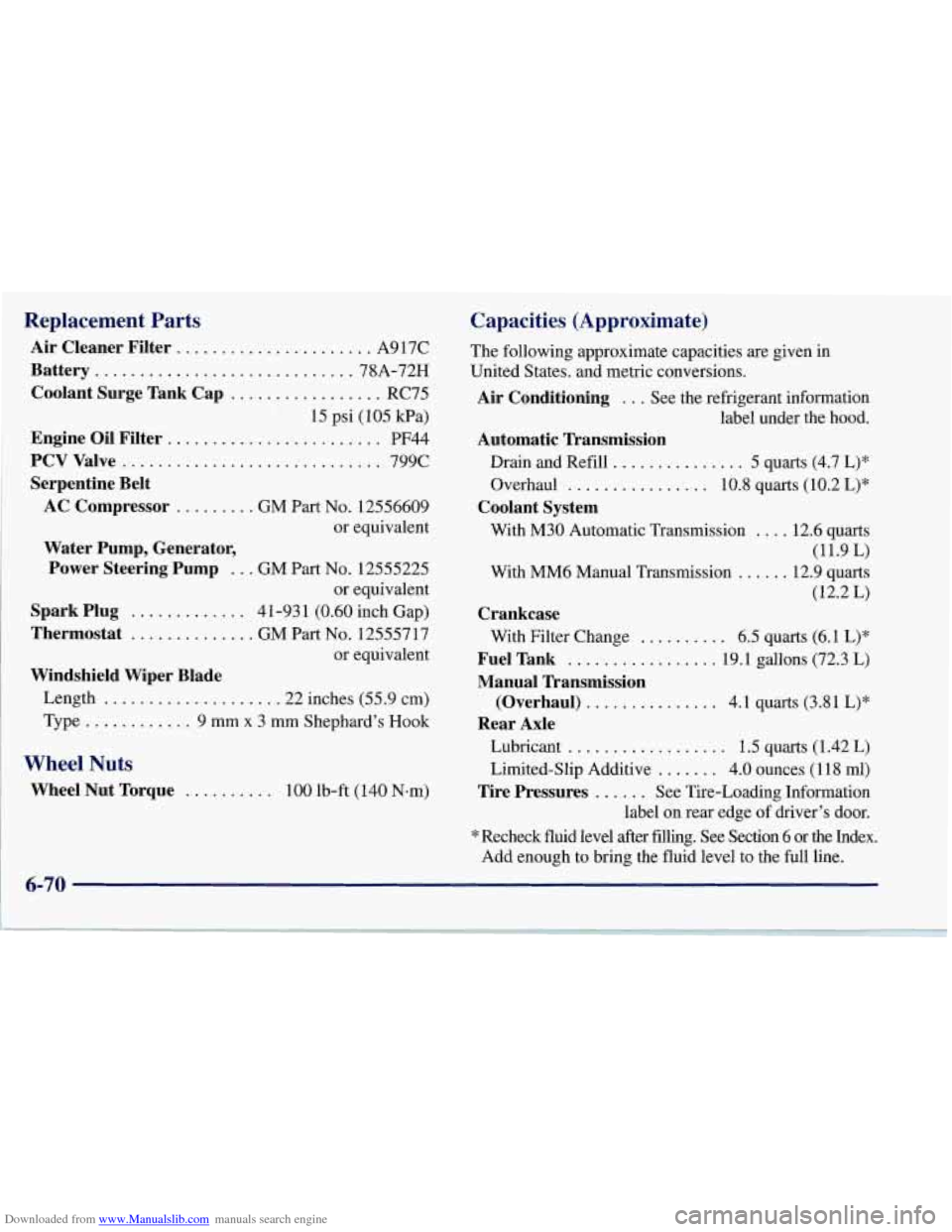
Downloaded from www.Manualslib.com manuals search engine Replacement Parts
Air Cleaner Filter ...................... A917C
Battery ............................. 78A-72H
Coolant Surge Tank Cap ................. RC75
Engine Oil Filter ........................ PF44
15
psi (105
kPa)
PCV Valve ............................. 799C
Serpentine Belt
AC Compressor
......... GM Part No. 12556609
or equivalent
Water Pump, Generator, Power Steering Pump
... GM Part No. 12555225
or equivalent
Thermostat .............. GM Part No. 125557 17
or equivalent
Windshield Wiper Blade Spark Plug
............. 4 1-93 1 (0.60 inch Gap)
Length
................... .22 inches (55.9 cm)
Type
............ 9 mm x 3 mm Shephard’s Hook
Wheel Nuts
Wheel Nut Torque .......... 100 lb-ft (140 Nsm)
Capacities (Approximate)
The following approximate capacities are given in
United States. and metric conversions.
Air Conditioning ... See the refrigerant information
label under the hood.
Automatic Transmission
Drain and Refill ............... 5 quarts (4.7 L)*
Overhaul
................ 10.8 quarts (10.2 L)*
With M30 Automatic Transmission
.... 12.6 quarts
With MM6 Manual Transmission
...... 12.9 quarts
(12.2 L)
With Filter Change
.......... 6.5 quarts (6.1 L)*
Fuel Tank ................. 19.1 gallons (72.3 L)
Coolant System
(11.9 L)
Crankcase
Manual Transmission Rear Axle (Overhaul)
................ 4.1 quarts
(3.81 L)*
Lubricant
.................. 1.5 quarts (1.42 L)
Limited-Slip Additive
....... 4.0 ounces (1 18 ml)
Tire Pressures ...... See Tire-Loading Information
label on rear edge of driver’s door.
*Recheck fluid level after filling. See Section
6 or the Index.
Add enough to bring the fluid level to the full line.
Page 306 of 356
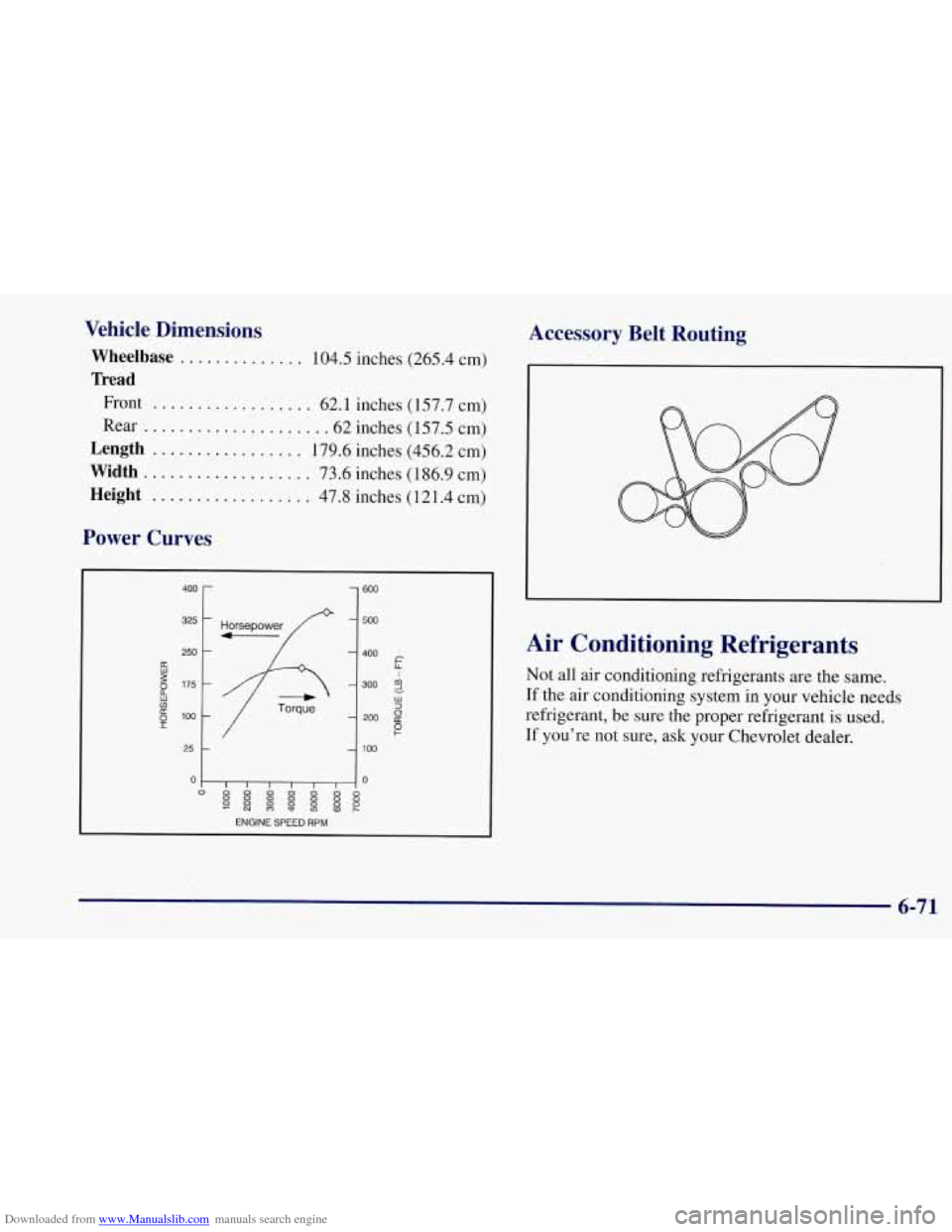
Downloaded from www.Manualslib.com manuals search engine Vehicle Dimensions
Wheelbase .............. 104.5 inches (265.4 cm)
Tread
Front .................. 62.1 inches (157.7 cm)
Rear
.................... .62 inches (1 57.5 cm)
Length ................. 179.6 inches (456.2 cm)
Width ................... 73.6 inches (1 86.9 cm)
Height .................. 47.8 inches (1 21.4 cm)
Power Curves
I 400
325
250
-
a
g ' 175 -
w v) U
I 0 100 -
- Horsepower
Torque
25 t
600
500
400 E I 300 5
UI 3 200 8
P
1 loo
Accessory Belt Routing
Air Conditioning Refrigerants
Not all air conditioning refrigerants are the same.
If the air conditioning system in your vehicle needs
refrigerant, be sure the proper refrigerant is used.
If you're not sure, ask your Chevrolet dealer.
6-71
Page 316 of 356
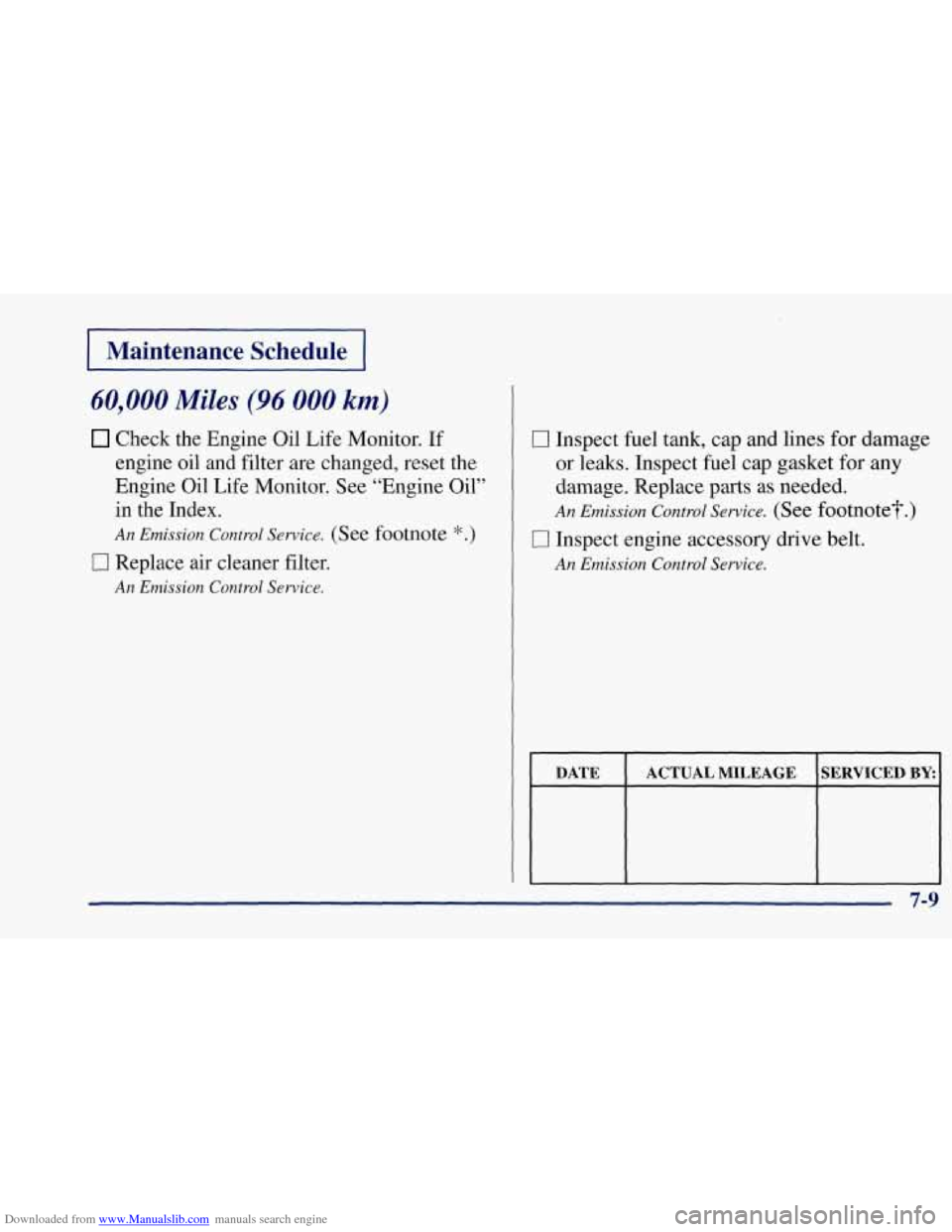
Downloaded from www.Manualslib.com manuals search engine I Maintenance Schedule I
60,000 Miles (96 000 km)
Check the Engine Oil Life Monitor. If
engine oil and filter are changed, reset the
Engine Oil Life Monitor. See “Engine Oil”
in the Index.
An Emission Control Service. (See footnote *.)
0 Replace air cleaner filter.
An Emission Control Service.
0 Inspect fuel tank, cap and lines for damage
or leaks. Inspect fuel cap gasket for any
damage. Replace parts as needed.
An Emission Control Service. (See footnote?.)
0 Inspect engine accessory drive belt.
An Emission Control Service.
I DATE I ACTUAL MILEAGE ISERVICED BY:(
7-9