1997 CHEVROLET CAVALIER weight
[x] Cancel search: weightPage 86 of 388
Downloaded from www.Manualslib.com manuals search engine Leaving Your Vehicle With the Engine
Running (Automatic Transaxle
Models
Only)
It can be dangerous to leave your vehicle with
the engine running. Your vehicle could move
suddenly if the shift lever
is not fully in PARK (P)
with the parking brake firmly set. And, if you
leave the vehicle with the engine running, it could
overheat and even catch fire.
You or others could
be injured. Don’t leave your vehicle with the
engine running unless you have to.
f you have to leave your vehicle with the engine running,
)e sure your vehicle is in PARK
(P) and your parking
Torque Lock (Automatic Transaxle)
If you are parking on a hill and you don’t shift your
transaxle
into PARK (P) properly, the weight of the
vehicle may put too much force on the parking pawl in
the transaxle. You may find
it difficult to pull the shift
lever out of PARK
(P). This is called “torque lock.” To
prevent torque lock, set the parking brake and then shift
into PARK
(P) properly before you leave the driver’s
seat.
To find out how, see “Shifting Into PARK (P)” in
the Index.
When you are ready to drive, move the shift lever out of
PARK
(P) before you release the parking brake.
If torque lock does occur, you may need to have another
vehicle push yours a little uphill to take some of the
pressure from the parking pawl in the transaxle,
so
you can pull the shift lever out of PARK (P).
brake is firmly set before you leave it. After you’ve moved\
the
shift lever into the PARK (P) position, hold the regular
brake pedal down. Then, see
if you can move the shift
lever away from PARK (P) without first pushing
the button.
If you can, it means that the shift lever wasn’t fully
locked into PARK
(P).
2-28
Page 165 of 388
Downloaded from www.Manualslib.com manuals search engine Police records show that almost half of all motor
vehicle-related deaths involve alcohol. In most cases,
these deaths are the result of someone who was drinking
and driving.
In recent years, some 17,000 annual motor
vehicle-related deaths have been associated with the use
of alcohol, with more than
300,000 people injured.
Many adults
-- by some estimates, nearly half the adult
population
-- choose never to drink alcohol, so they
never drive after drinking. For persons under
21, it’s
against the law in every
U.S. state to drink alcohol.
There are good medical, psychological and
developmental reasons for these laws.
The obvious way to solve this highway safety problem
is for people never to drink alcohol and then drive. But
what if people do? How much is “too much” if the
driver plans to drive? It’s a lot less than many might
think. Although it depends on each person and situation,
here
is some general information on the problem. The
Blood Alcohol Concentration (BAC) of someone
who is drinking depends upon four things:
0 The amount of alcohol consumed
0 The drinker’s body weight
0 The amount of food that is consumed before and
during drinking
consume the alcohol.
0 The length of time it has taken the drinker to
According to the American Medical Association, a
180-lb. (82 kg) person who drinks three 12-ounce
(355 ml) bottles of beer in an hour will end up with a
BAC
of about 0.06 percent. The person would reach the
same BAC by drinking three 4-ounce
(120 ml) glasses
of wine
or three mixed drinks if each had 1 - 1/2 ounces
(45 ml) of a liquor like whiskey, gin or vodka.
4-3
~-
Page 166 of 388
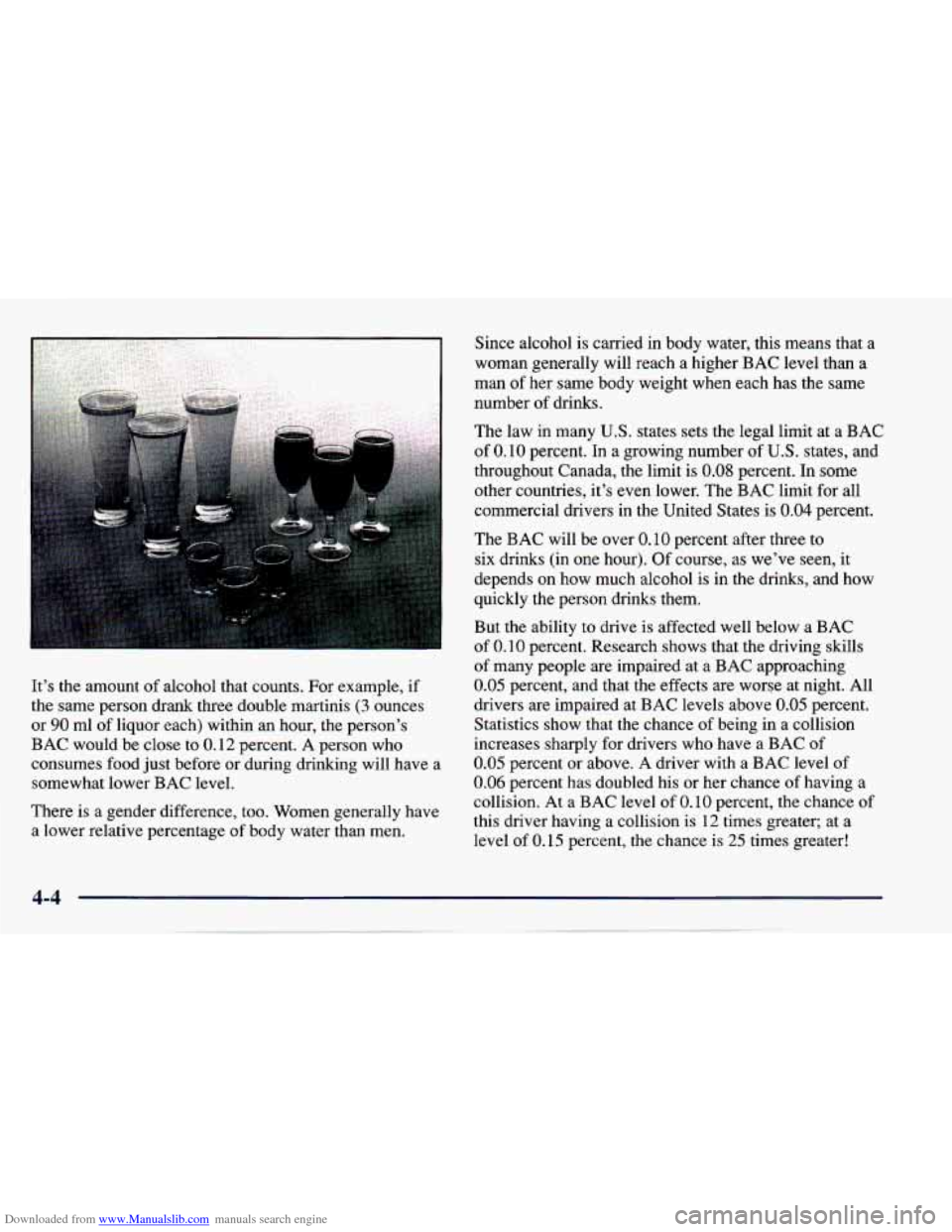
Downloaded from www.Manualslib.com manuals search engine It’s the amount of alcohol that counts. For example, if
the same person drank three double martinis
(3 ounces
or
90 ml of liquor each) within an hour, the person’s
BAC would be close to 0.12 percent. A person who
consumes food just before or during drinking will have
a
somewhat lower BAC level.
There is a gender difference,
too. Women generally have
a lower relative percentage of body water than men. Since alcohol is carried in body water,
this means that
a
woman generally will reach a higher BAC level than a
man
of her same body weight when each has the same
number of drinks.
The law in many
U.S. states sets the legal limit at a BAC
of
0.10 percent. In a growing number of U.S. states, and
throughout Canada, the limit
is 0.08 percent. In some
other countries, it’s even lower. The BAC limit for all
commercial drivers in the United States
is 0.04 percent.
The BAC will be over
0.10 percent after three to
six
drinks (in one hour). Of course, as we’ve seen, it
depends on how much alcohol
is in the drinks, and how
quickly the person drinks them.
But the ability to drive
is affected well below a BAC
of 0.10 percent. Research shows that the driving skills
of many people are impaired at a BAC approaching
0.05 percent, and that the effects are worse at night. All
drivers are impaired at BAC levels above
0.05 percent.
Statistics show that the chance of being in a collision
increases sharply for drivers who have a BAC of
0.05 percent or above. A driver with a BAC level of
0.06 percent has doubled his or her chance of having a
collision. At a BAC level of
0.10 percent, the chance of
this driver having a collision
is 12 times greater; at a
level of 0.15 percent, the chance
is 25 times greater!
Page 168 of 388
Downloaded from www.Manualslib.com manuals search engine Control of a Vehicle
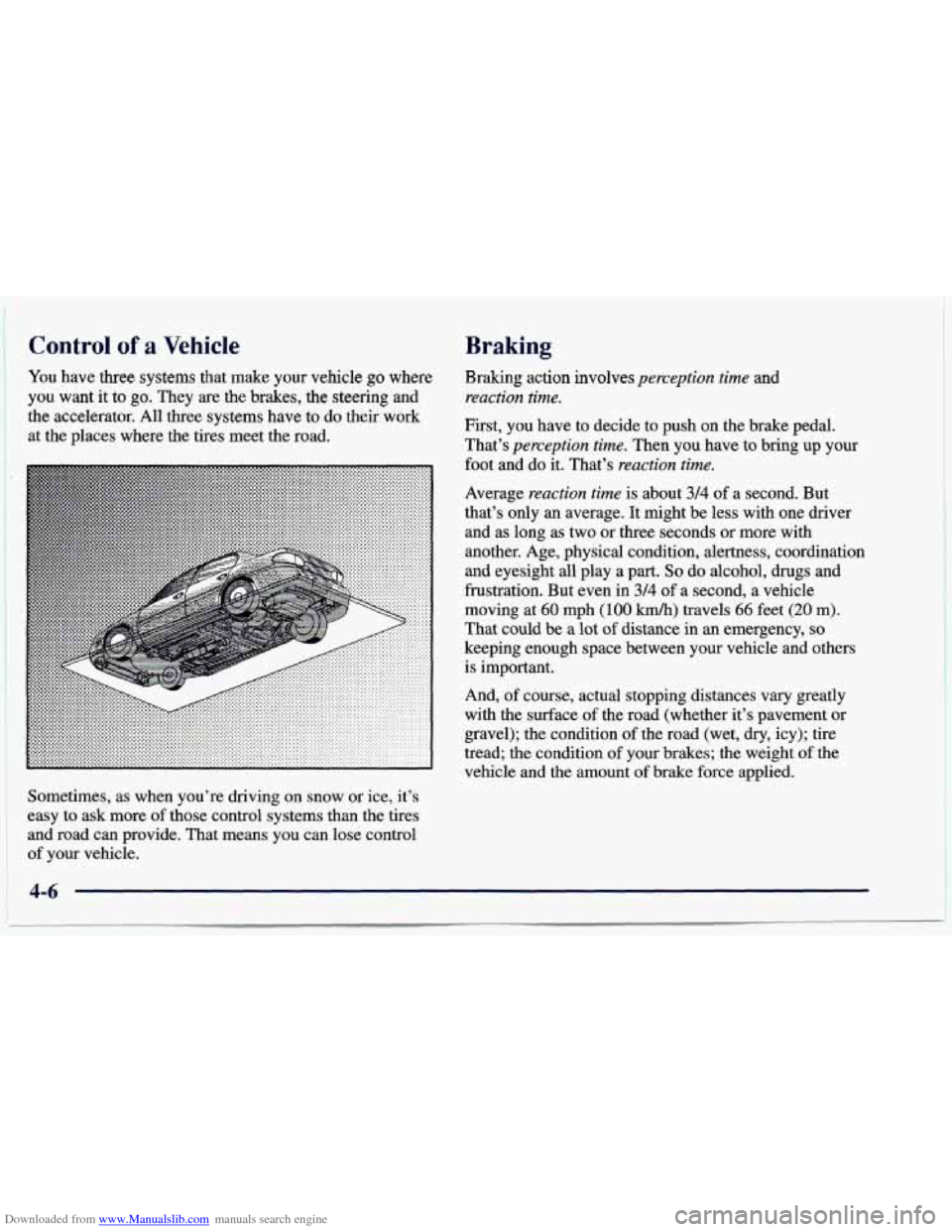
You have three systems that make your vehicle go where
you want it to go. They are the brakes, the steering and
the accelerator. All
three systems have to do their work
at the places where the tires meet the road.
Braking
Braking action involves perception time ana
reaction time.
First, you have to decide to push on the brake pedal.
That’s
perception time. Then you have to bring up your
foot and do it. That’s reaction time.
Average reaction time is about 314 of a second. But
that’s only an average. It might be less with one driver
and as long as two or three seconds
or more with
another. Age, physical condition, alertness, coordination
and eyesight all play a part. So do alcohol, drugs and
frustration. But even in
3/4 of a second, a vehicle
moving at
60 mph (100 km/h) travels 66 feet (20 m).
That could be a lot of distance in an emergency, so
keeping enough space between your vehicle and others
is important.
And,
of course, actual stopping distances vary greatly
with the surface of the road (whether it’s pavement or
gravel); the condition of the road (wet,
dry, icy); tire
tread; the condition of
your brakes; the weight of the
vehicle and the amount of brake force applied.
Sometimes, as when you’re driving on snow or ice,
it’s
easy to ask more of those control systems than the tires
and road can provide. That means
you can lose control
of your vehicle.
4-6
Page 195 of 388
Downloaded from www.Manualslib.com manuals search engine Towing Your Vehicle from the Rear Loading Your Vehicle
I- I
8
‘m OCCUPANTS VEHICLE CAP. WT.
TIRE-LOADING INFORMATION
FRT. CTR.
RR. TOTAL LBS. KG
MAX. LOADING & GVWR SAME AS VEHICLE
CAPACITY WEIGHT XXX
COLD TIRE
TIRE SIZE SPEED PRESSURE
RTG
PSI/KPa
FRT.
RR.
SPA.
IF TIRES ARE HOT, ADD 4PS1/28KPa
SEE OWNER‘S MANUAL FOR ADDITIONAL
INFORMATION
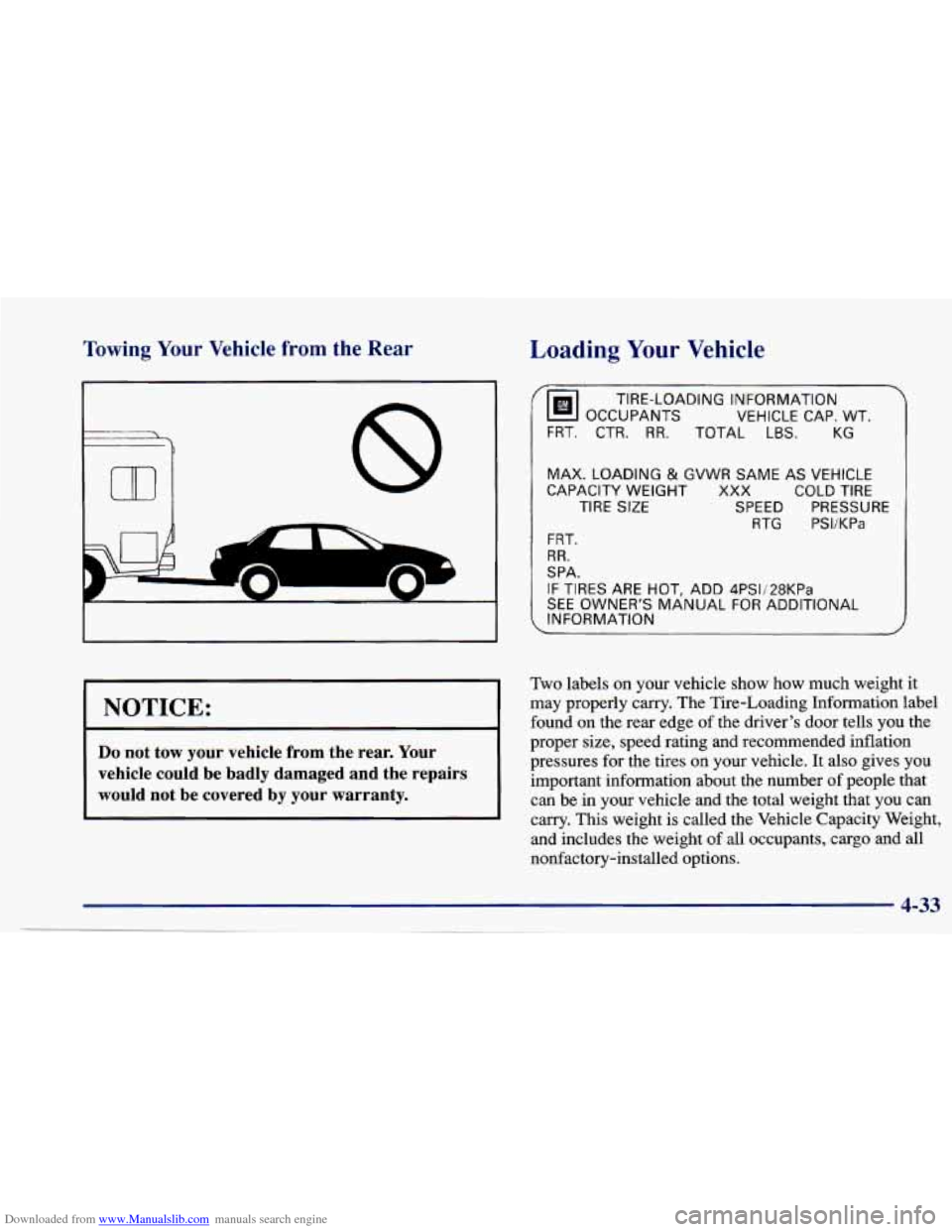
Two labels on your vehicle show how much weight it
found on the rear edge
of the driver’s door tells you the
Do not tow your vehicle from the rear. Your proper size, speed rating and recommended inflation
pressures for the tires on your vehicle. It also gives you
vehicle could be badly damaged and the repairs important information about the number of people that
would not be covered by your warranty. can be in your vehicle and the total weight that you can
carry. This weight is called the Vehicle Capacity Weight,
and includes the weight of all occupants, cargo and all
nonfactory-installed options.
NOTICE: may properly carry. The Tire-Loading Information label
4-33
. ~
Page 196 of 388
Downloaded from www.Manualslib.com manuals search engine r
MFD BY GENERAL MOTORS CORP
DATE GVWR GAWR FRT GAWR RR
THIS VEHICLE CONFORMS TO ALL APPLI-
CABLE U.S. FEDERAL MOTOR VEHICLE
SAFETY,
BUMPER, AND THEFT PREVENTION
STANDARDS
IN EFFECT ON THE DATE OF
MANUFACTURE SHOWN ABOVE.
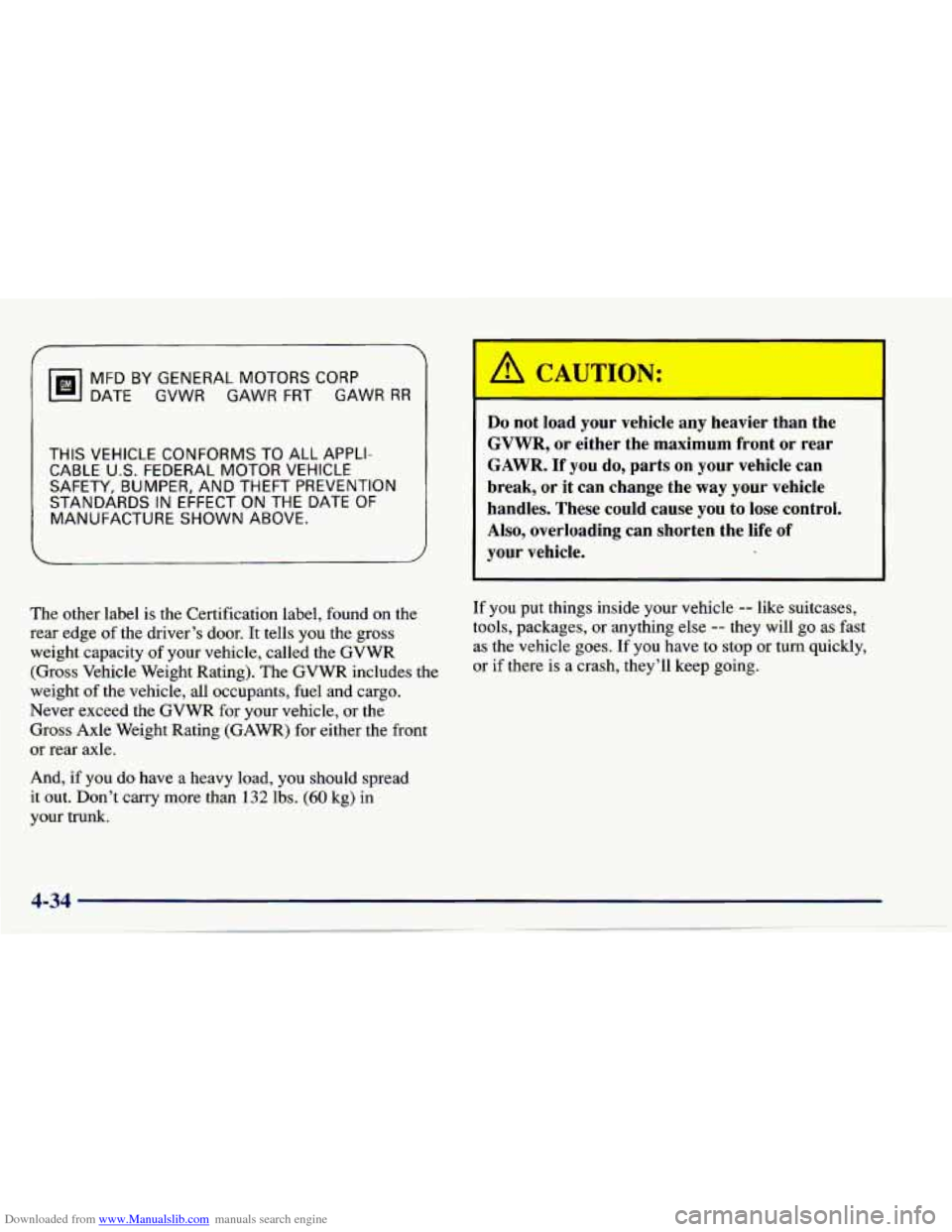
The other label is the Certification label, found on the
rear edge of the driver’s door.
It tells you the gross
weight capacity of your vehicle, called the GVWR
(Gross Vehicle Weight Rating).
The GVWR includes the
weight of the vehicle,
all occupants, fuel and cargo.
Never exceed the GVWR for your vehicle, or the
Gross Axle Weight Rating
(GAWR) for either the front
or rear axle.
And, if you
do have a heavy load, you should spread
it out. Don’t carry more than
132 lbs. (60 kg) in
your trunk.
I A CAU’110.k
Do not load your vehicle any heavier than the
GVWR, or either the maximum front or rear
GAWR. If you do, parts on your vehicle can
break, or it can change the way your vehicle
handles. These could cause you
to lose control,
Also, overloading can shorten the life of
your vehicle.
~ ~~
If you put
things inside your vehicle -- like suitcases,
tools, packages, or anything else
-- they will go as fast
as the vehicle goes.
If you have to stop or turn quickly,
or
if there is a crash, they’ll keep going.
Page 197 of 388
Downloaded from www.Manualslib.com manuals search engine /! CAUTION:
Things you put inside your vehicle can strike
and injure people in
a sudden stop or turn,
or in
a crash.
Put things in the trunk or rear area of your
vehicle. In
a trunk, put them as far forward
as you can. Try to spread the weight evenly.
If you have fold-down rear seats, you’ll
find four anchors on the back wall
of your
trunk.
You can use these anchors to tie
down lighter loads. They’re not strong
enough
for heavy things, however, so put
them
as far forward as you can in the trunk
or rear area.
CAUTION: (Continued) CAUTION: (Continued)
e Never stack heavier things, like suitcases,
inside the vehicle
so that some of them are
above the tops of the seats.
a Don’t leave an unsecured child restraint in
your vehicle.
When you carry something inside the
vehicle, secure it whenever you can.
Don’t leave a seat folded down unless you
need to.
Page 199 of 388
Downloaded from www.Manualslib.com manuals search engine Your vehicle can tow a trailer if it is equipped with
proper trailer towing equipment.
To identify what the
vehicle trailering capacity is for your vehicle, you
should read the information in “Weight of the Trailer”
that appears later in this section. But trailering is
different than just driving your vehicle by itself.
Trailering means changes in handling, durability and
fuel economy. Successful, safe trailering takes correct
equipment, and it has to be used properly.
That’s the reason for this part. In it are many
time-tested, important trailering tips and safety rules.
Many of these are important for your safety and that of
your passengers.
So please read this section carefully
before you pull a trailer.
Load-pulling components such
as the engine, transaxle,
wheel assemblies and tires are forced to work harder
against the drag of the added weight. The engine is
required to operate
at relatively higher speeds and under
greater loads, generating extra heat. What’s more, the
trailer adds considerably to wind resistance, increasing
the pulling requirements.
If You Do Decide To Pull A Trailer
If you do, here are some important points:
0 There are many different laws, including speed limit
restrictions, having to do with trailering. Make sure
your rig will be legal, not only where you live but
also where you’ll be driving.
A good source for this
information can be state or provincial police.
Consider using a sway control. You can ask a hitch
dealer about sway controls.
Don’t tow a trailer at all during the first 1,000 miles
(1 600 km) your new vehicle is driven. Your engine,
axle or other parts could be damaged.
Then, during the first 500 miles (800 km) that you
tow a trailer, don’t drive over
50 mph (80 km/h) and
don’t make starts at full throttle. This helps your
engine and other parts of your vehicle wear
in at the
heavier loads.
0 Obey speed limit restrictions when towing a trailer.
Don’t drive faster than the maximum posted speed
for trailers (or no more than
55 mph (90 km/h)) to
save wear on your vehicle’s parts.
Do not tow when the ambient temperature is above
100°F (38°C).
0 Do not tow more than 1,OOO miles (1 600 km) per year.