1997 CHEVROLET CAVALIER headlamp
[x] Cancel search: headlampPage 192 of 388
Downloaded from www.Manualslib.com manuals search engine A CAUTIl- N:
Snow can trap exhaust gases under your vehicle.
This can cause deadly
CO (carbon monoxide) gas
to get inside.
CO could overcome you and kill
you. You can’t see it or smell it, so you might not
know it is in your vehicle. Clear away snow from
around the base
of your vehicle, especially any
that is blocking your exhaust pipe. And check
around again from time to time to be sure snow
doesn’t collect there.
Open
a window just a little on the side of the
vehicle that’s away from the wind. This will help
keep
CO out. Run your
engine only as long as
you must. This saves
fuel. When you run the engine, make it go
a little faster
than just idle. That is, push the accelerator slightly. This
uses less fuel for the heat that you get and
it keeps the
battery charged. You will need a well-charged battery to
restart the vehicle, and possibly for signaling later on
with
your headlamps. Let the heater run for awhile.
Then,
shut the engine off and close the window almost
all the way to preserve the heat. Start the engine again
and repeat this only when you feel really uncomfortable
from the cold. But do it
as little as possible. Preserve the
fuel
as long as you can. To help keep warm, you can get
out of the vehicle and
do some fairly vigorous exercises
every half hour or
so until help comes.
Page 278 of 388
Downloaded from www.Manualslib.com manuals search engine Front Exterior
Headlamps
For the type of bulb to use, see “Replacement Bulbs” in
the Index.
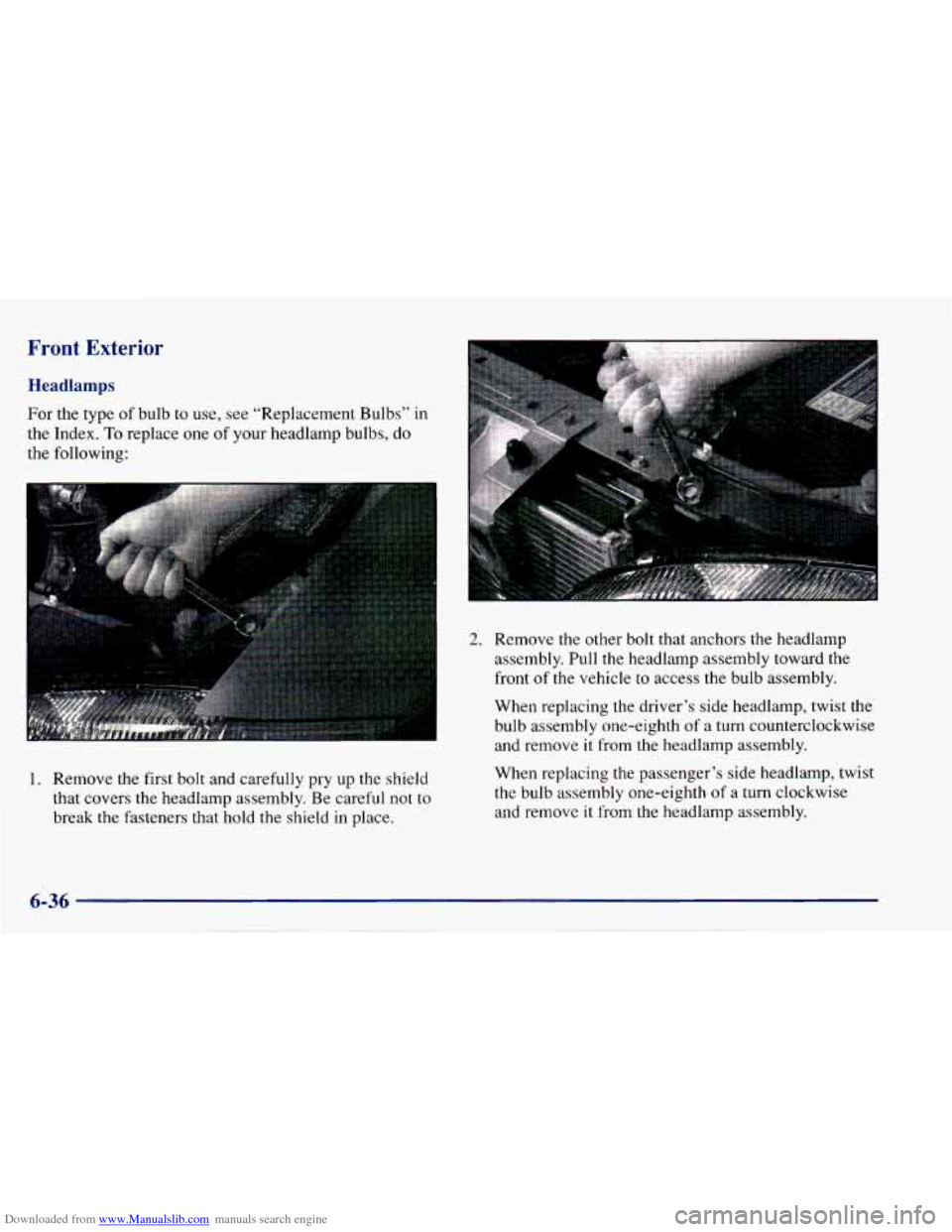
To replace one of your headlamp bulbs, do
the following:
1. Remove the first bolt and carefully pry up the shield
that covers the headlamp assembly. Be careful not to
break the fasteners that hold the shield in place.
2. Remove the other bolt that anchors the headlamp
assembly. Pull the headlamp assembly toward the
front of the vehicle
to access the bulb assembly.
When replacing the driver’s side headlamp, twist the bulb assembly one-eighth of a turn counterclockwise
and remove it from the headlamp assembly.
When replacing the passenger’s side headlamp, twist
the bulb assembly one-eighth
of a turn clockwise
and remove
it from the headlamp assembly,
6-36
Page 279 of 388
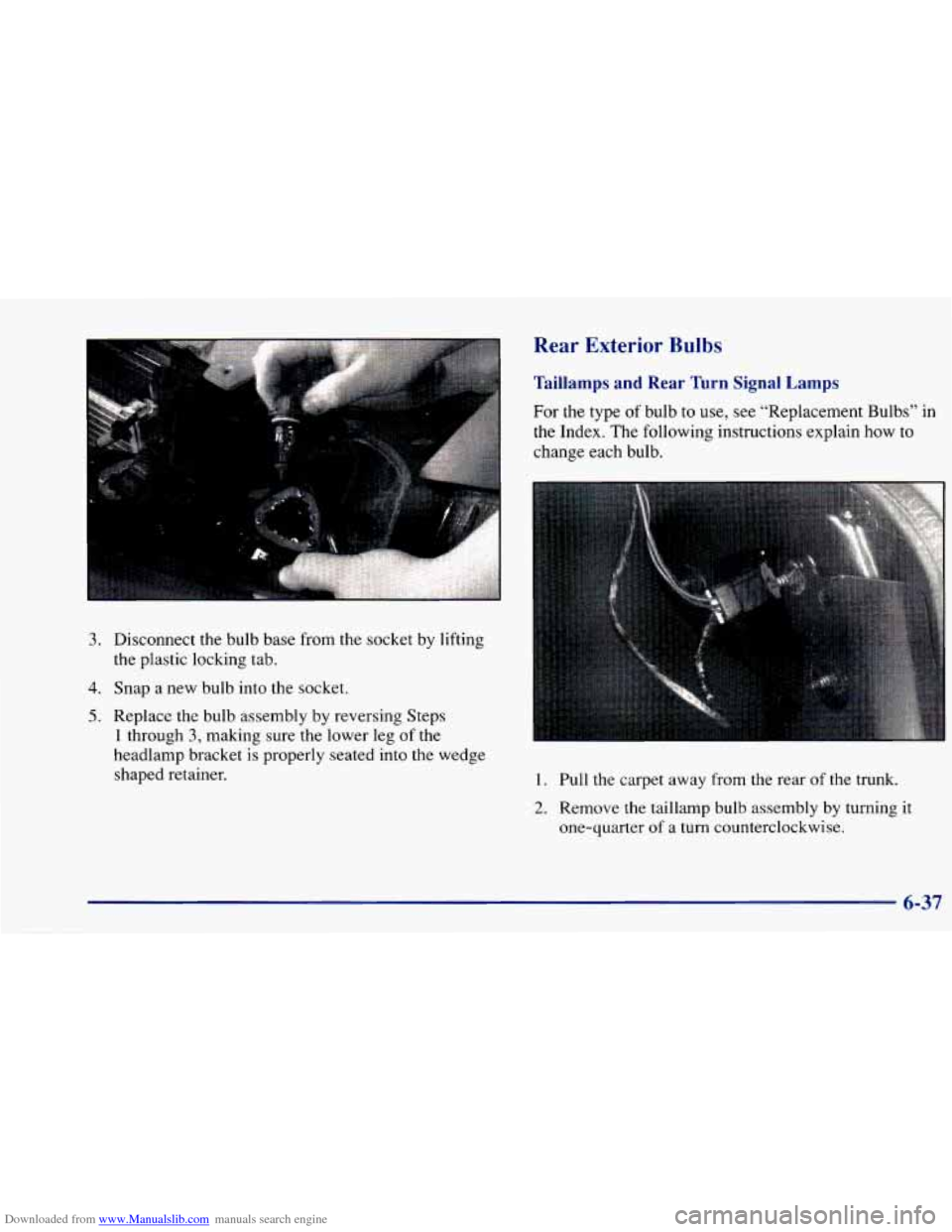
Downloaded from www.Manualslib.com manuals search engine 3. Disconnect the bulb base from the socket by lifting
the plastic locking tab.
4. Snap a new bulb into the socket.
5. Replace the bulb assembly by reversing Steps
1 through 3, making sure the lower leg of the
headlamp bracket is properly seated into the wedge
shaped retainer.
Rear Exterior Bulbs
Taillamps and Rear Turn Signal Lamps
For the type of bulb to use, see “Replacement Bulbs” in
the Index. The following instructions explain how to
change each bulb.
1. Pull the carpet away from the rear of the trunk.
2. Remove the taillamp bulb assembly by turning it
one-quarter of a turn counterclockwise.
6-37
Page 289 of 388
Downloaded from www.Manualslib.com manuals search engine Using the wrong replacement wheels, wheel
bolts
or wheel nuts on your vehicle can be
dangerous.
It could affect the braking and
handling of your vehicle, make your tires lose
air and make
you lose control. You could have a
collision in which you or others could be injured.
Always use the correct wheel, wheel bolts and
wheel nuts for replacement.
NOTICE:
The wrong wheel can also cause problems with
bearing life, brake cooling, speedometer or
odometer calibration, headlamp aim, bumper
height, vehicle ground clearance and tire or tire
chain clearance to the body and chassis.
See “Changing a Flat Tire” in the Index for
more information.
Putting a used wheel on your vehicle is
dangerous. You can’t know how it’s been used or
how
far it’s been driven. It could fail suddenly
and cause an accident.
If you have to replace a
wheel, use a new GM original equipment wheel.
Tire Chains
NOTICE:
If your Chevrolet has P195/65R15 or P205/55R16
size tires, don’t use tire chains. They can damage
your vehicle because there
is not enough clearance.
NOTICE: (Continued)
Page 301 of 388
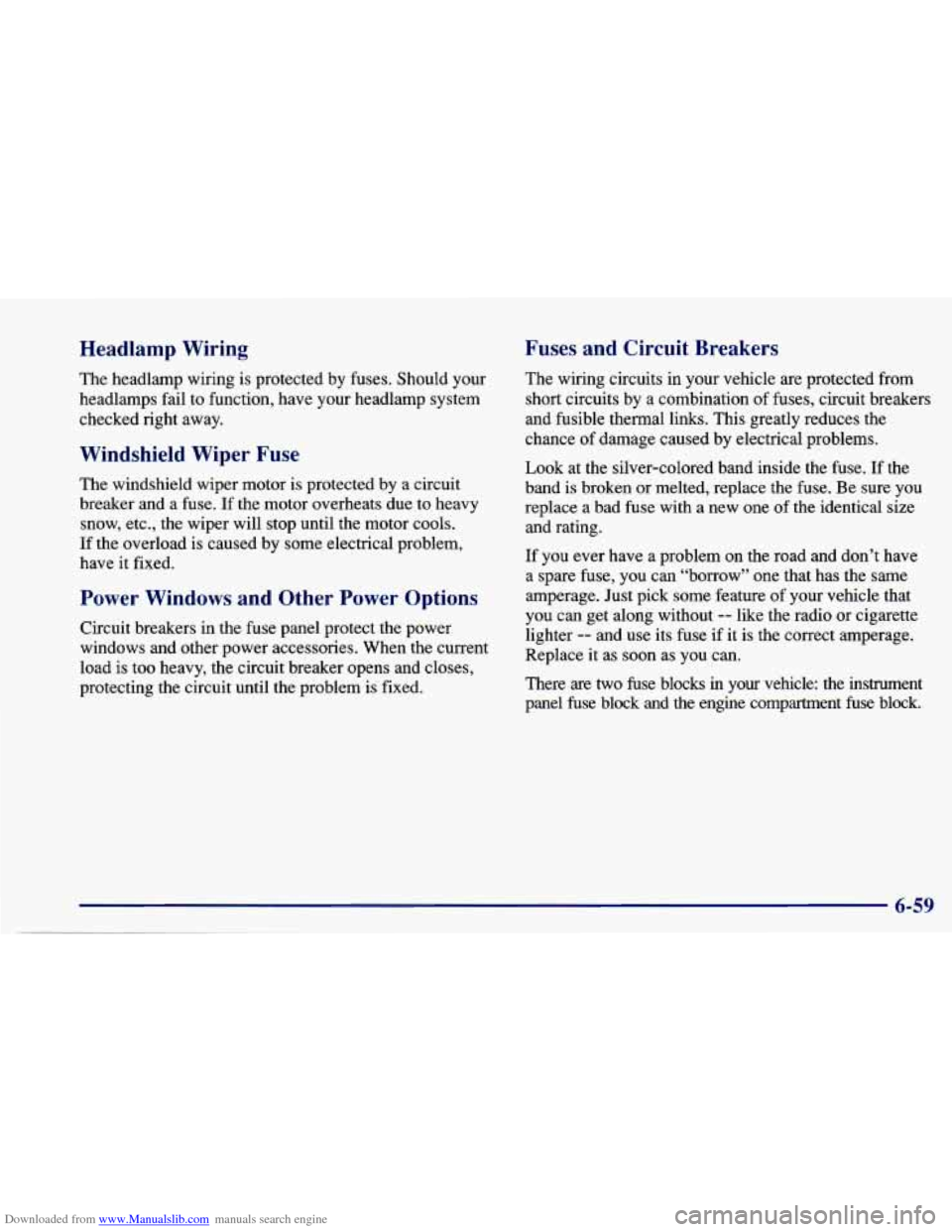
Downloaded from www.Manualslib.com manuals search engine Headlamp Wiring Fuses and Circuit Breakers
The
headlamp wiring is protected by fuses. Should your
headlamps fail to function, have your headlamp system
checked right away.
Windshield Wiper Fuse
The windshield wiper motor is protected by a circuit
breaker and a fuse. If the motor overheats due to heavy
snow, etc., the wiper will stop until the motor cools.
If the overload is caused by some electrical problem,
have it fixed.
Power Windows and Other Power Options
Circuit breakers in the fuse panel protect the power
windows and other power accessories. When the current
load
is too heavy, the circuit breaker opens and closes,
protecting the circuit until the problem is fixed. The
wiring circuits in your vehicle
are protected from
short circuits by a combination of fuses, circuit breakers
and fusible thermal links. This greatly reduces the
chance of damage caused by electrical problems.
Look at the silver-colored band inside the fuse. If the
band is broken or melted, replace the fuse. Be sure you
replace a bad fuse with a new one of the identical size
and rating.
If you ever have
a problem on the road and don’t have
a spare fuse, you can “borrow” one that has the same
amperage. Just pick some feature of your vehicle that
you can get along without
-- like the radio or cigarette
lighter
-- and use its fuse if it is the correct amperage.
Replace it as
soon as you can.
There are
two fuse blocks in your vehicle: the instrument
panel fuse block and the engine compartment
fuse block.
6-59
Page 303 of 388
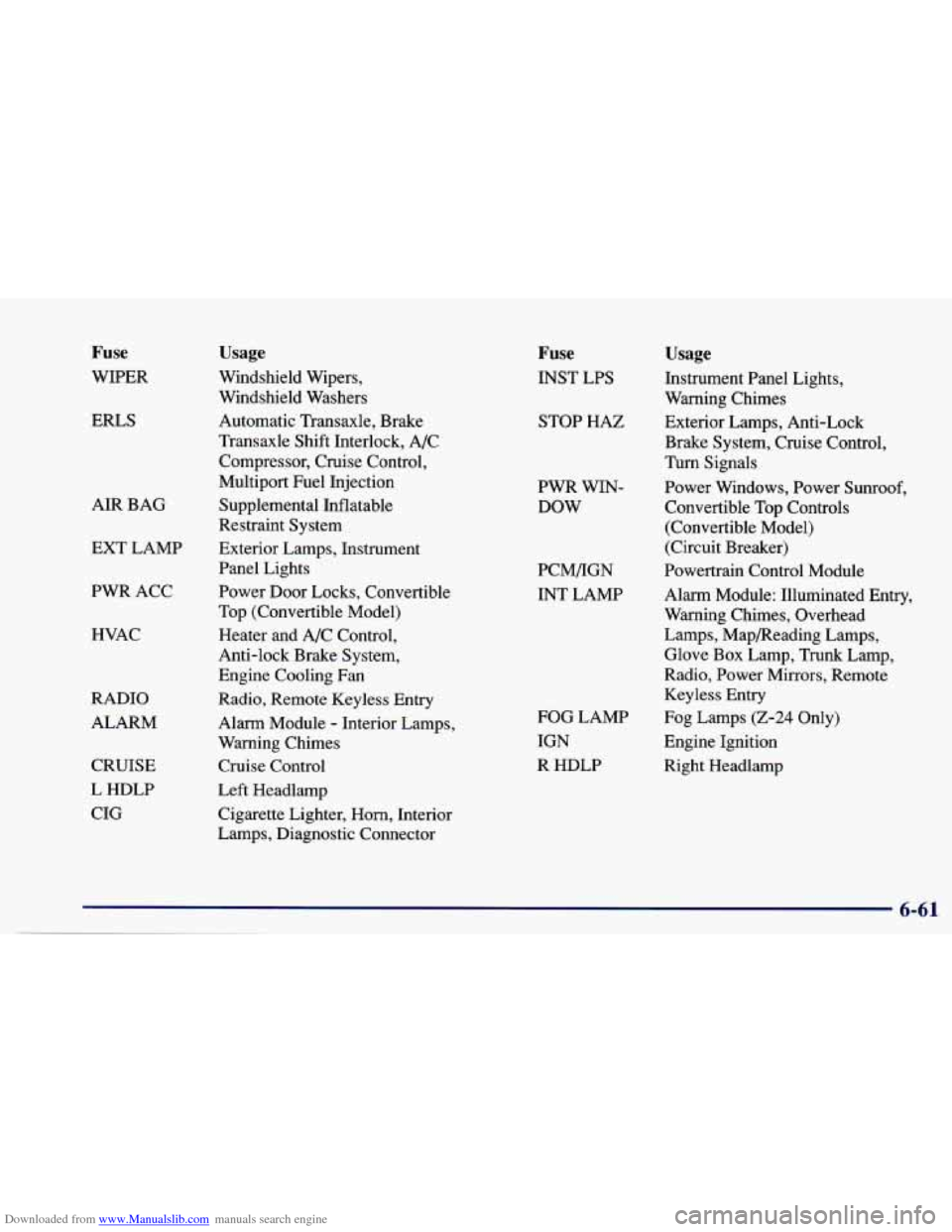
Downloaded from www.Manualslib.com manuals search engine Fuse
WIPER
ERLS
AIR BAG
EXT LAMP
PWR ACC
HVAC
RADIO
ALARM
CRUISE
L HDLP
CIG
Usage
Windshield Wipers,
Windshield Washers
Automatic Transaxle, Brake
Transaxle Shift Interlock, A/C
Compressor, Cruise Control,
Multiport Fuel Injection
Supplemental Inflatable
Restraint System
Exterior Lamps, Instrument
Panel Lights
Power Door Locks, Convertible
Top (Convertible Model)
Heater and A/C Control,
Anti-lock Brake System,
Engine Cooling Fan
Radio, Remote Keyless Entry
Alarm Module
- Interior Lamps,
Warning Chimes
Cruise Control
Left Headlamp Cigarette Lighter,
Horn, Interior
Lamps, Diagnostic Connector
Fuse
INST LPS
STOP HAZ
PWR WIN- DOW
PCM/IGN
INT LAMP
FOG LAMP
IGN
R HDLP
Usage
Instrument Panel Lights,
Warning Chimes
Exterior Lamps, Anti-Lock
Brake System, Cruise Control,
Turn Signals
Power Windows, Power Sunroof,
Convertible Top Controls
(Convertible Model)
(Circuit Breaker)
Powertrain Control Module
Alarm Module: Illuminated Entry,
Warning Chimes, Overhead
Lamps, Mapmeading Lamps,
Glove Box Lamp, Trunk Lamp,
Radio, Power Mirrors, Remote
Keyless Entry
Fog Lamps
(2-24 Only)
Engine Ignition
Right Headlamp
6-61
Page 305 of 388
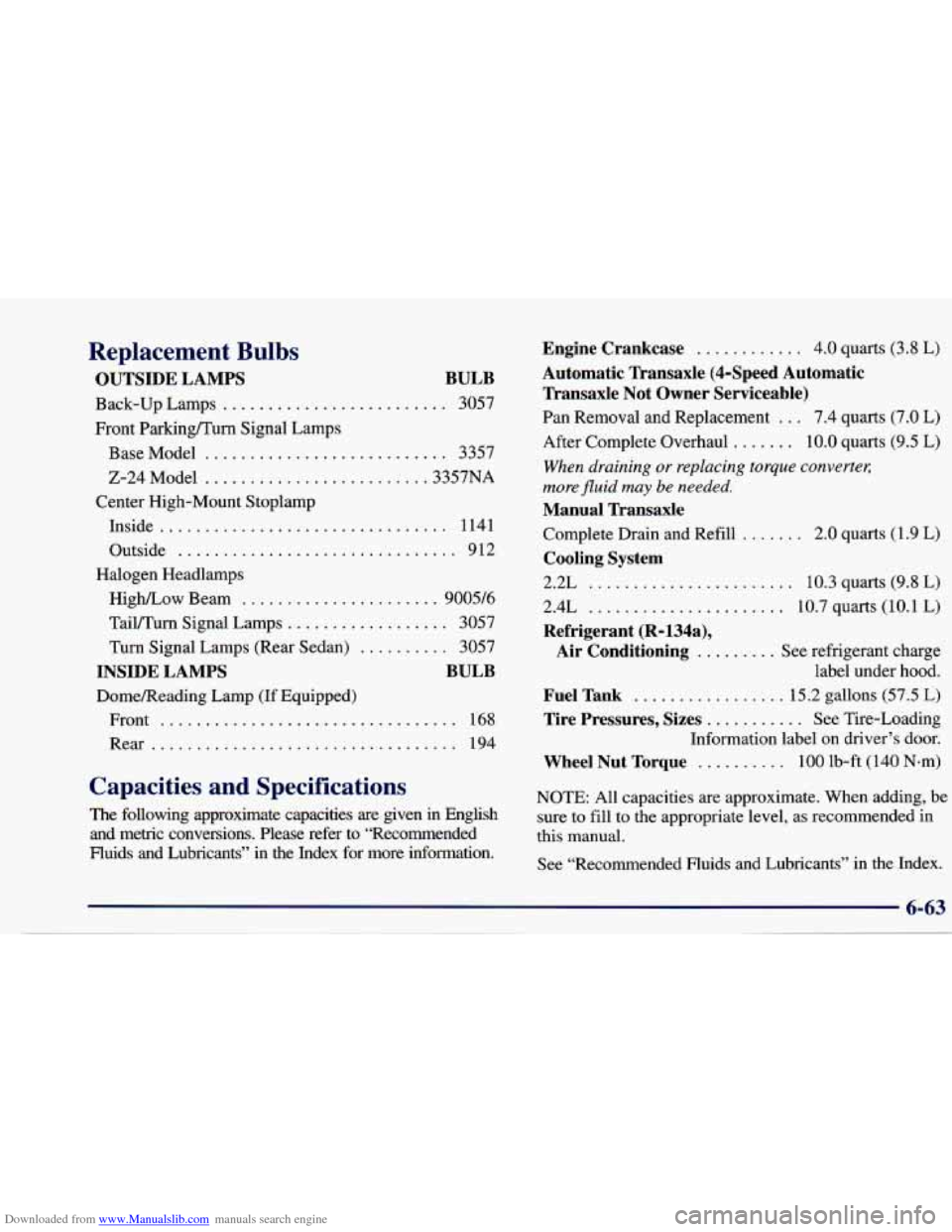
Downloaded from www.Manualslib.com manuals search engine Replacement Bulbs
OUTSIDE LAMPS BULB
Back-up Lamps ......................... 3057
Front Parking/Turn Signal Lamps
BaseModel
........................... 3357
2-24Model
......................... 3357NA
Center High-Mount Stoplamp
Inside
................................ 1141
Outside
............................... 9 12
Halogen Headlamps High/Low Beam
...................... 9005/6
TaiVTurn Signal Lamps
.................. 3057
Turn Signal Lamps (Rear Sedan)
.......... 3057
INSIDE LAMPS BULB
Domemeading Lamp (If Equipped)
Front
................................. 168
Re x.................................. 194
Capacities and Specifications
The following approximate capacities are given in English
and metric conversions.
Please refer to “Recommended
Huids
and Lubricants” in the Index for more information.
Engine Crankcase ............ 4.0 quarts (3.8 L)
Automatic Transaxle (4-Speed Automatic
Transaxle Not Owner Serviceable)
Pan Removal and Replacement ... 7.4 quarts (7.0 L)
After Complete Overhaul ....... 10.0 quarts (9.5 L)
When draining or replacing torque converter;
more fluid may be needed.
Manual Transaxle
Complete Drain and Refill ....... 2.0 quarts (1.9 L)
Cooling System
2.2L ....................... 10.3 quarts (9.8 L)
2.4L
...................... 10.7 quarts (10.1 L)
Refrigerant (R=134a),
Air Conditioning
......... See refrigerant charge
label under hood.
Fuel Tank ................. 15.2 gallons (57.5 L)
Tire Pressures, Sizes ........... See Tire-Loading
Information label
on driver’s door.
Wheel Nut Torque .......... 100 lb-ft (140 Nem)
NOTE: All capacities are approximate. When adding, be
sure to fill to the appropriate level, as recommended in
this manual.
See “Recommended Fluids and Lubricants” in the Index.
Page 379 of 388
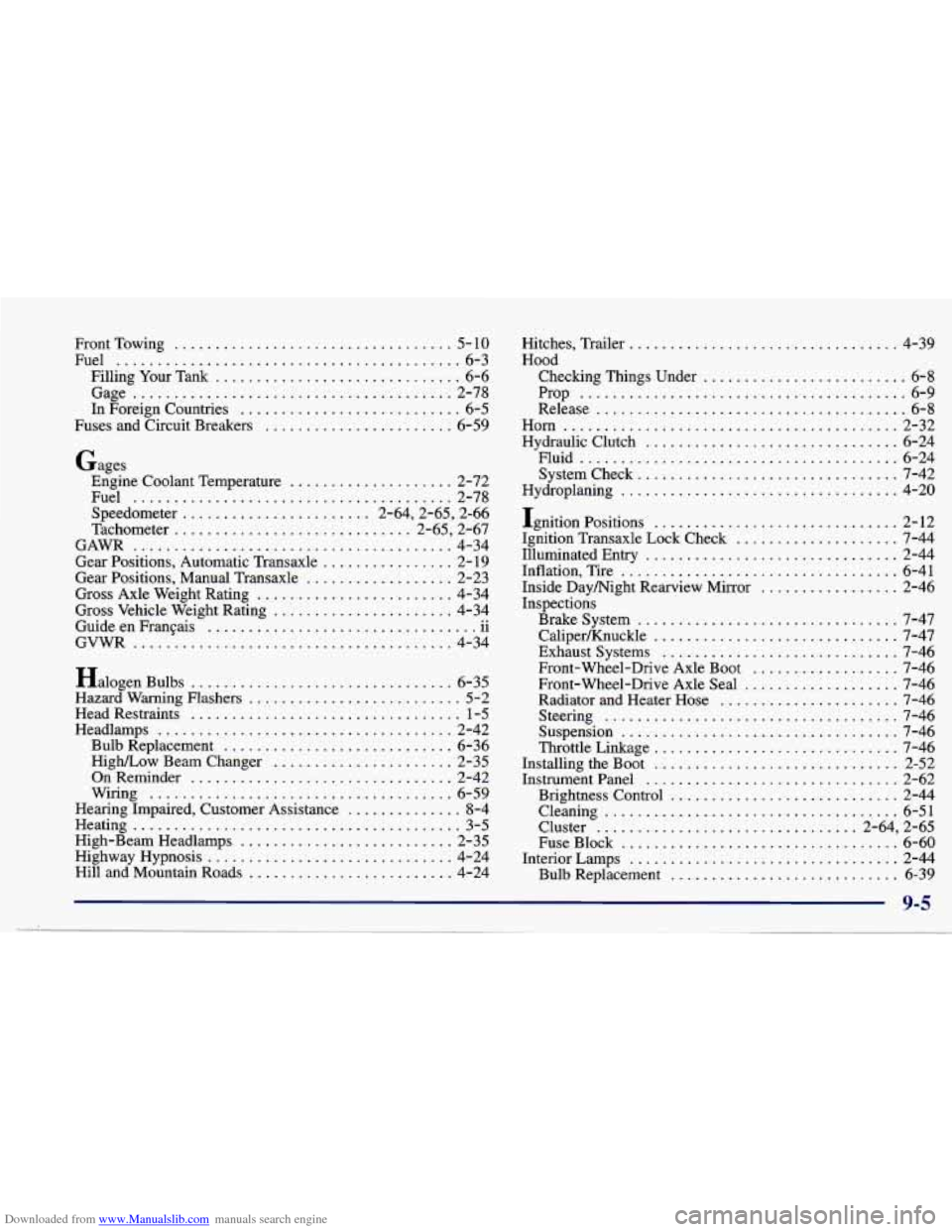
Downloaded from www.Manualslib.com manuals search engine FrontTowing .................................. 5-10
Fuel .......................................... 6-3
Filling Your Tank
.............................. 6-6
Gage ....................................... 2-78
In Foreign Countries
........................... 6-5
Fuses and Circuit Breakers ....................... 6-59
Gages Engine Coolant Temperature
.................... 2-72
Fuel
....................................... 2-78
Speedometer
....................... 2-64.2-65. 2.66
Tachometer
............................. 2.65. 2.67
GAWR
....................................... 4-34
Gear Positions. Automatic Transaxle
................ 2- 19
Gear Positions. Manual Transaxle
.................. 2-23
Gross Axle Weight Rating
........................ 4-34
Gross Vehicle Weight Rating
...................... 4-34
Guide en Frangais
11 .. .................................
GVWR ....................................... 4-34
Halogen Bulbs
................................ 6-35
Hazard Warning Flashers
.......................... 5-2
Head Restraints
................................. 1-5
Headlamps .................................... 2-42
Bulb Replacement
............................ 6-36
High/Low Beamchanger
...................... 2-35
OnReminder
................................ 2-42
Wiring
..................................... 6-59
Hearing Impaired. Customer Assistance
.............. 8-4
High-Beam Headlamps
.......................... 2-35
Highway Hypnosis
.............................. 4-24
Hill and Mountain Roads
......................... 4-24
Heating
........................................ 3-5 Hitches.
Trailer 4-39
Hood Checking Things Under
......................... 6-8
Release ...................................... 6-8
Hydraulic Clutch ............................... 6-24
Fluid
....................................... 6-24
..
.................................
Prop ........................................ 6-9
Horn ......................................... 2-32
System Check
................................ 7-42
Hydroplaning
.................................. 4-20
Ignition Positions
.............................. 2-12
Ignition Transaxle Lock Check
.................... 7-44
Inflation, Tire
.................................. 6-41
Inside Daymight Rearview Mirror
................. 2-46
Inspections Brakesystem
................................ 7-47
Caliper/Knuckle
.............................. 7-47
Exhaust Systems
............................. 7-46
Front-Wheel-Drive Axle Boot
.................. 7-46
Front-Wheel-Drive Axle Seal
................... 7-46
Radiator and Heater Hose
...................... 7-46
Steering
.................................... 7-46
Suspension
.................................. 7-46
Throttle Linkage
.............................. 7-46
InstrumentPanel
............................... 2-62
Brightness Control
............................ 2-44
Cleaning
.................................... 6-51
Cluster
................................ 2-64, 2-65
FuseBlock
.................................. 6-60
Interior Lamps ................................. 2-44
Bulb Replacement ............................ 6-39
Illuminated Entry
............................... 2-44
Installing the Boot
.............................. 2-52
9-5