Page 74 of 388
Downloaded from www.Manualslib.com manuals search engine Starting Your 2.4 Liter Engine
1. Without pushing the accelerator pedal, turn your
ignition key to START. When the engine starts, let
go of the key. The idle speed will go down as your
engine gets warm.
NOTICE:
I
Holding your key in START for lon&!r than
15 seconds at a time will cause your battery to be
drained much sooner. And the excessive heat can
damage your starter motor.
2. If it doesn’t start right away, and if the weather is
very cold (below
-20” F or -29” C), push the
accelerator pedal about one-quarter of the way down
while you turn the key
to START. Do this until the
engine starts.
As soon as it does, let go of the key.
stops),
it could be flooded with too much gasoline.
3. If your engine still won’t start (or starts but then Try pushing
your accelerator pedal all
the way to the
floor and holding it there as
you hold the key in
START for about three seconds. This clears the extra
gasoline from the engine. If the vehicle starts briefly
but then stops again, do the same thing, but this time
keep the pedal about one-quarter
of the way down
for five
or six seconds.
I
NOTICE:
Your engine is designed to work with the
electronics in your vehicle.
If you add electrical
parts or accessories, you could change the way
the engine operates. Before adding electrical
equipment, check with your dealer.
If you don’t,
your engine might not perform properly.
If you ever have to have your vehicle towed, see
the part of this manual that tells how to do it
without damaging your vehicle. See “Towing
Your Vehicle” in the Index.
Page 92 of 388
Downloaded from www.Manualslib.com manuals search engine lhrn Signal and Lane Change Indicator
The turn signal has two upward (for right) and two
downward (for left) positions. These positions allow you
to signal a turn or a lane change.
To signal a turn, move the lever all the way up or down.
When
the turn is finished, the lever will return automatically.
An arrow on the instrument
panel will flash in the
direction of the turn or
lane change.
To signal a lane change, just raise or lower the lever
until the arrow starts to flash. Hold
it there until you
complete your lane change. The lever will return by
itself when you release it.
As you signal a turn or a lane change, if the arrows don’t
flash rapidly, a signal bulb may be burned out and other drivers won’t see your turn signal.
If a bulb is burned out, replace it to help avoid an
accident.
If the arrows don’t go on at all when you
signal a turn, check the fuse (see “Fuses and Circuit
Breakers” in the Index) and for burned-out bulbs.
Page 106 of 388
Downloaded from www.Manualslib.com manuals search engine Convex Outside Mirror
Your passenger’s side mirror is convex. A convex
mirror’s surface is curved
so you can see more from the
driver’s seat.
Storage Compartments
Center Console Storage Area
A convex mirror can make things (like other
vehicles)
look farther away than they really are.
If you cut too sharply into the right lane, you
could hit
a vehicle on your right. Check your
inside mirror or glance over your shoulder before
changing lanes.
To open the center console, pull the lift lever up and the
lid back.
To close the center console, push the lid down until
it clicks.
Center Console Cupholders
Open the center console lid all the way to uncover the
front
and rear cupholders. There is also a cupholder at
the
front of the console.
Page 117 of 388
Downloaded from www.Manualslib.com manuals search engine Lowering the Top Manually
NOTICE:
I
Do not attempt to lower the top manually as
damage to the vehicle will occur. If the top fails to
raise
or lower completely, see “Raising the Top
Manually” following.
Raising the Top Manually
If your vehicle loses power, or something else happens
that prevents you from raising the top electrically, you
may need to raise the top manually. This will allow you
to safely drive the vehicle until
you can get the top
repaired. Raising the convertible top manually should
only be done in an emergency and requires two people.
Before you do these steps, check to make sure that
the bypass switch in the
trunk is switched up to the
NORMAL OPERATION position.
If it is not, switch it
to the NORMAL OPERATION position
and see if the
power top works.
1. Set the parking brake and shift your automatic
transaxle to PARK
(p) or your manual transaxle to
NEUTRAL
(N). Turn the engine off.
2. Push the button in the latch handle and rotate the
handle down.
3. Open the trunk.
Page 125 of 388
Downloaded from www.Manualslib.com manuals search engine Tachometer (If Equipped)
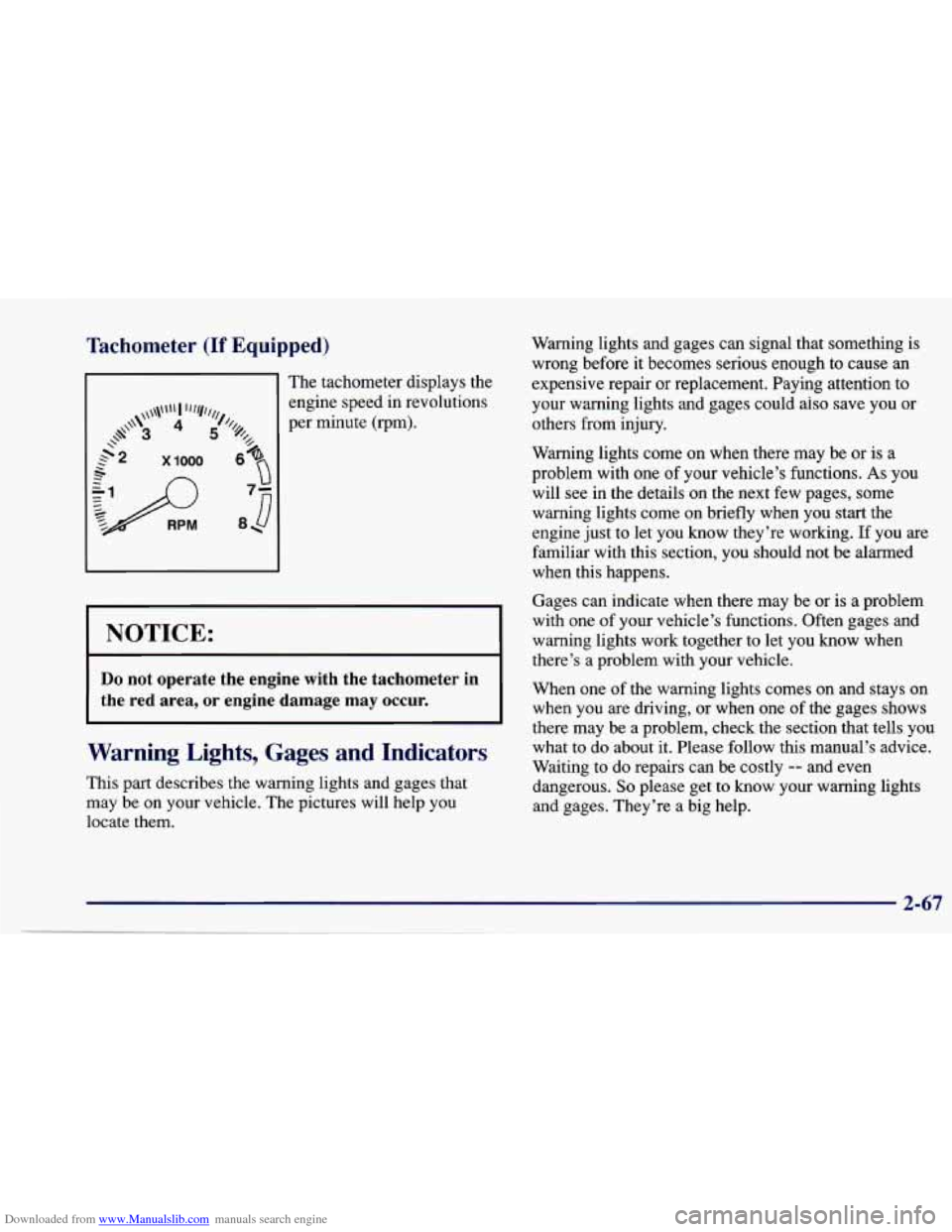
11 The tachometer displays the Warning lights and gages
can signal that something is
wrong before it becomes serious enough to cause an
expensive repair or replacement. Paying attention to
your warning lights and gages could ais0 save you or
others from injury.
Warning lights come on when there may be or is a
problem with one of your vehicle's functions.
As you
will see in the details on the next few pages, some
warning lights come on briefly when you start the
engine just to let you know they're working. If you are
familiar with this section, you should not be alarrned
when this happens.
Gages can indicate when there may be or is
a problem
with one of your vehicle's functions. Often gages and
warning lights work together to
let you know when
there's a problem with
your vehicle.
NOTICE:
-
I
Do not operate the engine with the tachometer in
the red area, or engine damage
may occur. I
When one of the warning lights comes on and stays on
when you are driving, or when one
of the gages shows I I there may be a problem, check the section that tells you
Warning Lights, Gages and Indicators
This part describes the warning lights and gages that
may be on your vehicle. The pictures will help
you
locate them. what to
do about
it. Please follow this manual's advice.
Waiting to do repairs can be costly
-- and even
dangerous. So please get to know your warning lights
and gages. They're a big help.
2-67
__
Page 126 of 388
Downloaded from www.Manualslib.com manuals search engine Safety Belt Reminder Light
When the key is turned to RUN or START, a chime will
come on for about eight seconds to remind people to
fasten their safety belts, unless the driver’s safety belt is
already buckled.
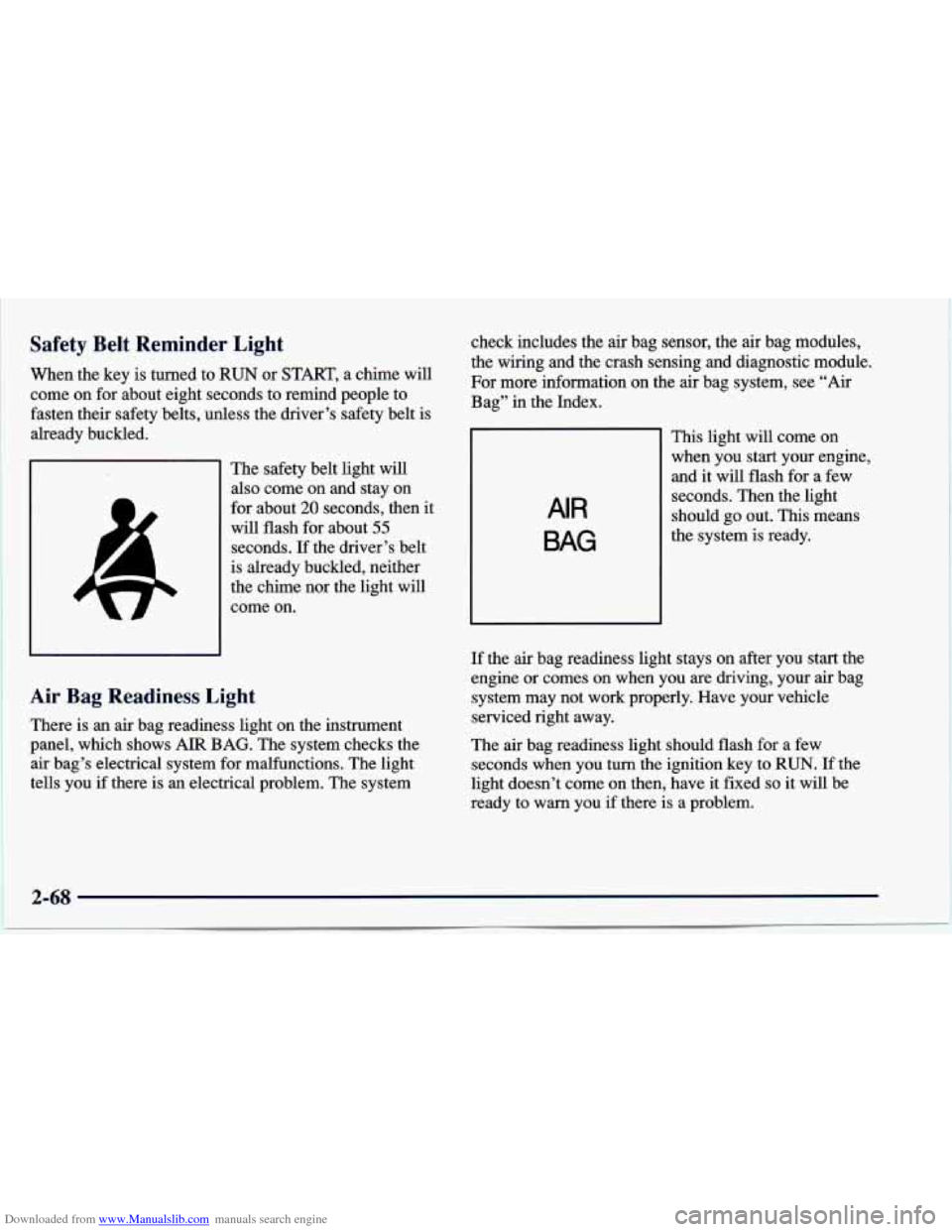
I The safety belt light will
also come on and stay on
for about
20 seconds, then it
will flash for about
55
seconds. If the driver’s belt
is already buckled, neither
the chime nor the light will
come on.
Air Bag Readiness Light
There is an air bag readiness light on the instrument
panel, which shows AIR BAG. The system checks the
air bag’s electrical system for malfunctions. The light
tells you if there
is an electrical problem. The system check includes
the air bag sensor, the
air bag modules,
the wiring and the crash sensing and diagnostic module.
For more information on the
air bag system, see “Air
Bag” in the Index.
AIR
BAG
This light will come on
when you start your engine,
and it will flash for a few
seconds. Then the light
should go out. This means
the system is ready.
~~~~
If the air bag readiness light stays on after you start the
engine
or comes on when you are driving, your air bag
system may not work properly. Have your vehicle
serviced right away.
The air bag readiness light should flash for a few
seconds when you turn the ignition key to RUN. If the
light doesn’t come on then, have it fixed
so it will be
ready to warn you if there
is a problem.
2-68
Page 127 of 388
Downloaded from www.Manualslib.com manuals search engine Charging System Light
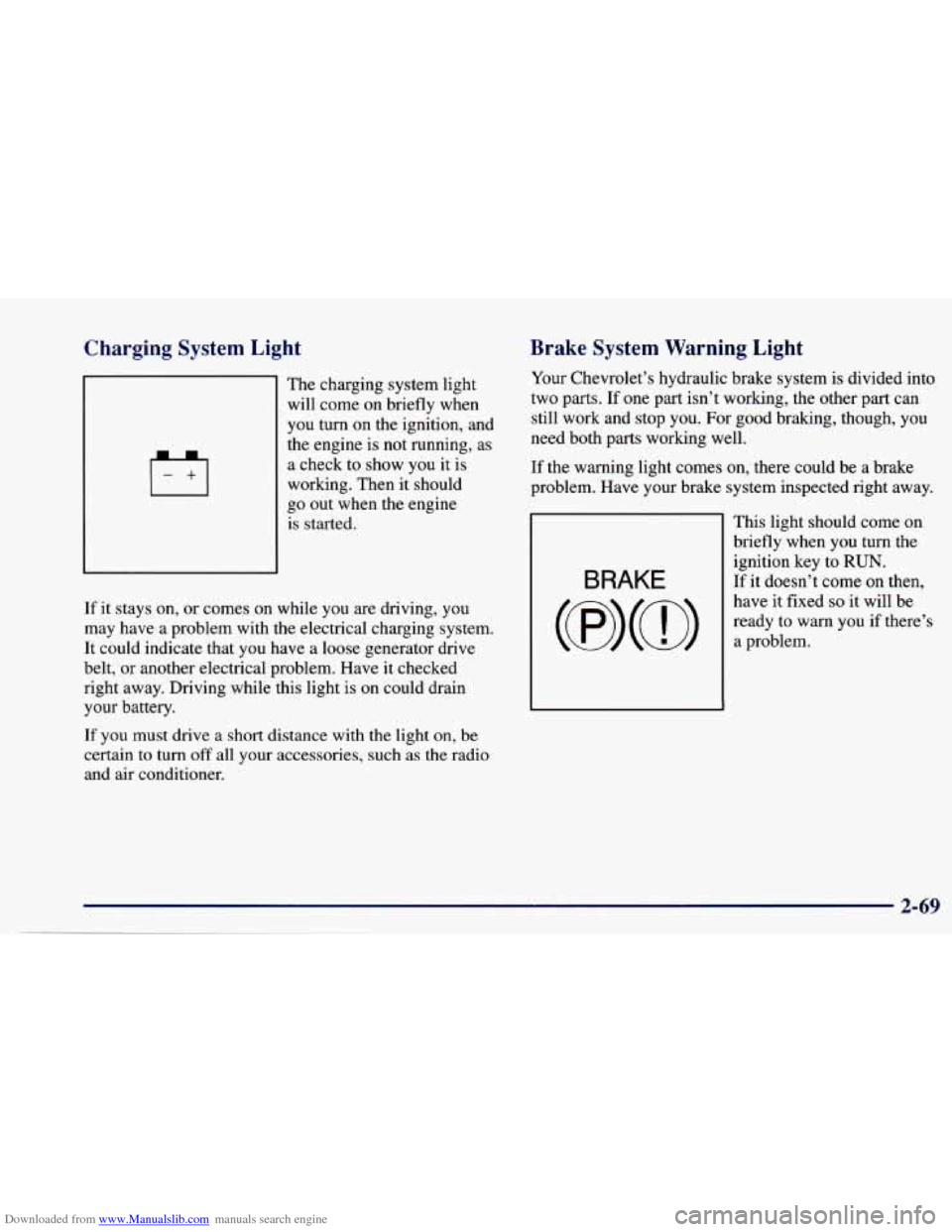
The charging system light
will come on briefly when
you turn on the ignition, and
the engine is not running, as
a check to show you it is
working. Then
it should
go out when the engine
is started.
If it stays on, or comes on while you are driving, you
may have a problem with the electrical charging system.
It could indicate that you have a loose generator drive
belt, or another electrical problem. Have
it checked
right away. Driving while this light is on could drain
your battery.
If you must drive a short distance with the light on, be
certain to turn
off all your accessories, such as the radio
and air conditioner.
Brake System Warning Light
Your Chevrolet’s hydraulic brake system is divided into
two parts.
If one part isn’t working, the other part can
still work and stop you. For good braking, though, you
need both parts working well.
If the warning light comes on, there could be a brake
problem. Have your brake system inspected right away.
BRAKE
This light should come on
briefly when you turn the
ignition key to
RUN.
If it doesn’t come on then,
have it fixed
so it will be
ready to warn you if there’s
a problem.
2-69
Page 131 of 388
Downloaded from www.Manualslib.com manuals search engine Low Coolant Warning Light
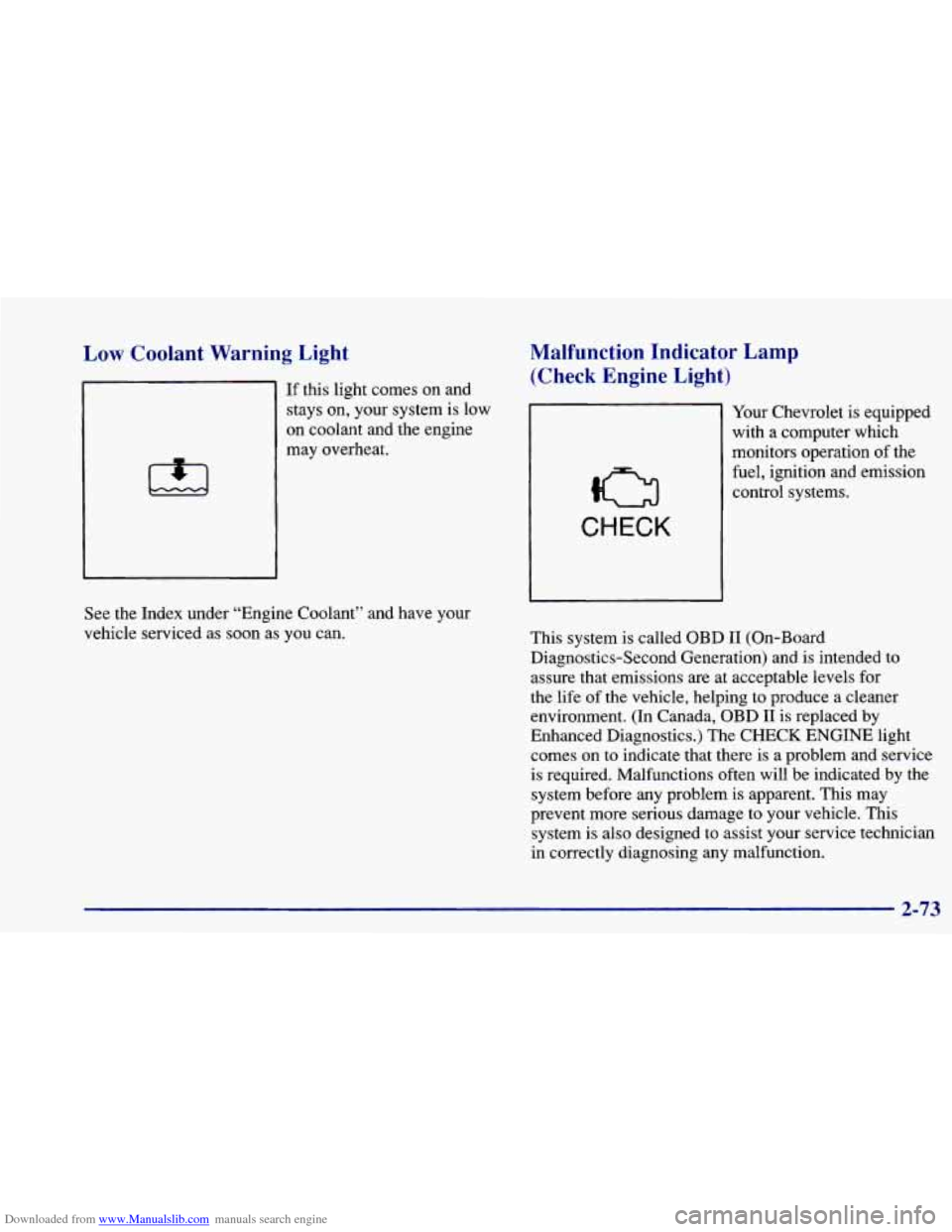
If this light comes on and
stays on, your system is low
on coolant and the engine
may overheat.
Malfunction Indicator Lamp
(Check Engine Light)
CHECK
Your Chevrolet is equipped
with a computer which
monitors operation of the
fuel, ignition
and emission
control systems.
See the Index under “Engine Coolant’’ and have your
vehicle serviced as soon as
you can.
This system is called OBD I1 (On-Board
Diagnostics-Second Generation) and is intended to
assure that emissions are at acceptable levels for
the life of
the vehicle, helping to produce a cleaner
environment. (In Canada,
OBD I1 is replaced by
Enhanced Diagnostics.) The CHECK ENGINE light
comes on to indicate that there
is a problem and service
is required, Malfunctions often will be indicated by the
system before any problem is apparent. This may
prevent more serious damage to your vehicle. This
system is also designed to assist your service technician
in correctly diagnosing any malfunction.
2-73