Page 111 of 388
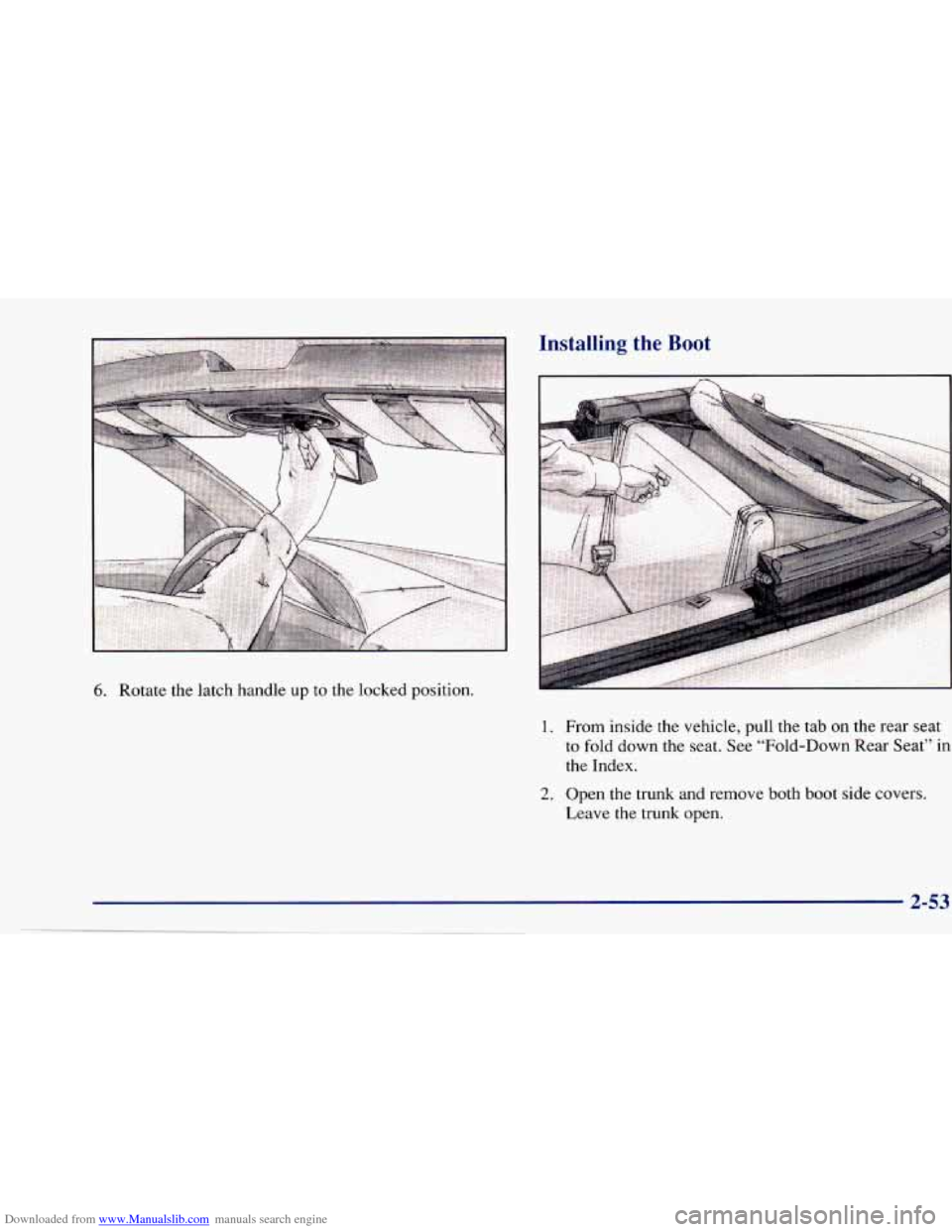
Downloaded from www.Manualslib.com manuals search engine 6. Rotate the latch handle up to the locked position.
Installing the Boot
I 1
1. From inside the vehicle, pull the tab on the rear seat
to fold down the seat. See “Fold-Down
Rear Seat” in
the Index.
2. Open the trunk and remove both boot side covers.
Leave the trunk open.
Page 112 of 388
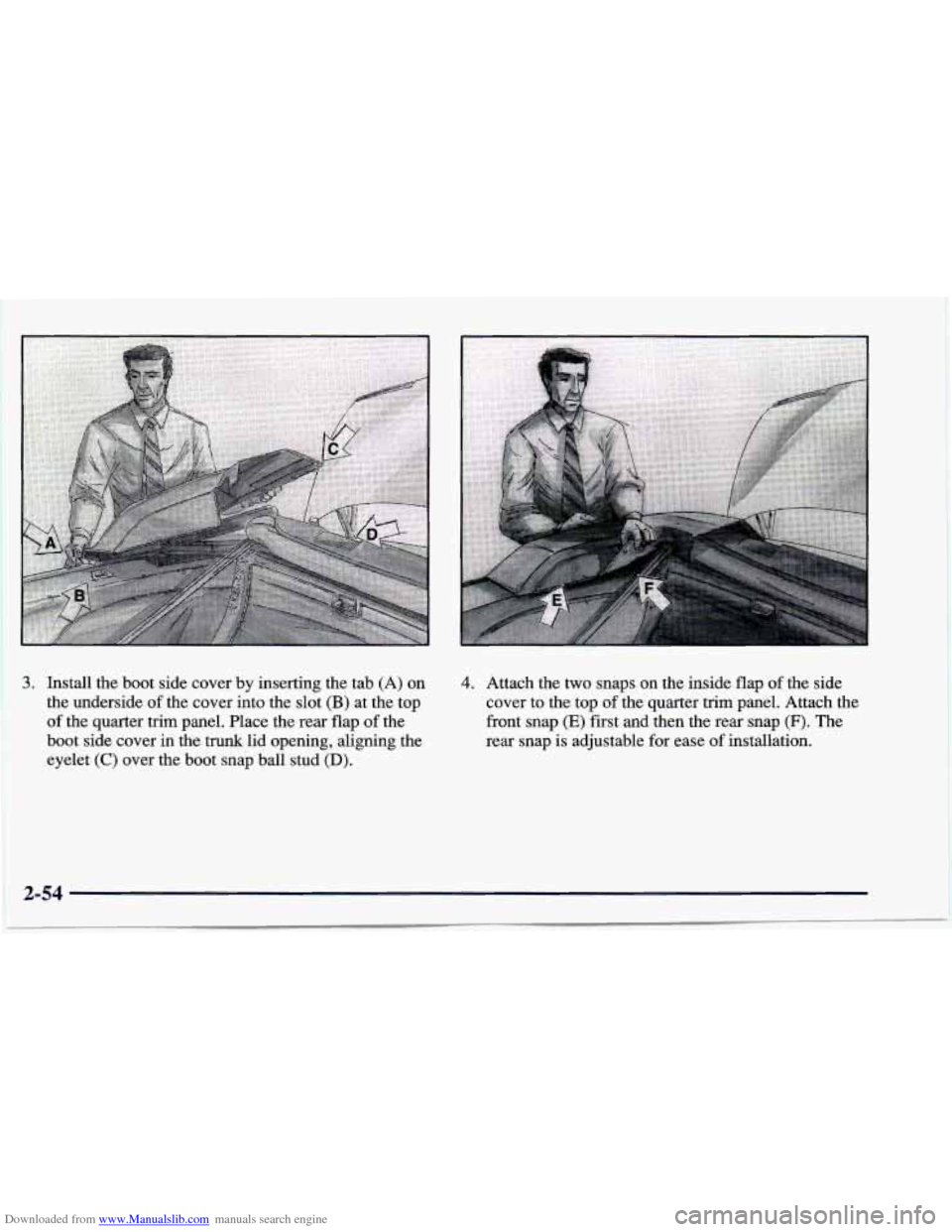
Downloaded from www.Manualslib.com manuals search engine 3. Install the boot side cover by inserting the tab (A) on
the underside of the cover into the slot
(B) at the top
of the quarter trim panel. Place the rear flap of the
boot side cover in the
trunk lid opening, aligning the
eyelet
(C) over the boot snap ball stud (D).
4. Attach the two snaps on the inside flap of the side
cover to the top of the quarter trim panel. Attach the
front snap
(E) first and then the rear snap (F). The
rear snap is adjustable for ease of installation.
2-54
Page 113 of 388
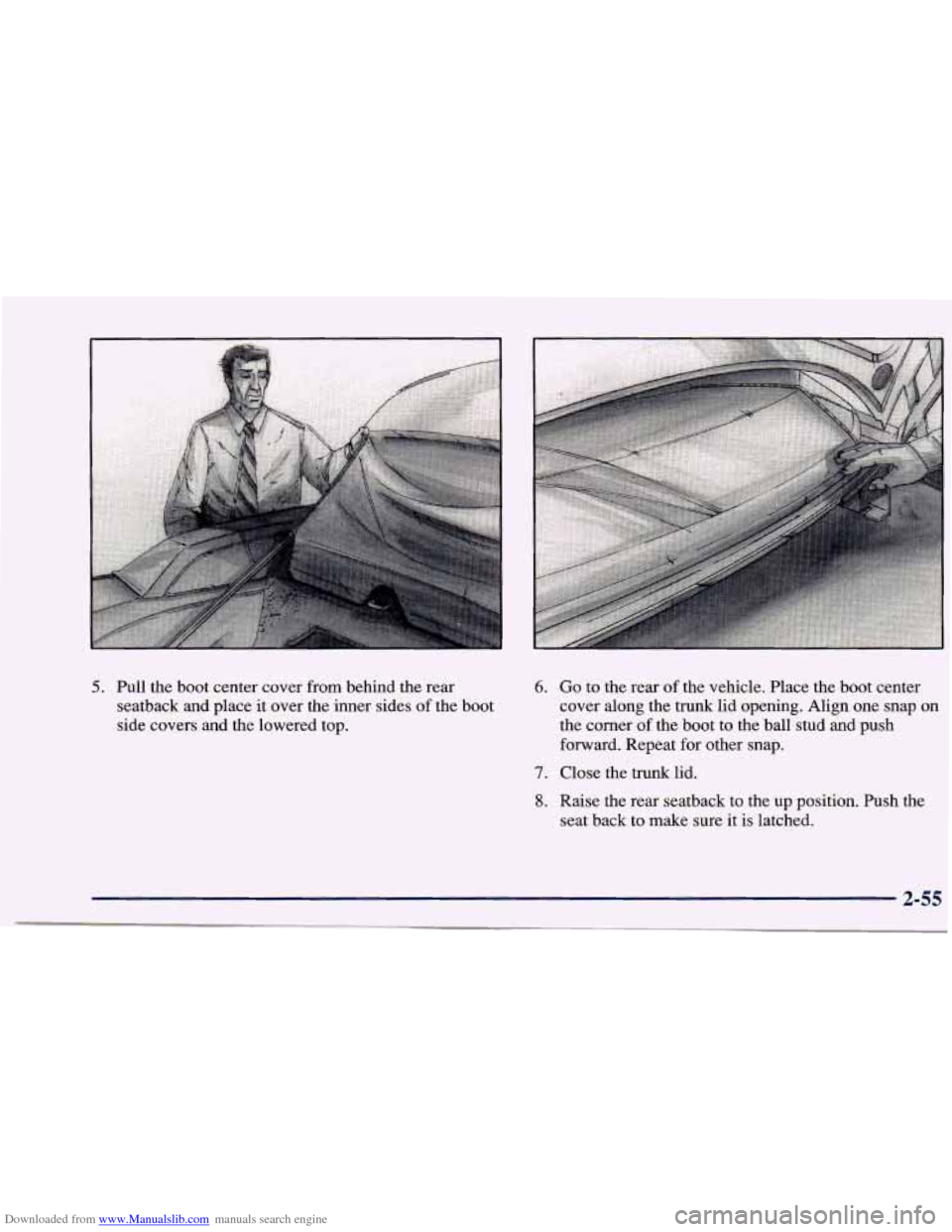
Downloaded from www.Manualslib.com manuals search engine 5. Pull the boot center cover from behind the rear
seatback and place it over the inner sides of the boot
side covers and the lowered top. 6. Go to the rear of the vehicle. Place the boot center
cover along the
trunk lid opening. Align one snap on
the corner of the boot to the ball stud and push
forward. Repeat
for other snap.
7. Close the trunk lid.
8. Raise the rear seatback to the up position. Push the
seat back to make sure
it is latched.
2-55
Page 114 of 388
Downloaded from www.Manualslib.com manuals search engine nemoving the Boot
1. Set the parking brake and shift your automatic
transaxle to
PARK (P) or your manual transaxle to
NEUTRAL (N).
2. Open the trunk and leave it open.
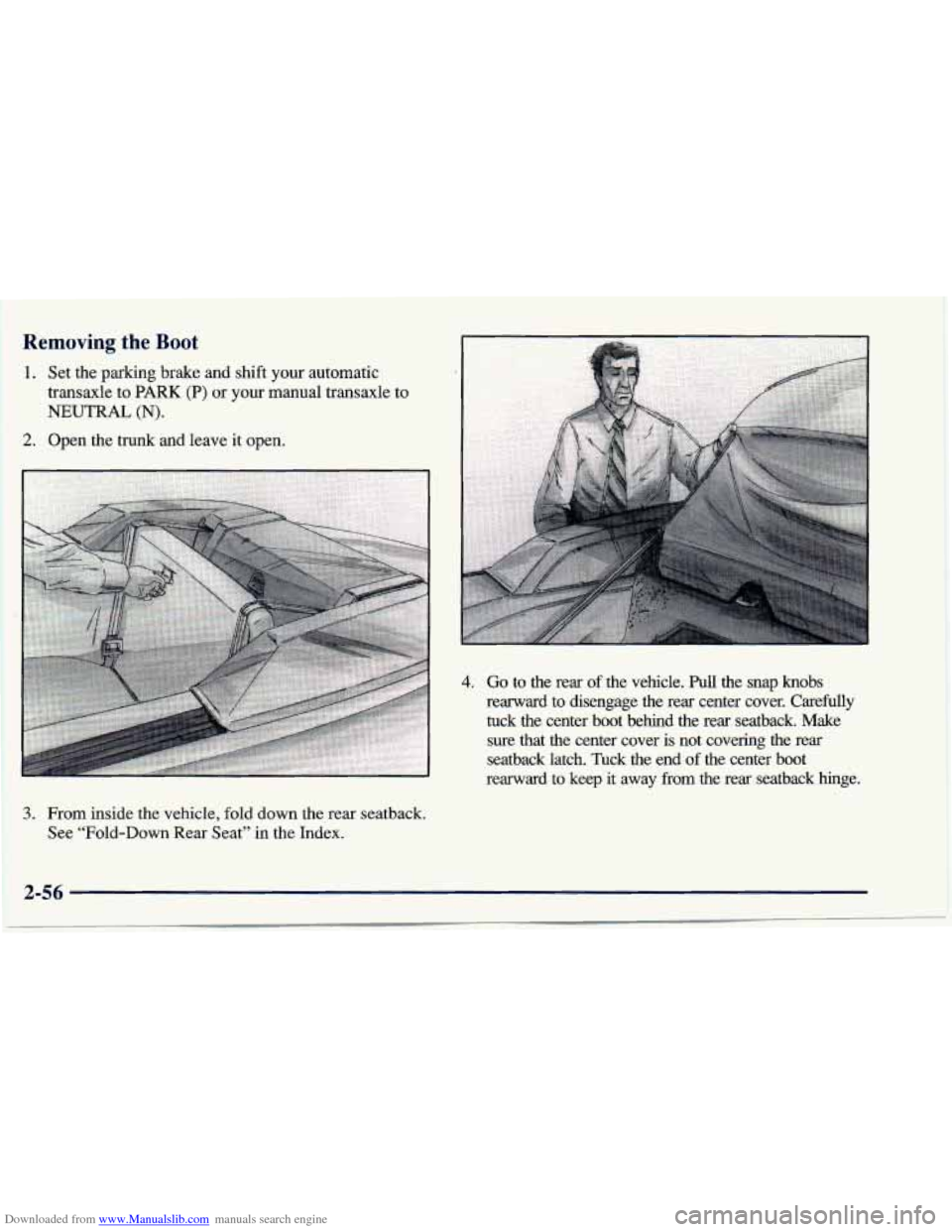
4. Go to the rear of the vehicle. Pull the snap knobs
rearward to disengage the rear center cover. Carefully
tuck the center boot behind the rear seatback. Make
sure that the center cover is not covering the rear
seatback latch. Tuck
the end of the center boot
rearward
to keep it away from the rear seatback hinge.
I
3. From inside the vehicle, fold down the rear seatback.
See “Fold-Down Rear Seat” in the Index.
2-56
Page 115 of 388
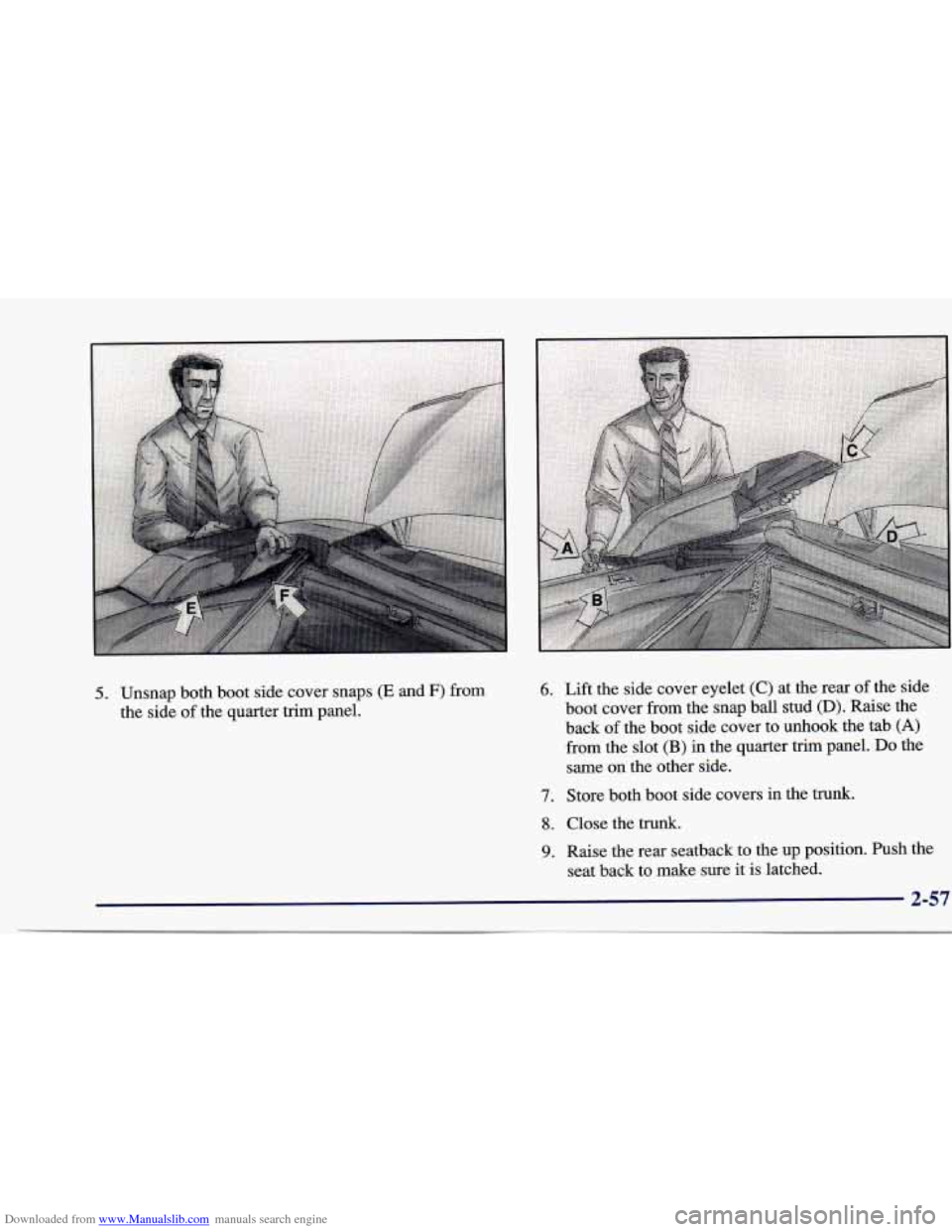
Downloaded from www.Manualslib.com manuals search engine 5. Unsnap both boot side cover snaps (E and F) from
the side
of the quarter trim panel. 6.
7.
8.
9.
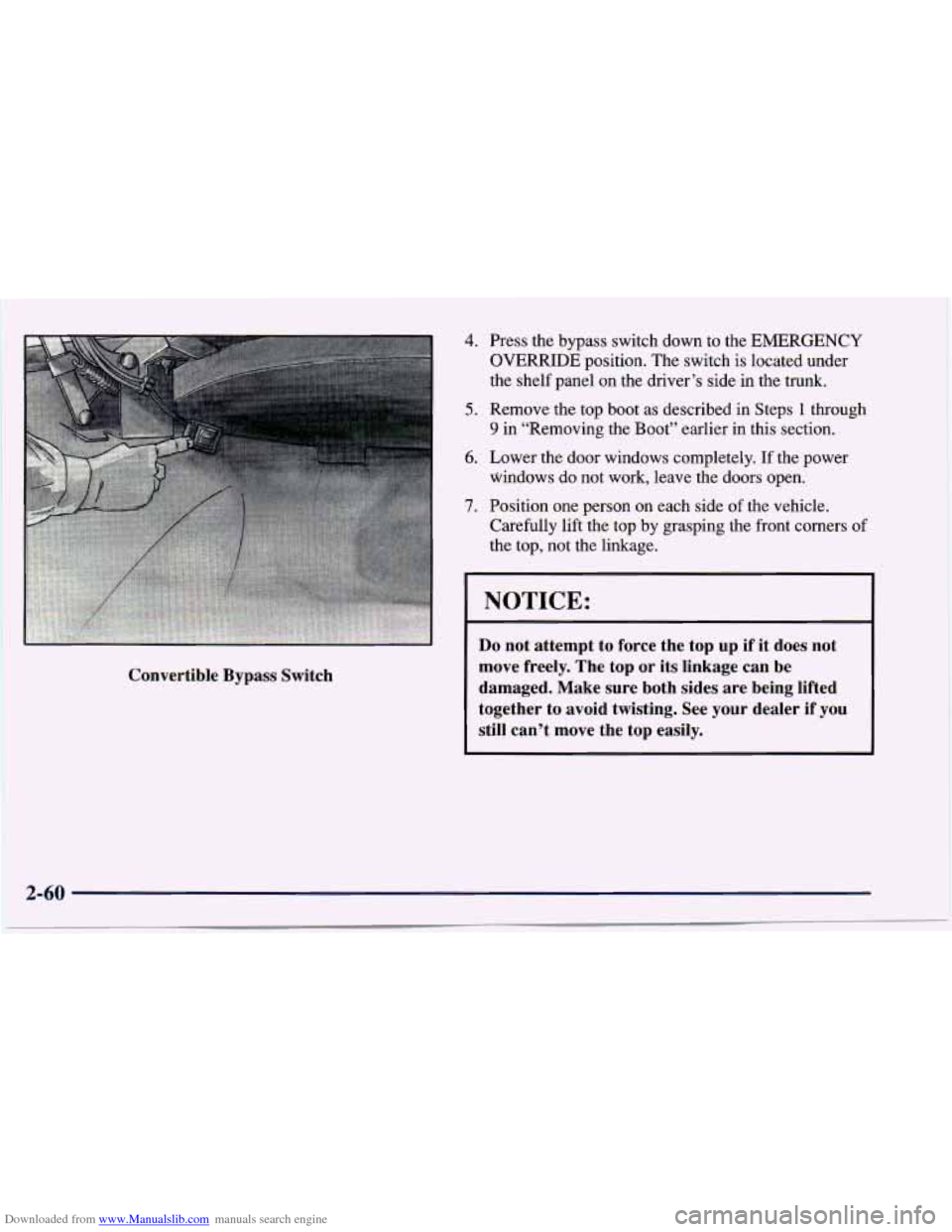
Lift the
side cover eyelet (C) at the rear of the side
boot cover from the snap ball stud
(D). Raise the
back of the boot side cover to
unhook the tab (A)
from the slot (B) in the quarter trim panel. Do the
same on the other side.
Store both boot side covers in the
trunk.
Close the trunk.
Raise the rear seatback to the up position. Push the
seat back to make sure
it is latched.
Page 118 of 388
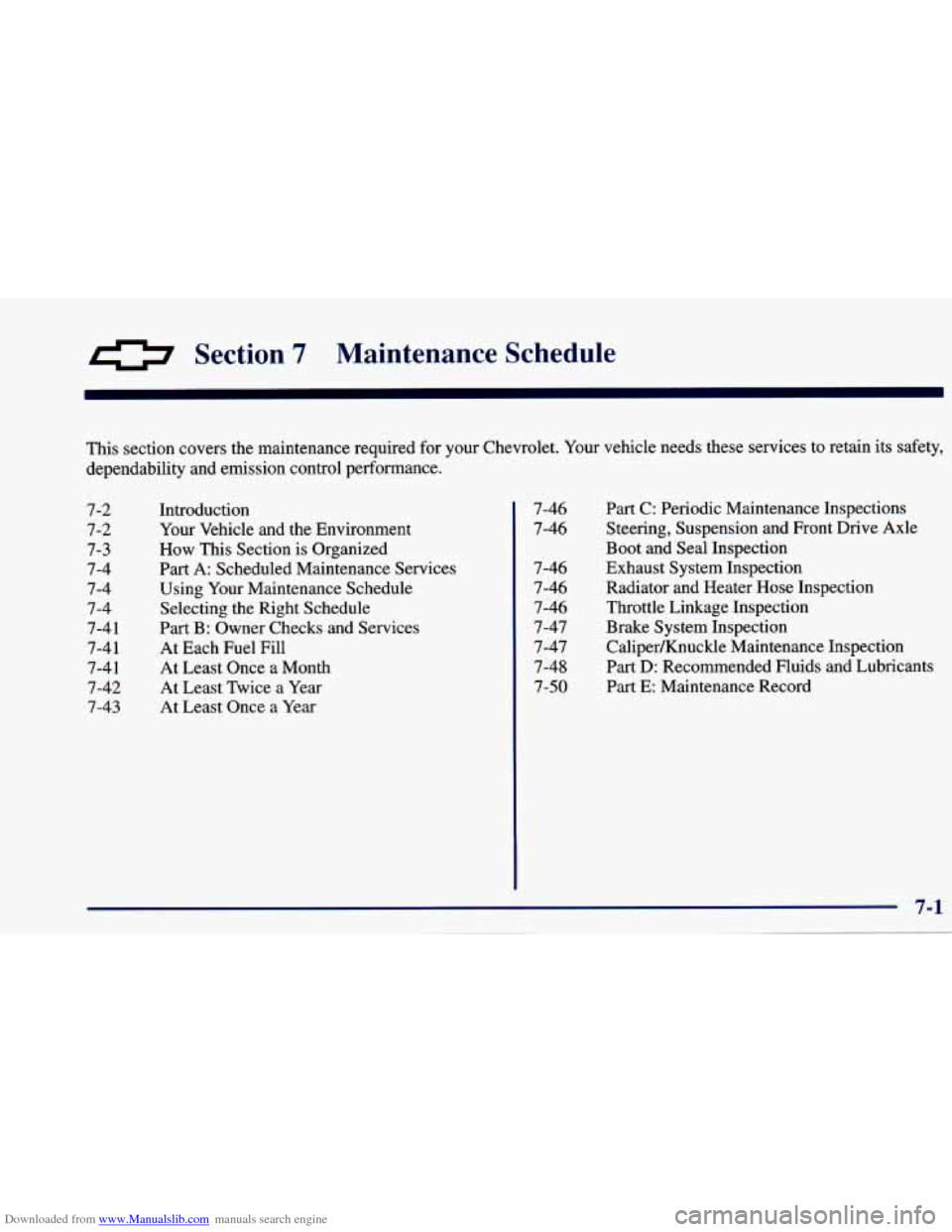
Downloaded from www.Manualslib.com manuals search engine Convertible Bypass Switch
4. Press the bypass switch down to the EMERGENCY
OVERRIDE position. The switch is located under
the shelf panel on the driver’s side in the
trunk.
5. Remove the top boot as described in Steps 1 through
9 in “Removing the Boot” earlier in this section.
6. Lower the door windows completely. If the power
windows
do not work, leave the doors open.
7. Position one person on each side of the vehicle.
Carefully lift the top by grasping the front corners of
the top, not the linkage.
NOTICE:
Do not attempt to force the top up if it does not
move freely. The top
or its linkage can be
damaged. Make sure both sides are being lifted
together to avoid twisting. See your dealer
if you
still can’t move the top easily.
2-60
Page 309 of 388
Downloaded from www.Manualslib.com manuals search engine 0 Section 7 Maintenance Schedule
This section covers the maintenance required for your Chevrolet. Your vehicle needs these services to retain its safety,
dependability and emission control performance.
7-2
7-2
7-3
7-4
7-4
7-4 7-4
1
7-4 1
7-4 1
7-42
7-43
Introduction Your Vehicle and the Environment
How This Section
is Organized
Part A: Scheduled Maintenance Services
Using Your Maintenance Schedule
Selecting the Right Schedule
Part B: Owner Checks and Services
At Each Fuel Fill
At Least Once
a Month
At Least Twice
a Year
At Least Once a Year
7-46
7-46
7-46
7-46
7-46
7-47
7-47
7-48
7-50 Part C: Periodic Maintenance Inspections
Steering, Suspension and Front Drive Axle
Boot and Seal Inspection
Exhaust System Inspection
Radiator and Heater Hose Inspection
Throttle Linkage Inspection
Brake System Inspection
CaliperKnuckle Maintenance Inspection
Part
D: Recommended Fluids and Lubricants
Part E: Maintenance Record
Page 354 of 388
Downloaded from www.Manualslib.com manuals search engine Part C: Periodic Maintenance
Inspections
Listed below are inspections and services which should
be performed at least twice a year (for instance, each
spring and fall).
You should let your GM dealer’s
service department or other qualified service center do
these jobs. Make sure any necessary repairs are
completed at once.
Proper procedures to perform these services may be
found in a
GM service manual. See “Service and Owner
Publications” in the Index.
Steering, Suspension and Front Drive Axle
Boot and Seal Inspection
Inspect the front and rear suspension and steering
system for damaged, loose or missing parts, signs
of
wear or lack of lubrication. Inspect the power steering
lines and hoses for proper hook-up, binding, leaks,
cracks, chafing, etc. Clean and then inspect the drive axle boot seals for damage, tears or leakage. Replace
seals if necessary.
I
Exhaust System Inspection
Inspect the complete exhaust system. Inspect the body
near the exhaust system.
Look for broken, damaged,
missing
or out-of-position parts as well as open seams,
holes, loose connections or other conditions which could
cause a heat build-up in the floor pan or could let
exhaust fumes into the vehicle. See “Engine Exhaust’’
in the Index.
Radiator and Heater Hose Inspection
Inspect the hoses and have them replaced if they are
cracked, swollen or deteriorated. Inspect all pipes,
fittings and clamps; replace as needed.
Throttle Linkage Inspection
Inspect the throttle linkage for interference or binding,
and for damage or missing parts. Replace parts as
needed. Replace any cables that have high effort or
excessive wear.
Do not lubricate accelerator and cruise
control cables.