Page 186 of 404

Downloaded from www.Manualslib.com manuals search engine Freeway Driving
Mile for mile, freeways (also called thruways, parkways,
expressways, turnpikes or superhighways) are the safest
of all roads. But they have their own special rules.
The most important advice on freeway driving is: Keep
up with traffic and keep to
the right. Drive at the same
speed most of the other drivers are driving. Too-fast or
too-slow driving breaks a smooth traffic
flow. Treat the
left lane
on a freeway as a passing lane. At
the entrance, there is usually
a ramp that leads to the
freeway. If
you have a clear view of the freeway as you
drive along the entrance ramp,
you should begin to
check traffic. Try
to determine where you expect to
blend with the flow. Try to merge into the gap at close to
the prevailing speed. Switch on your turn signal, check
your mirrors and glance over your shoulder
as often as
necessary. Try to blend smoothly with the traffic flow.
Once you are on the freeway, adjust your speed to the
posted limit or to the prevailing rate if it’s slower. Stay
in the right lane unless you want to pass.
Before changing lanes, check your mirrors. Then use
your turn signal.
Just before you leave the lane, glance quickly over your
shoulder
to make sure there isn’t another vehicle in your
“blind” spot.
Once you are moving on the freeway, make certain you
allow a reasonable following distance. Expect to move
slightly slower at night.
When you want to leave the freeway, move to the proper
lane well
in advance. If you miss your exit, do not,
under any circumstances, stop and back up. Drive on to
the next exit.
The exit ramp can be curved, sometimes quite sharply.
4-22
Page 190 of 404
Downloaded from www.Manualslib.com manuals search engine Winter Driving
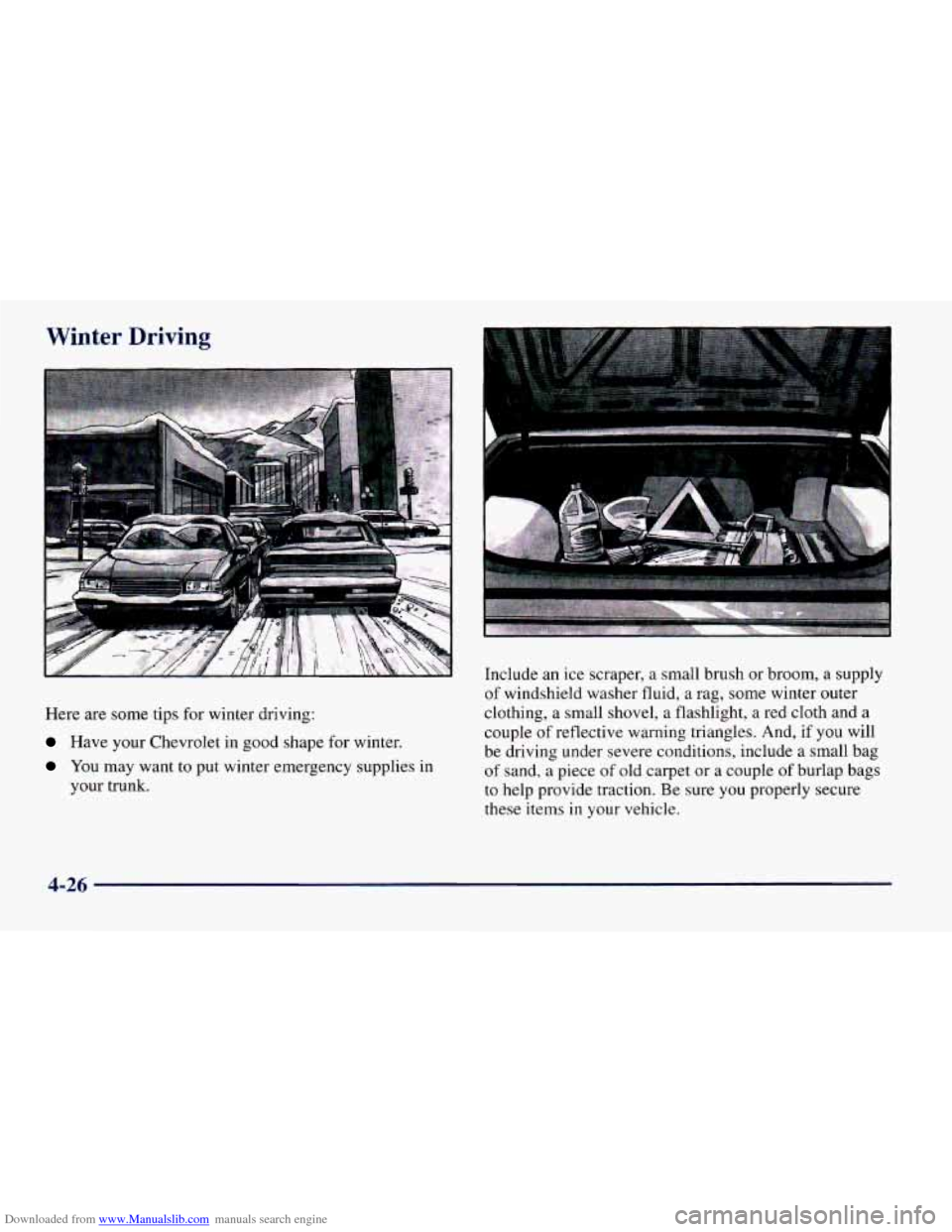
Here are some tips for winter driving:
Have your Chevrolet in good shape for winter.
You may want to put winter emergency supplies in
your trunk. Include
an ice scraper,
a small brush or broom, a supply
of windshield washer fluid, a rag, some winter outer
clothing, a small shovel, a flashlight,
a red cloth and a
couple of reflective warning triangles. And, if you will
be driving under severe conditions, include a small bag
of sand, a piece of old carpet or a couple of burlap bags
to help provide traction. Be sure you properly secure
these items
in your vehicle.
4-26
Page 194 of 404

Downloaded from www.Manualslib.com manuals search engine Run your engine only as long as you must. This saves
fuel.
When you run the engine, make it go a little faster
than just idle. That
is, push the accelerator slightly. This
uses less fuel for the heat that you get and it keeps the
battery charged. You will need
a well-charged battery to
restart the vehicle, and possibly for signaling later on
with your headlamps. Let the heater run for awhile.
Then, shut the engine
off and close the window almost
all the way to preserve the heat. Start the engine again
and repeat this only when
you feel really uncomfortable
from the cold. But do it as little
as possible. Preserve the
fuel
as long as you can. To help keep warm, you can get
out
of the vehicle and do some fairly vigorous exercises
every half hour or
so until help comes.
Loading Your Vehicle
i"
.
TIRE-LOADING INFORMATION
OCCUPANTS VEHICLE CAP.
WT.
FRT. CTR. RR. TOTAL LBS. KG
MAX. LOADING
& GVWR SAME AS VEHICLE
CAPACITY WEIGHT
XXX COLD TIRE
TIRE SIZE SPEED PRESSURE
RTG PSUKPa
FRT.
RR.
SPA.
IF TIRES ARE HOT, ADD 4PS1/28KPa
SEE OWNER'S MANUAL FOR ADDITIONAL
, INFORMATION
Two labels on your vehicle show how much weight it
may properly carry. The Tire-Loading Information label
found on the rear edge
of the driver's door tells you the
proper size, speed rating and recommended inflation
pressures for the tires on your vehicle. It also gives you
important information about the number of people that
can be in your vehicle and the total weight that you can
carry. This weight is called the vehicle capacity weight
and includes the weight of all occupants, cargo and all
nonfactory-installed options.
4-30
Page 208 of 404
Downloaded from www.Manualslib.com manuals search engine NOTICE:
Ignoring these steps could result in costly damage
to your vehicle that wouldn’t be covered by
your warranty.
Trying to start your Chevrolet by pushing
or
pulling it could damage your vehicle, even if you
have a manual transmission. And if you have an
automatic transmission,
it won’t start that way.
1. Check the other vehicle. It must have a 12-volt
battery with a negative ground system.
NOTICE:
If the other system isn’t a 12-volt system with a
negative ground, both vehicles can be damaged.
2.
3.
Get the vehicles close enough so the jumper cables
can reach, but be sure the vehicles aren’t touching
each
other. If they are, it could cause a ground
connection you don’t want.
You wouldn’t be able to
start
your Chevrolet, and the bad grounding could
damage the electrical systems.
Turn off the ignition
on both vehicles. Turn off all
lights that aren’t needed, and radios. This will avoid
sparks and help save both batteries. And it could
save your radio!
I NOTICE:
If you leave your radio on, it could be badly
damaged. The repairs wouldn’t be covered by
your warranty.
4. Open the hoods and locate the batteries.
Find
the positive (+) and negative (-) terminals on
each battery.
5-4
Page 209 of 404

Downloaded from www.Manualslib.com manuals search engine A CAUTIOR-
Using a match near a battery can cause battery
gas to explode. People have been hurt doing this,
and some have been blinded. Use
a flashlight if
you need more light.
Be sure the battery has enough water. You don’t
need to add water to the Delco Freedom@ battery
installed in every new
GM vehicle. But if a
battery has filler caps, be sure the right amount
of fluid is there. If it is low, add water to take care
of that
first. If you don’t, explosive gas could
be present.
Battery fluid contains acid that can burn you.
Don’t get it on you.
If you accidentally get it in
your eyes or on your skin, flush the place with
water and get medical help immediately.
5. Check that the jumper cables don’t have loose or
missing insulation.
If they do, you could get a shock.
The vehicles could be damaged,
too.
Before you connect the cables, here are some basic
things
you should know. Positive (+) will go to
positive
(+) and negative (-) will go to negative (-)
or a metal engine part. Don’t connect (+) to (-) or
you’ll get a short that would damage the battery and
maybe other parts,
too.
r
I
ms or other moving engine parts can injure you
badly. Keep your hands away from moving parts
once the engines are running.
5-5
Page 218 of 404

Downloaded from www.Manualslib.com manuals search engine 'Engine Overheating
You will find a coolant temperature gage on your
Chevrolet's instrument panel. You may also find a LOW
COOLANT warning light on your Chevrolet's
instrument panel.
(V8 Engine Only)
If Steam Is Coming From Your Engine
t A
/! CAUTION:
Steam from an overheated engine can burn
badly, even if you just open the hood. Stay away
from the engine
if you see or hear steam coming
from it. Just turn
it off and get everyone away
from the vehicle until it cools down. Wait until
there
is no sign of steam or coolant before you
open the hood.
If you keep driving when your engine is
overheated, the liquids in it can catch fire. You or
others could be badly burned. Stop your engine
if
it overheats, and get out of the vehicle until the
engine is cool.
I NOTICE:
~~ ~
If your engine catches fire because you keep
driving with no coolant, your vehicle can be
badly damaged. The costly repairs would not be
covered
by your warranty.
5-14
Page 246 of 404

Downloaded from www.Manualslib.com manuals search engine ~ NOTICE:
Spinning your wheels can destroy parts of your
vehicle as well as the tires.
If you spin the wheels
too fast while shifting your transmission back
and forth, you can destroy your transmission.
For information about using tire chains on your vehicle,
see “Tire Chains” in the Index.
Rocking Your Vehicle To Get It Out
First, turn your steering wheel left and right. That will
clear the area around your front wheels. If
your vehicle
has ASR, you should
turn the system off. (See “ASR
System” in the Index.) Then shift back and forth between
REVERSE (R) and a
forward gear (or with a manual
transmission, between FIRST
(1) or SECOND (2) and
REVERSE
(R)), spinning the wheels as little as possible.
Release the accelerator pedal while you shift, and press
lightly on
the accelerator pedal when the transmission is
in gear. If that doesn’t get you
out after a few tries, you
may need to be towed out. If you do need to be towed
out, see “Towing Your Vehicle” in the Index.
5-42
Page 258 of 404
Downloaded from www.Manualslib.com manuals search engine Before closing the hood, be sure all the filler caps
are on.
Then just pull the hood down and close it firmly.
Engine Oil
If the LOW OIL light
on the instrument panel
comes on, it means you
need
to check your engine
oil level right away.
LOW OIL
For more information, see “Low Oil Light” in the Index.
You should check your engine oil level regularly; this is
an added reminder.
It’s a good idea
to check your engine oil every time you
get fuel. In order
to get an accurate reading, the oil must
be warm and the vehicle must be on level ground.
3800 Engine Oil Dipstick
The engine oil dipstick is the yellow loop near the back
of the engine
6-12