1997 CHEVROLET BLAZER belt
[x] Cancel search: beltPage 129 of 402
Downloaded from www.Manualslib.com manuals search engine Warning Lights, Gages and Indicators
This part describes the warning lights and gages that
may be on
your vehicle. The pictures will help you
locate them.
Warning lights and gages can signal that something is
wrong before it becomes serious enough to cause an
expensive repair or replacement. Paying attention to
your warning lights and gages could also save you
or
others from injury.
Warning lights come on when there may be
or is a
problem with one of
your vehicle's functions. As you
will see in the details on the next few pages. some
warning lights come on briefly when
you start the
engine just
to let you know they're workinz. If you are
familiar with this section, you
should not be alarmed
when this happens.
Gages can indicate when there may be or is a problem
with one of your vehicle's functions. Often gages and
warning lights
work together to let you know when
there's a problem
with your vehicle. When
one
of the warning lights comes on and stays on
when you are driving, or when one
of the gages shows
there may be a problem, check the section that tells
you
what to do about it. Please follow this manual's advice.
Waiting
to do repairs can be costly -- and even
dangerous.
So please get to know your warning lights
and gages. They're
a big help.
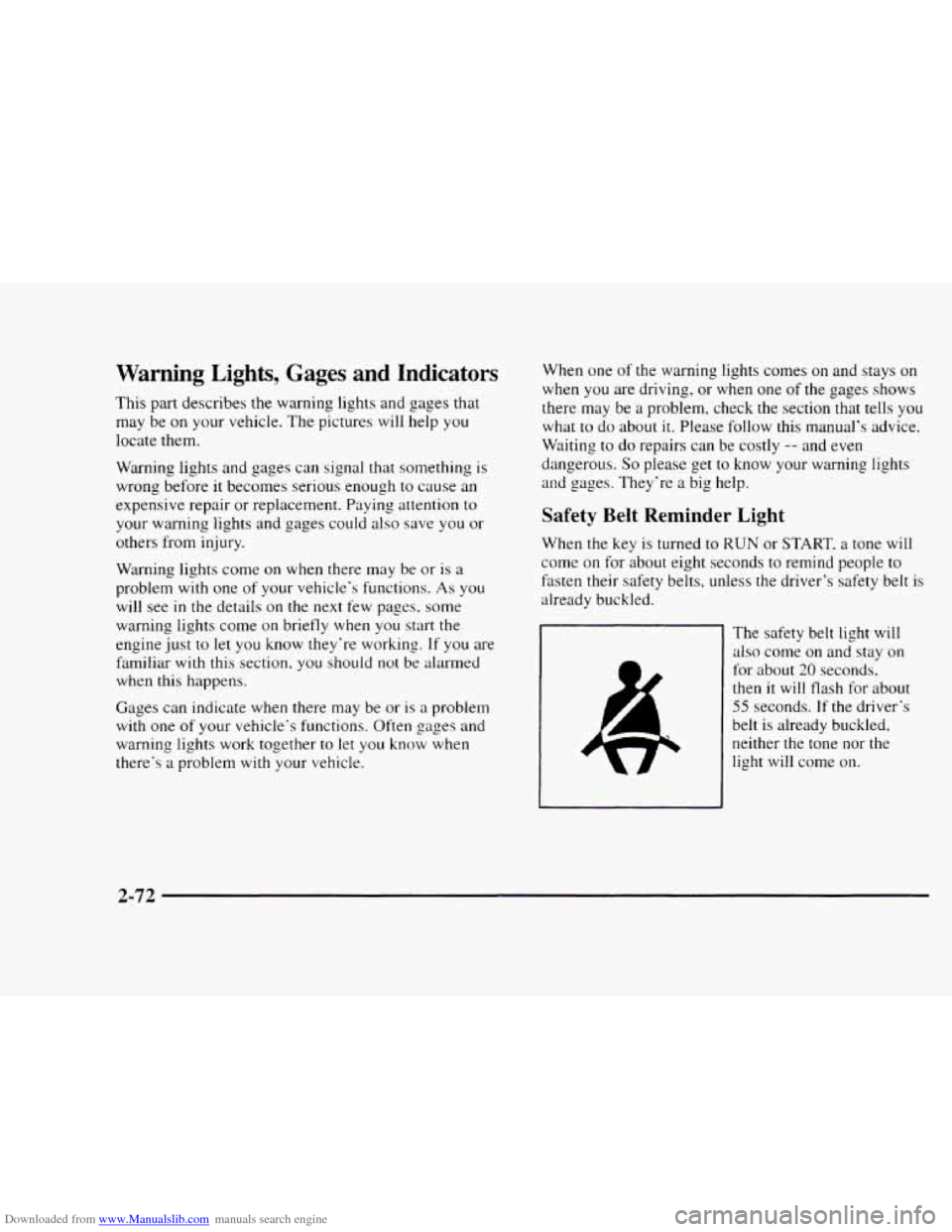
Safety Belt Reminder Light
When the key is turned to RUN or START. a tone will
come on for about eight seconds
to remind people to
fasten their safety belts, unless the driver's safety belt is
already buckled.
The safety belt
light will
also come on and stay on
for about
20 seconds.
then
it will flash for about
55 seconds. If the driver's
belt is already buckled,
neither the tone nor the
light
will come on.
2-72
Page 130 of 402

Downloaded from www.Manualslib.com manuals search engine Air Bag Readiness Light
There is an air bag readiness light on the instrument
panel, which shows
AIR BAG. The system checks the
air bag’s electrical system for malfunctions. The light
tells you
if there is an electrical problem. The system
check includes
the air bag sensors, the air bag module,
the wiring and
the diagnostic module. For more
information
on the air bag system, see ‘*Air Bag” in
the Index.
AIR
BAG
This light will come on
when you start your engine,
and
it will flash for a few
seconds.
Then the light
should
go out. This means
the system
is ready.
If the air bag readiness light stays on after you start the
engine or comes on when you are driving, your air bag
system may
not work properly. Have your vehicle
serviced right away. The
air bag
readiness light should flash for a few
seconds when
you turn the ignition key to RUN. If the
light doesn’t corne
on then, have it fixed so it will be
ready
to warn you if there is a problem.
Charging System Indicator Light
II..
~ The charging system light
~ will come on briefly when
you turn on the ignition,
but the engine is not
running,
as a check to
show you it is working.
It should go out once the engine is running. If it stays
on, or comes on while you are driving, you may have
a problem with the charging system. It could indicate
that
you have problems with a generator drive belt, or
another electrical problem. Have
it checked right away.
Driving while
this light is on could drain your battery.
If you must drive a short distance with the light on, be
certain to turn off all your accessories, such as the radio
and air conditioner.
2-73
Page 160 of 402
Downloaded from www.Manualslib.com manuals search engine You may also choose a non-scrubbing action, wet-type
cleaner which uses
a cassette with a fabric belt to clean
the tape head. This type
of cleaning cassette will not
eject and,
it may not clean as thoroughly as the
scrubbing type cleaner.
Cassettes
are subject to wear and the sound quality
may degrade over
time. Always make sure the cassette
tape is
in good condition before you have your tape
player serviced.
Care of Your Compact Discs
Handle discs carefully. Store them in their original cases
or other protective cases and away from direct sunlight
and dust.
If the surface of a disc is soiled, dampen a
clean, soft cloth in a mild, neutral detergent solution and
clean it, wiping from the center
to the edge.
Be sure never to touch the signal surface when handling
discs. Pick
up discs by grasping the outer edges or the
edge
of the hole and the outer edge.
Fixed Mast Antenna
The fixed mast antenna can withstand most car washes
without being damaged. If
the mast should ever become
slightly bent, you can straighten
it out by hand. If the
mast is badly bent, as
it might be by vandals, you should
replace it.
Check
every once in a while to be sure the mast is still
tightened
to the fender.
3-2 1
Page 163 of 402
Downloaded from www.Manualslib.com manuals search engine Defensive Driving
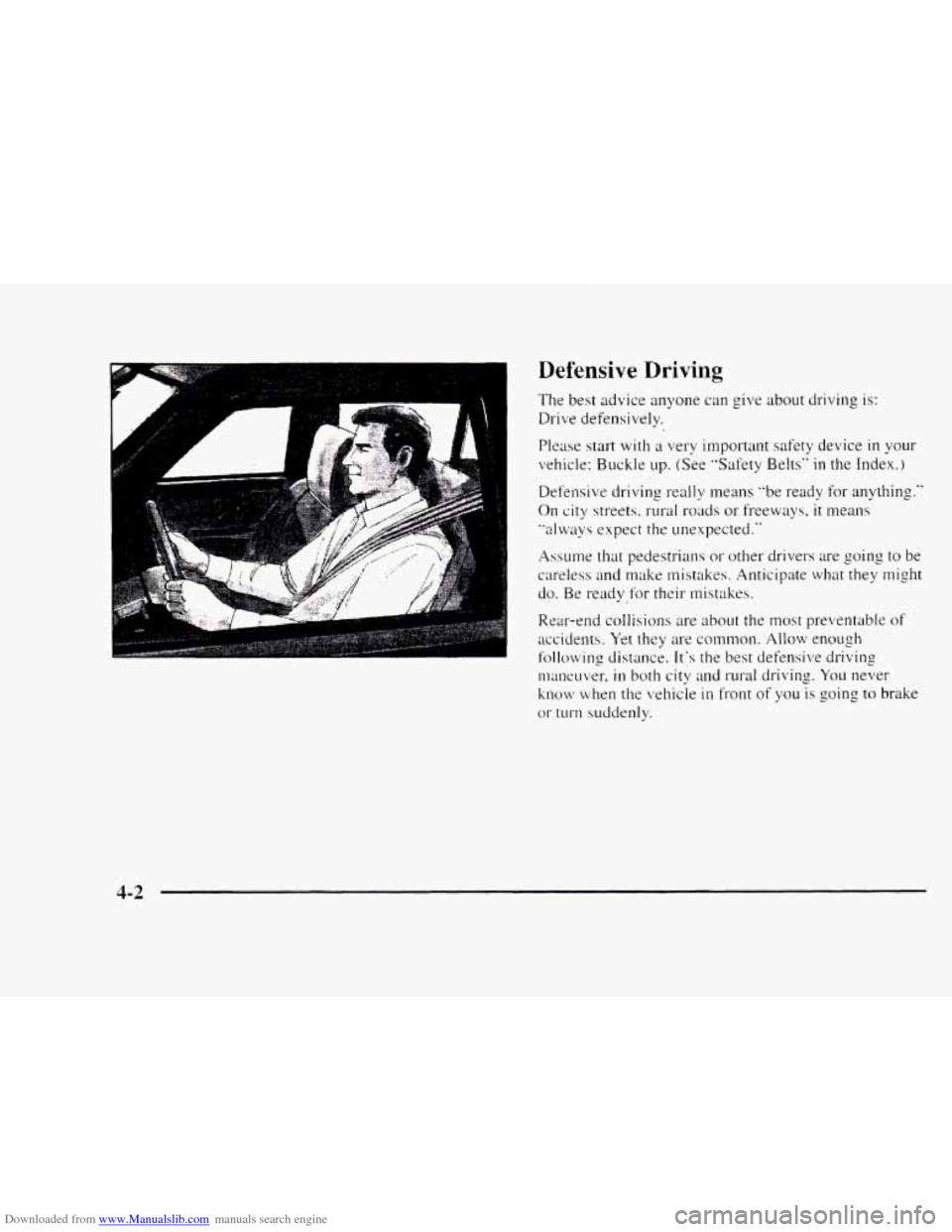
The best advice anyone can give about driving is:
Drive defensively.
Please start with
a very important safety device in your
vehicle: Buckle LIP. (See "Safety Belts" in the Index.)
Defensive driving really means "be ready for
anything."
On city streets, rural roads or freeways. it nleans
"always expect the unexpected."
Assume that pedestrians
or other drivers are going to be
careless and make mistakes. Anticipate what they might
do. Be ready for their mistakes.
Rear-end collisions are
about the most preventable of
accidents. Yet they are common. Allow enough
follonring distance.
It's the best defensive driving
mmeuver.
in both city and rural driving. You never
know when the vehicle in front of you is going to brake
or
turn suddenly.
4-2
Page 172 of 402
Downloaded from www.Manualslib.com manuals search engine An emergency like this requires close attention and a
quick decision. If you are holding the steering wheel at
the recommended
9 and 3 o'clock positions, you can
turn
it a tull 180 degrees very quickly without removing
either
hand. Bur you hrt\*e to act fast, steer quickly, and
just ah quickly straighten the wheel once you have
avoided
the ob-jcct.
The fact that wch clncrgcncy situations are always
possible ih ;I good reason to practice defensive driving at
all
times and NYN satety belts properly.
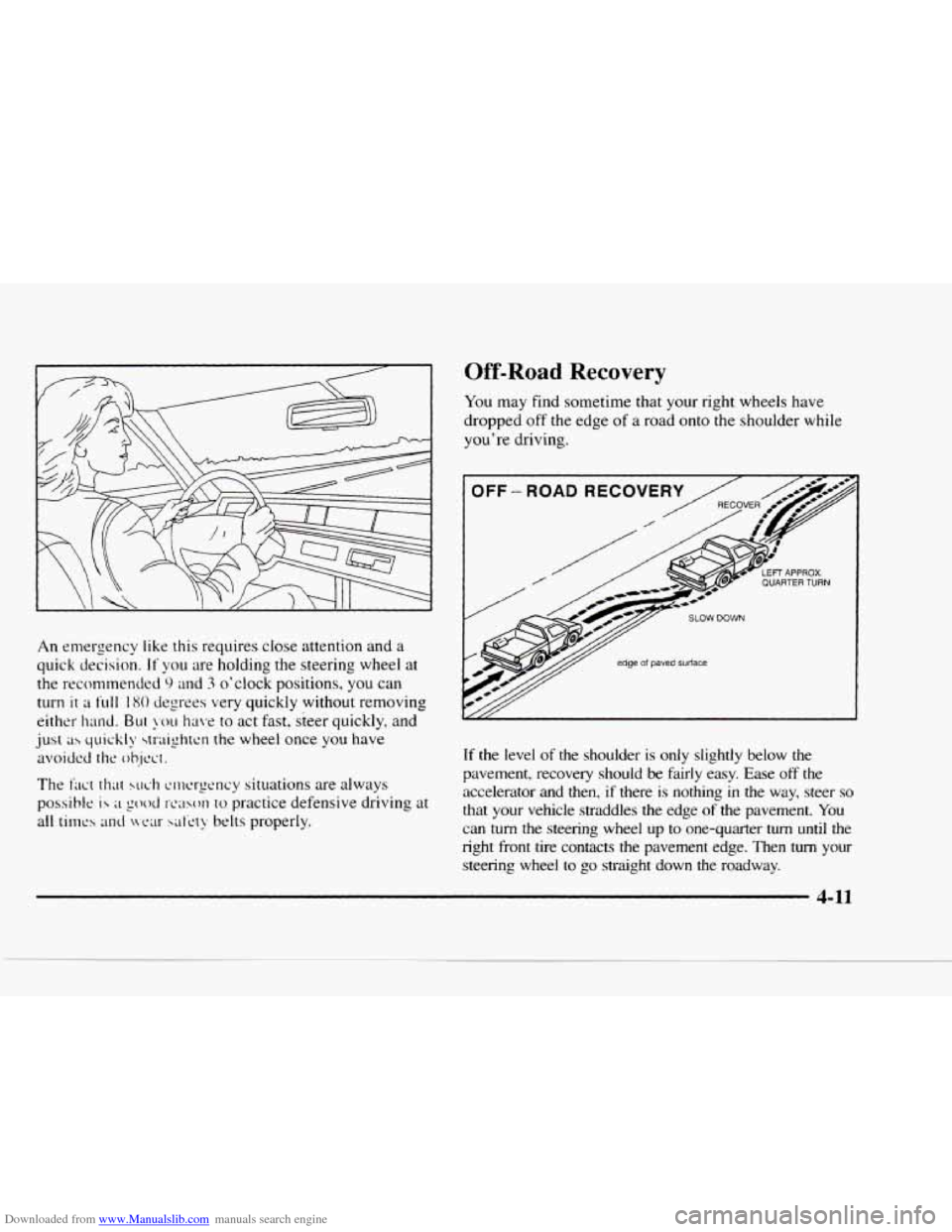
Off-Road Recovery
You may find sometime that your right wheels have
dropped off
the edge of a road onto the shoulder while
you're driving.
I OFF - ROA
v/// edge of paved surface
If the level of the shoulder is only slightly below the
pavement, recovery should be
fairly easy. Ease off the
accelerator and then, if there is nothing in the way, steer so
that your vehicle straddles the edge of the pavement. You
can turn the steering wheel up to one-quarter turn until the
right front tire contacts the pavement
edge. Then turn your
steering wheel to go straight down the roadway.
4-11
Page 178 of 402
Downloaded from www.Manualslib.com manuals search engine Traveling to Remote Areas
It makes sense to plan your trip, especially when going
to a remote area. Know the terrain and plan your route.
You are much less likely to get bad surprises. Get
accurate maps of trails and terrain. Try to learn
of any
blocked or closed roads.
It’s also
a good idea to travel with at least one other
vehicle. If something happens to one of them, the other
can help quickly.
Does your vehicle have
a winch? If so. be sure to read
the winch instructions.
In a remote area, a winch can be
handy if you get stuck. But you’ll want to know how to
use
it properly.
Getting Familiar with Off-Road Driving
It’s a good idea to practice in an area that’s safe and
close to home before you
go into the wilderness.
Off-road
driving does require some new and different
driving
skills. Here’s what we mean.
Tune your senses to different kinds of signals. Your
eyes. for example, need to constantly sweep the terrain
for unexpected obstacles. Your ears need to listen for
unusual tire
or engine sounds. With your arms, hands,
feet and body, you’ll need to respond to vibrations and
vehicle bounce. Controlling
your vehicle is the key to successful
off-road driving. One of
the best ways to control your
vehicle is to control your speed. Here are some things to
keep
in mind. At higher speeds:
0
e
0
a
you approach things faster and you have less time to
scan the terrain for obstacles.
you have less time to react.
you have more vehicle bounce when you drive
over obstacles.
you’ll need more distance for braking, especially
since you’re on
an unpaved surface.
I A CAUTION:
When you’re driving off-road, bouncing and
quick changes in direction can easily throw you
out
of position. This could cause you to lose
control and crash. So, whether you’re driving on
or off the road, you and your passengers should
wear safety belts.
Page 215 of 402
Downloaded from www.Manualslib.com manuals search engine When You Are Ready to Leave After
Parking
on a Hill
1. Apply your regular brakes and hold the pedal down
whiie you:
Start your engine:
Shift into a gear: and
Release the parking brake.
3,. Let up on the brake pedal.
3. Drive slowly until the trailer is clear of the chocks.
4. Stop and have someone pick up and store the chocks.
Maintenance When Trailer Towing
Your vehicle will need service more often when you’re
pulling
a trailer. See the Maintenance Schedule for more
on this. Things that are especially important in trailer
operation are automatic transmission fluid (don’t
overfill), engine
oil, axle lubricant, belt. cooling system
and brake adjustment. Each
of these is covered in this
manual. and
the Index will help you find them quickly.
If you’re trailering, it‘s a good idea to review these
sections before you start your
trip.
Check periodically to see that all hitch nuts and bolts
are tight.
4-54
Page 256 of 402
Downloaded from www.Manualslib.com manuals search engine Section 6 Service and Appearance Care
Here you will find information about the care of your vehicle. This section begins with service and fuel information,
and then
it shows how to check important fluid and lubricant levels. There is also technical information about your
vehicle, and a part devoted
to its appearance care.
6-3
6-4
6-5
6-6
6-9 6-
13
6- 14
6-18
6- 19
6-
20
6-2 1
6-23
6-26
6-26
6-26 6-27
Fuel
Fuels in Foreign Countries
Filling Your Tank
Checking Things Under the Hood
Engine Oil
Air Cleaner
Automatic Transmission Fluid
Manual Transmission Fluid
Hydraulic Clutch
Rear Axle
Four-wheel Drive and All-Wheel Drive
Engine Coolant Radiator Pressure Cap
Thermostat Power Steering Fluid
Windshield Washer Fluid 6-28
6-32
6-3 3 6-3 8
6-40 6-49
6-49
6-52
6-54
6-5
7
6-5 8
6-58
6-58
6-62
6-63
6-64
Brakes
Battery
Bulb Replacement
Windshield Wiper Blade Replacement
Tires
Appearance Care
Cleaning the Inside
of Your Vehicle
Care
of Safety Belts
Cleaning the Outside of Your Vehicle
Appearance Care Materials Chart
Vehicle Identification Number
(VIN)
Service Parts Identification Label
Electrical System
Replacement Bulbs
Capacities and Specifications
Air Conditioning Refrigerants