Page 212 of 402
Downloaded from www.Manualslib.com manuals search engine Following Distance
Stay at least twice as far behind the vehicle ahead as you
would when driving your vehicle without a trailer. This
can help
you avoid situations that require heavy braking
and sudden turns.
Passing
You’ll need more passing distance up ahead when
you‘re towing
a trailer. And, because you’re a good deal
longer,
you’ll need to go much farther beyond the
passed vehicle before you can return
to your lane.
Backing Up
Hold the bottom of the steering wheel with one hand.
Then, to move the trailer to the left, just move that hand
to the left. To move the trailer to the right, move your
hand
to the right. Always back up slowly and, if
possible, have someone guide you.
Making Turns
I NOTICE:
Making very sharp turns while trailering could
cause the trailer to come in contact with the
vehicle. Your vehicle could be damaged. Avoid
making very sharp turns while trailering.
When you’re turning with a trailer, make wider turns
than normal.
Do this so your trailer won’t strike soft
shoulders, curbs, road signs, trees or other objects.
Avoid jerky or sudden maneuvers. Signal well
in advance.
I’urn Signals When Towing a Trailer
When you tow a trailer, your vehicle has to have extra
wiring and
a heavy-duty turn signal flasher (included in
the optional trailering package).
The arrows
on your instrument panel will flash
whenever you signal
a turn or lane change. Properly
hooked up, the trailer lamps will
also flash, telling other
drivers you‘re about
to turn, change lanes or stop.
4-51
Page 224 of 402
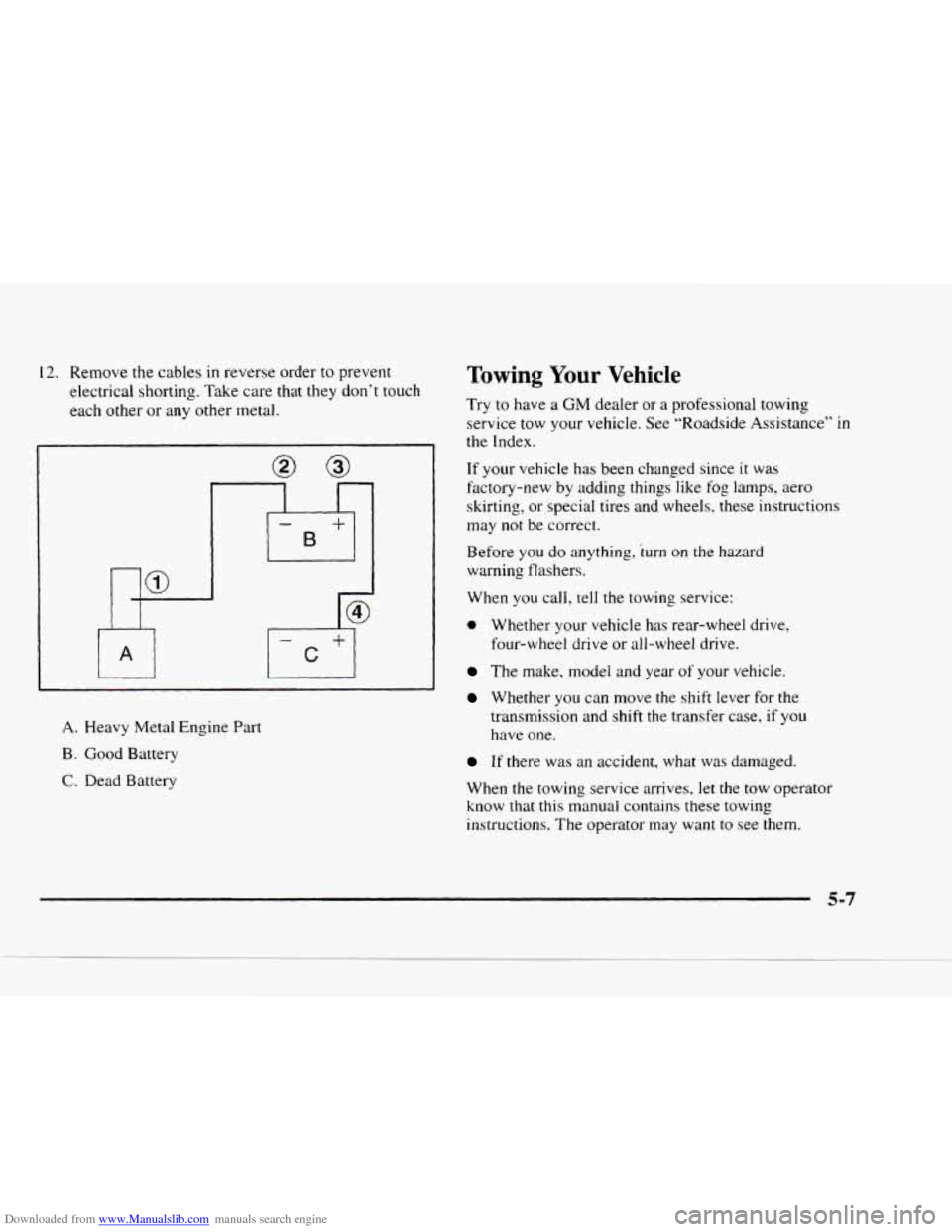
Downloaded from www.Manualslib.com manuals search engine 12. Remove the cables in reverse order to prevent
electrical shorting. Take care that they don’t touch
each other or any other metal.
-0
A
A. Heavy Metal Engine Part
B. Good Battery
C. Dead Battery
Towing Your Vehicle
Try to have a GM dealer or a professional towing
service tow your vehicle. See “Roadside Assistance” in
the index.
If your vehicle has been changed since it was
factory-new by adding things like fog lamps, aero
skirting,
or special tires and wheels, these instructions
may not be correct.
Before
you do anything, turn on the hazard
warning flashers.
When you call, tell the towing service:
e Whether your vehicle has rear-wheel drive,
four-wheel drive
or all-wheel drive.
The make, model and year of your vehicle.
Whether you can move the shift lever for the
transmission and shift the transfer
case, if you
have one.
If there was an accident, what was damaged.
When the towing service arrives, let
the tow operator
know that this manual contains these towing
instructions.
The operator may want to see them.
5-7
Page 240 of 402
Downloaded from www.Manualslib.com manuals search engine Changing a Flat Tire
If a tire goes flat, avoid further tire and wheel damage
by driving slowly to a level
place. Turn on your hazard
warning flashers.
A CAUTION:
Changing a tire can cause an injury. The vehicle
can slip off the jack and roll over you or other
people.
You and they could be badly injured.
Find a level place to change your tire.
To help
prevent the vehicle from moving:
1. Set the parking brake firmly.
2. Put an automatic transmission shift
lever in PARK
(P) or shift a manual
transmission
to FIRST (1) or
REVERSE
(R).
CAUTION: (Continued)
CAUTION: (Continued)
3. If you have a four-wheel-drive vehicle
with a manual transfer case shift lever,
be sure the transfer case is in a drive
gear
-- not in NEUTRAL (N).
4. lbrn off the engine.
5. Put the wheel blocks at the front and
rear
of the tire farthest away from the
one being changed. That would be the
tire
on the other side of the vehicle, at
the opposite end.
5-23
Page 241 of 402
Downloaded from www.Manualslib.com manuals search engine The following steps will tell you how to use the jack and
change a tire.
Removing the Spare Tire and Tools
The jacking equipment you'll need is stored along the
driver's rear wall.
In some cases. you may have to
remove the spare tire
in order to reach the jack. Your
vehicle is
also equipped with work gloves and a plastic
ground mat
to assist in the changing of a flat tire.
h
To remove your jack cover,
pull up on the latch at the
end
of the cover, near the
endgate and the latch
on the
top
of the cover. Remove
the wheel blocks, jack and
wheel wrench.
The following instructions explain
how to remove the
spare tire, depending on where it is mounted on
your vehicle.
[ NOTICE:
Never remove or restow a tire frodto a stowage
position under the vehicle while the vehicle
is
supported by a jack. Always tighten the tire fully
against the underside
of the vehicle when
restowing.
5-24
Page 247 of 402
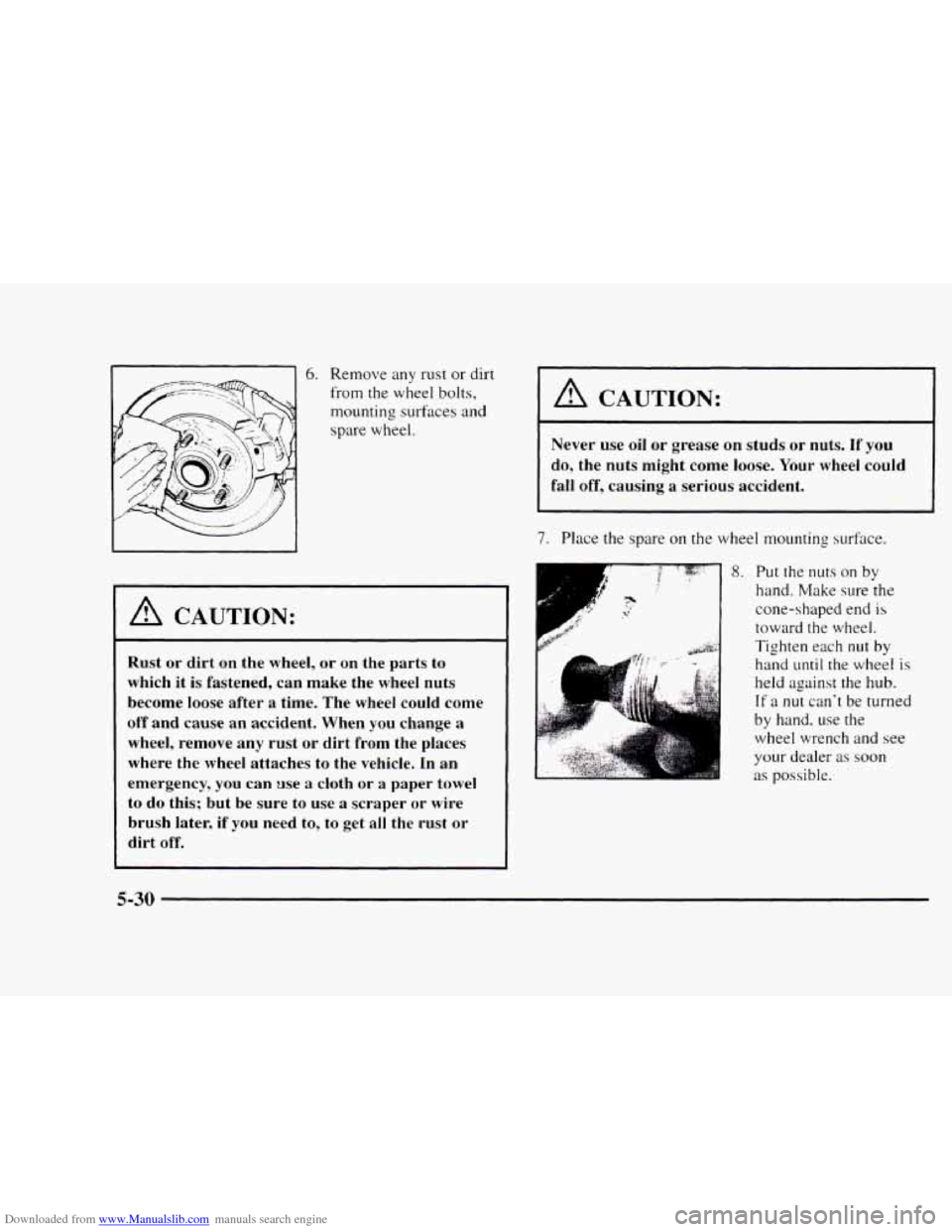
Downloaded from www.Manualslib.com manuals search engine 6. Remove' any rust or dirt
from
the wheel bolts,
mounting surfaces and
spare wheel.
A CAUTION:
Rust or dirt on the wheel, or on the parts to
which it
is fastened, can make the wheel nuts
become loose after
a time. The wheel could come
off and cause an accident. When
you change a
wheel, remove any rust or dirt from the places
where the wheel attaches to the vehicle. In an
emergency, you can use
a cloth or a paper towel
to do this; but be sure to use a scraper or wire
brush later, if
you need to, to get all the rust or
dirt off.
I A CAUTION:
~~
Never use oil or grease on studs or nuts. If you
do, the nuts might come loose. Your wheel could
fall off, causing a serious accident.
7. Place the spare on the wheel mounting surface.
8. Put the nuts on by
hand. Make sure the
cone-shaped end is
toward the wheel.
Tighten each nut by
hand until the wheel is
held against the hub.
If a nut can't be turned
by hand. use the
wheel wrench and see
your dealer as
soon
as possible.
5-30
Page 267 of 402
Downloaded from www.Manualslib.com manuals search engine Engine Oil Additives
Don't add anything to your oil. Your GM dealer is ready
to advise if you think something should be added.
When to Change Engine Oil
If any one of these is true for you. use the short tripkity
. maintenance schedule:
a
a
a
0
a
Most trips are less than 5 to 10 miles (8 to 16 km).
This is particularly important when outside
temperatures are below freezing.
Most trips include extensive idling (such
as frequent
driving in stop-and-go traffic).
You operate
your vehicle in dusty areas or
off-road frequently.
You frequently tow
a trailer or use a currier on top of
your vehicle.
The vehicle is used for delivery service. police, taxi
or other commercial application. Driving under
these conditions causes engine oil
to
break down sooner. If any one of these is true for your
vehicle, then you need
to change your oil and filter
every
3.000 miles (5 000 km) or 3 months -- whichever
occllrs first.
If none of them is true, use the long trip/highway
maintenance schedule. Change the oil and filter every
7,500 miles ( 12 500 km) or 12 months -- whichever
occurs first. Driving
a vehicle with a fully warmed
engine under highway conditions causes engine oil
to
break down slower.
Remote Oil Filter (Four-wheel Drive)
The access door for the remote oil filter is in the steering
linkage shield assembly located under the radiator
support.
Twist the screw to unlock or lock the door.
Make sure
if you open the door. it is securely closed
when
~OLI are finished.
6-12
Page 298 of 402
Downloaded from www.Manualslib.com manuals search engine i
I
LWA r I
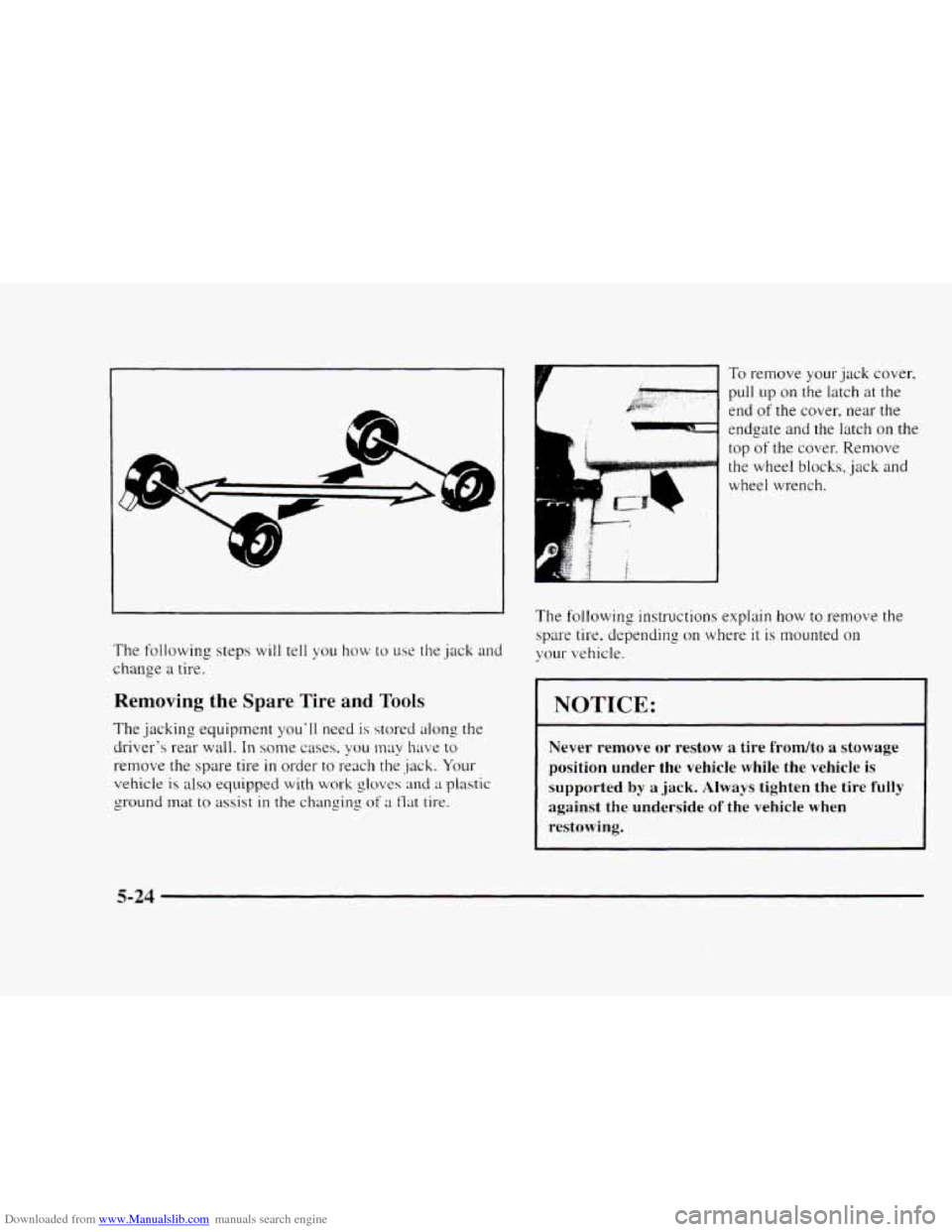
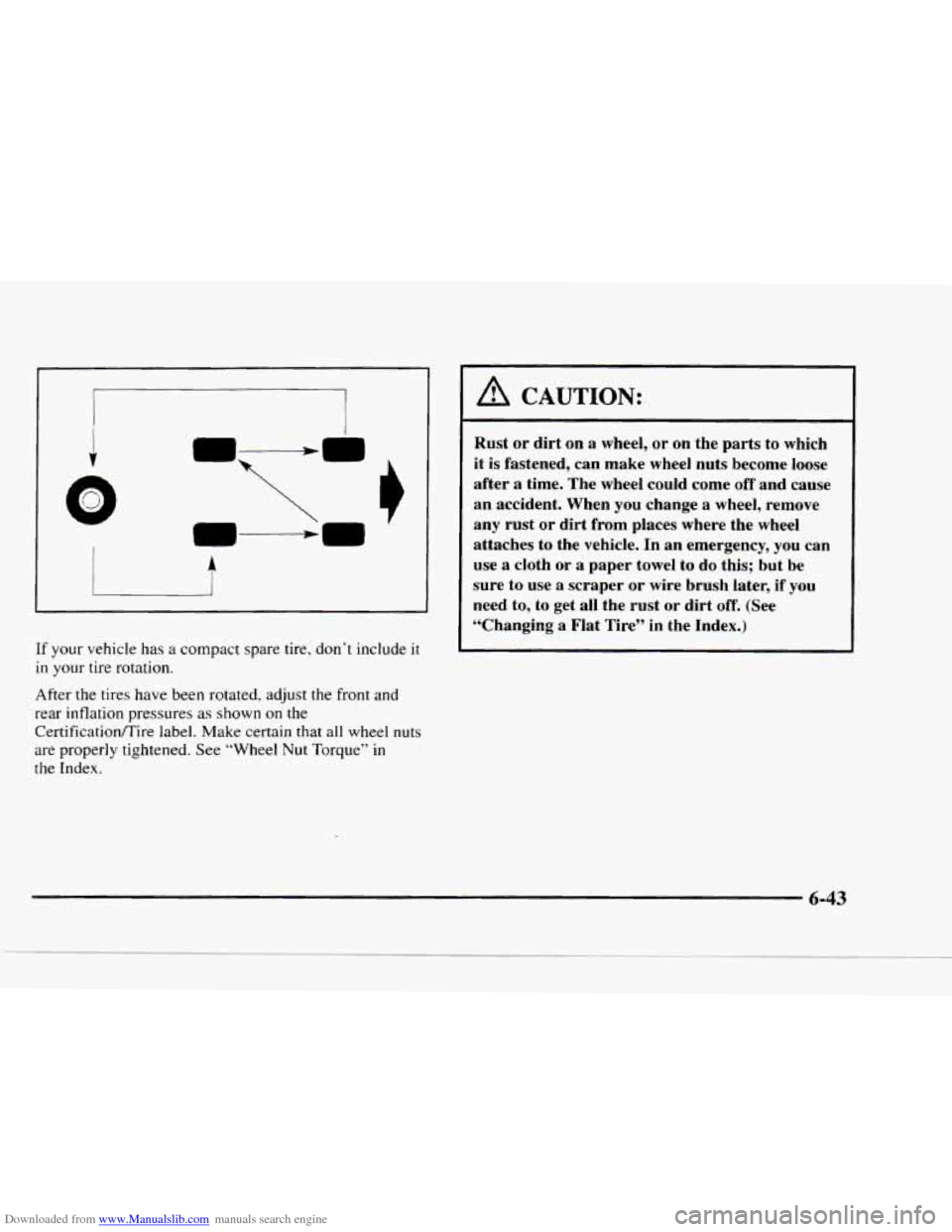
If your vehicle has a compact spare tire, don’t include it
in your tire rotation.
After the tires have been rotated, adjust the front and
rear inflation pressures as shown on the
CertificationRire label. Make certain that all wheel nuts
are properly tightened. See “Wheel
Nut Torque” in
the Index.
Rust or dirt on a wheel, or on the parts to which
it
is fastened, can make wheel nuts become loose
after a time. The wheel could come off and cause
an accident. When
you change a wheel, remove
any rust or dirt from places where the wheel
attaches to the vehicle.
In an emergency, you can
use a cloth or a paper towel to do this; but
be
sure to use a scraper or wire brush later, if you
need to, to get all the rust or dirt off. (See
“Changing a Flat Tire”
in the Index.)
6-43
Page 318 of 402
Downloaded from www.Manualslib.com manuals search engine Capacities and Specifications
Engine Description ............ “VORTEC” 4300
Type .................................... V6
VINCode
................................. W
Firing Order ...................... 1-6-5-4-3-2
Horsepower ................... 190 at 4,400 rpm
Thermostat Specification
........... 195°F (91°C)
Spark Plug Gap
.......... 0.045 inches (0.114 cm)
Wheels and Tires
Wheel Nut Torque ............ 95 Ib-ft (130 N-m)
Tire Pressure
...... See the Certificationflire label. See “Loading Your
Vehicle” in
the Index.
Normal Maintenance Replacement Parts
Replacement part numbers listed in this section are
based on the latest information available at the time
of
printing, and are subject to change. If a part listed in this
manual is not
the same as the part used in your vehicle
when it was built, or if
you have any questions, please
contact your
GM truck dealer.
Thermostat
......................... 12551472
Oil Filter
............................... PF52
Air Cleaner Filter
...................... A1 163C
PCV Valve
.......................... CV746C
Automatic Transmission Filter Kit
...... 24200796
Spark Plugs .......................... .4 1-932
Fuel Filter
............................. GF48 1
Front Windshield Wiper Blade
.......... Trico (20 inches/50.8 cm)
Backglass Wiper Blade
... Trico (14 inched35.6 cm)
6-63