1997 CHEVROLET BLAZER change time
[x] Cancel search: change timePage 170 of 402
Downloaded from www.Manualslib.com manuals search engine Remember: Anti-lock doesn’t change the time you need
to get your foot up to the brake pedal or always decrease
stopping distance.
If you get too close to the vehicle in
front of you‘ you won’t have time to apply your brakes
if that vehicle suddenly slows or stops. Always leave
enough room up ahead to stop, even though you have
anti-lock brakes.
Using Anti-Lock
Don’t pump the brakes. Just hold the brake pedal down
and let anti-lock work for you. You may feel the brakes
vibrate, or you may notice some noise, but this is
normal. On vehicles
with four-wheel drive, your
anti-lock brakes work at all times
-- whether you are in
two-wheel drive or four-wheel drive.
Braking in Emergencies
With anti-lock, you can steer and brake at the same
time.
In many emergencies, steering can help you more
than even the very best braking.
Steering
Power Steering
If you lose power steering assist because the engine
stops
or the system is not functioning, you can steer but
it will take much more effort.
Steering Tips
Driving on Curves
It’s important to take curves at a reasonable speed.
A lot of the “driver lost control” accidents mentioned on
the news happen on curves. Here’s why:
Experienced driver or beginner, each
of us is subject to
the same laws
of physics when driving on curves. The
traction of the tires against the road surface makes
it
possible for the vehicle to change its path when you turn
the
front wheels. If there’s no traction, inertia will keep
the vehicle going
in the same direction. If you’ve ever
tried to steer
a vehicle on wet ice, you‘ll understand this.
The traction you can get in a curve depends on the
condition
of your tires and the road surface, the angle at
which the curve
is banked, and your speed. While you’re
in a curve, speed is the one factor you can control.
4-9
Page 174 of 402
Downloaded from www.Manualslib.com manuals search engine Check your mirrors, glance over your shoulder and
start your
left lane change signal before moving out
of the right lane to pass. When you are far enough
ahead
of the passed vehicle to see its front in your
inside mirror, activate your right lane change signal
and move back
into the right lane. (Remember that
your right outside mirror is convex.
The vehicle you
just passed may seem
to be farther away from you
than it really is.)
Try not to pass more than one vehicle at a time on
two-lane roads. Reconsider before passing the
next vehicle.
Don’t overtake a slowly moving vehicle too rapidly.
Even though
the brake lamps are not flashing, it may
be slowing down or starting to turn.
If you’re being passed, make it easy for the
following driver to get ahead of you. Perhaps you
can ease
a little to the right.
Loss of Control
Let’s review what driving experts say about what
happens when the three control systems (brakes, steering
and accelerationj don’t have enough friction where the
tires meet the road
to do what the driver has asked.
In any emergency, don‘t give up. Keep trying to steer and
constantly seek an escape route or area
of less danger.
Skidding
In a skid, a driver can lose control of the vehicle.
Defensive drivers avoid
most skids by taking reasonable
care suited
to existing conditions, and by not
“overdriving” those conditions. But skids are
always possible.
The three types
of skids correspond to your vehicle‘s
three control systems.
In the braking skid, your wheels
aren’t rolling. In the steering or cornering skid,
too
much speed or steering in a curve causes tires to slip and
lose cornering force. And in the acceleration skid, too
much throttle causes the driving wheels
to spin.
A cornering skid and an acceleration skid are best
handled
by easing your foot off the accelerator pedal.
4-13
Page 178 of 402
Downloaded from www.Manualslib.com manuals search engine Traveling to Remote Areas
It makes sense to plan your trip, especially when going
to a remote area. Know the terrain and plan your route.
You are much less likely to get bad surprises. Get
accurate maps of trails and terrain. Try to learn
of any
blocked or closed roads.
It’s also
a good idea to travel with at least one other
vehicle. If something happens to one of them, the other
can help quickly.
Does your vehicle have
a winch? If so. be sure to read
the winch instructions.
In a remote area, a winch can be
handy if you get stuck. But you’ll want to know how to
use
it properly.
Getting Familiar with Off-Road Driving
It’s a good idea to practice in an area that’s safe and
close to home before you
go into the wilderness.
Off-road
driving does require some new and different
driving
skills. Here’s what we mean.
Tune your senses to different kinds of signals. Your
eyes. for example, need to constantly sweep the terrain
for unexpected obstacles. Your ears need to listen for
unusual tire
or engine sounds. With your arms, hands,
feet and body, you’ll need to respond to vibrations and
vehicle bounce. Controlling
your vehicle is the key to successful
off-road driving. One of
the best ways to control your
vehicle is to control your speed. Here are some things to
keep
in mind. At higher speeds:
0
e
0
a
you approach things faster and you have less time to
scan the terrain for obstacles.
you have less time to react.
you have more vehicle bounce when you drive
over obstacles.
you’ll need more distance for braking, especially
since you’re on
an unpaved surface.
I A CAUTION:
When you’re driving off-road, bouncing and
quick changes in direction can easily throw you
out
of position. This could cause you to lose
control and crash. So, whether you’re driving on
or off the road, you and your passengers should
wear safety belts.
Page 179 of 402
Downloaded from www.Manualslib.com manuals search engine Scanning the Terrain
Off-road driving can take you over mLmy different kinds
of terrain.
You need to be fatniliar with the terrain and its
many different features.
Here are some things to consider.
Surface Cmditiom. Off-roading can take you over
hard-packed dirt, gravel. rocks. grass. sand, mud, snow
or ice. Each
of these surfaces affects the steering,
acceleration and brakinz
of your vehicle in different
ways. Depending upon the kind of surfxe you are on.
you may experience slipping. sliding. wheel spinning.
delayed acceieration, poor traction and longer
braking distances.
Sru-fnce 0hstcrcle.v. Unseen or hidden obstacles can be
hazardous.
A rock. log hole. rut or bump CUI startle you if
you're not prepared for them. Often these obstacles are
hidden
by grass, bushes. snow or even the rise and fall of
the terrain itself. Here are some things to consider:
Is the path ahead clear'?
0 Will the surface texture change abruptly up ahead'?
Does the travel take you uphill or downhill'? (There's
more discussion
of these sub-jects later.)
Will you have to stop suddenly or change
direction quicklv'? When
you drive
over obstacles or rough terrain, keep a
firm grip on the steering wheel. Ruts, troughs or other
surface features can jerk the wheel out of
your hands if
you're not prepared.
When
you drive over bumps. rocks, or other obstacles,
your wheels can leave
the ground. If this happens. even
with one or two wheels, you can't control the vehicle as
well or at all.
Because you
will be on an unpaved surface. it's
especially important to avoid sudden acceleration.
sudden
turns or sudden braking.
In a way, off-road driving requires a different kind of
alertness from driving on paved roads and highways.
There are
no road signs. posted speed limits or signal
lights. You have to
use your own good judgment about
what is
safe and what isn't.
Drinking and driving can be very dangerous on any
road.
And this is certainty true for off-road driving. At
the very time you need special alertness and driving
skills, your reflexes. perceptions and judgment can be
affected
by even z1 small amount of alcohol. You could
have a serious -- or even fatal -- accident if you drink
and drive or ride with a driver who has been drinking.
See "Drunken Driving" in the index.
4-18
Page 206 of 402
Downloaded from www.Manualslib.com manuals search engine Towing a Trailer
I A CAUTION:
If you don’t use the correct equipment and drive
properly, you can lose control when you pull
a
trailer. For example, if the trailer is too heavy, the
brakes may not work well
-- or even at all. You
and your passengers could be seriously injured.
Pull a trailer only if you have followed all the
steps in this section.
Ask your GM dealer for
advice and information about towing a trailer
with your vehicle.
I NOTICE:
I
~ Pulling a trailer improperly can damage your
i vehicle and result in costly repairs not covered by
your warranty.
To pull a trailer correctly, follow
the advice in this part, and see your
GM dealer
for important information about towing
a trailer
I
~ with your vehicle.
Every vehicle is ready for $time trailer towing. If yours
was built with trailering options, as many are, it’s ready
for heavier trailers. But trailering is different than just
driving your vehicle
by itself. Trailering means changes
in handling, durability and fuel economy. Successful.
safe trailering takes correct equipment, and
it has to be
used properly.
That’s
the reason for this part. In it are many
time-tested, important trailering tips and safety rules.
Many of these are important for your safety and that
of
your passengers. So please read this section carefully
before
you pull a trailer.
4-45
Page 247 of 402
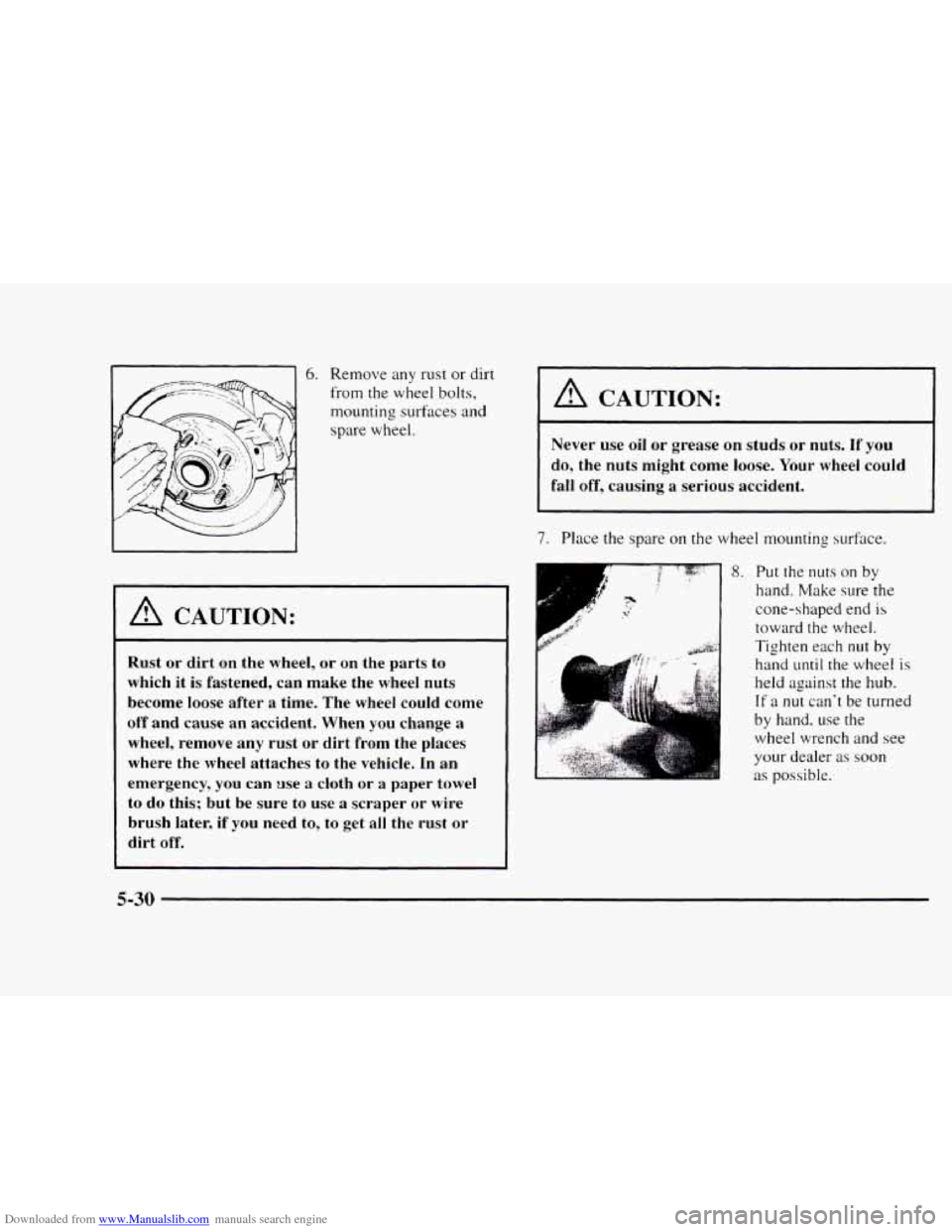
Downloaded from www.Manualslib.com manuals search engine 6. Remove' any rust or dirt
from
the wheel bolts,
mounting surfaces and
spare wheel.
A CAUTION:
Rust or dirt on the wheel, or on the parts to
which it
is fastened, can make the wheel nuts
become loose after
a time. The wheel could come
off and cause an accident. When
you change a
wheel, remove any rust or dirt from the places
where the wheel attaches to the vehicle. In an
emergency, you can use
a cloth or a paper towel
to do this; but be sure to use a scraper or wire
brush later, if
you need to, to get all the rust or
dirt off.
I A CAUTION:
~~
Never use oil or grease on studs or nuts. If you
do, the nuts might come loose. Your wheel could
fall off, causing a serious accident.
7. Place the spare on the wheel mounting surface.
8. Put the nuts on by
hand. Make sure the
cone-shaped end is
toward the wheel.
Tighten each nut by
hand until the wheel is
held against the hub.
If a nut can't be turned
by hand. use the
wheel wrench and see
your dealer as
soon
as possible.
5-30
Page 269 of 402
Downloaded from www.Manualslib.com manuals search engine A CAUTION:
Operating the engine with the air cleaner off can
cause you or others to be burned. The air cleaner
not only cleans the
air, it stops flame if the engine
backfires.
If it isn’t there, and the engine
backfires, you could be burned. Don’t drive with
it
off, and be careful working on the engine with
the air cleaner
off.
NOTICE:
If the air cleaner is off, a backfire can cause a
damaging engine fire. And, dirt can easily get
into your engine, which will damage
it. Always
have the air cleaner in place when you’re driving.
Automatic Transmission Fluid
When to Check and Change
A good time to check your automatic transmission fluid
level is when the engine oil is changed.
Change both the fluid and filter every
50,000 miles
(53 000 km) if the vehicle is mainly driven under one or
more
of these conditions:
In heavy city traffic where the outside temperature
regularly reaches
90°F (32°C) or higher.
In hilly or mountainous terrain.
When doing frequent trailer towing.
Uses such as found in taxi. police or delivery service.
If you do not use your vehicle under any of these
conditions, the fluid and filter
do not require changing.
See “Scheduled Maintenance Services”
in the Index.
6-14
Page 273 of 402
Downloaded from www.Manualslib.com manuals search engine Manual Transmission Fluid
When to Check
A good time to have it checked is when the engine oil is
changed. However, the fluid in your manual
transmission doesn't require changing.
How to Check
Because this operation can be a little difficult. you
rnay choose to have this done at your GM dealership
Service Department.
If you do it yourself. be sure to follow all the
instructions here, or
you could get a false reading.
I NOTICE:
i Too much or too little fluid can damage your
1 transmission. Too much can mean that some of
the fluid could come out and fall on hot engine
parts or exhaust system parts, starting a fire. Be
sure
to get an accurate reading if you check your
transmission fluid.
Check the fluid level only when your engine is off, the
vehicle
is parked on a level place and the transmission is
cool enough for
you to rest your fingers on the
transmission case.
Then. follow these steps:
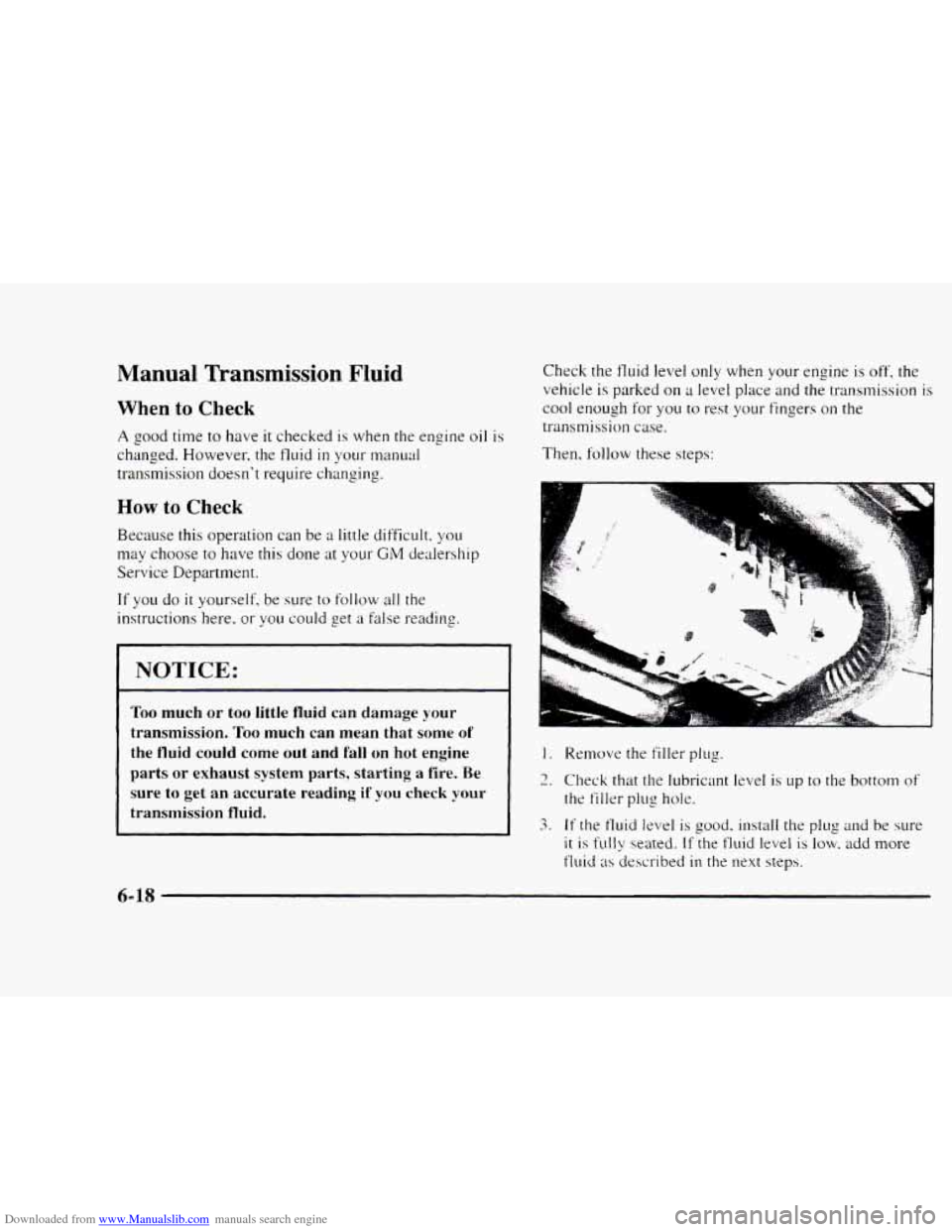
1. Remove the filler plug.
2. Check that the lubricant level is LIP to the bottom of
the filler plug hole.
3. If the fluid level is good. install the pl~~g md be sure
it is f~llly seated. If the fluid level is low. add more
fluid as described in the next steps.
6-18