Page 78 of 402
Downloaded from www.Manualslib.com manuals search engine Manual Transmission Operation
5-Speed
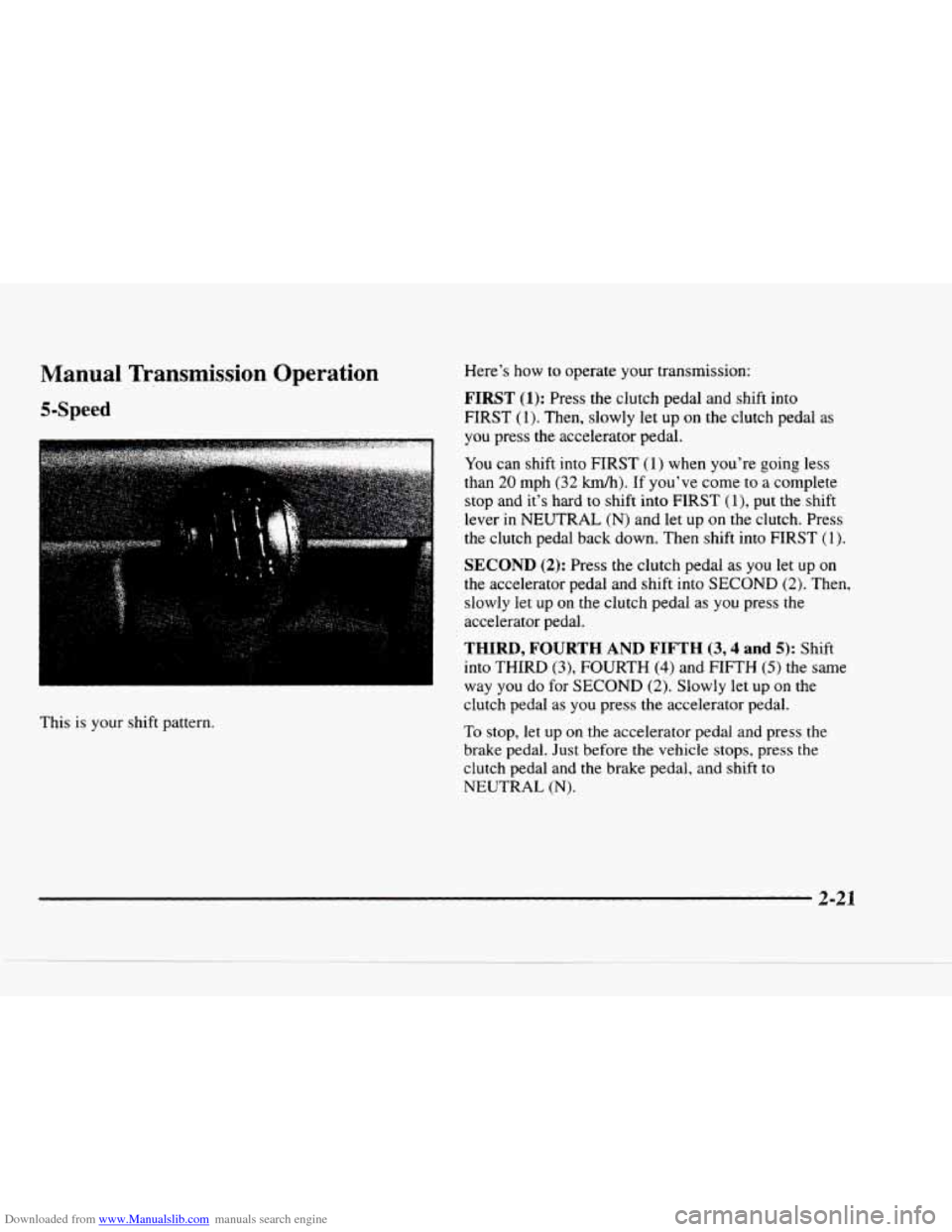
This is your shift pattern. Here’s
how to operate your transmission:
FIRST (1): Press the clutch pedal and shift into
FIRST
(1). Then, slowly let up on the clutch pedal as
you press the accelerator pedal.
You can shift into FIRST
(1) when you’re going less
than
20 mph (32 km/h). If you’ve come to a complete
stop and it’s hard to shift into FIRST
(1), put the shift
lever in NEUTRAL
(N) and let up on the clutch. Press
the clutch pedal back down. Then shift into
FIRST (1).
SECOND (2): Press the clutch pedal as you let up on
the accelerator pedal and shift into SECOND (2). Then,
slowly let up on the clutch pedal as you press the
accelerator pedal.
THIRD, FOURTH AND FIFTH (3,4 and 5): Shift
into THIRD
(3), FOURTH (4) and FIFTH (5) the same
way you do for SECOND (2). Slowly let up on the
clutch pedal as you press the accelerator pedal.
To stop, let up on the accelerator pedal and press the
brake pedal. Just before the vehicle stops, press
the
clutch pedal and the brake pedal, and shift to
NEUTRAL (N).
2-21
Page 79 of 402
Downloaded from www.Manualslib.com manuals search engine NEUTRAL (N): Use this position when you start or
idle your engine.
REVERSE (R): To back up, press the clutch pedal, wait
about six seconds, then shift into
REVERSE (R). Then
let up
on the clutch pedal slowly while pressing the
accelerator pedal.
NOTICE:
Shift to REVERSE (R) only after your vehicle
is stopped. Shifting to REVERSE (R) while
your vehicle is moving could damage
your transmission.
Use REVERSE (R), along with the parking brake, for
parking your vehicle.
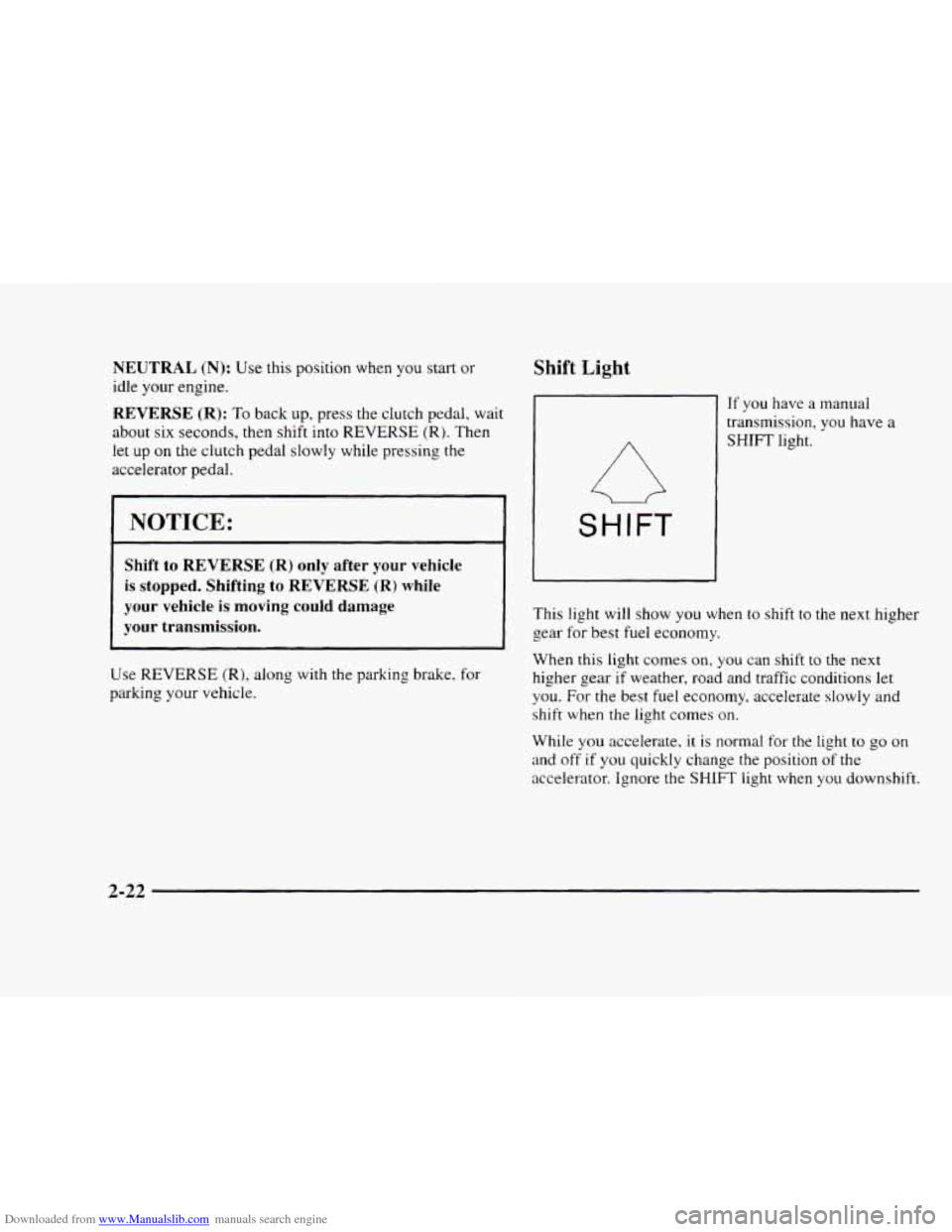
Shift Light
SHIFT
If you have a manual
transmission, you have
a
SHIFT light.
This light will show you when
to shift to the next higher
gear for best fuel economy.
When this light comes
on, you can shift to the next
higher gear if weather, road and traffic conditions let
you. For the best fuel economy, accelerate slowly and
shift when the light comes
on.
While you accelerate. it is normal for the light to go on
and off if you quickly change the position of the
accelerator. Ignore the SHIFT light when you downshift.
2-22
Page 81 of 402
Downloaded from www.Manualslib.com manuals search engine Manual Transfer Case
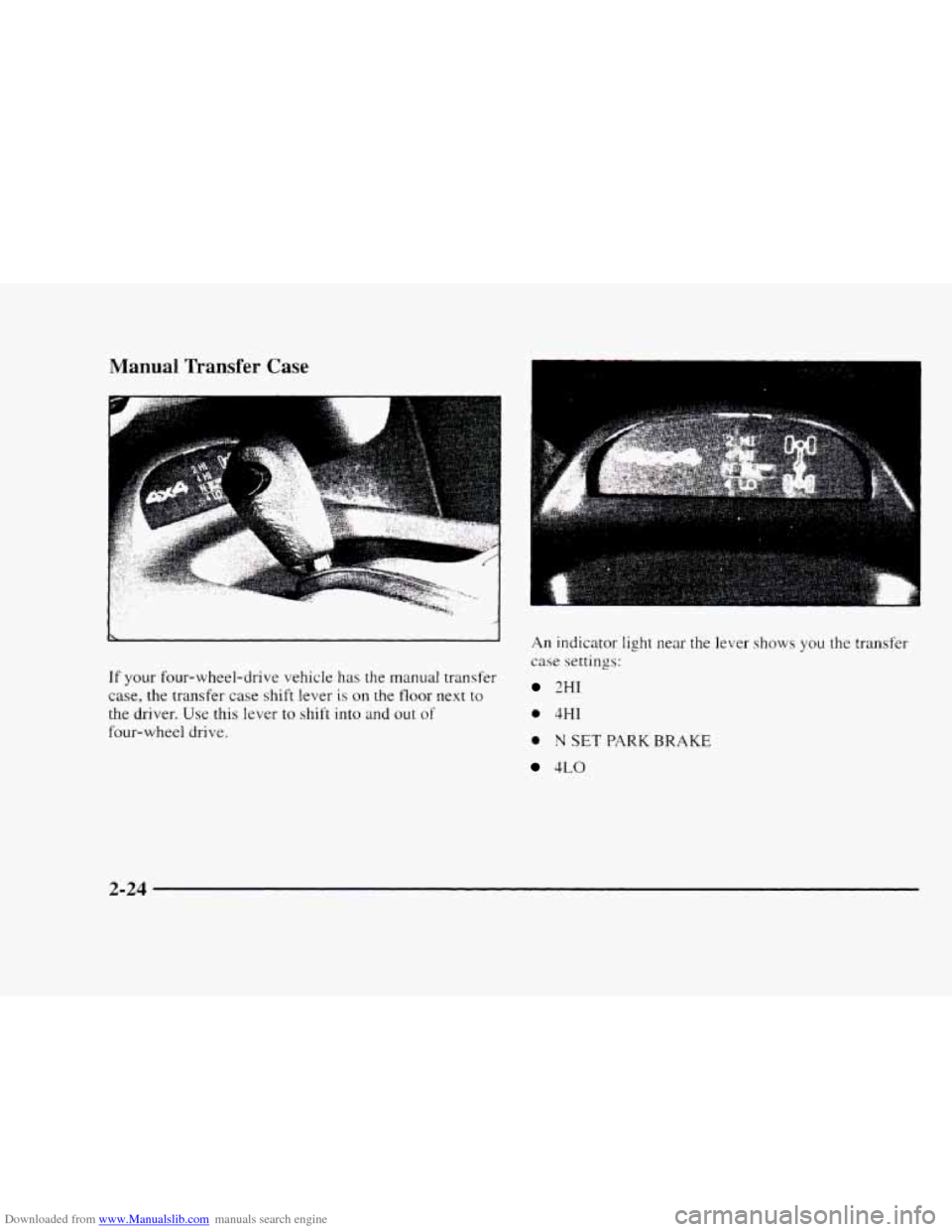
If your four-wheel-drive vehicle has the manual transfer
case,
the transfer case shift lever is on the floor next to
the driver. Use this lever to shift into and out of
four-wheel drive.
An indicator light near the lever shows you the transfer
case settings:
2HI
0 4HI
0 N SET PARK BRAKE
4LO
2-24
Page 82 of 402

Downloaded from www.Manualslib.com manuals search engine The front axle portion of the diagram on the indicator
will light up when you shift
into four-wheel drive. A
slight delay between shifting and the pattern’s lighting is
normal. If the pattern does not light up, or if the front
axle lights do not go out after you shift out of
four-wheel drive, have your dealer check your system.
Turn the INT LIGHTS switch located to the right of
your headlamp switch
to dim your transfer case
indicator light when your headlamps or parking lamps
are on. This will also cause your instrument panel lights
to dim.
2HI: This setting is for driving in most street and
highway situations. Your front axle is
not engaged in
two-wheel drive.
4HI: This setting engages your front axle to help
drive
your vehicle. Use 4HI when you need extra
traction, such as on snowy
or icy roads, or in most
off-road situations.
N SET PARK BRAKE: Shift to this neutral setting
only when your vehicle needs to be towed.
4LO: This setting also engages your front axle to give
you extra traction and provides extra gear reduction.
You may never need 4LO. It sends the maximum power
to all four wheels. You might choose 4LO if you were
driving off-road in sand, mud or deep snow and
climbing or descending steep hills.
You can shift from 2HI to 4HI or from 4HI to 2HI while
the vehicle is moving. Do not press the transfer case
shift lever button when shifting from 2HI
to 4HI or
from 4HI to 2HI.
To shift your transfer case into N SET PARK BRAKE:
1. Stop the vehicle and shift your transmission into
NEUTRAL
(N).
2. Set the parking brake. Your vehicle can roll unless
the brakes are applied.
3. Pull the transfer case shift lever into N SET
PARK BRAISE.
2-25
Page 83 of 402
Downloaded from www.Manualslib.com manuals search engine To shift into or out of 4LO:
1. The vehicle must be moving less than 3 mph
(4.8
kmh) with the transmission in NEUTRAL (N)
for an automatic transmission. For a manual
transmission, the clutch pedal must be engaged.
The preferred method for shifting into
or out of 4LO
is to have your vehicle moving 1 to 2 mph (1.6 to
3.2 km/h).
2. Press the transfer case shift button and shift in one
continuous motion.
Don't pause in
N SET PARK BRAKE as you shift into
or out
of 4L0, or your gears could clash.
Remember that driving
in 4HI or 4LO may reduce fuel
economy. Also. driving in four-wheel drive on dry
pavement could cause
your tires to wear faster and
make your transfer case harder to shift and reduce
powertrain longevity.
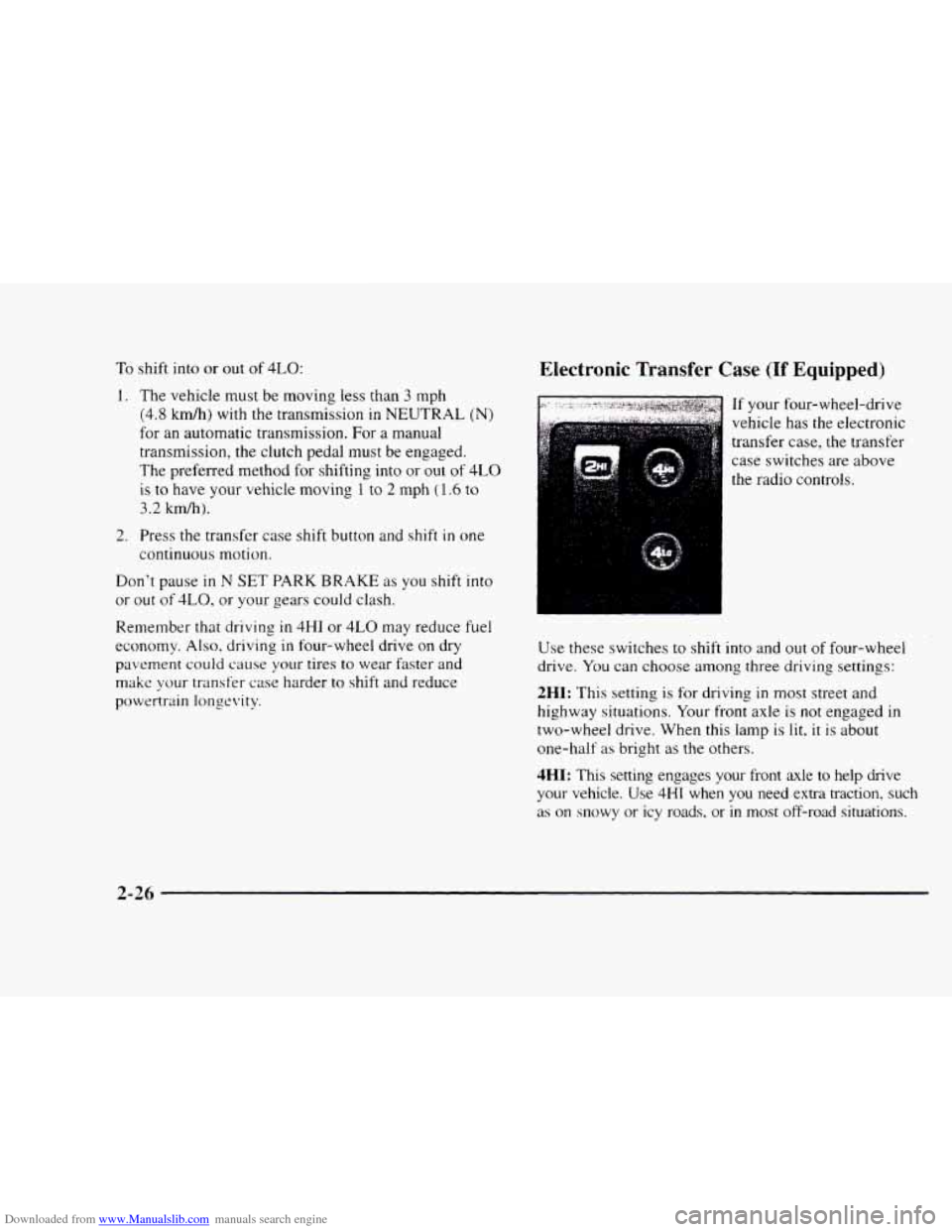
Electronic Transfer Case (U' Equipped)
. . ... If your four-wheel-drive
vehicle has the electronic
transfer case,
the transfer
case switches are above
Use these switches
to shift into and out of four-wheel
drive.
You can choose among three driving settings:
2HI: This setting is for driving in most street and
highway situations. Your front axle is not engaged in
two-wheel drive. When this lamp
is lit, it is about
one-half
as bright as the others.
4HI: This setting engages your front axle to help drive
your vehicle. Use
4HI when you need extra traction, such
as on snowy or icy roads, or in most off-road situations.
2-26
Page 86 of 402
Downloaded from www.Manualslib.com manuals search engine Parking Brake
To set the parking brake, hold the regular brake pedal
down with your right foot. Push down the parking brake
pedal with your left
foot. If the ignition is on, the brake
system warning light will come
on.
To release the parking brake hold the regular brake
pedal down.
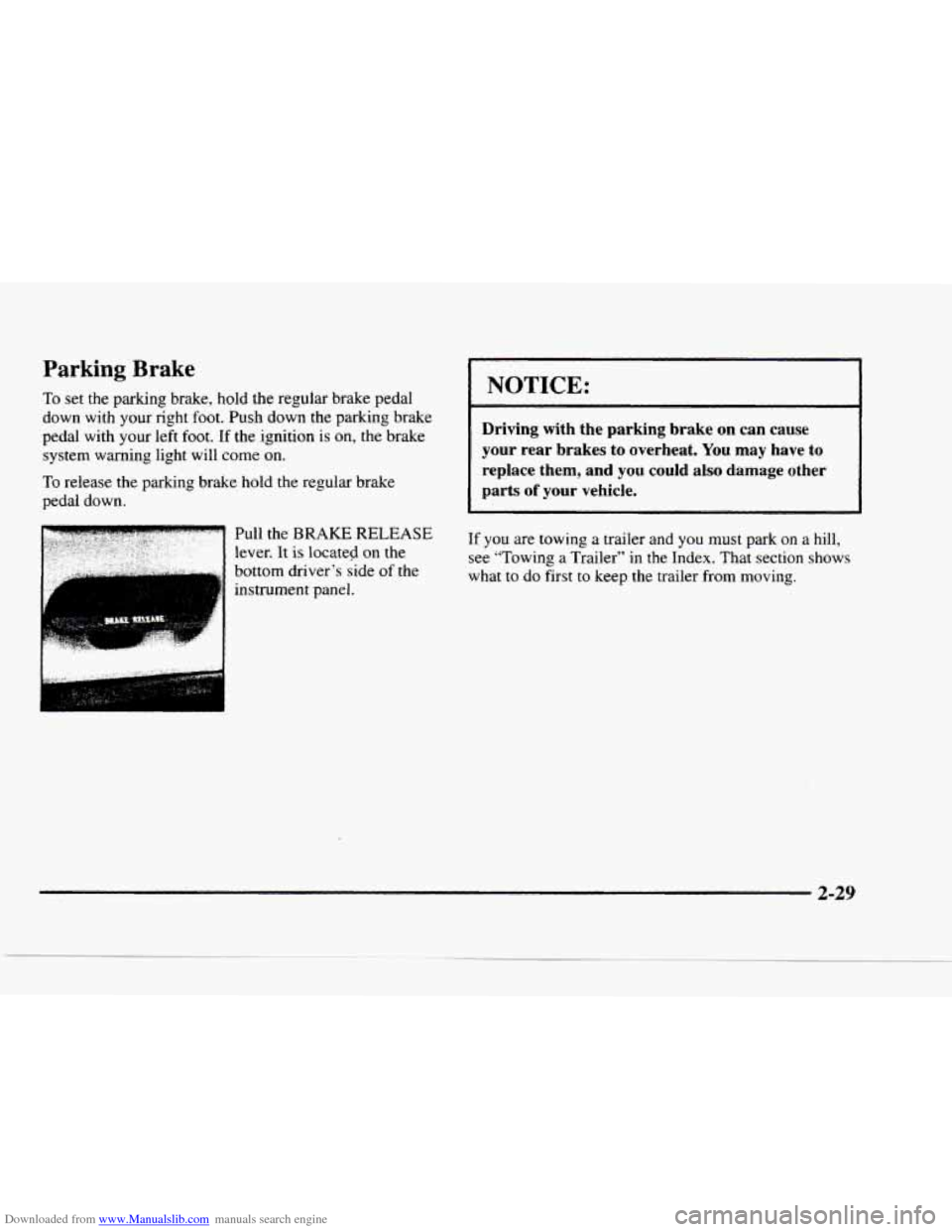
Pull the
BRAKE RELEASE
lever. It is located on the
bottom driver’s side
of the
instrument panel. ..
NOTICE:
r
Driving with the parking brake on can cause
your rear brakes to overheat.
You may have to
replace them, and you could also damage other
parts
of your vehicle.
If you are towing a trailer and you must park on a hill,
see “Towing a Trailer” in the Index. That section shows
what to do first to keep the trailer from moving.
2-29
Page 87 of 402
Downloaded from www.Manualslib.com manuals search engine Shifting Into PARK (P) (Automatic
Transmission
Models Only)
A CAUTION:
~~
It can be dangerous to get out of your vehicle .. ,. if I
the shift lever is not fully in PARK (P) with the
parking brake firmly set. Your vehicle can roll.
If you have left the engine running, the vehicle can
move suddenly. You
or others could be injured.
To be sure your vehicle won’t move, even when
you’re
on fairly level ground, use the steps that
follow.
If you have fourwheel drive with a manual
transfer case shift lever
and your transfer case is
in NEUTRAL (N), your vehicle will be free to roll,
even
if your shift lever is in PARK (P). So, be sure
the transfer case is in
a drive gear -- not in
NEUTRAL (N). If you’re pulling a trailer, see
“Towing a ’Iltailer” in the Index.
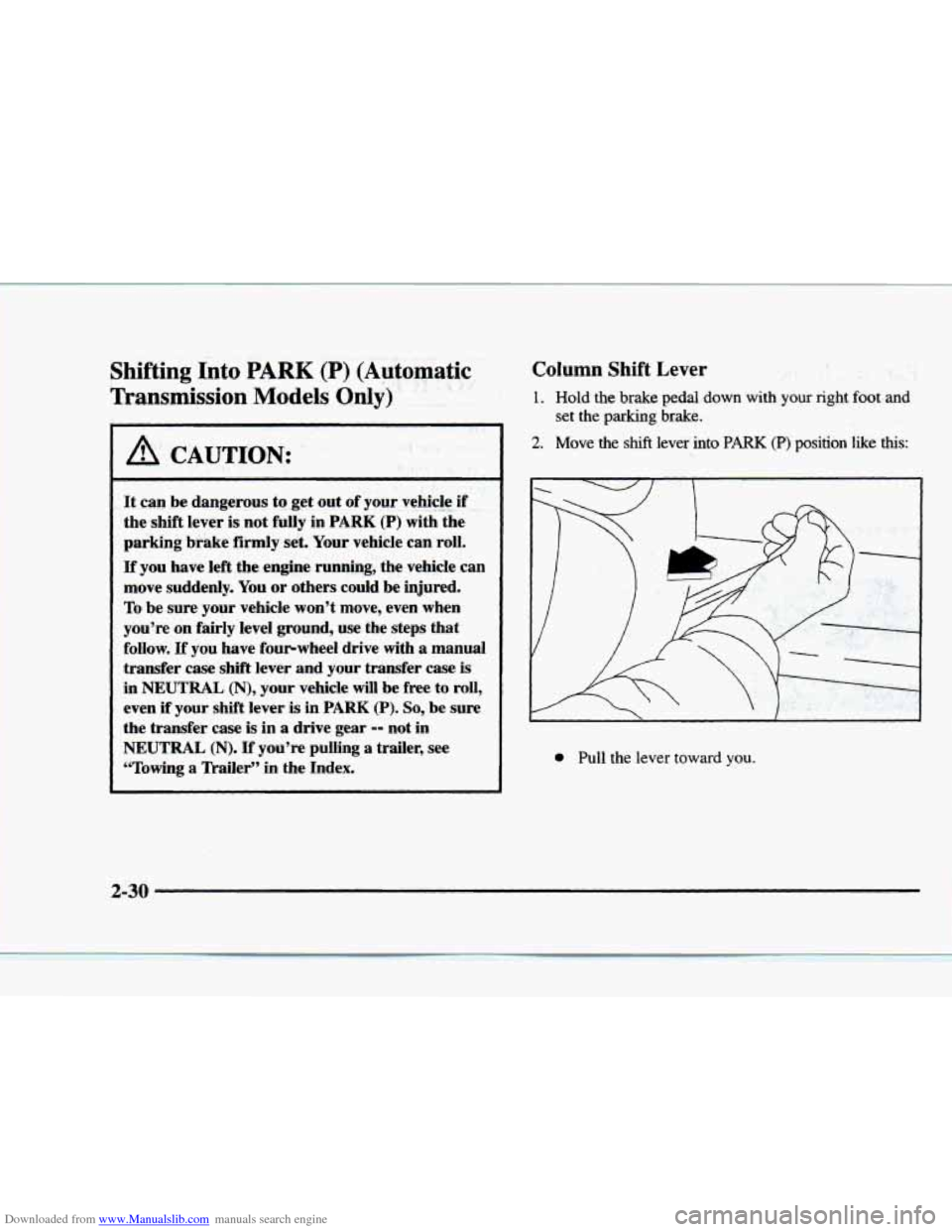
Column Shift Lever
1. Hold the brake pedal down with your right foot and
2. Move the shift lever into PARK (P) position ‘like this:
set the parking brake.
0 Pull the lever toward you.
2-30
Page 88 of 402
Downloaded from www.Manualslib.com manuals search engine F
3.
4.
5.
0 Move the lever up as far as it will go.
If you have four-wheel drive with a manual transfer
case shift lever, be sure the transfer case
is in a drive
gear
-- not in NEUTRAL (N).
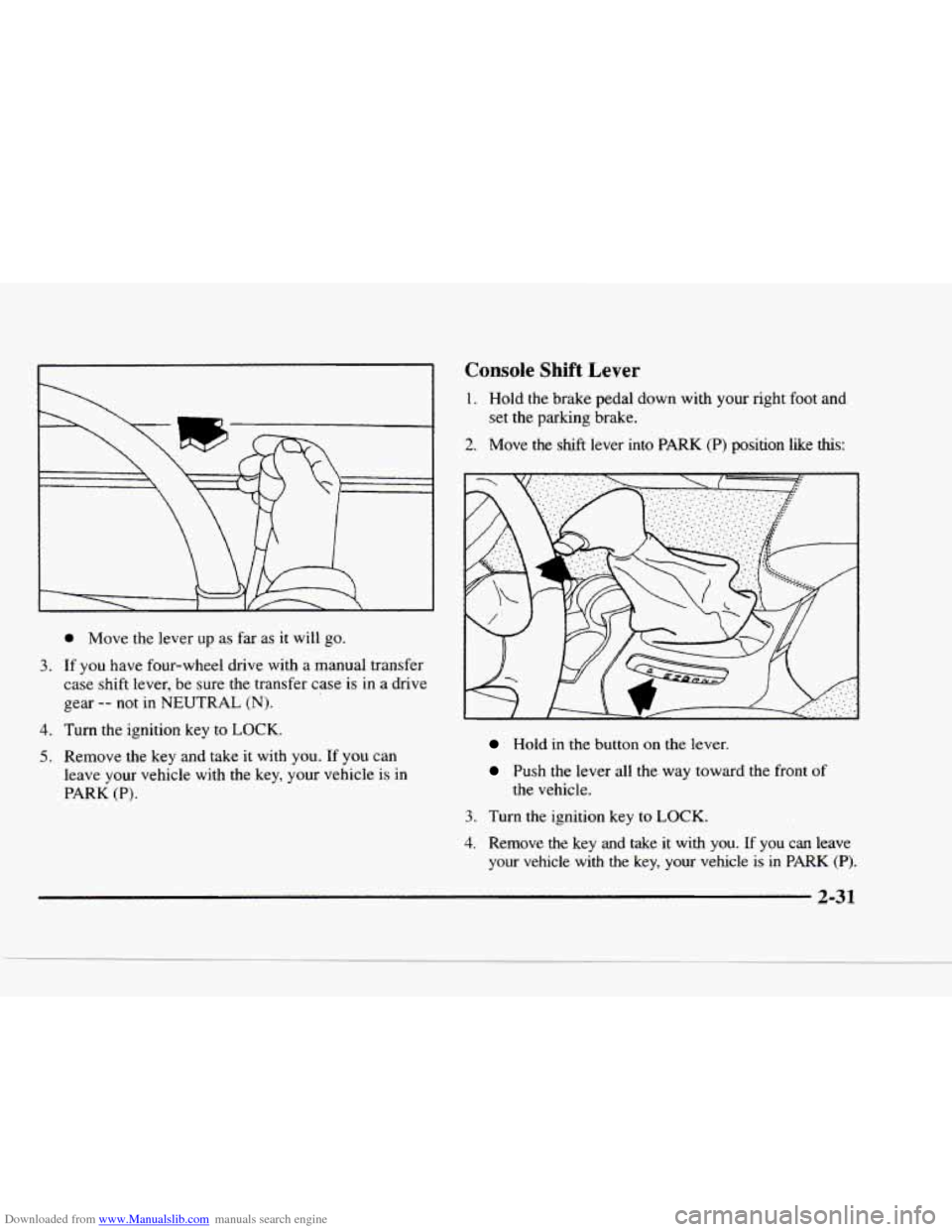
Console Shift Lever
1. Hold the brake pedal down with your right foot and
set
the parking brake.
2. Move the shtft lever into PARK (P) position like this:
Turn the ignition key to LOCK.
Remove the key and take it with you. If you can
leave your vehicle with
the key, your vehicle is in
PARK (P).
Hold in the button on the lever.
Push the lever all the way toward the front of
the vehicle.
3. Turn the ignition key to LOCK.
4. Remove the key and take it with you. If you can leave
your vehcle with the key, your vehicle
is in PARK (P).