Page 91 of 404
Downloaded from www.Manualslib.com manuals search engine Starting Your Engine
Move your shift lever to PARK (P) or NEUTRAL (N).
Your engine won’t start in any other position -- that’s a
safety feature.
To restart when you’re already moving,
use NEUTRAL
(N) only.
NOTICE:
Don’t try to shift to PARK (P) if your vehicle
is moving.
If you do, you could damage the
transmission. Shift
to PARK (P) only when
your vehicle is stopped.
1. Without pushing the accelerator pedal, turn your
ignition key to START. When the engine starts, let
go
of the key. The idle speed will go down as your
engine gets warm.
NOTICE:
Holding your key in START for longer than
15 seconds at a time will cause your battery to
be drained much sooner. And the excessive heat
can damage your starter motor.
2. If it doesn’t start right away, hold your key in
START. If it doesn’t start in 10 seconds, push the
accelerator pedal all the way down for five more
seconds, or until it starts.
2-17
Page 94 of 404

Downloaded from www.Manualslib.com manuals search engine REVERSE (R): Use this gear to back up.
Don’t leave your vehicle when the engine is
running unless you have to.
If you have left the
engine running, the vehicle can move suddenly.
You or others could be injured.
To be sure your
vehicle won’t move, even when you’re on fairly
level ground, always set your parking brake anc
move the shift lever to
PARK (P).
See “Shifting Into PARK (P)” in the Index. If
you’re pulling
a trailer, see “Towing a Trailer”
in the Index.
Ensure the shift lever is
fully in PARK (P)
before starting the engine. Your vehicle has a
brake-transmission shift interlock.
You have to fully
apply your regular brakes before you can shift from
PARK
(P) when the ignition key is in the RUN position.
If you cannot shift out
of PARK (P), ease pressure on
the shift lever
-- push the shift lever all the way into
PARK
(P) as you maintain brake application. Then
move the shift lever into the gear
you wish. See
“Shifting Out of PARK (P)” in this section.
NOTICE:
Shifting to REVERSE (R) while your vehicle is
moving forward could damage your
transmission. Shift to
REVERSE (R) only after
your vehicle is stopped.
To rock your vehicle back and forth to get out of snow,
ice or sand without damaging your transmission, see
“Stuck: In Sand, Mud, Ice or Snow” in the Index.
2-20
Page 97 of 404
Downloaded from www.Manualslib.com manuals search engine Parking Brake
To set the parking brake, hold the regular brake pedal
down with your right foot.
Push down the parking brake pedal with your left foot.
If the ignition is
on, the brake system warning light will
come
on.
To release the parking brake, hold the regular brake
pedal down. Pull the brake release lever located on the
lower
left side of the steering column.
I NOTICE:
Driving with the parking brake on can cause
your rear brakes to overheat. You may have to
replace them, and you could also damage other
parts
of your vehicle.
If you are towing a trailer and are parking on any hill,
see “Towing a Trailer’’ in the Index. That section shows
what
to do first to keep the trailer from moving.
2-23
Page 99 of 404
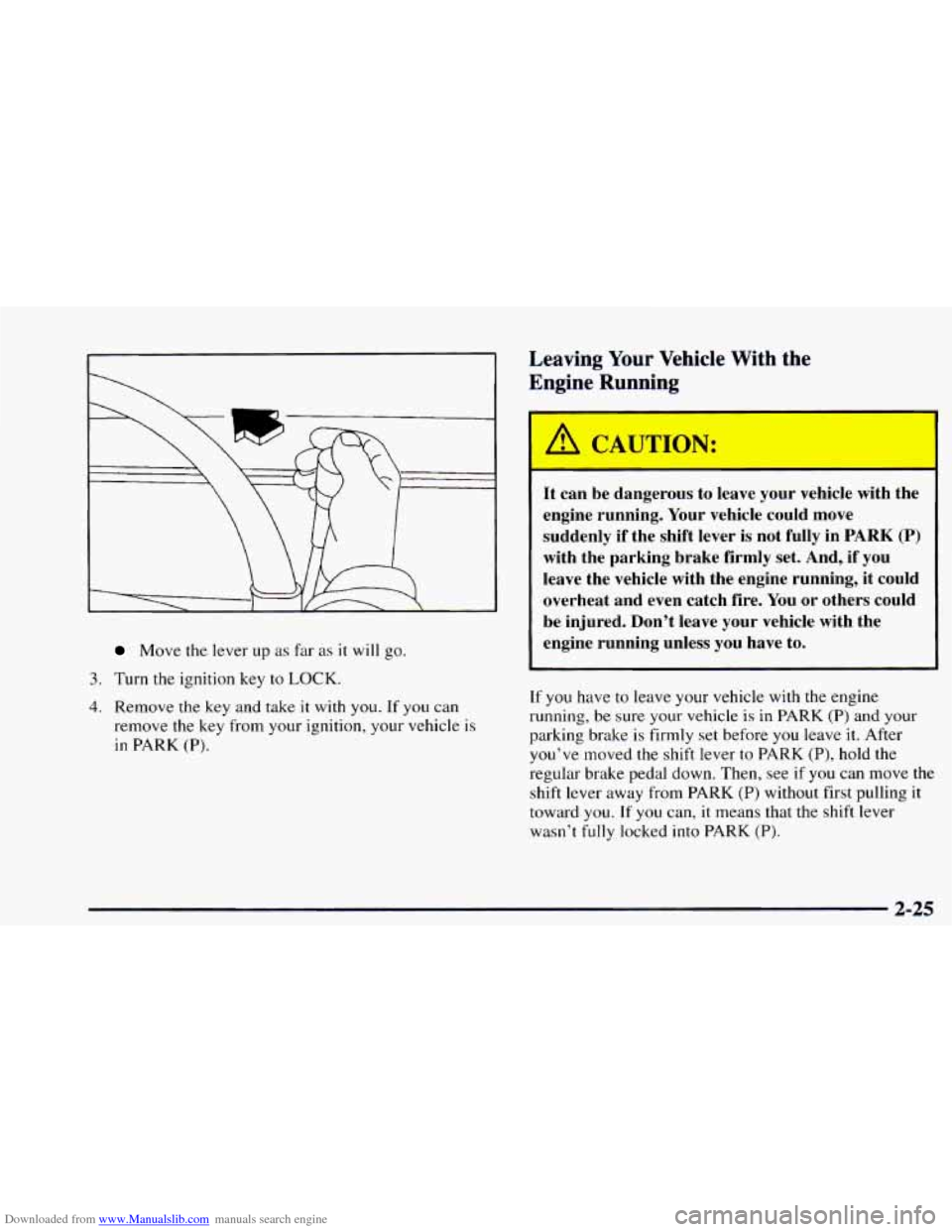
Downloaded from www.Manualslib.com manuals search engine Move the lever up as far as it will go.
3. Turn the ignition key to LOCK.
4. Remove the key and take it with you. If you can
remove the key from your ignition, your vehicle is
in PARK
(P).
Leaving Your Vehicle With the
Engine Running
It can be dangerous to leave your vehicle with the
engine running. Your vehicle could move
suddenly if the shift lever is not fully in
PARK (P)
with the parking brake firmly set. And, if you
leave the vehicle with the engine running, it could
overheat and even catch fire. You
or others could
be injured. Don’t leave your vehicle with the
engine running unless you have to.
If you have to leave your vehicle with the engine
running, be sure your vehicle
is in PARK (P) and your
parking brake
is firmly set before you leave it. After
you’ve moved the shift lever to PARK (P), hold the
regular brake pedal down. Then, see if
you can move the
shift lever away from
PARK (P) without first pulling it
toward you. If you can, it means that the shift lever
wasn’t
fully locked into PARK (P).
2-25
Page 100 of 404
Downloaded from www.Manualslib.com manuals search engine Torque Lock
If you are parking on a hill and you don’t shift your
transmission into PARK (P) properly, the weight of the
vehicle may put too much force on
the parking pawl in
the transmission. You may find it difficult to pull the
shift lever out of PARK (P). This is called “torque lock.”
To prevent torque lock, set the parking brake and then
shift into PARK (P) properly before you leave the
driver’s seat. To find out how, see “Shifting Into
PARK
(P)” in the Index.
When
you are ready to drive, move the shift lever out
of PARK (P) before you release the parking brake.
If torque lock does occur, you may need to have another
vehicle push yours
a little uphill to take some of the
pressure from
the parking pawl in the transmission,
so you can pull the shift lever out of PARK (P).
Shifting Out of PARK (P)
Your vehicle has a brake-transmission shift interlock.
You have to fully apply your regular brake before
you can shift from PARK (P) when
the ignition is in
the
RUN position. See “Automatic Transmission” in
the Index.
If you cannot shift out
of PARK (P), ease pressure on
the shift lever
-- push the shift lever all the way into
PARK (P) as you maintain brake application. Then
move the shift lever into the gear
you want.
If you ever hold the brake pedal down but still can’t
shift out of PARK
(P), try this:
I. Turn the key to OFF.
2. Apply and hold the brake until the end of Step 4.
3. Shift to NEUTRAL (N).
4. Start the vehicle and then shift to the drive gear
you want.
5. Have the vehicle fixed as soon as you can.
2-26
Page 103 of 404
Downloaded from www.Manualslib.com manuals search engine Windows
Manual Windows
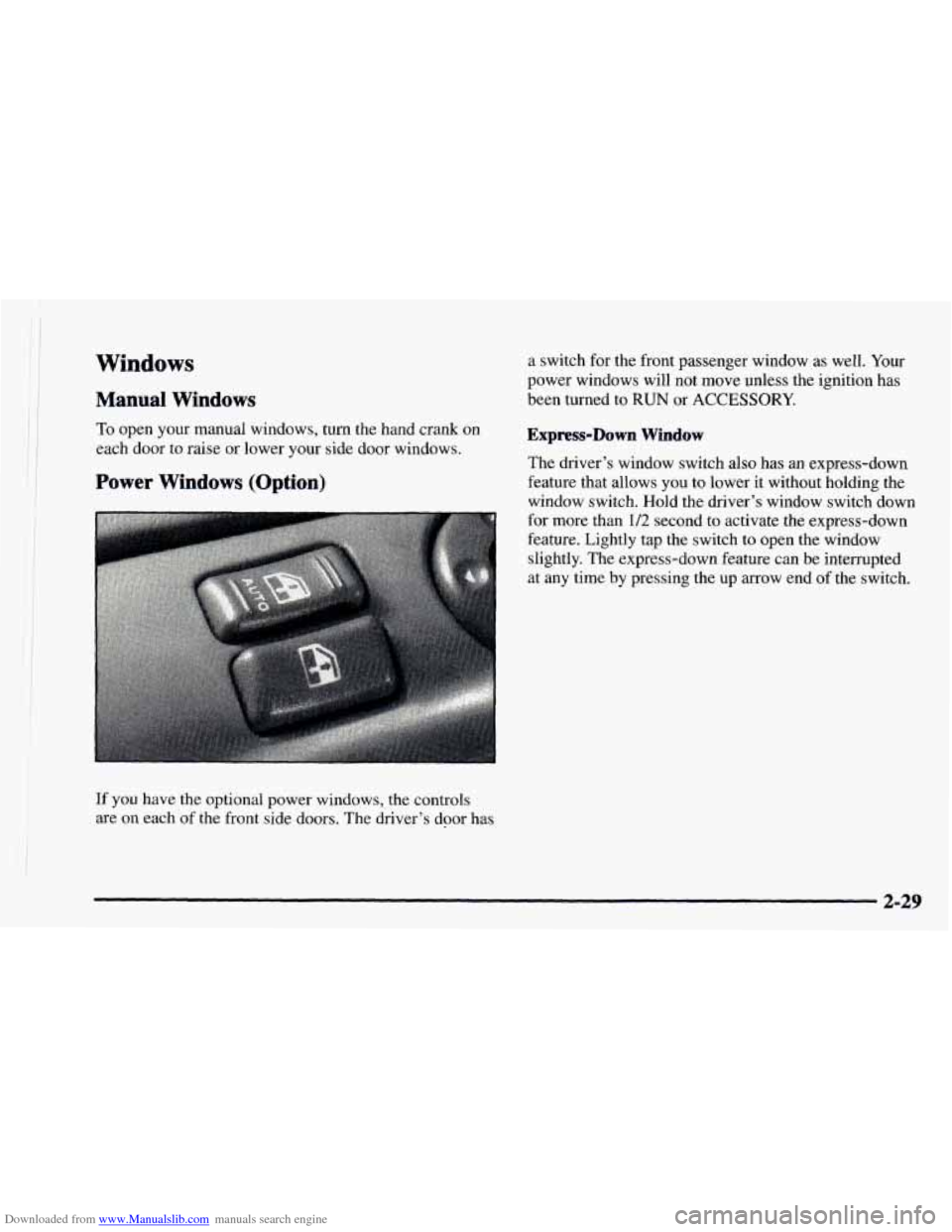
To open your manual windows, turn the hand crank on
each door to raise or lower your side door windows.
Power Windows (Option)
a switch for the front passenger window as well. Your
power windows will not move unless the ignition has
been turned to
RUN or ACCESSORY.
Express-Down Window
The driver's window switch also has an express-down
feature that allows you to lower it without holding the
window switch. Hold the driver's window switch down
for more than
1/2 second to activate the express-down
feature. Lightly tap the switch to open the window
slightly. The express-down feature can be interrupted
at any time by pressing the up arrow end of the switch.
If
you have the optional power windows, the controls
are on each of the front side doors. The driver's door has
2-29
Page 111 of 404
Downloaded from www.Manualslib.com manuals search engine Passing Another Vehicle Wh’- bing Cruise Control
Use the accelerator pedal to increase your speed. When
you take your foot off the pedal, your vehicle will slow
down
to the cruise control speed you set earlier.
Using Cruise Control on Hills
How well your cruise control will work on hills depends
upon your speed, load and the steepness
of the hills.
When going up steep hills,
you may want to step on the
accelerator pedal to maintain your speed. When going
downhill,
you may have to brake or shift to a lower gear
to keep your speed down. Of course, applying the brake
takes
you out of cruise control. Many drivers find this
to be too much trouble and don’t use cruise control on
steep hills.
Ending Cruise Control
There are two ways to turn off the cruise control:
Step lightly on the brake pedal.
0 Move the cruise switch to OFF.
Erasing Speed Memory
When you turn off the cruise control or the ignition,
your cruise control set speed memory
is erased.
Lamps
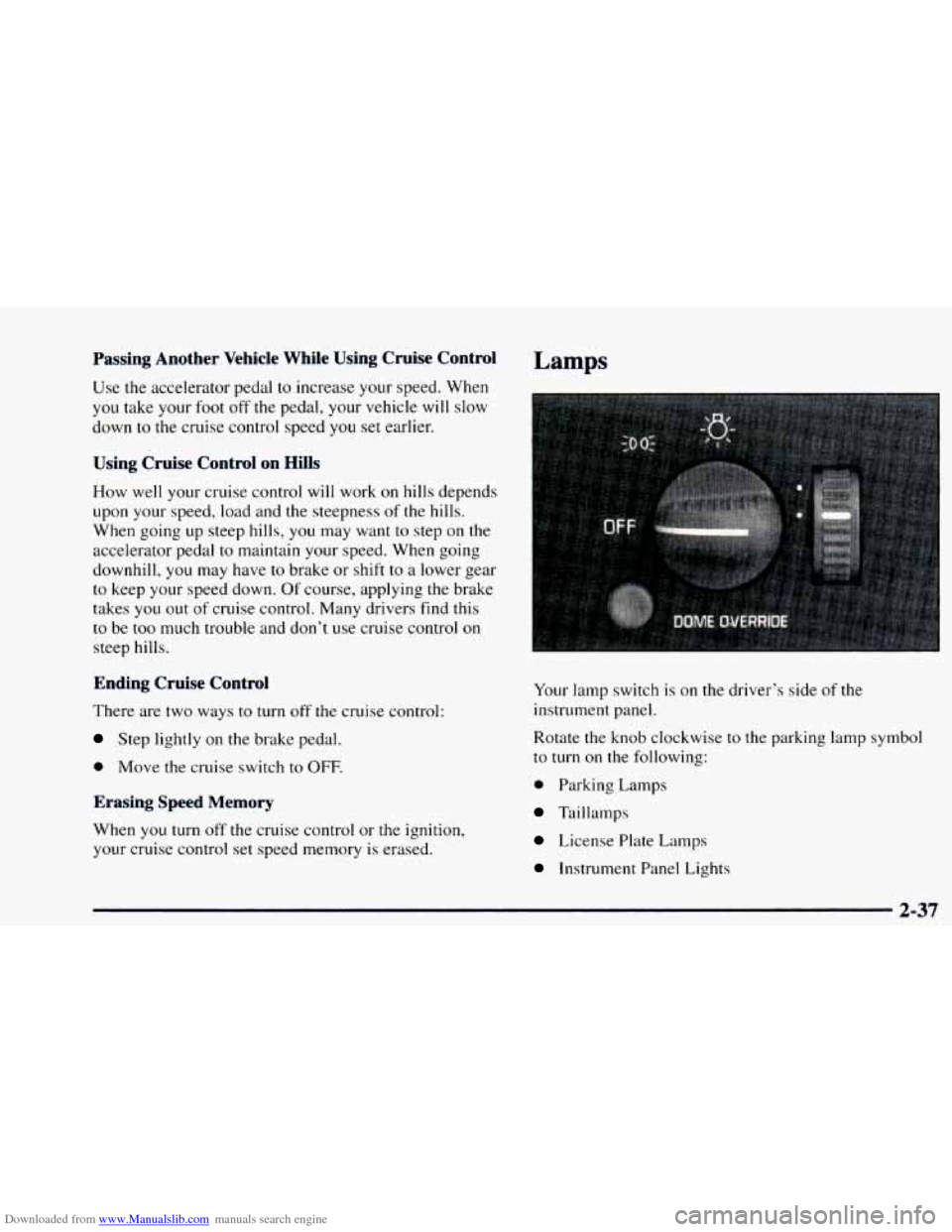
Your lamp switch is on the driver’s side of the
instrument panel.
Rotate
the knob clockwise to the parking lamp symbol
to turn on the following:
0 Parking Lamps
Taillamps
License Plate Lamps
Instrument Panel Lights
2-37
Page 112 of 404

Downloaded from www.Manualslib.com manuals search engine Rotate the knob clockwise again to the master
lighting symbol
to turn on all the lamps listed as
well as the headlamps.
Rotate the knob counterclockwise
to OFF to turn off
your lamps.
Rotate the dial next to the knob up
to adjust your
instrument panel lights. Rotate the dial up
to the first
notch for full intensity.
If you rotate the dial to the
second notch, your interior lamps will come on.
Rotate the dial next to the lamp switch down
to dim
your instrument panel lights.
Headlamps
You can switch your headlamps from high to low beam
by pulling the multifunction lever toward
you.
A circuit breaker protects your headlamps. If you have
an electrical overload, your headlamps will flicker on
and off. Have your headlamp wiring checked right away
if this happens.
Headlamps On Reminder
A reminder tone will sound when your headlamps or
parking lamps are turned on and your ignition is
in the
OFF, LOCK or ACCESSORY position. To turn the tone
off, turn the switch to
OFF.
Daytime Running Lamps
Daytime Running Lamps (DRL) can make it easier
for others
to see the front of your vehicle during the
day. DRL can be helpful in many different driving
conditions, but they can be especially helpful
in the
short periods after dawn and before sunset.
The DRL system will make your headlamps come
on at
a reduced brightness when:
0 the ignition is on,
0 the headlamp switch is off and
0 the parking brake is released.
2-38