Page 3 of 404
Downloaded from www.Manualslib.com manuals search engine The 1997 Chevrolet Astro Owner’s Manual
1-1
2-1
3- 1
4-1
5- 1
6-1
7-1
8-1
9- 1
Seats and Restraint Systems
This section tells you how to use your seats and safety belts properly. It also explains the “SIR’ system.
Features and Controls
This section explains how to start and operate your vehicle.
Comfort Controls and Audio Systems
This section tells you how to adjust the ventilation and comfort controls and how to operate your audio system.
Your Driving and the Road
Here you’ll find helpful information and tips about the road and how to drive under different conditions.
Problems on the Road
This section tells what to do if you have a problem while driving, such as a flat tire or overheated engine, etc.
Service and Appearance Care
Here the manual tells you how to keep your vehicle running properly and looking good.
Maintenance Schedule
This section tells you when to perform vehicle maintenance and what fluids and lubricants to use.
Customer Assistance Information
This section tells you how to contact Chevrolet for assistance and how to get service and owner publications.
It
also gives you information on “Reporting Safety Defects” on page 8-10.
Index
Here’s an alphabetical listing of almost every subject in this manual. You can use it to quickly find
something you want to read.
i
Page 9 of 404
Downloaded from www.Manualslib.com manuals search engine Section 1 Seats and Restraint Systems
Here you’ll find information about the seats in your vehicle and how to use your safety belts properly. You can also
learn about some things
you should not do with air bags and safety belts.
1-2
1-12
1-17
1-18
1-18
1-26 1-27
1-27
1-34
Seats and Seat Controls
Safety Belts: They’re for Everyone
Here Are Questions Many People
Ask
About Safety Belts -- and the Answers
How to Wear Safety Belts Properly
Driver Position Safety Belt Use During Pregnancy
Right Front Passenger Position
Supplemental Inflatable Restraint (SIR)
System
Rear Seat Passengers
1-37
1-39
1-41
1-44
1-53
1-62
1-65
1-65
1-66 Rear Safety
Belt Comfort Guides
for
Children and Small Adults
Center Passenger Position
(Bench Seat)
Children
Built-in Child Restraint (Option)
Child Restraints
Larger Children
Safety Belt Extender
Checking Your Restraint Systems
Replacing Restraint System Parts After a
Crash
Page 10 of 404
Downloaded from www.Manualslib.com manuals search engine Seats and Seat Controls
This section tells you about the seats -- how to adjust
them, take them
out and put them back in. It also tells
you about bucket and bench seats, power seats and
head restraints.
Mant-1 Front Seats
You can lose control of the v icle if you try to
adjust a manual driver’s seat while the vehicle is
2-Way Front Seat
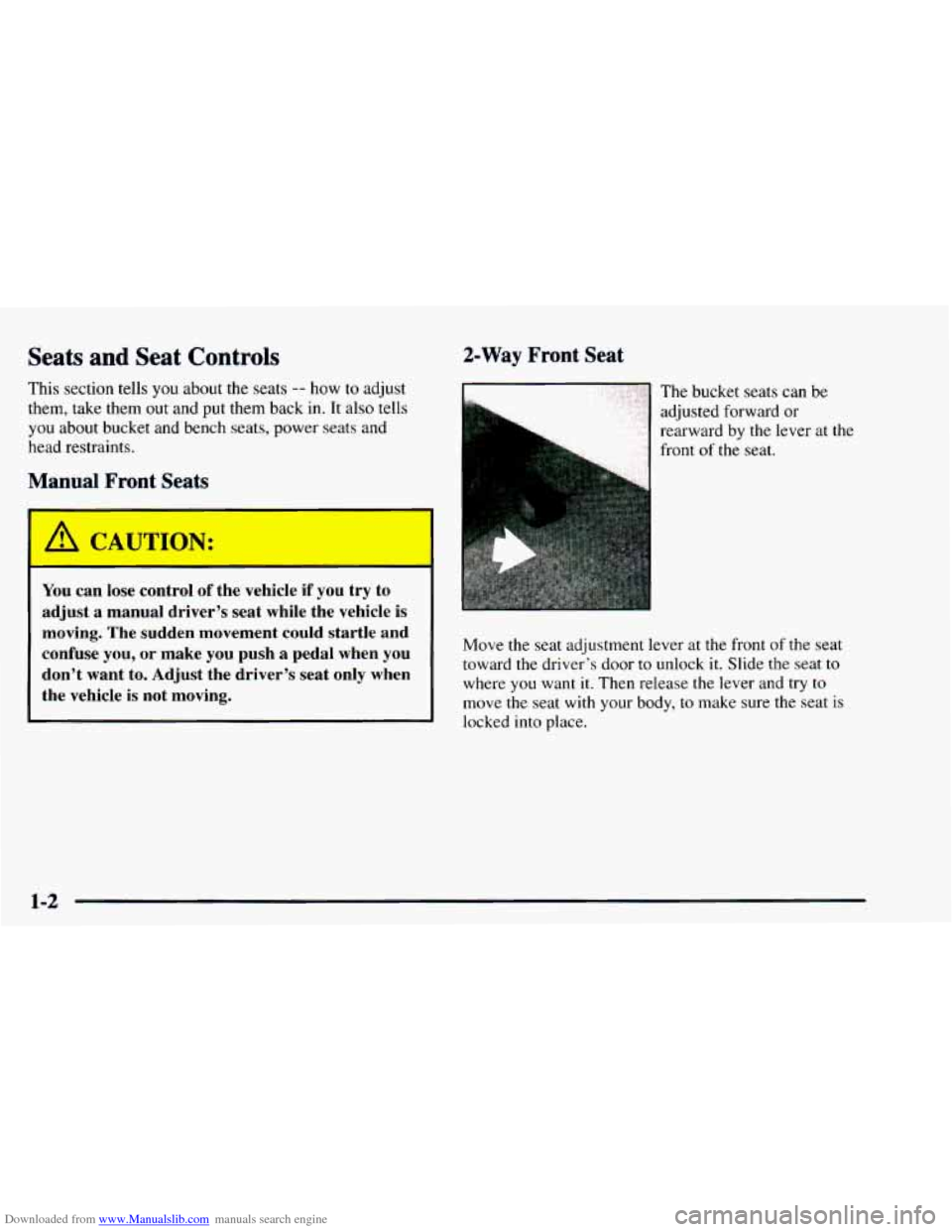
The bucket seats can be
adjusted forward or
rearward by the lever at
the
front of the seat.
moving. The sudden movement could startle and
confuse you, or make you push a pedal when you
don’t want to. Adjust the driver’s seat only when the vehicle is not moving. Move the seat adjustment lever at the front of the seat
toward
the driver’s door to unlock it. Slide the seat to
where you want it. Then release the lever and try to
move the seat with your body, to make sure the seat is
locked into place.
1-2
Page 11 of 404
Downloaded from www.Manualslib.com manuals search engine Manual Lumbar Support (If Equipped) Power Seats (If Equipped)
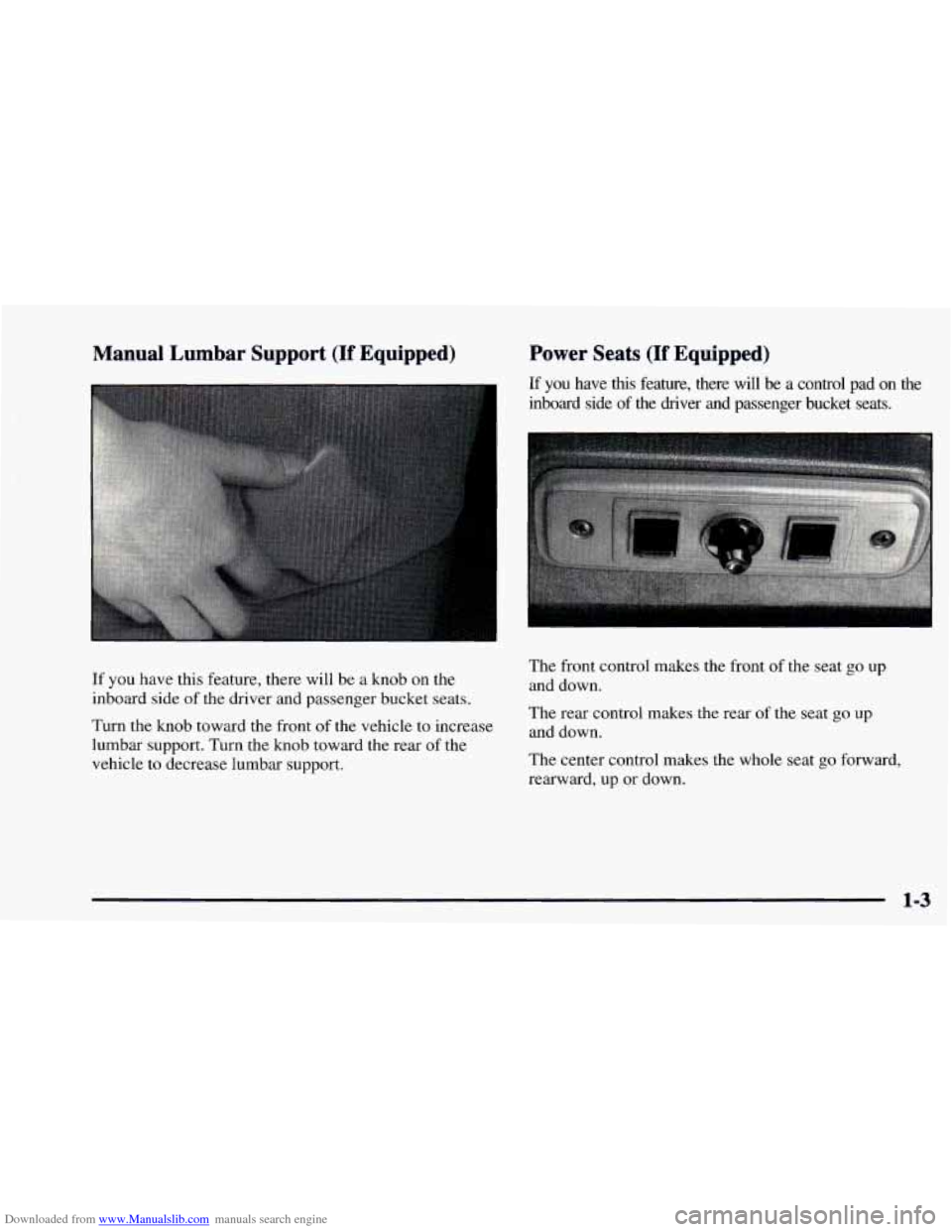
If you have this feature, there will be a control pad on the
inboard side
of the driver and passenger bucket seats.
If you have this feature, there will be a
knob on the
inboard side
of the driver and passenger bucket seats.
Turn the knob toward the front
of the vehicle to increase
lumbar support. Turn the knob toward the rear
of the
vehicle to decrease lumbar support. The
front control makes the front
of the seat go up
and down.
The rear control makes
the rear of the seat go up
and down.
The center control makes the whole seat
go forward,
rearward, up or down.
1-3
Page 13 of 404
Downloaded from www.Manualslib.com manuals search engine I-
up, your safety belts can’t do their job when
you’re reclined like this. The shoulder belt can’t do its job because it
won’t be against your body. Instead, it
will be in
front of you. In a crash you could
go into it,
receiving neck or other injuries.
The lap belt can’t
do its job either. In a crash the
belt could
go up over your abdomen. The belt
forces would be there, not at your pelvic bones.
This could cause serious internal injuries.
For proper protection when the vehicle is in
motion, have the seatback upright. Then sit well
back in the seat and wear your safety belt properly.
Head Restraints
Head restraints are fixed on some models and adjustable
on others. Slide an adjustable head restraint up or down
so that the top of the restraint is closest to the top of
your ears. This position reduces the chance of a neck
injury
in a crash.
Seatback Latches (Non-Touring
Bench Seats)
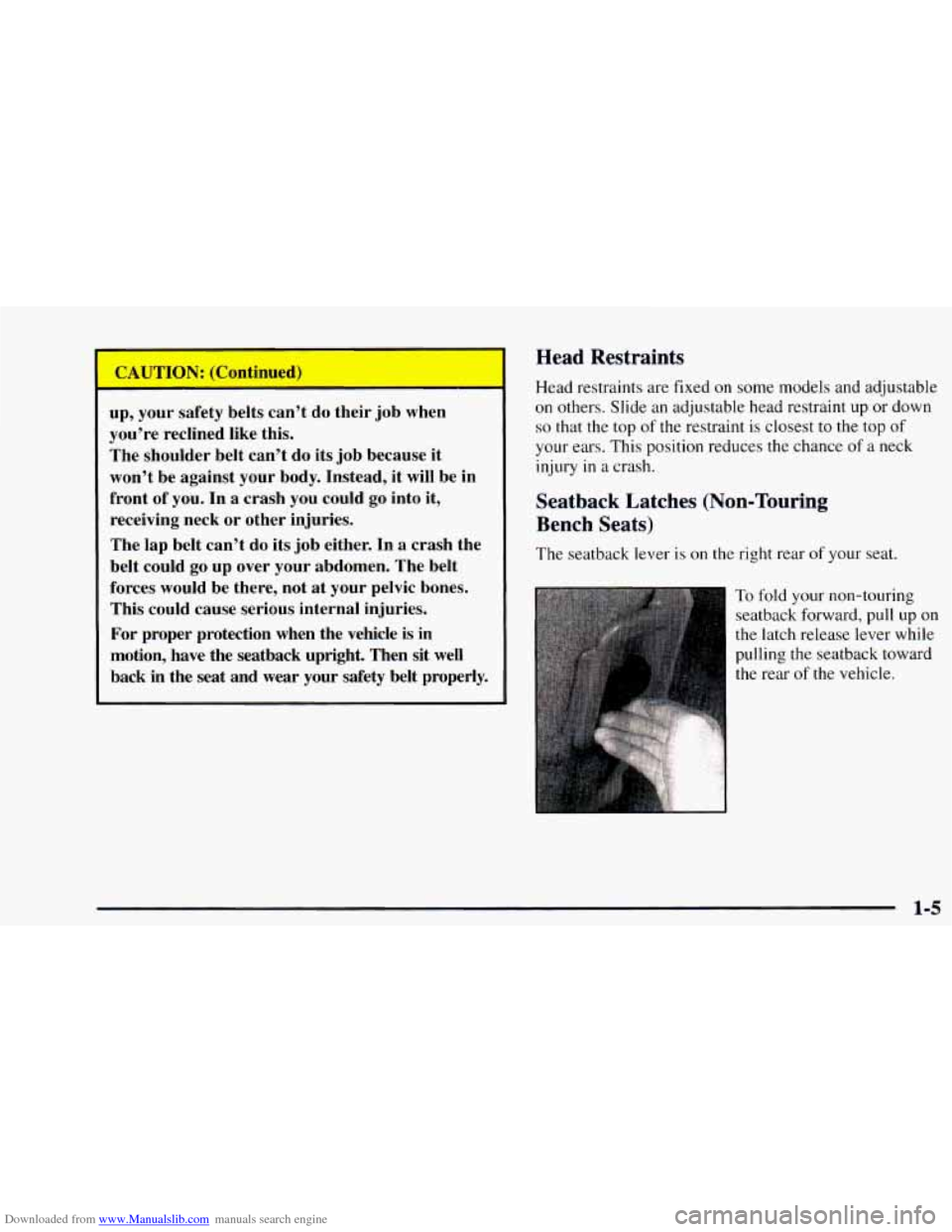
The seatback lever is on the right rear of your seat.
To fold your non-touring
seatback forward, pull
up on
the latch release lever while
pulling the seatback toward
the rear of
the vehicle.
Page 14 of 404

Downloaded from www.Manualslib.com manuals search engine After the latch has been released, push the seatback
toward the front
of the vehicle until it locks in place. To
raise the seatback, unlock the seatback latch by pushing
up on the lever while pushing down on the upper edge
of the seatback. Move the seatback into the upright
position. Make sure
the seatback is locked when it is
bacl 1 th lpright position.
A CAUTION:
If the seatback isn’t locked, it could move
forward in
a sudden stop or crash. That could
cause injury to the person sitting there. Always
press rearward
on the seatback to be sure it
is locked.
Rear Seats
A CAUTION:
A seat that isn’t locked into place properly can
move around
in a collision or sudden stop. People
in the vehicle could be injured. Be sure to lock
the seat into place properly when installing it.
A CAUTION:
- I
A safety belt that is twisted or not properly
attached won’t provide the protection needed in
a
crash. The person wearing the belt could be
seriously injured. After installing the seat, always
check to be sure that the safety belts are not
twisted and are properly attached.
1-6
Page 15 of 404
Downloaded from www.Manualslib.com manuals search engine Bucket Seats
If you have rear bucket seats in your vehicle, they will
recline and adjust the same way as the front manual
bucket seats. See “Reclining Seatbacks” earlier
in this
section or
in the Index.
Bench Seats
If you have bench seats in your vehicle, each seat can
carry up to three passengers. They can also be removed
to increase storage space.
The center bench (if not equipped with
a built-in child
restraint) and rear bench seats can be adjusted forward
or rearward by
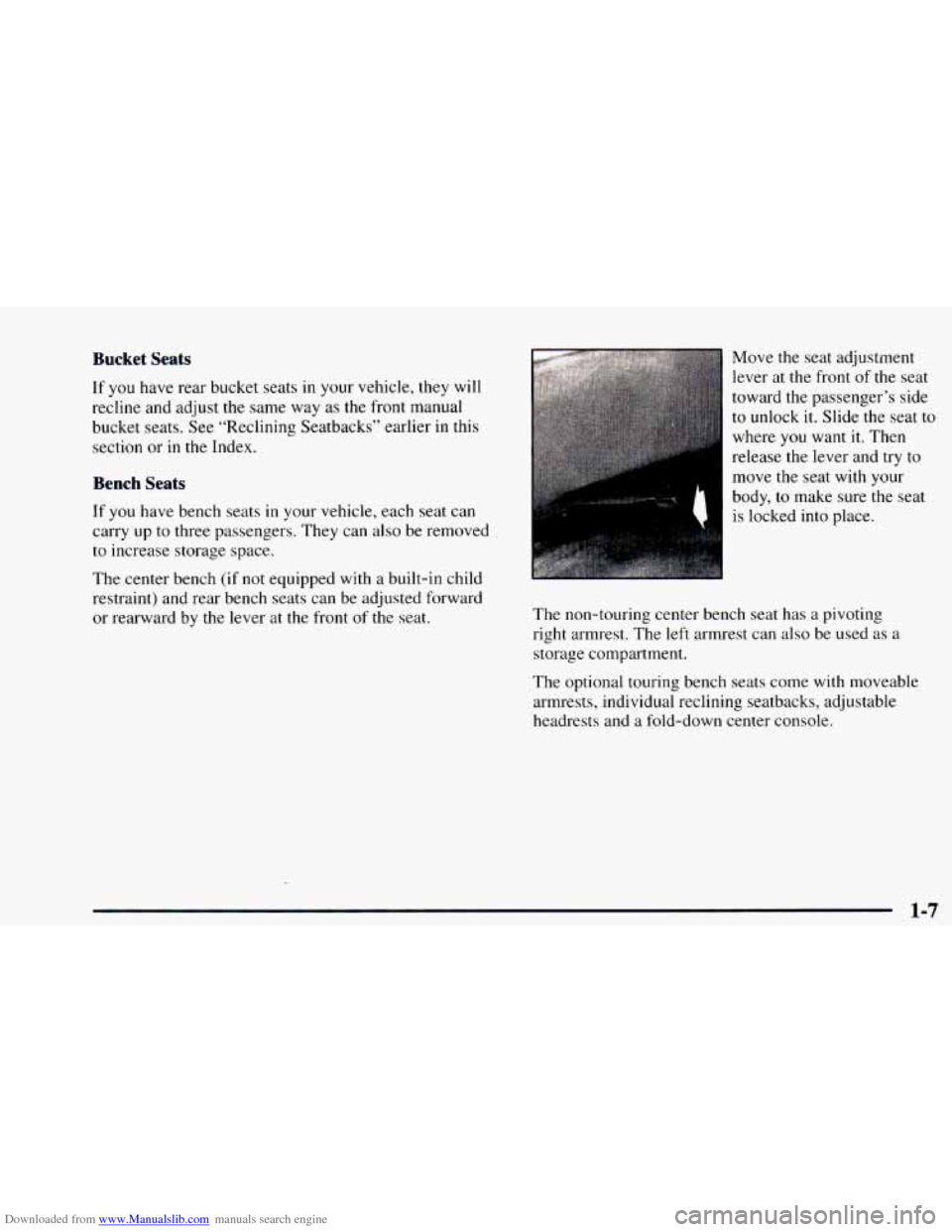
the lever at the front of the seat. Move
the seat adjustment
lever at the front of the seat
toward the passenger’s side
to unlock it. Slide the seat to
where
you want it. Then
release the lever and try to
move the seat with your
body,
to make sure the seat
is locked into place.
The non-touring center bench seat has
a pivoting
right armrest. The left armrest can also be used as
a
storage compartment.
The optional touring bench seats come with moveable
armrests, individual reclining seatbacks, adjustable
headrests
and a fold-down center console.
1-7
Page 17 of 404
Downloaded from www.Manualslib.com manuals search engine Removing the Rear Seats
To remove the rear seats, do the following:
c I TO DETACH
‘1 BELT FOR
SEAT REMOVAL
-9.- I
INSERT KEY , 1
INTO HOLE
AND PUSH I
I I
1 I
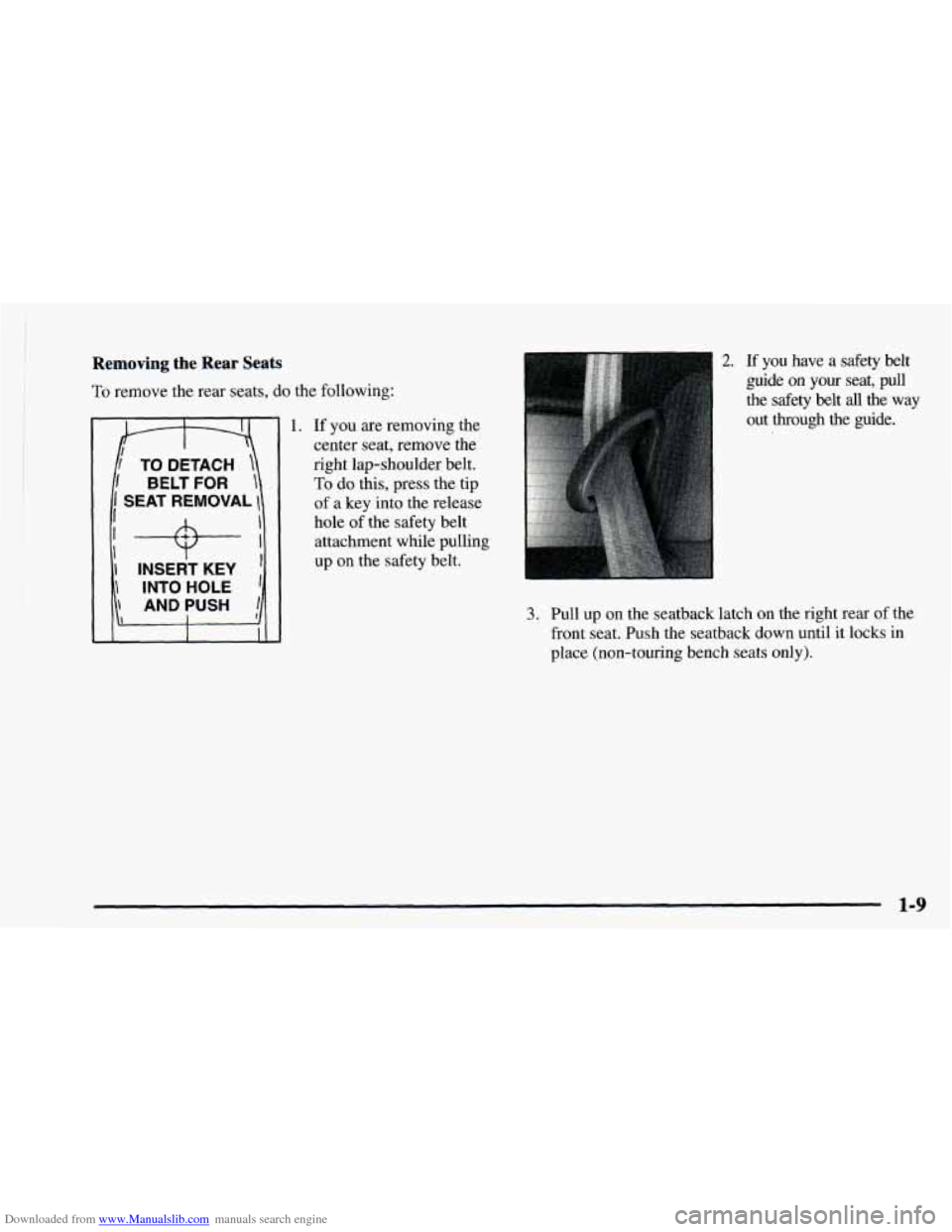
1. If you are removing the
center seat, remove the
right lap-shoulder belt.
To do this, press the tip
of a key into the release
hole of the safety belt
attachment while pulling
up on the safety belt.
2. If you have a safety belt
guide on
your seat, pull
the
safety belt all the way
I, out through the guide.
3. Pull up on the seatback latch on the right rear of the
front seat. Push the seatback
down until it locks in
place (non-touring bench seats only).
1-9