1997 CHEVROLET ASTRO power steering
[x] Cancel search: power steeringPage 185 of 404
Downloaded from www.Manualslib.com manuals search engine Remember: Anti-lock doesn’t change the time you need
to get your foot up to the brake pedal or always decrease
stopping distance.
If you get too close to the vehicle in
front of you, you won’t have time to apply your brakes
if that vehicle suddenly slows or stops. Always leave
enough room up ahead to stop,
even though you have
anti-lock brakes.
Using Anti-Lock
Don’t pump the brakes. Just hold the brake pedal down
and let anti-lock work for
you. You may feel the brakes
vibrate, or you may notice some noise, but
* ‘.s is normal.
Braking in Emergencies
With anti-lock, you can steer and brake at the same
time. In many emergencies, steering can help you more
than even the very best braking.
Steering
Power Steering
If you lose power steering assist because the engine
stops or the system
is not functioning, you can steer but
it will take much more effort.
Steering Tips
Driving on Curves
It’s important to take curves at a reasonable speed.
A lot of the “driver lost control’’ accidents mentioned on
the news happen on curves. Here’s why:
Experienced driver or beginner, each
of us is subject to
the same laws of physics when driving on curves. The
traction
of the tires against the road surface makes it
possible for the vehicle to change its path when you turn
the front wheels. If there’s no traction, inertia will keep
the vehicle going in the same direction.
If you’ve ever
tried
to steer a vehicle on wet ice, you’ll understand this.
The traction
you can get in a curve depends on the
condition of your tires and the road surface,
the angle at
which the curve is banked, and your speed. While you’re
in a curve, speed is the one Factor you can control.
Suppose you’re steering through
a sharp curve. Then you
suddenly accelerate. Both control systems -- steering and
acceleration
-- have to do their work where the tires meet
the road. Adding the sudden acceleration can demand too much
of those places. You can lose control.
4-9
Page 257 of 404

Downloaded from www.Manualslib.com manuals search engine Section 6 Service and Appearance Care
Here you will find information about the care of your vehicle. This section begins with service and fuel information,
and
then it shows how to check important fluid and lubricant levels. There is also technical information about your
vehicle, and
a part devoted to its appearance care.
6- 2
6-3
6-4
6-5
6-7
6-1 1
6- 15
6- 19
6-20
6-23
6-25
6-25
6-29
6-30
6-30
6-3
1
6-32
6-36
6-36
6-36 Service
Fuel Fuels
in Foreign Countries
Filling Your Tank
Checking Things Under the Hood
Engine Oil
Engine Cover
Air Cleaner
Automatic Transmission Fluid
All-Wheel Drive Rear Axle
Engine Coolant
Radiator Pressure Cap
Thermostat Power Steering Fluid
Windshield Washer Fluid
Brakes Battery
Bulb Replacement Halogen Bulbs 6-42
6-43
6-50
6-5
1
6-54
6-55
6-55
6-57
6-5
8
6-5 8
6-5
8
6-59
6-60
6-60
6-60
6-66
6-66
6-67
6-68 Windshield Wiper Blade Replacement
Tires Appearance Care
Cleaning
the Inside of Your Vehicle
Cleaning Glass Surfaces
Cleaning the Outside
of the Windshield,
Backglass and Wiper Blades
Cleaning the Outside
of Your Vehicle
Cleaning Tires Finish Damage Underbody Maintenance
Chemical Paint Spotting
Appearance Care Materials Chart
Vehicle Identification Number
(VIN)
Service Parts Identification Label
Electrical System Replacement Bulbs
Capacities and Specifications
Air Conditioning Refrigerants
Normal Maintenance Replacement Parts
6-1
Page 265 of 404
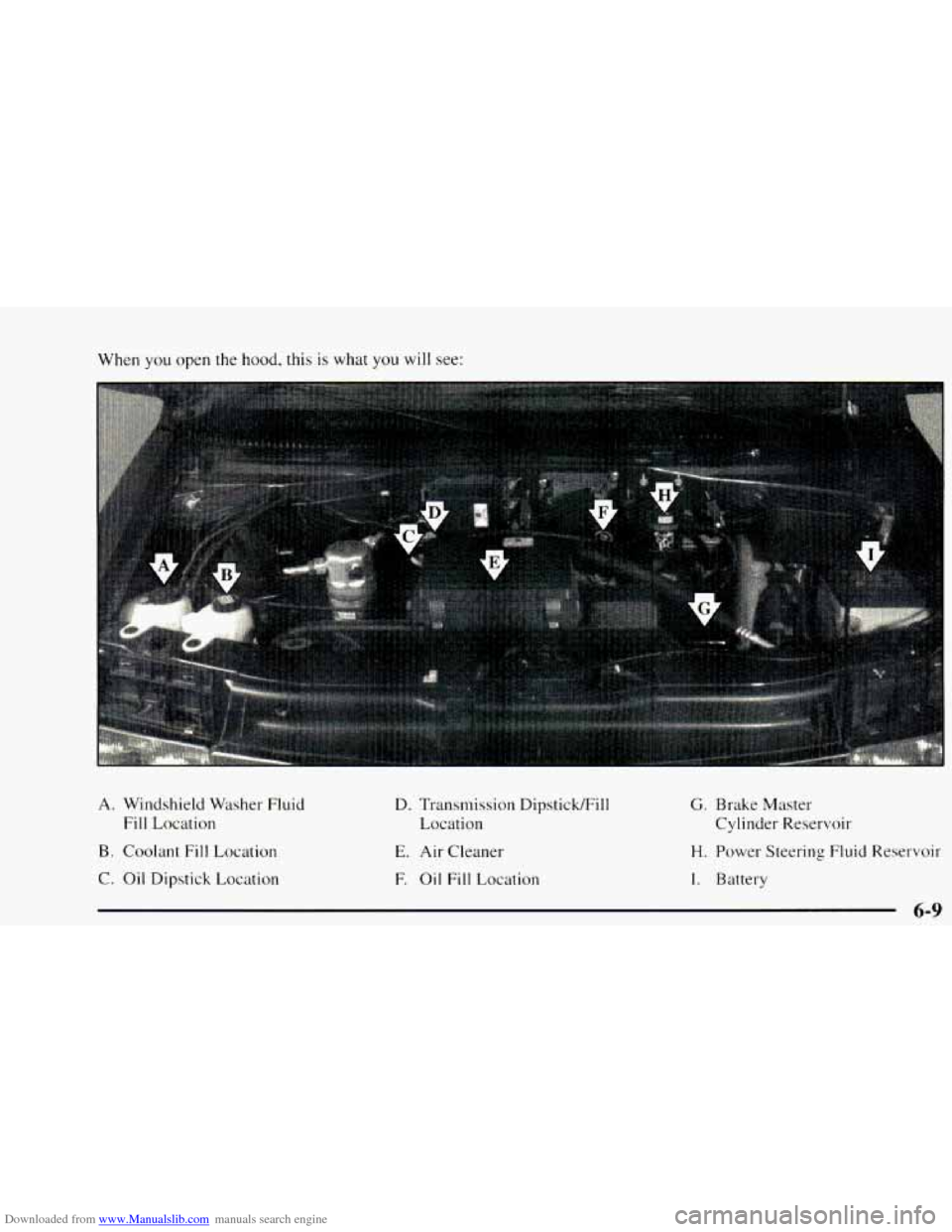
Downloaded from www.Manualslib.com manuals search engine When you open the hood, this is what you will see:
A. Windshield Washer Fluid
Fill Location
B. Coolant Fill Location
C. Oil Dipstick Location D. Transmission Dipstick/Fill
Location
E. Air Cleaner
F.
Oil Fill Location
G. Brake Master
Cylinder Reservoir
H. Power Steering Fluid Reservoir
I. Battery
6-9
Page 286 of 404

Downloaded from www.Manualslib.com manuals search engine Thermostat
Engine coolant temperature is controlled by a thermostat
in the engine coolant system. The thermostat stops the
flow
of coolant through the radiator until the coolant
reaches
a preset temperature.
Power Steering Fluid
When to Check Power Steering Fluid
It is not necessary to regularly check power steering
fluid unless you suspect there is
a leak in the system or
you hear an unusual noise. A fluid loss in this system
could indicate a problem. Have the system inspected
and repaired.
How To Check Power Steering Fluid
When the engine compartment is cool, unscrew the cap
and wipe the dipstick
with a clean rag. Replace the cap
and completely tighten it. Then remove the cap again
and look at the fluid level on the dipstick.
The level should be at the
FULL COLD mark. If
necessary, add only enough fluid to bring the level up
to the mark.
What to Use
To determine what kind of fluid to use, see
“Recommended Fluids and Lubricants”
in the Index.
Always use the proper fluid. Failure to use the proper
fluid can cause leaks and damage
hoses and seals.
6-30
Page 371 of 404
Downloaded from www.Manualslib.com manuals search engine Part C: Periodic Maintenance
Inspections
Listed below are inspections and services which should
be performed at least twice a year (for instance, each
spring and fall).
You should let your GM dealership’s
service department or other qualified service center do
these jobs. Make sure any necessary repairs
are
completed at once.
Proper procedures to perform these services may be
found in
a GM service manual. See “Service and Owner
Publications” in the Index.
Steering, Suspension and Front Drive Axle
Boot and Seal Inspection
Inspect the front and rear suspension and steering
system for damaged, loose or missing parts, signs of
wear or lack of lubrication. Inspect the power steering
lines and hoses for proper hook-up, binding, leaks,
cracks, chafing, etc. Clean and then inspect the drive
axle boot seals for damage, tears or leakage. Replace
seals if necessary.
Exhaust System Inspection
Inspect the complete exhaust system. Inspect the body
near the exhaust system.
Look for broken, damaged,
missing or out-of-position parts as well as open seams,
holes, loose connections or other conditions ‘which could
cause
a heat build-up in the floor pan or could let
exhaust fumes into the vehicle. See “Engine Exhaust”
in
the Index.
Radiator and Heater Hose Inspection
Inspect the hoses and have them replaced if they are
cracked, swollen or deteriorated. Inspect all pipes,
fittings and clamps; replace as needed.
Throttle Linkage Inspection
Inspect the throttle linkage for interference or binding,
and for damage or missing parts. Replace parts as
needed. Replace any cables that have high effort or
excessive wear.
Do not lubricate accelerator and cruise
control cables.
i;.
7-47
Page 373 of 404
Downloaded from www.Manualslib.com manuals search engine !‘ Part D: Recommended Fluids
and Lubricants
NOTE: Fluids and lubricants identified below by name, part number or specification may be obtained from your
GM dealer.
I USAGE
Engine Coolant
Coolant Supplement
Sealer
FLUIDLUBRICANT
Engine oil with the American
Petroleum Institute Certified For
Gasoline Engines “Starburst”
symbol of the proper viscosity.
To
determine the preferred viscosity
for your vehicle’s engine, see
“Engine Oil” in the Index.
50/50 mixture of clean water
(preferably distilled) and GM
Goodwrench@ DEX-COOL
or
Havoline@ DEX-COOL TM
(silicate-free) antifreeze. See
“Engine Coolant’’ in the Index.
GM Part No. 3634621 or
equivalent with a complete flush
and refill.
-_
USAGE
Delco Supreme 11 @ Brake Fluid Hydraulic Brake
FLUIDLUBRICANT
(GM Part No. 12377967 or System equivalent DOT-3 brake fluid).
Parking Brake Chassis lubricant (GM
Part
Cable Guides No. 1052497 or equivalent) or
lubricant meeting requirements
of NLGI
# 2, Category LB
or GC-LB.
Power Steering
GM Power Steering Fluid
System (GM
Part No. 1052884 - 1 pint,
Automatic DEXRON@-I11 Automatic
Transmission Transmission Fluid.
Key
Lock Multi-Purpose lubricant, Superlube@
Cylinders
(GM Part No. 12346241
or equivalent).
1050017
- 1 quart, or equivalent).
Chassis Chassis lubricant
(GM Part
Lubrication No. 1052497 or equivalent)
or
lubricant meeting requirements
of NLGI # 2, Category LB
or GC-LB.
7-49
Page 397 of 404

Downloaded from www.Manualslib.com manuals search engine Parking AtNight
.................................... 2-14
Brake
...................................... 2-23
BrakeMechanism Check
....................... 7-46
Over Things That Burn
........................ 2-27
With
a Trailer ................................ 4-38
Passing
....................................... 4-12
Payload
....................................... 4-30
Periodic Maintenance Inspections
.................. 7-47
Power
Accessory Outlet
............................. 2-52
DoorLocks
................................... 2-7
Option Fuses
................................ 6-61
Seat
......................................... 1-3
Steering
..................................... 4-9
Steering Fluid
................................ 6-30
Windows
................................... 2-29
Pregnancy. Use
of Safety Belts .................... 1-26
Problems on the Road
............................ 5-2
Publications, Service and Owner
.............. 8-1 1. 8- I2
Lots ....................................... 2-14
Radiator
..................................... 5- 19
Radiator Pressure Cap
........................... 6-29
Radio Reception
................................ 3-28
Radios
........................................ 3-9
Rain. Driving In
................................ 4- 16
Reading Lamps ................................ 2-40
Rear
Air Conditioning System
........ ........... 3-5 Axle
....................................... 6-25
Heating System
............................... 3-4
Outside Seat Position
.......................... 1-34
Safety Belt Comfort Guides
..................... 1-37
SeatAudio
.................................. 3-18
Seatpassengers
.............................. 1-34
Storage ..................................... 2-43
Towing
................................ 5-11. 5-12
Window Defogger
............................. 3-8
Windshield Washer
........................... 2-34
Rearview Mirror
................................ 2-41
Reclining Front Seatbacks
......................... 1-4
Recommended Fluids and Lubricants
............... 7-49
Recovery Tank. Coolant
.......................... 5-16
Refrigerants. Air Conditioning
.................... 6-67
Regulator. Fuel
................................. 2-18
Removable Rear Seats
............................ 1-9
Replacement
Bulbs
...................................... 6-66
Parts
....................................... 6-68
Wheel
...................................... 6-48
Replacing Safety Belts
........................... 1-66
Reporting Safety Defects
.................... 8- IO. 8-11
Restraints
Built-in Child
................................ 1-44
Checking
................................... 1-65
Child
........................ 1-41. 1-42. 1-43. 1-53
Head
........................................ 1-5
Replacing Parts After
a Crash ................... 1-66
Systemcheck
................................ 7-44
Reverse
....................................... 2-20
9-7
Page 399 of 404

Downloaded from www.Manualslib.com manuals search engine Shoulder Belt Height Adjuster ..................... 1-20
SIR .......................................... 1-27
Skidding
...................................... 4-13
Sound Equipment. Adding
........................ 3-28
Spare Tire. Compact
............................. 5-35
Specifications and Capacities
...................... 6-67
Speech Impaired. Customer Assistance
............... 8-4
Speedometer
................................... 2-59
Stains. Cleaning
................................ 6-52
Starter Switch Check
............................ 7-45
Starting Your Engine
............................ 2- 17
Steam
........................................ 5-13
In Emergencies ............................... 4- IO
Power ....................................... 4-9
Tips
......................................... 4-9
Wheel. Tilt
.................................. 2-31
Storage Compartments
........................... 2-42
Storage. Vehicle
................................ 6-36
Stuck: In Sand. Mud. Ice or Snow
.................. 5-36
Sunvisors
.................................... 2-51
Sunglasses Storage
.............................. 2-48
Supplemental Inflatable Restraint
.................. 1-27
Symbols. Vehicle .................................. v
Steering ....................................... 4-9
Taillamp Bulb Replacement
...................... 6-41
Tape Player Care
............................... 3-29
Temperature & Compass Display .................. 2-47 Theft
......................................... 2-14
Theft-Deterrent Feature
.......................... 3-26
Thermostat
.................................... 6-30
Third Gear
.................................... 2-21
Tilt Steering Wheel
............................. 2-31
Time. Setting
................................... 3-9
Tire Chains
.................................... 6-50
TireLoading
................................... 4-28
Tire-Loading Information Label
................... 4-28
Tires
......................................... 6-43
Alignment and Balance
........................ 6-48
BuyingNew
................................. 6-46
Chains
..................................... 6-50
ChangingaFlat
.............................. 5-23
Cleaning
.................................... 6-57
Compact Spare
............................... 5-35
Inflation
.................................... 6-44
Inflation Check
............................... 7-43
Inspection and Rotation
........................ 6-45
Loading .................................... 4-28
Pressure
.................................... 6-44
Temperature
................................. 6-48
Traction
.................................... 6-48
Treadwear
................................... 6-47
Uniform Quality Grading
....................... 6-47
Wear Indicators
.............................. 6-46
Wheel Replacement
........................... 6-48
When It’s Time for New
....................... 6-46
THEFTLOCK
................................ 3-26
9-9