1997 CADILLAC SEVILLE ESP
[x] Cancel search: ESPPage 107 of 370
Downloaded from www.Manualslib.com manuals search engine The wiper activated headlamps will deactivate if you
turn off the twilight sentinel or if the windshield wipers
have been turned off' for a period of one or two seconds.
You will hear a warning chime if you open any door
while leaving
the lamps on, if the manual headlamp
control
is activated. An exception to this is when you're
using twilight sentinel.
Daytime Running Lamps (DRL) can make
it easier for
others
to see the front of your vehicle during the day.
DRL can be helpful in many different driving
conditions, but they can be especially helpful in the
short periods after dawn and before sunset.
The DRL system will make
the high-beam headlamps
come on at reduced brightness when:
0 the ignition is on,
0 the headlamp switch is off and
6 the transaxle is not in PARK (P).
When
DRL are on, only your high-beam headlamps (at
reduced brightness) will be
on. No other exterior- lamps
such as the parking lamps, taillamps, etc. will be on
when the DRL are being used. YGW instsument panel
won't be lit
up either.
When the twilight sent!xL s\s-i:ch is 011 and it's dark
enough outside. the hi@1-ixaE
hea&s (at reduced
intensity)
will turn off and nor:nal low-beam headlamy
operation will occur.
When the t\:..iiight sentinel switch
is on and it's bright enough otltsids.
the regular lamps
will
go off, and the high-beax headlmps at reduced
brightness will
take ovc- for the DRL.
If it's dark enough outside and the twilight sentinel
control is off. a HEADLAMPS SUGGESTED message
will display on the DIC. This message infotms the driver
that turning
on the exterior lamps is reconmended even
though the
DRE are still illunlinated (it's become dark
enough outside to require the headlamps and/or other
exterior lamps). Turning
on the twilight sentinel, the
headlamp switch or the fog lamp switch will remove
the HEADLAMPS
SUGGESTED message.
To idle your vehicle with the DRL off, turn off the
twilight sentinel switch and shift the transaxle into
PARK (P). Placing your vehicle in PARK (P) disables
the DRL.
Ths DRL will stay off until you shift out of
PARK (P).
As with any vehicle. you should turn on the regular
headlamp system when
you need it.
Page 112 of 370
Downloaded from www.Manualslib.com manuals search engine c
c-
~~~~~~~~~~~~~~~..~ Po\wr=
This feature is designed to protect your vehicle's battery
against drainage from the interior lamps, trunk lamp,
glove
box ianlp, cigarette lighters or the garage door
opener. When
the ignition is turned off, the power
to these features will automatically turn off after
10 minutes (three minutes if a new car has 15 miles
or less). Power will be restored for an additional
10 minutes if any door is opened, the trunk is opened
or the courtesy lamp switch is turned on.
This feature is for long term use and must be
programmed through the
DIC while the ignition is in the
RUN position. Battery guard storage protects the battery
by placing the vehicle in
a storage mode so that the
radio, amplifiers, instrument cluster and RKE will
not
drain the battery over a long period of time.
'To begin programming, press the INFORMATION
(.INFO) and RESET (INFO RESET) buttons at the same
time for about two seconds.
The first message to appear
is DOORS LOCK IN GEAR. Press the INFORMATION
(INFO) button after this prompt is displayed until
STORAGE MODE prompt appears on the DIC. Press
the
TRIP SET (TRIP RESET) button to answsr '.yes" or
press the RESET (INFO RESET) button to indicate a
"no" response.
FEATURE ON appears when a yes response is made
and
FEATlJRE OFF shows when a no response is made.
Since this is the last personalization feature available,
a yes or no response will end out of the DIC display.
Once the battery guard has been programmed. your
vehicle will enter the storage mode about
20 minutes
after the ignition key has been turned
off. The RKE will
also be disabled at this point. The RICE will reactivate
when
a door or the trunk is opened. however. if your
vehicle is
left inactive for another 30 minutes, the RKE
will re-enter the storage mode.
Your vehicle will
stay in the storage mode until the
ignition key
is turned out of LOCK. The system will
"wake-up" when the door key is inserted
into the door,
however, your vehicle
will remain in the storage mode.
The ignition must be out of LOCK before the battery
E Ouard is disabled.
Page 157 of 370
Downloaded from www.Manualslib.com manuals search engine TRUNK OPEN - 24: This message indicates that the
trunk is open when the ignition is
in RUN.
TURN SIGNAL ON - 20: This message is a reminder,
after driving about a mile, that you have the turn signal
on.
A multiple chime will also sound when this message
is displayed.
VEHICLE SPEED LIh'IITED TO XXX MPH
(KM/H) - 113: A failure in the suspension control
system
has occurred when this message appears. The
PCM determines the speed your vehicle is limited to.
Have your Cadillac serviced if this message appears. The
CV-RTD automatically adjusts the ride
of your
vehicle. Automatic ride control
is achieved through a
computer used to control and monitor the suspension
system.
The controller receives inputs from various
sensors
to determine the proper system response. If the
controller detects a problem within the system, the DIC
will display a SERVICE RIDE CONTROL message. If
this message appears, have your vehicle serviced at your
Cadillac dealership.
VERY LOW REFRIGERANT A/C COMPRESSOR
OFF - 12: This message means that the air conditioning
system detects a refrigerant level that is
low enough to
cause damage to the air conditioning compressor.
To
avoid damage. the air conditioning compressor
automatically turns
off and the Electronic Climate
Control will automatically switch from AUTO to
ECON and remain there. Have the air conditioning
system serviced if this message appears.
Page 169 of 370
Downloaded from www.Manualslib.com manuals search engine With this feature, your vehicle will recall the latest
climate control settings
as adjusted the last time your
vehicle was operated. Thjs feature. allows two different
drivers to store and recall their own climate control
settings. The settings recalled by the climate control
system are determined
by which RKE transmitter (“1”
or “2“) was used to enter the vehicle. The number on the
back of the
RKE transmitter corresponds to driver 1 or
to driver
2. After the unlock button is pressed on the
RKE transmitter or the ignition key is placed in the
ignition, the climate control settings will automatically
adjust
to where they were last set. The settings can also
be changed by briefly pressing the memory seat buttons
1 or 2 located on the driver’s door.
i,C) ~~~~~~~~~.~ 5’
Your Cadillac audio system has been designed to operate
easily and give years of listening pleasure.
You will get
the most enjoyment
out of it if you acquaint yourself with
it first. Find out what
your audio system can do and how
to operate all its controls, to be sure you’re getting the
most out of the advanced engineering that went into
it.
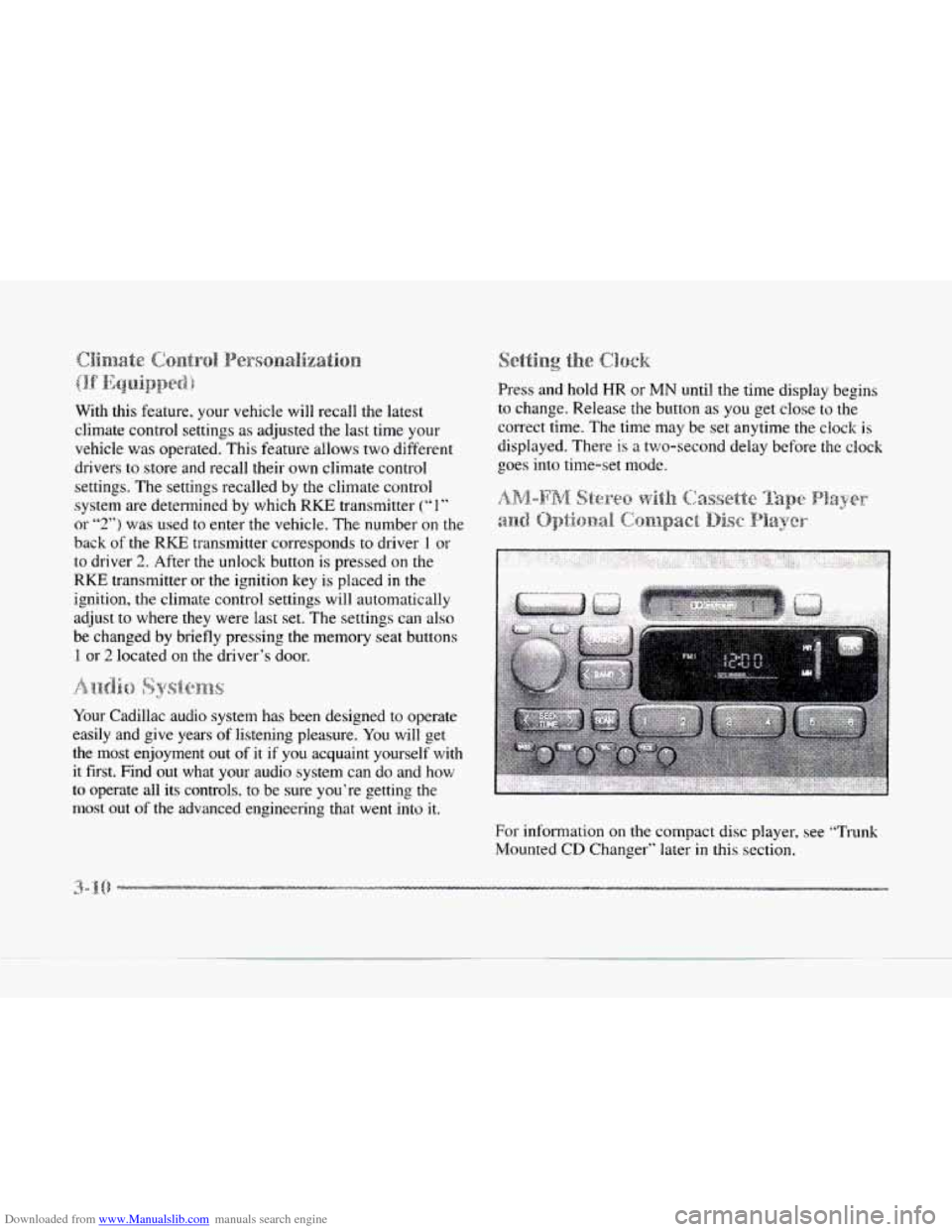
Press and hold HR or MN until the time display begins
to change. Release
the button as you get close to the
correct time. The time may be
set anytime the clock is
displayed. There is a two-second delay before the clock
goes into time-set mode.
For information on the compact disc player, see “Trunk
Mounted
GD Changer” later in this section.
-.
.d
Page 184 of 370
Downloaded from www.Manualslib.com manuals search engine c
c1
c
P
With this feature, your vehicle will recall the latest radio
settings as adjusted the last time your vehicle was
operated. This feature allows two different drivers
to
store and recall their own radio settings. The settings
recalled by the radio are determined by which
RKE
transmitter (“1” or “2’’) was used to enter the vehicle.
The number on the back
of the RKE transmitter
corresponds
to driver 1 or to driver 2. After the unlock
button is pressed
on the RKE transmitter or the ignition
key
is placed in the ignition, the radio settings will
automatically adjust to where they were last
set. The
settings can also be changed
by briefly pressing the
memory seat buttons 1 or
2 located on the driver’s door.
Your Cadillac has
a “built-in“ theft-deterrent feature on
each radio that is automatic -- there is no programming
required. The radio in your Cadillac cannot be used in
any other vehicle besides another Cadillac if it were to
be removed.
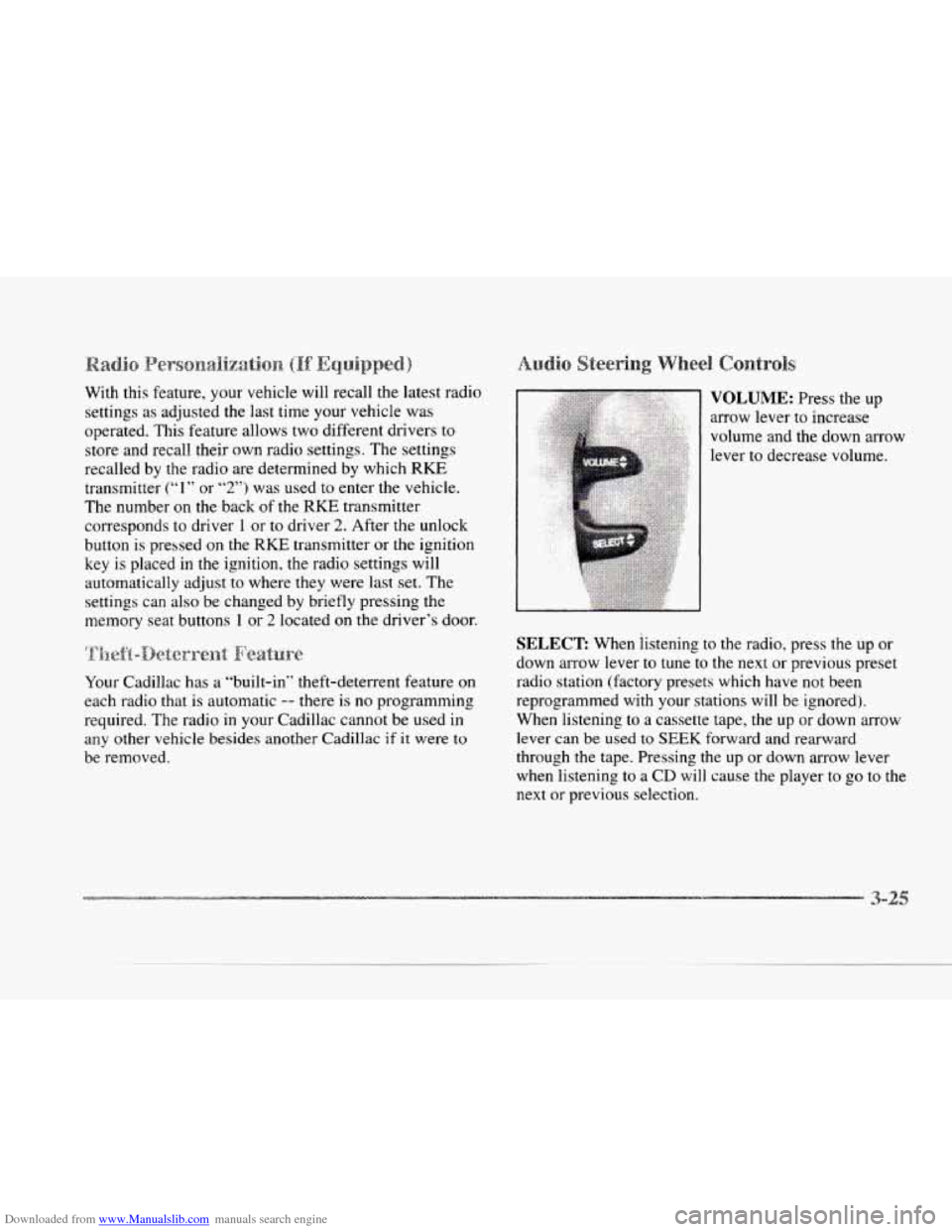
VOLUME: Press the up
arrow lever to increase
volume and the down arrow
lever to decrease volume.
SELECT: When listening to the radio, press the up or
down arrow lever
to tune to the next or previous preset
radio station (factory presets which have not been
reprogrammed with your stations will be ignored).
When listening to a cassette tape, the up
or clown arrow
lever
can be used to SEEK forward and rearward
through the tape. Pressing the up or down arrow lever
when listening to a
CD will cause the player to go to the
next or previous selection.
3-2
Page 185 of 370

Downloaded from www.Manualslib.com manuals search engine FM stereo will give you the best sound. But FM signals
will reach only about
10 to 40 miles (16 to 65 km). Tall
buildings or hills can interfere with
FM signals, causing
the sound to come
and go.
The range for most AM stations IS greater than for FM,
especially at night. The longer range, however, can
cause stations to interfere with each other.
AM can pick
up noise from things like storms and power lines. Try
reducing the treble
to reduce this noise if you ever get it.
Hearing damage from loud noise is almost undetectable
until it
is too late. Your hearing can adapt to higher
volumes of sound. Sound that seems normal can be loud
and harmful to your hearing. Take precautions by
adjusting the volume control
on your radio to a safe
sound level before your hearing adapts to
it.
To help avoid hearing loss or damage:
Adjust the volume control to the lowest setting.
Increase volume slowly until you hear comfortably
and clearly.
NOTICE:
Before you add any sound equipment to your
vehicle -- like a tape player, CB radio, mobile
telephone or two-way radio
-- be sure you can add
what you want. If you can, it’s very important to
do it properly. Added sound equipment may
interfere with the operation
of your vehicle’s
engine, Cadillac radio
or other systems, and even
damage them. Your vehicle’s systems may interfere
with the operation
of sound equipment that has
been added improperly.
So, before adding sound equipment, check with
your dealer and be sure to check Federal rules
covering mobile radio and telephone units.
1
Page 196 of 370
Downloaded from www.Manualslib.com manuals search engine c
c
The body takes about an hour to rid itself of the alcohol
in one drink. No amount of coffee or number of cold
showers will speed that up.
"1'11 be carefui" isn't the
right answer. What if there's an emergency.
a need to
take sudden action, as when a child darts into the street?
A person with even a moderate BAC might not be able
to react quickly enough
to avoid the collision.
There's something else about drinking and driving that
many people don't
know. Medical research shows that
alcohol
in a person's system can make crash injuries
worse, especially injuries to the brain, spinal cord or
heart.
This Ineans that when anyone who has been
drinking
-- driver or passenger -- is in a crash. that
person's chance
of being killed or permanently disabled
1s hlghsr than if the person had not been drinking. ..
/d CAUTION:
Drinking and then driving is very dangerous.
Your reflexes, perceptions, attentiveness and
judgment can be affected
by even a small amount
of alcohol. You can have a serious -- or even
fatal
-- collision if you drive after drinking.
Please don't drink and drive or ride
with a driver
who has been drinking. Ride home in a cab; or if
you're with a group, designate a driver who will
not drink.
Page 200 of 370
Downloaded from www.Manualslib.com manuals search engine c
c
c
L
Remember: Anti-lock doesn’t change the time you need
to get your foot up to the brake pedal
or always decrease
stopping distance.
If you get too close to the vehicle in
front of you, you won’t have time to apply your brakes
if that vehicle suddenly slows or stops. Always leave
enough room up ahead to stop. even though
you have
anti-lock brakes.
thg AnJ:i=f,.ciick
Don’t pump the brakes. Just hold the brake pedal down
and let anti-lock work for you.
You may hear the
anti-lock pump or motor operate. and feel the brake
pedal pulsate. but this is normal.
Your vehicle
has a traction control system that limits wheel
spin.
This is especially useful in slippely road conditions.
The system operates only
if it senses that one or both of
the front wheels are spinning or beginning to lose traction.
When
this happens, the system works the front brakes and
reduces engine power to limit wheel
spin.
The TRACTION ENGAGED message will display on
the Driver Information Center when the traction control
system is limiting wheel spin. See “Driver Information
Center Messages”
in the Index. You may feel or hear the
system working, but this
is normal.
If your vehicle is in cruise control when the traction
control system begins
to limit wheel spin, the cruise
control will automatically disengage. When road
conditions allow you
to safely use it again, you may
re-engage the cruise control. (See “Cruise Control”
in
the Index.)
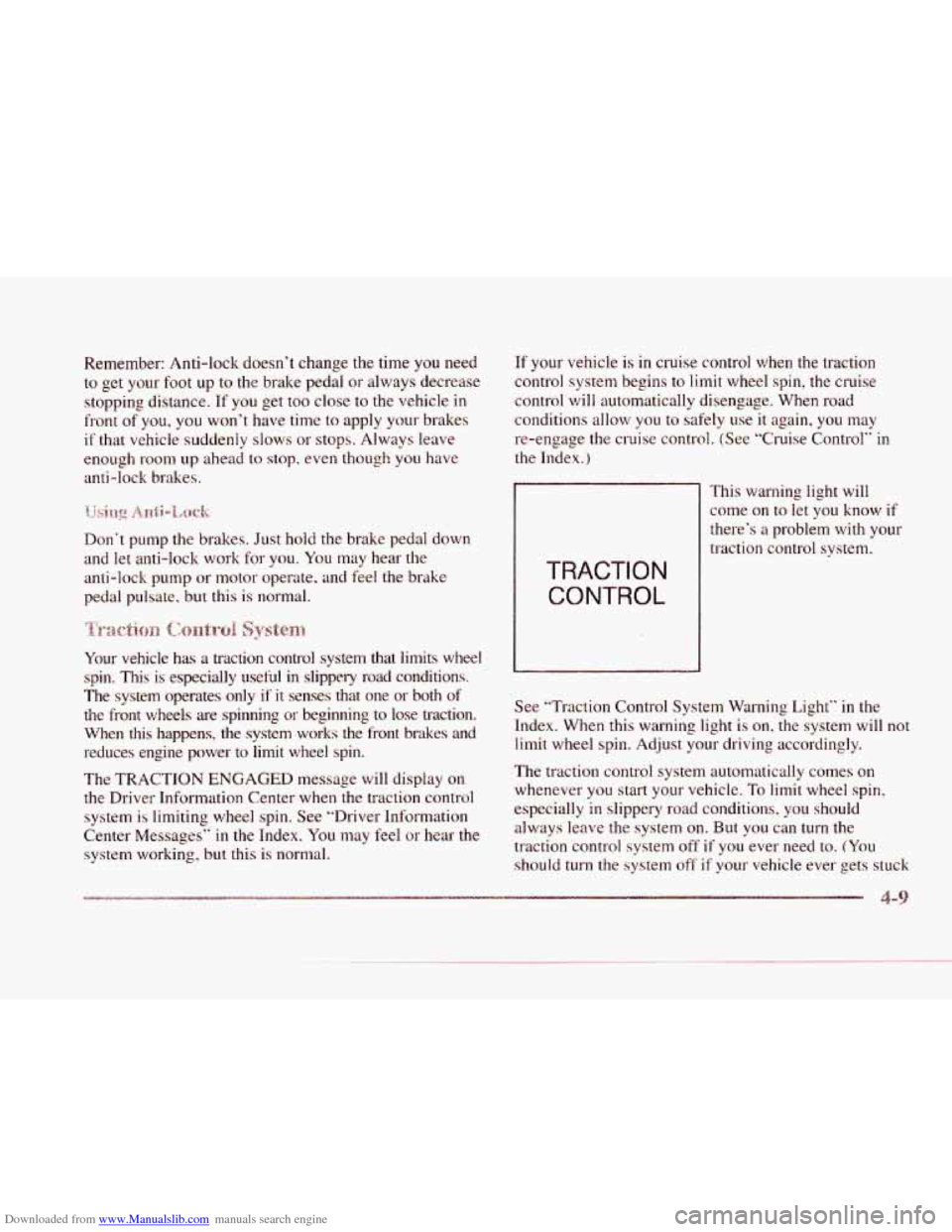
This warning light will
come
on to let you know if
there’s
a problem with your
traction control system.
TRACTION
CONTROL
See “Traction Control System Warning Light” in the
Index. When this warning light is on, the system will
not
limit wheel spin. Adjust your driving accordingly.
The traction control system automatically comes
on
whenever you start your vehicle. To limit wheel spin.
especially in slippery road conditions, you should
always leave the system on. But
you can turn the
traction control system off
if you ever need to. (You
should turn
the system off if your vehicle ever gets stuck