1997 CADILLAC SEVILLE brakes
[x] Cancel search: brakesPage 11 of 370
Downloaded from www.Manualslib.com manuals search engine The electronics and computerization which were
pioneered
by Cadillac in the '70s came of age in the
'80s with Digital Fuel Injection and On-Board
Diagnostics
in 1980, four wheel Anti-lock Brakes on
I486 models and Traction Control in the fdl of 1989.
The 1992 SevilIe S'TS was the first car ever to win all
three major automotive awards: Car of the Year. Motor
Trend; Ten Best I..& Car & Driver; Car of the Yeac
Automobile Magazine.
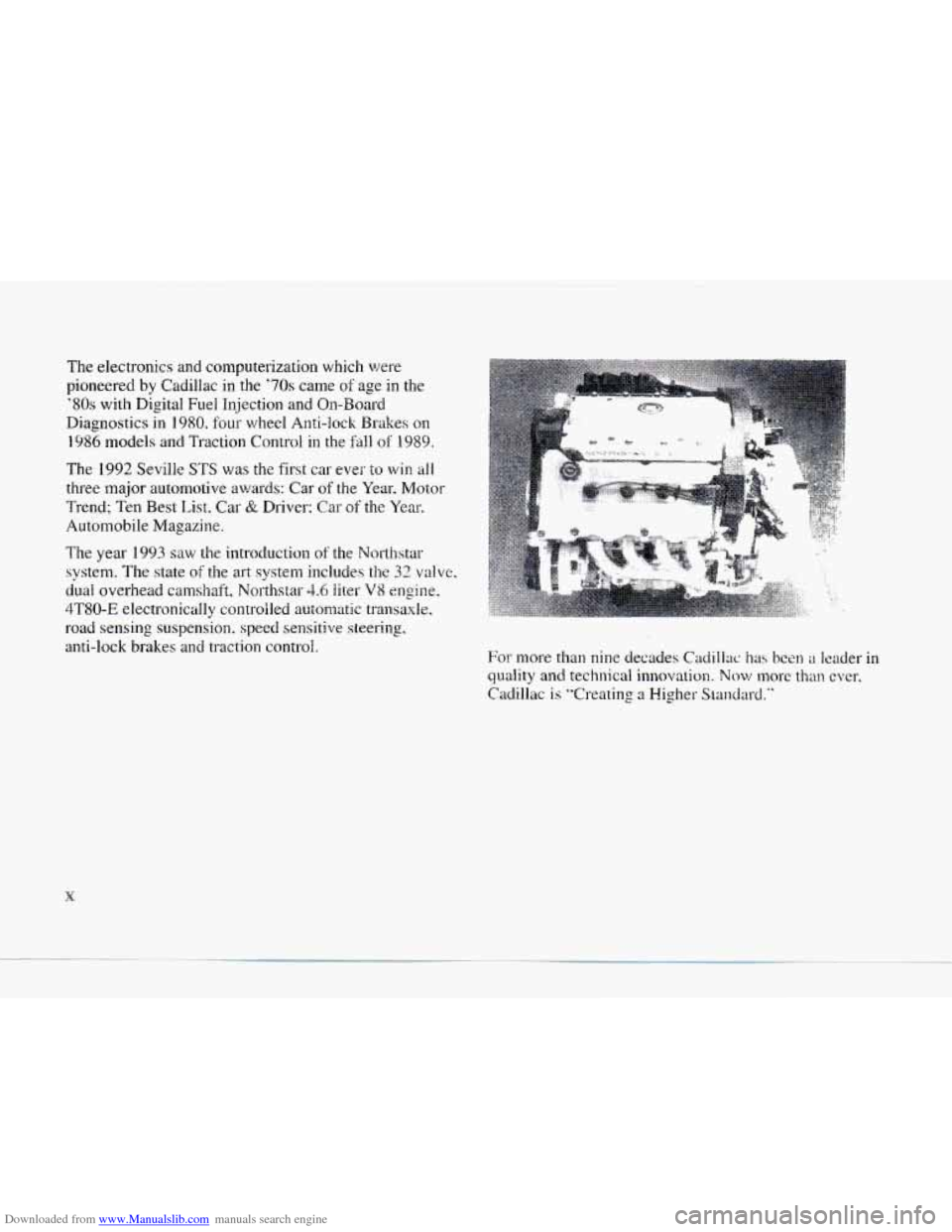
The year I993 saw the introduction of the Northstar.
system. The state
of the art system includes the 32 valve.
dual overhead camshaft, Northstar 4.6 liter VX engine.
47'80-E electronically controlled automatic transaxle.
road sensing suspension.
speed sensitive steering,
anti-lock brakes and traction control.
For inore than nine decades Cadillac has been a leader in
quality
and technical innovation. Now nlorc than ever.
Cadillac is
"Creating a Higher- Standard."
*-
x
Page 14 of 370
Downloaded from www.Manualslib.com manuals search engine c
c
c
c
c
VeSnicle Synb&
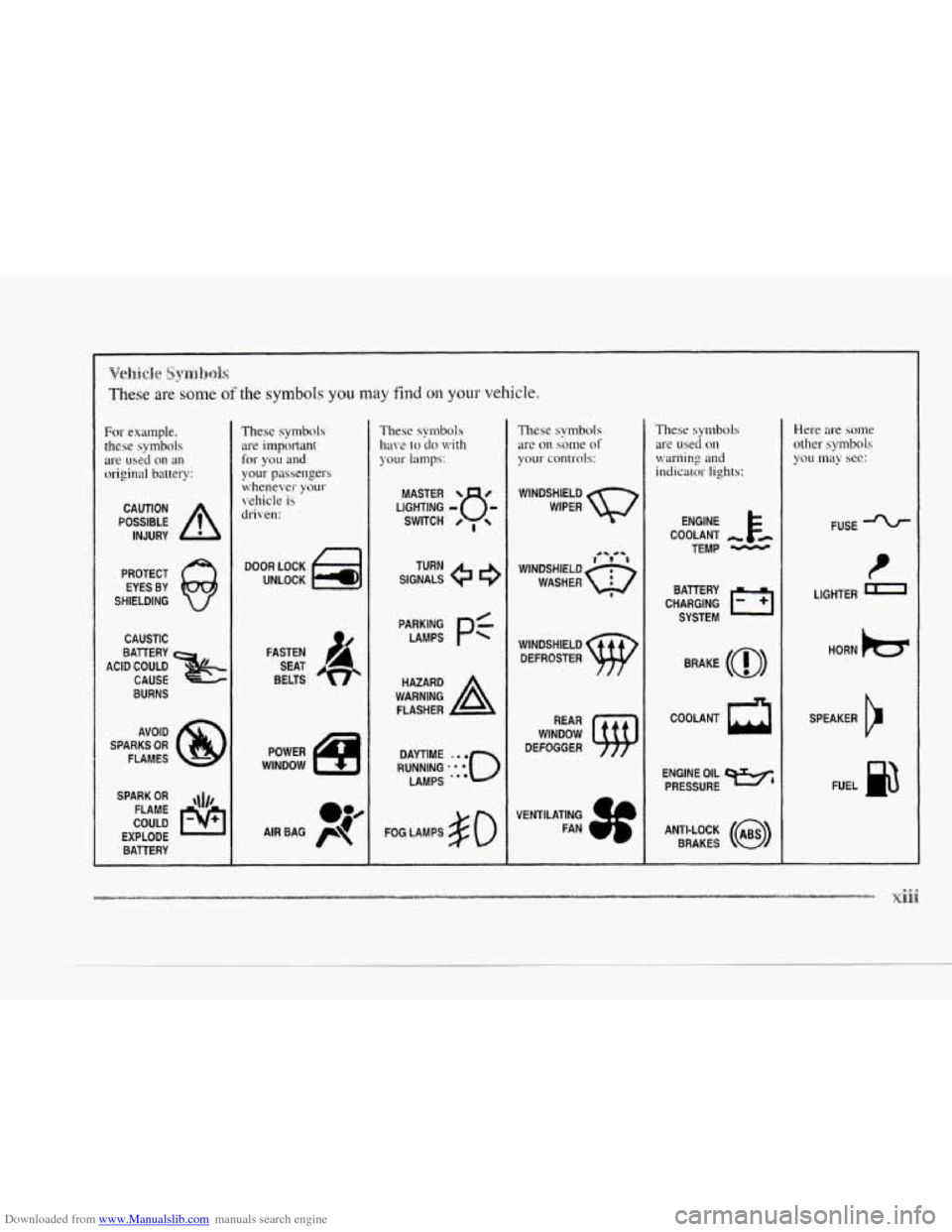
These are some of the symbols you may find 011 your vehicle.
For example.
these symbols
are used on
an
original battery:
POSSIBLE A
CAUTION
INJURY
PROTECT EYES
BY
SHIELDING
CAUSTIC
ACID COULD
x
BATTERY
CAUSE
BURNS
SPARK
OR ,\I/,
COULD FLAME
EXPLODE BATTERY
These symbols
arc
important
for you and
your passengers
u:henever your
\.chicle is
driven:
n
DOOR LOCK
UNLOCK
FASTEN BELTS SEAT
.;$-
e;/
AIR
BAG f!! FOG
LAMPS # 0
These symbols
are
on some of
your controls:
WINDSHIELD
WIPER
WINDSHIELD
DEFROSTER
VENTILATING FAN
These symbols
are used on
warning and
indicator lights:
COOLANT -
TEMP -
BRAKE (0)
COOLANT
a
ENGINE OIL w,
PRESSURE
ANTI-LOCK
(@)
BRAKES
Here are some
other symbols
you may see:
FUSE -%-
t
LIGHTER m
HORN kz7
SPEAKER
b
FUEL p3
Page 86 of 370
Downloaded from www.Manualslib.com manuals search engine c
CAUTION:
It is dangerous to get out of your vehicle if the
shift lever
is not fully in PARK (P) with the
parking brake firmly set. \’our vehicle can roll.
Don’t leave your vehicle when the engine is
running unless you have to. If
you have left the
engine running,
the vehicle can move suddenly.
I70u or others could be injured. To be sure your
vehicle won’t move, even when you’re
on fairly
level ground, always set your parking brake and
move the shift lever to
PARK (a).
See “Shifting Into PARK (P)” in the Index. If
you9re pulling
a trailer, see “Towing a Trailer”
in the Index. cnsure
the shift lever
is fully in PARK (P) range before
starting the engine. Your Cadillac has
a brake-transaxle
shift interlock.
You have to fully qph your regular
brakes
befory you can shift f’ron? PARK (P) when the
ignition key
is in the RLTN position. I!’you cannot shift
out of PARK (PI. ust‘ pr~~ssurc or] thc shift lever -- push
the shift lever
a11 thc \&+.a!. into PARI< (1’) and release the
shift lever button
on thc: floor shii t cxulhoic models as
you maintain bralit. application. Then IIIO\.C the shift
lever into the gear
~OLI \&:ish. ( p1-c.4~ tflc hi t‘t lever button
before
moving the shit’t le\^^- 011 I’loor shi t‘t console
models.) See ”Shifting Out of‘ PARK PI** in this section.
REVERSE (R): Use t,his pear to iwck 1113.
moving forward could damage your transaxle.
Shift to
REVERSE (R) only after your vehicle
Also use this gear to rock your vehicle back and forth to
get out of snow. ice or sand without damaging your
transaxle. See
“If You‘re Stuck in Sand. Mud, Ice or
Snow” in the Index for additional information.
2-2
Page 88 of 370
Downloaded from www.Manualslib.com manuals search engine c
c
THIRD (3): This position is also used for normal
driving, however,
it offers more power and lower fuel
economy than OVERDRIVE
(@).
Here are examples for using THIRD (3 j instead of
OVERDRIVE (@) j:
0 When driving on hilly, winding roads.
0 When towing a trailer. so there is less shifting
between gears.
0 When going down a steep hill.
SECOND (2): This position gives you more power. You
can use SECOND (2) on hills. It can help control your
speed
as you go down steep mountain roads, but then
you would also want to use your brakes off and on.
.__
NOTICE:
Don’t shift into SECOND (2) unless you are going
slower than
65 mph (105 km/h), or you can
damage your engine.
FIRST (1): This position gives you even more power
than SECOND
(2). You can use it on very steep hills,
or in deep snow or mud. (If the shift lever is put in
FIRST (1). the transaxle won’t shift into gear until
the vehicle is
going slowly enough.)
NOTICE:
If your front wheels can’t rotate, don’t try to
drive. This might happen
if you were stuck in
very deep sand or mud or were up against a
solid object. You could damage your transaxle.
Also, if you stop when going uphill, don’t hold
your vehicle there with only the accelerator
pedal. This could cause overheating and damage
the transaxle. Use your brakes
to hold your
vehicle
in position on a hill.
Page 90 of 370
Downloaded from www.Manualslib.com manuals search engine I A CAUTION:
If your hand or arm is in the way of the pedal,
you could be hurt. The pedal springs back
quickly. Keep your hand and
arm away when you
use the manual release lever.
NOTICE:
Driving with the parking brake on can cause
your rear brakes to overheat.
You may have to
replace them and
you could also damage other
parts
of your vehicle.
If you are towing a trailer and are parking on a hill, see
what to do first to keep the trailer from moving.
6b Towing a Trailer” in the Index. This section shows
A CAUTION:
It can be dangerous to get out of’ your vehicle if
the shift lever is not fully in PARK (P) with the
parking brake firmly
set. Your vehicle can roll.
If you have left the engine running, the vehicle
can move suddenly.
You or others could be
injured.
To be sure your vehicle won’t move, even
when you’re
on fairly level ground, use the steps
that follow.
If you’re pulling a trailer, see
“Towing a Trailer” in the Index.
Page 93 of 370
Downloaded from www.Manualslib.com manuals search engine without first pulling it toward you (or, if you have the
console shift lever, without
first pushing the button). If
you can, it means that the shift lever wasn't fully locked
into PARK (Pj.
If you are parking on a hill and you don't shift your
transaxle into PARK
(P) properly, the weight of the
vehicle may put too much force
on the parking pawl in
the transaxle. You may find it difficult to pull the shift
lever out
of PARK (P). This is called "torque lock." To
prevent torque lock, set the parking brake and then shift
into PARK (P) properly before you leave the driver's
seat. To find out
how, see "Shifting Into PARK (P)" in
the Index.
If torque
lock does occur, you may need to have another
vehicle push yours
a little uphill to take some of the
pressure from the parking
pawl in the transaxle, so you
can pull the shift lever out of PARI' (P). Your
Cadillac has
a Brake-Transaxle Shift Interlock
(BTSIj.
You have to fully apply your regular brakes
bqfim you can shift from PARK (P) when the ignition is
in the RUN position. See "Automatic Transaxle" in the
Index.
If you cannot shift out of PARK (P), ease pressure on
the shift lever -- push the shift lever all the way into
PARK (P, and also release the shift lever button on floor
shift models as you maintain brake application. Then
move the shift lever into the gear
you want. (Press the
shift lever button before moving the shift lever.)
If you
ever hold the brake pedal down but still can't shift out of
PARK (P). try this: .
1.
2.
3.
4.
5.
Turn the key to OFF. Open and close the driver's
door to turn
oft the RAP feature.
Apply
and hold the brake until the end of Step 4.
Shift to NEUTRAL (N).
Start the vehicle and then shift to the drive pear
you want.
Have the vehicle fixed as soon as you can.
Page 102 of 370
Downloaded from www.Manualslib.com manuals search engine c
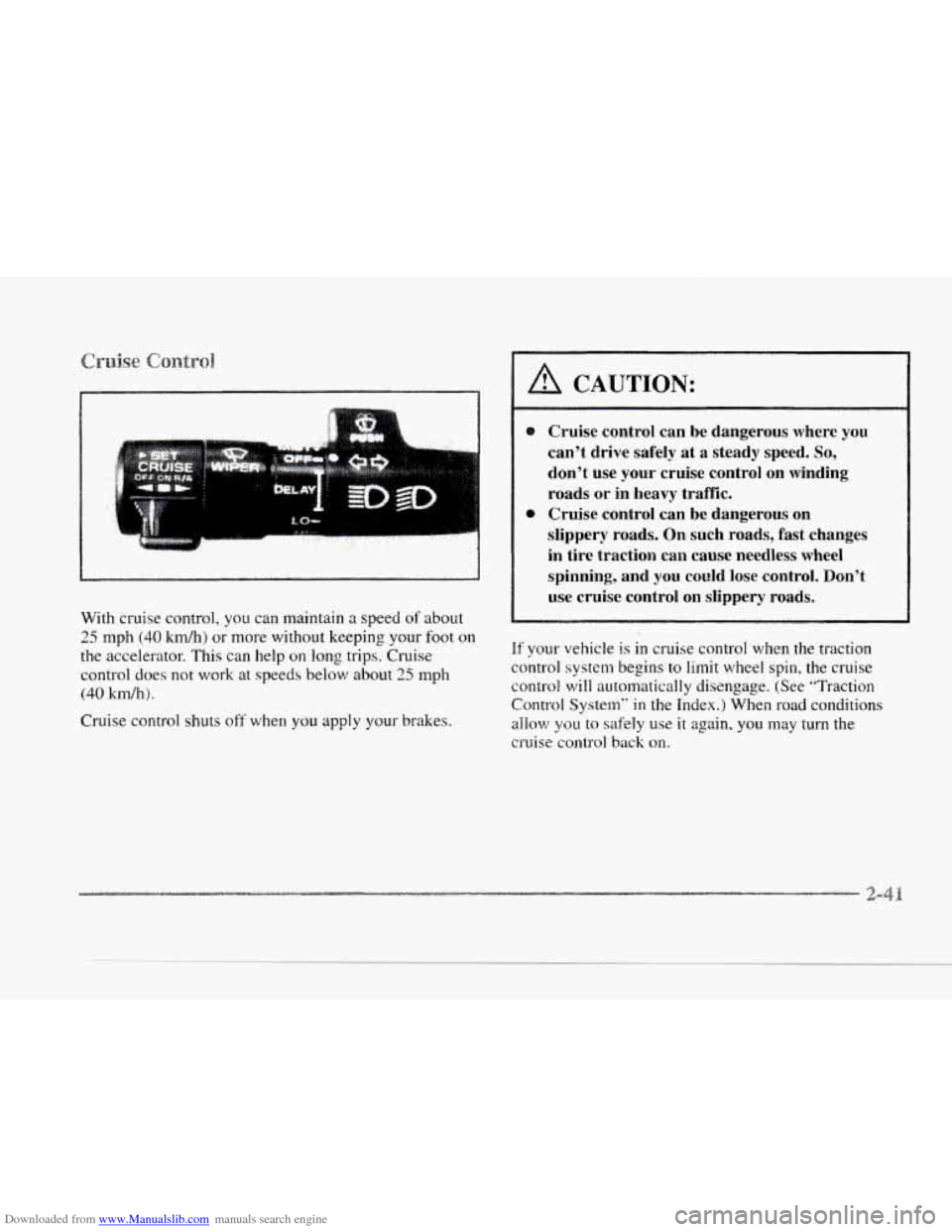
With cruise control, you can maintain a speed of about
25 mph (40 km/h) or more without keeping your foot on
the accelerator. This can help on long trips. Cruise
control does not work at speeds below about 25 tnph
(40 km/h).
Cruise control shuts off when
you apply your brakes
8 Cruise control can be dangerous where you
can’t drive safely at a steady speed.
So,
don’t use your cruise control on winding
roads or in heavy traffic.
slippery roads. On such roads, fast changes
in tire tractiom can cause needless wheel
spinning, and
you could lose control. Don’t
@ Cruise control can be dangerous on
If your vehicle is in cruise control when the traction
control system begins to limit wheel
spin, the cruise
control
will automatically disengage. (See “Traction
Control System”
in the Index.) When road conditions
allow
~CXI to safely use it again. you may turn the
cruise control
back on.
Page 105 of 370
Downloaded from www.Manualslib.com manuals search engine There are two ways to reduce your speed while using
cruise control:
0
0 Push in the button at the end of the lever until you
reach a desired lower speed, then release it. A
CRUISE ENGAGED message will then display.
To slow down in very small amounts, push the
button for less
than half a second. Each time you
do this,
you'll go 1 mph (1.6 kmh) slower.
P2Ssjgkg .&n@theY VQfricXe "%'8j.j;,iHc. j:.1siu.g;- (3x-nfse $.:t,rktg=(%l
Use the accelerator pedal to increase your speed. When
you take your foot off the pedal, your vehicle will slow
down
to the cruise control speed you set earlier.
How well your cruise control will work on hills depends
upon your speed, load and the steepness of the hills.
When going up steep hills, you may have to step on the
accelerator pedal
to maintain your speed. When going
downhill, you may have to brake or shift
to a lower gear
to keep your speed down. Of c.ourse, applying the brakes
or downshifting into
FIRST (1) takes you out of cruise
control. Many drivers find this to be
too much trouble
and don't use cruise control
on steep hills.
There are two ways
to end cruise control:
0 Step lightly on the brake pedal.
0 Move the CRUISE switch to OFF.
The cruise control set speed memory is erased when you
turn off the cruise control or the ignition.