Page 282 of 361
Downloaded from www.Manualslib.com manuals search engine Wait at least 30 minutes before checking the transaxle
fluid Bevel
if you have been driving:
When outside temperatures are above
90" F (32 " C).
At high speed for quite a while.
In heavy traffic
-- especially in hot weather.
While pulling
a trailer.
To get the right reading, the fluid should be at normal
operating temperature, which
is 180°F to 200" F
(82°C to 93°C).
Get the vehicle warmed up by driving about 15 miles
(24 km) when outside temperatures are above 50°F
(10°C). If it's colder than 50°F ( 10°C), YSU may
have to drive longer.
Park your vehicle on a level place. Keep the
engine running.
With the parhng brake applied, place the shift
lever
in PARK (P).
With your foot on the brake pedal, move the shift
lever through each gear range, pausing for about
three seconds
in each range. Then, position the shift
lever in
PARK (P).
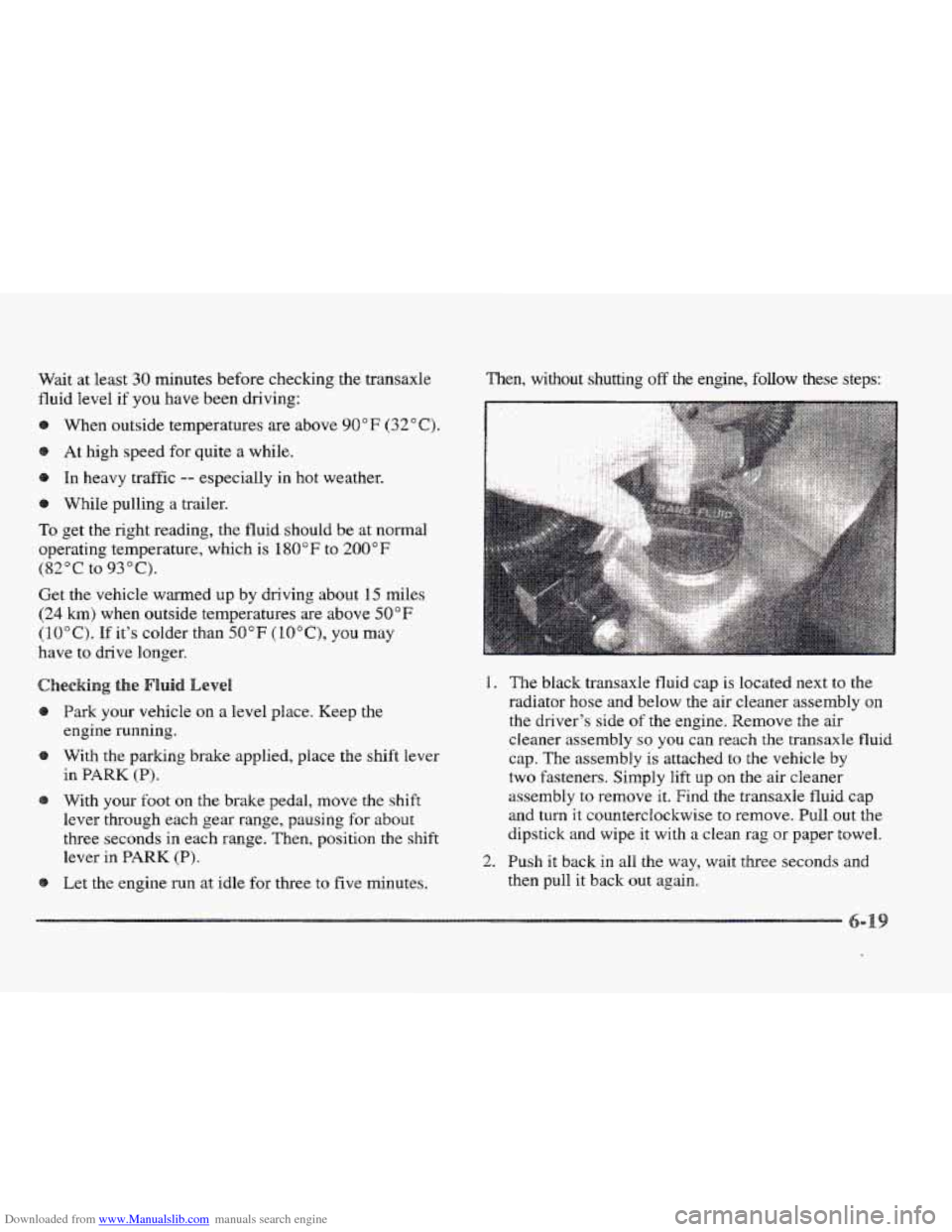
Let the engine run at idle for three to five minutes. Then, without shutting
off the engine, follow these steps:
1.
2.
The
black transaxle fluid cap is located next to the
radiator hose and
below the air cleaner assembly on
the driver's side of the engine. Remove the air
cleaner assembly
so you can reach the transaxle fluid
cap. The assembly
is attached to the vehicle by
two fasteners. Simply lift up on the air cleaner
assembly to remove it.
Find the transaxle fluid cap
and
turn it counterclockwise to remove. Pull out the
dipstick and wipe it with
a clean rag or paper towel.
Push it back in all the way, wait three seconds and
then pull it back out again.
Page 306 of 361
Downloaded from www.Manualslib.com manuals search engine The following information relates to the system developed
by the United States National Highway Traffic Safety
Administration, which grades tires by treadwear, traction
and temperature performance.
(This applies only to
vehicles sold in the United States.) The grades are molded
on
the sidewalls of most passenger car tires. The Uniform
Tire Quality Grading system does not apply to deep tread, winter-type snow tires, space-saver or temporary use spare
tires, tires with nominal rim diameters of 10 to 12 inches
(25 to 30 cm), or to some limited-production tires.
While the tires available on General Motors passenger
cars and
light trucks may vary with respect to these
grades, they must also conform
to Federal safety
requirements and additional General Motors Tire
Performance Criteria
(TPC) standards.
eadwear
The treadwear grade is a comparative rating based on
the wear rate of the tire when tested under controlled
conditions
on a specified government test course. For
example, a tire graded 150 would wear one and a haIf
( 1 1/2) times as well on the government course as a tire
upon the actual conditions of their use, however, and
may depart significantly from the norm due to variations
b Oraded 100. The relative performance of tires depends in
driving habits, service practices and differences in
road characteristics and climate.
action -- A9
The traction grades, from highest to lowest, are A, €3 and
C, and they represent the tire’s ability to stop on wet
pavement as measured under controlled conditions on
specified government test surfaces of asphalt and concrete.
A tire marked C may have poor traction performance.
Warning:
The traction grade assigned to this tire is based
on braking (straightahead) traction tests and does not
include cornering (turning) traction.
~~~~~~~~~~~ -ID A?
The temperature grades are A (the highest), B and C,
representing the tire’s resistance to the generation of
heat and its ability to dissipate heat when tested under
controlled conditions on a specified indoor laboratory
test wheel. Sustained high temperature can cause the
material
of the tire to degenerate and reduce tire life, and
excessive temperature can lead to sudden
tire failure.
The grade
C corresponds to a level of performance
which all passenger car tires must meet under the
Federal Motor Vehicle Safety Standard
No. 109. Grades
A and B represent higher levels of performance on the
laboratory test wheel than the minimum required by law.
Page 339 of 361
Downloaded from www.Manualslib.com manuals search engine You are responsible for primary insurance coverage of
the vehicle provided. In many cases, your own auto
insurance policy may provide this coverage under
provisions
for rental car agreements. Please consult your
insurance carrier to be certain
of what’s covered.
While your dealership will cover the rental expense of
a vehicle provided under the provisions
of Gold Key
Courtesy Transportation, you are responsible for
charges incurred for such items
as fuel used, additional
insurance coverage and any taxes or fees levied by state
or local governmental agencies. It
is important that your vehicle be picked up from the
dealership promptly following the completion of your
repairs. If your vehicle is not picked up from the
dealership within a reasonable amount
of time following
notification from
the dealer, you may be responsible
for any additional rental
charges incurred as a result
of this delay.
In Canada, for warranty repairs during
the Complete
Vehicle Coverage period
in the New Vehicle Limited
Warranty, interim transportation may
be available under
the Courtesy Transportation Program. Please consult
your dealer
for details.