1997 CADILLAC ELDORADO warning light
[x] Cancel search: warning lightPage 211 of 361
Downloaded from www.Manualslib.com manuals search engine .. . . .. .
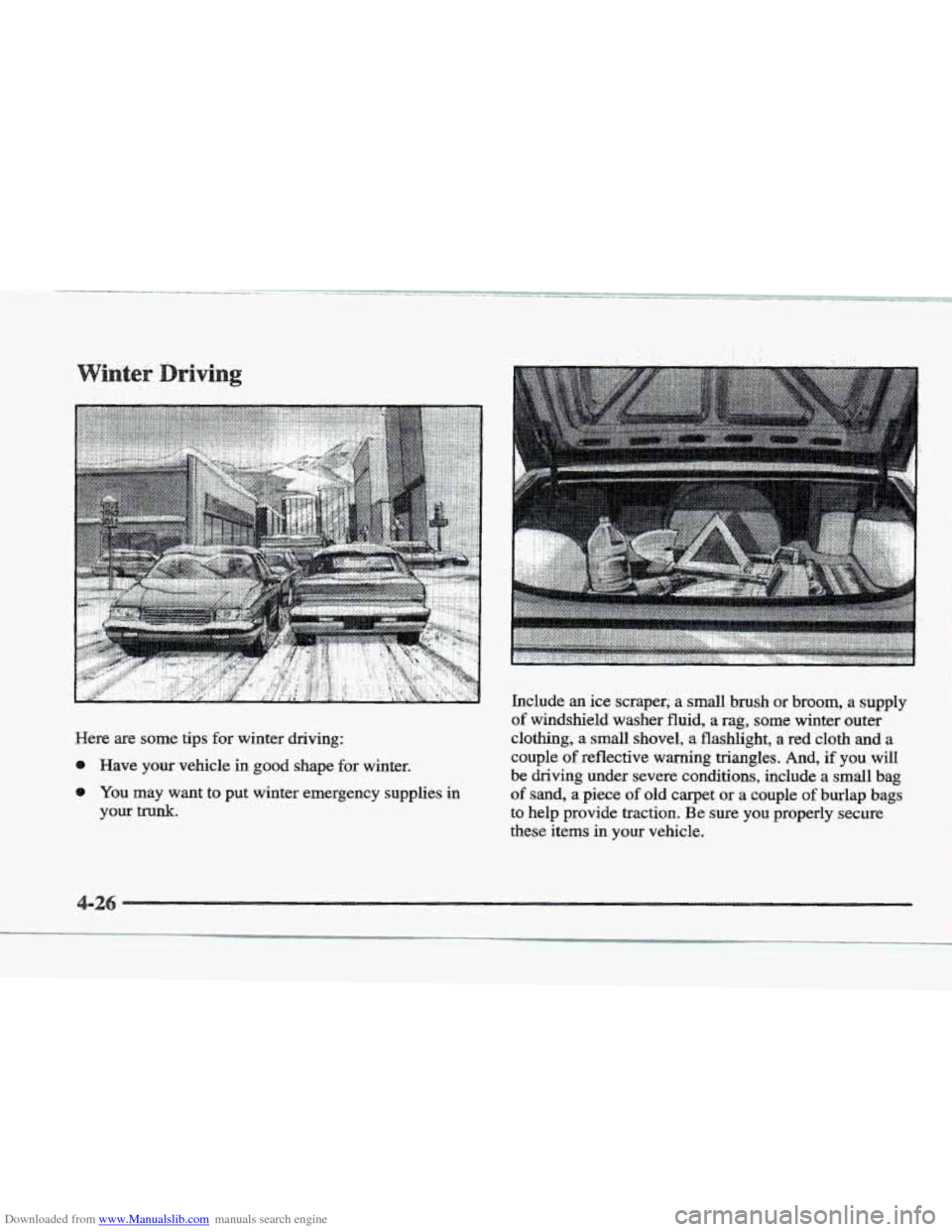
Here are some tips for winter driving:
@ Have your vehicle in good shape for winter.
0 You may want to put winter emergency supplies in
your trunk.
. ...
Include an ice scraper; a small brush or broom, a supply
of windshield washer fluid, a rag, some winter outer
clothing, a small shovel, a flashlight, a red cloth and a
couple
of reflective warning triangles. And, if you will
be driving under severe conditions,
include a small bag
of sand, a piece of old carpet or a couple of burlap bags
to help provide traction. Be sure you properly secure
these items
in your vehicle.
Page 228 of 361
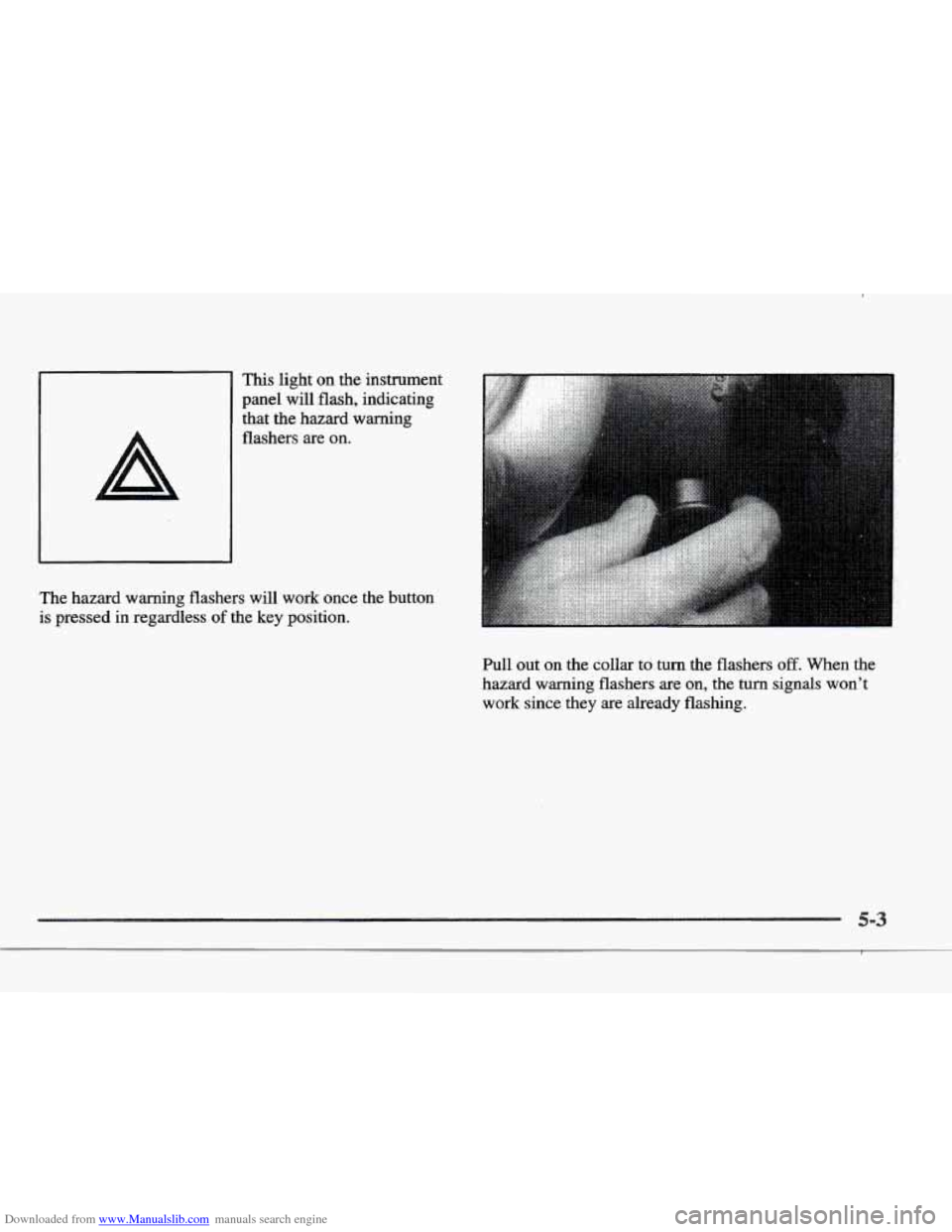
Downloaded from www.Manualslib.com manuals search engine This light on the instrument
I panel will flash, indicating
The hazard warning flashers will work once the button
is pressed in regardless
of the key position.
hll out on the collar to turn the flashers off. When the
hazard warning flashers are on, the turn signals won’t
work since they are already flashing.
Page 241 of 361
Downloaded from www.Manualslib.com manuals search engine . -.-
You will find an ENGINE COOLANT HOT-IDLE
ENGINE message or a STOP ENGINE ENGINE
OVERHEATED message on the Driver Information
Center
(IDIC). There is also an engine temperature
warning light andor gage on
the instrument panel.
See “Engine Coolant Temperature
Warning Light” or
“Engine Coolant Temperature Gage” in the Index.
Overheated Engine Protection
Should a low coolant condition exist and the message
STOP ENGINE ENGINE OVERHEATED is displayed,
an overheat protection mode which alternates firing
groups
of four cylinders helps prevent engine damage.
In this mode, you will notice a loss in power and engine
performance.
This operating mode allows your vehicle
to be driven to
a safe place in an emergency; you may
drive up to
50 miles (80 km). Towing a trailer in the
overheat protection mode
should be avoided.
NOTICE:
After driving in the overheated engine protection
operating mode, to avoid engine damage, allow the engine to cool before attempting
any repair.
The engine
oil will be severely degraded. Repair
the cause of coolant loss, change the
oil and reset
the
oil life indicator. See “Engine Oil, When to
Change” in the Index.
Page 284 of 361
Downloaded from www.Manualslib.com manuals search engine Your vehicle is equipped with a transaxle fluid change
indicator.
A CHANGE TRANS FLUID message will
display on
the Driver Information Center (DIC) when
the powertrain computer determines that the transaxle
fluid needs to be changed or at each
100,080 miles
(160 080 km) interval, whichever occurs first. See your
Maintenance Schedule booklet for more information.
When this message appears, change the transaxle fluid
and reset the transaxle fluid life indicator as follows:
I. Turn the ignition on but do not start the engine.
2. Press and hold the OFF and rear defog buttons on the
climate control at the same time until the
TRANS
FLUID RESET message appears on the DHC.
The cooling s stern in your vehicle is filled with
DEX-COOL engine coolant. This coolant is designed
to remain
in your vehicle for 5 years or 150,000 miles
(240 000 km) whichever occurs first, if you add only
DEX-COOL‘ extended life coolant.
2
The following explains your cooling system and how to
add coolant when
it is low. If YOU have a problem with
engine overheating, see “Engine Overheating”
in
the Index.
A 50/50 mixture of water and DEX-COOL@
coolant will:
@ Give freezing protection down to -34” F (-37°C).
Give boiling protection up to 265 OF (1 29°C).
Protect against rust and corrosion.
Help keep the proper engine temperature.
Let the warning lights and gages work as
they should.
When adding coolant, it is important that you use
only DEX-COOL~ (silicate-free) coolant.
If coolant other than DEX-COOL@is added t~
the system, premature engine, heater core or
radiator corrosion may result. In addition, the
engine coolant
will require change SOQWW 0- at
34b,8(Bo miles (50 000 km) or 24 months,
whichever CD~CUP’S first. Damage caused
of coolant other than
covered
by your new vehicle warranty.
Page 290 of 361

Downloaded from www.Manualslib.com manuals search engine Your brake master cylinder reservoir is here. It is filled
with
DOT-3 brake fluid.
There are only two reasons why the brake fluid level
in
the reservoir might go down. The first is that the brake
fluid goes down to an acceptable level during normal
brake lining wear. When new linings are put in, the fluid
level goes back up. The other reason
is that fluid is
leakng out of the brake system. If it is, you should have
your brake system fixed, since a leak means that sooner
or later your brakes won’t work well, 01- w~n’t work
at all.
so, it isn’t a good idea to “top off’ your brake fluid.
Adding brake fluid won’t correct a leak.
If you add fluid
when your linings are
worn, then you’ll have too much
fluid when you
get new brake linings. YOU should add
(or remove) brake fluid, as necessary, only when work is
done
on the brake hydraulic system.
When your brake fluid
falls to a low level, your brake
warning light will come on. See “Brake System Warning
Light” in the Index.
Page 292 of 361
Downloaded from www.Manualslib.com manuals search engine Your Cadillac has four-wheel disc brakes.
Disc brake pads have built-in wear indicators that make a
high-pitched warning sound when the brake pads
are
worn and new pads are needed. The sound may come and
go or be heard all the time your vehicle is moving (except
when you are pushing on the brake pedal firmly).
The brake wear warning sound means that soon
your brakes won9$ work well. That could lead to
an accident. When you hear the brake wear
warning sound, have your vehicle serviced.
Some driving conditions or climates may cause a brake
squeal when the brakes are first applied or lightly
applied. This does
not mean something is wrong with
your brakes.
Properly torqued
wheel nuts are necessary to help
prevent brake pulsation. When tires are rotated, inspect
brake pads for wear and evenly torque wheel
nuts in the
proper sequence to GM specifications.
Brake linings should always be replaced
as complete
axle
sets.
See “Brake System Inspection” in the Maintenance
Schedule booklet under Part
C “Periodic Maintenance
Inspections”.
See your dealer
if the brake pedal does not return to
normal height, or if there is a rapid increase in pedal
travel. This could be a sign of brake trouble.
Every time you apply the brakes, with or without the
vehicle
moving, your brakes adjust for wear.
Page 306 of 361
Downloaded from www.Manualslib.com manuals search engine The following information relates to the system developed
by the United States National Highway Traffic Safety
Administration, which grades tires by treadwear, traction
and temperature performance.
(This applies only to
vehicles sold in the United States.) The grades are molded
on
the sidewalls of most passenger car tires. The Uniform
Tire Quality Grading system does not apply to deep tread, winter-type snow tires, space-saver or temporary use spare
tires, tires with nominal rim diameters of 10 to 12 inches
(25 to 30 cm), or to some limited-production tires.
While the tires available on General Motors passenger
cars and
light trucks may vary with respect to these
grades, they must also conform
to Federal safety
requirements and additional General Motors Tire
Performance Criteria
(TPC) standards.
eadwear
The treadwear grade is a comparative rating based on
the wear rate of the tire when tested under controlled
conditions
on a specified government test course. For
example, a tire graded 150 would wear one and a haIf
( 1 1/2) times as well on the government course as a tire
upon the actual conditions of their use, however, and
may depart significantly from the norm due to variations
b Oraded 100. The relative performance of tires depends in
driving habits, service practices and differences in
road characteristics and climate.
action -- A9
The traction grades, from highest to lowest, are A, €3 and
C, and they represent the tire’s ability to stop on wet
pavement as measured under controlled conditions on
specified government test surfaces of asphalt and concrete.
A tire marked C may have poor traction performance.
Warning:
The traction grade assigned to this tire is based
on braking (straightahead) traction tests and does not
include cornering (turning) traction.
~~~~~~~~~~~ -ID A?
The temperature grades are A (the highest), B and C,
representing the tire’s resistance to the generation of
heat and its ability to dissipate heat when tested under
controlled conditions on a specified indoor laboratory
test wheel. Sustained high temperature can cause the
material
of the tire to degenerate and reduce tire life, and
excessive temperature can lead to sudden
tire failure.
The grade
C corresponds to a level of performance
which all passenger car tires must meet under the
Federal Motor Vehicle Safety Standard
No. 109. Grades
A and B represent higher levels of performance on the
laboratory test wheel than the minimum required by law.
Page 346 of 361
Downloaded from www.Manualslib.com manuals search engine ..........
BS ......................................... 4-7
AK Off For Engine Protection Message ............. 2-84
Adding Equipment to the Outside
of Your Vehicle ...... 6-3
AirBag ....................................... 1-21
How Does it Restrain .......................... 1-25
How it Works ................................ 1-23
Location .................................... 1-23
Readiness Light
......................... 1.22. 2.71
Servicing
................................... 1-26
What Makes it Inflate
.......................... 1-24
What Will
You See After it Inflates ............... 1-25
When Should it Inflate
......................... 1-24
AirCIeaner
.................................... 6-15
Air Conditioning ................................ 3-6
Air Conditioning Refrigerants
..................... 6-66
Air Control, Climate Control System ................. 3-3
Alarm. Theft-Deterrent
.......................... 2- 16
Aluminum Wheels. Cleaning ...................... 6-51
Analog Control Buttons .......................... 2-83
Antenna . Power ................................ 3-27
Antifreeze
..................................... 6-21
Alignment and Balance.
Tire ...................... 6-44
Anti-Lock
Brake System Warning Light
................ 2.73. 4..
Brakes .....,................................ 4-:
Anti-Lockout Feature ............................ 2-t
Anti-Theft, Radio .............................. 3-21
Appearance Care ............................... 6-4t
Appearance Care Materials
....................... 6-5:
Apply Brake
To Shift Message .................... 2-8'
Arbitration Program ............................. 7-11
Arrnrest, Storage
............................... 2-5t
Ashtrays ...................................... 2-5;
Assist Handles ................................. 2-55
Astroroof ..................................... 2-55
Audio Equipment, Adding ........................ 3-2f
Audio Steering Wheel Controls
.................... 3-25
Audio Systems
.................................. 3-5
Automatic Door Locks
............................ 2-5
Automatic Overdrive ............................ 2-25
Automatic Pull-Down Feature
..................... 2-15
Automatic Transaxle ............................ 2-21
Fluid
....................................... 6-18
Shiftin ,o ..................................... 2-23
Starting Your Engine
.......................... 2-21
Operation
................................... 2-23