Page 235 of 361
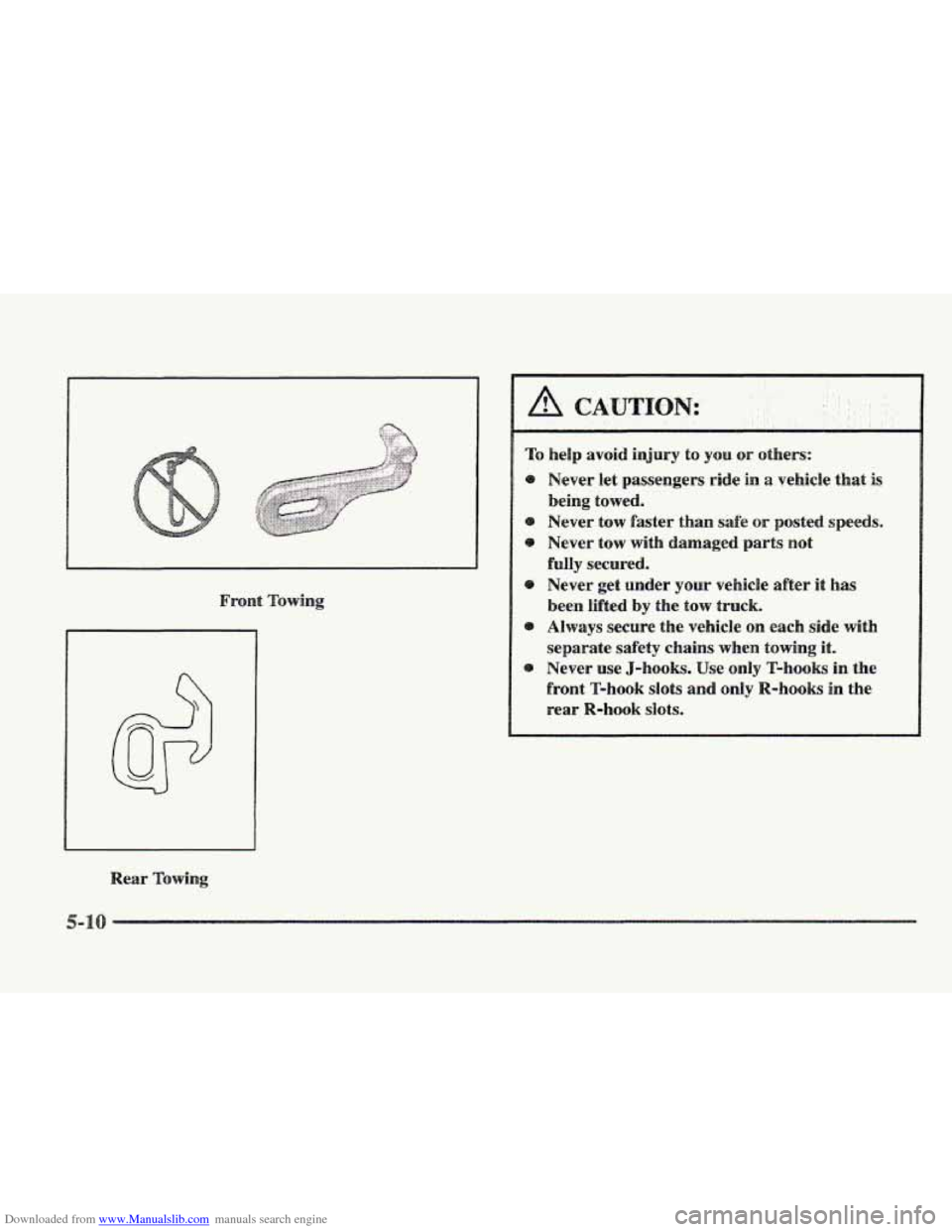
Downloaded from www.Manualslib.com manuals search engine Rear Towing
To help avoid injury to you or others:
Never
let passengers ride in a vehicle that is
being towed.
Never
tow faster than safe or posted speeds.
Never tow with damaged parts not
fully secured.
Never get under your vehicle after it has
been lifted
by the tow truck.
Always secure the vehicle
on each side with
separate safety chains when towing it.
Never use J-hooks. Use only T-hooks in the
front
T-hook slots and only R-hooks in the
rear R-hook slots.
Page 236 of 361
Downloaded from www.Manualslib.com manuals search engine ..
CA,U
.. .. . ,
A vehicle ran fall from a car-carrier if it isn’t
adequately secured. This can cause a ccollisiora,
serious
personal injury and vehicle damage. The
vehicle should
be tightly secured with chains or
steel cabIes before it is transported.
Donst
use substitutes (ropes, leather straps,
canvas webbing, etc.) that can be cut by sharp
edges underneath the towed vehicle. Always use
2’-hooks inserted in the front T-h~ok slots or
Ha-hooks inserted in the rear R-hook slots. Never
use J-lho~ks~
They will damage drivetrain and
suspension components.
When your vehicle is being towed, have the ignition
key turned
to the OFF position. The steering wheel
should be clamped in a straight-ahead position, with
a clamping device designed for towing service. Do not
use the vehicle’s steering column lock for this. The
transaxle should be
in NEUTRAL (N) and the parking
brake released.
Don’t have your vehicle towed on the drive wheels
unless you must. If the vehicle must be towed on the
drive wheels,
be sure to follow the speed and distance
restrictions later
in this section or your transaxle will be
damaged. If these limitations must be exceeded, then the
drive wheels
have to be supported on a dolly.
Page 237 of 361
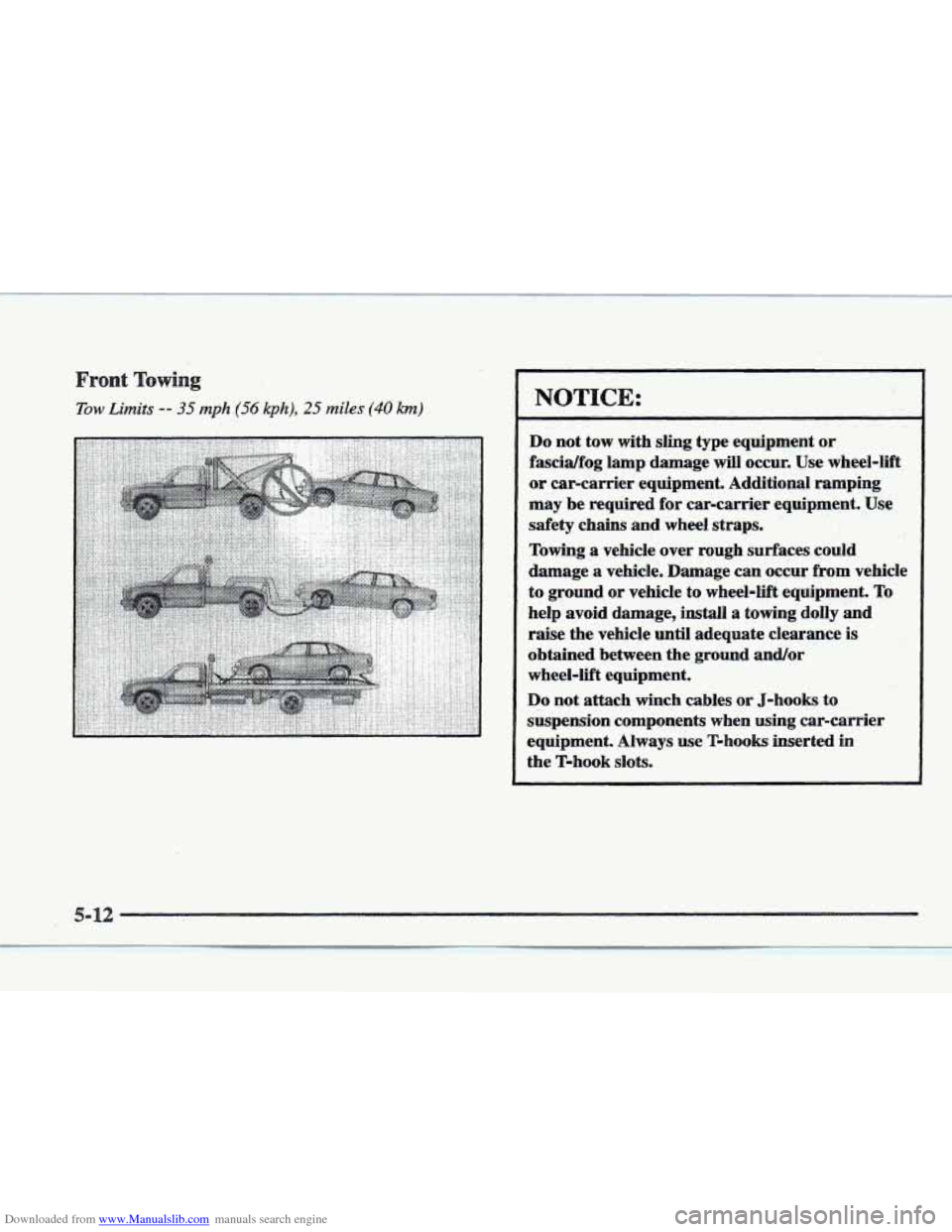
Downloaded from www.Manualslib.com manuals search engine FrOne TQ
Tow Limits -- 35 mph .(56 kph), 25 miles (40 km) NOTICE:
Do not tow with sling type equipment or
fascidfog lamp damage will occur. Use wheel-lift
or car-carrier equipment. Additional ramping
may
be required for car-carrier equipment. Use
safety chains and wheel straps.
Towing a vehicle over rough surfaces could
damage a vehicle. Damage can occur from vehicle
to ground or vehicle to wheel-lift equipment. To
help avoid damage, install a towing dolly and
raise the vehicle until adequate clearance is
obtained between the ground and/or
wheel-lift equipment.
Do not attach winch cables or J-hooks to
suspension components when using car-carrier
equipment. Always use T-hooks inserted
in
the T-kook slots.
Page 239 of 361
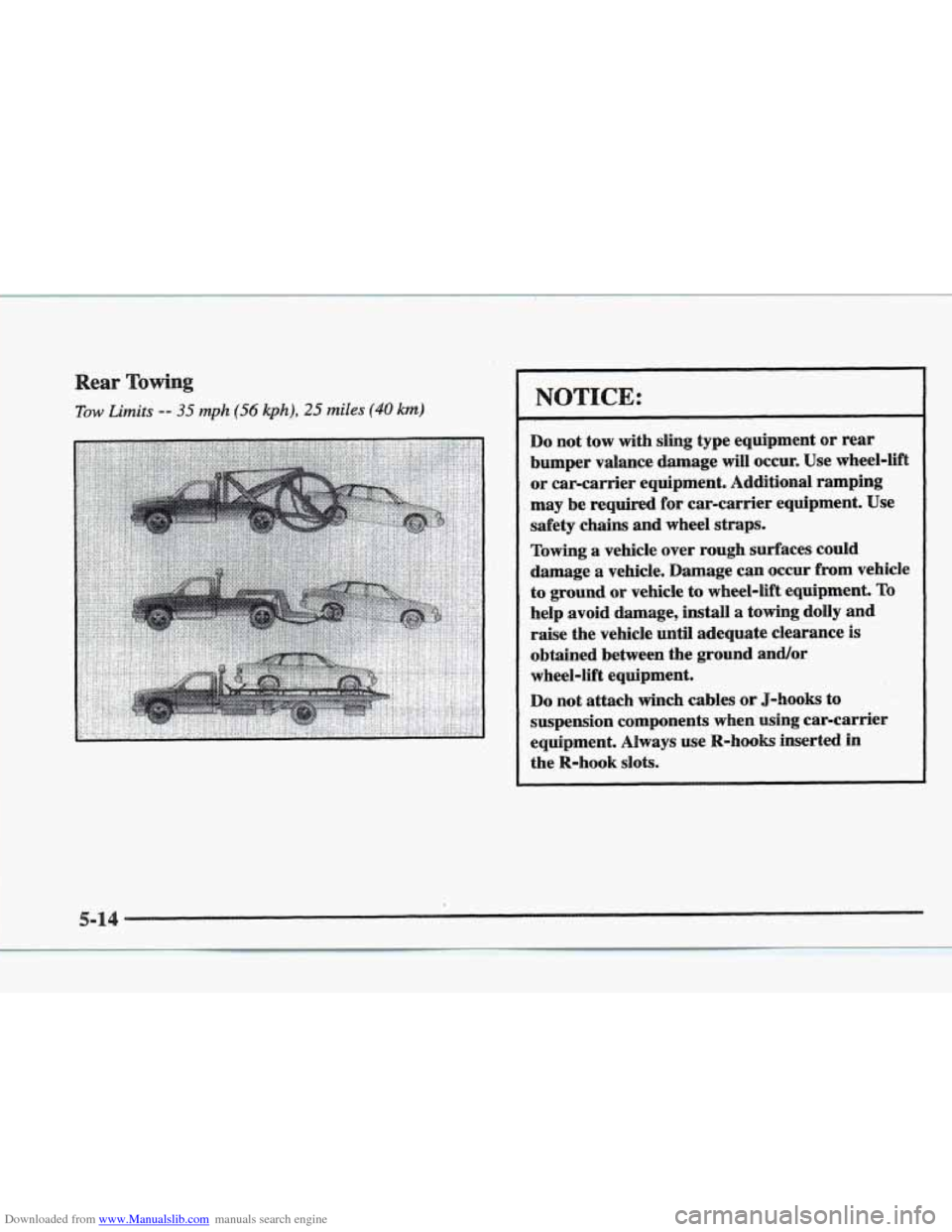
Downloaded from www.Manualslib.com manuals search engine NOTICE:
Do not tow with sling type equipment or rear
bumper valance damage will occur. Use wheel-lift
or car-carrier equipment. Additional
ramping
~ may be required for car-carrier equipment. Use
safety chains and wheel straps.
Towing
a vehicle over rough surfaces could
damage a vehicle. Damage can occur
from vehicle
to ground
or vehicle to wheel-lift equipment. To
help avoid damage, install
a towing dolly and
raise the vehicle until adequate clearance is
obtained between the
ground and/or
wheel-lift equipment.
..ti P J y..;
Do not attach winch cables or J-hooks to
suspension components when using car-carrier
equipment. Always use
W-hooks inserted in
the R-hook slots.
j
~
Page 241 of 361
Downloaded from www.Manualslib.com manuals search engine . -.-
You will find an ENGINE COOLANT HOT-IDLE
ENGINE message or a STOP ENGINE ENGINE
OVERHEATED message on the Driver Information
Center
(IDIC). There is also an engine temperature
warning light andor gage on
the instrument panel.
See “Engine Coolant Temperature
Warning Light” or
“Engine Coolant Temperature Gage” in the Index.
Overheated Engine Protection
Should a low coolant condition exist and the message
STOP ENGINE ENGINE OVERHEATED is displayed,
an overheat protection mode which alternates firing
groups
of four cylinders helps prevent engine damage.
In this mode, you will notice a loss in power and engine
performance.
This operating mode allows your vehicle
to be driven to
a safe place in an emergency; you may
drive up to
50 miles (80 km). Towing a trailer in the
overheat protection mode
should be avoided.
NOTICE:
After driving in the overheated engine protection
operating mode, to avoid engine damage, allow the engine to cool before attempting
any repair.
The engine
oil will be severely degraded. Repair
the cause of coolant loss, change the
oil and reset
the
oil life indicator. See “Engine Oil, When to
Change” in the Index.
Page 263 of 361
Downloaded from www.Manualslib.com manuals search engine Spinning yoas wheels can destroy parts of your
vehicle as well as the tires. If you spin the wheels
~QQ fast while shifting your transaxle back and
forth,
you can destroy your transaxle.
For
information about using tire chains on your vehicle,
see “Tire Chains” in the Index.
First, turn your steering wheel left and right. That will
clear the area around your front wheels.
You should turn
your traction control system off. (See “Traction Control
System”
in the Index.) Then shift back and forth
between
REVERSE (R) and a forward gear, spinning the
wheels as little as possible. Release the accelerator pedal
while you shift, and press lightly
on the accelerator
pedal when the transaxle
is in gear. If that doesn’t get
you
out after a few tries, you may need to be towed out.
If you do need to be towed out, see “Towing Your
Vehicle” in the Index.
Page 281 of 361
Downloaded from www.Manualslib.com manuals search engine ic
ange
A good time to check your automatic transaxle fluid
level
is when the engine oil is changed.
Change both
the fluid and filter every 50,000 miles
(83
000 km) if the vehicle is mainly driven under one or
more
of these conditions:
In heavy city traffic where the outside temperature
regularly reaches
90°F (32 O C) or higher.
In hilly or mountainous terrain.
When doing frequent trailer towing.
Uses such
as found in taxi, police or delivery service.
If you do not use your vehicle under any of these
conditions, the fluid and filter do not require changing.
See “Scheduled Maintenance Services”
in the
Maintenance Schedule booklet. Because this
operation can be
a little difficult, you may
choose
to have this done at your Cadillac dealership
service department.
If’ you do it yourself, be sure to follow all the instructions
here, or you could get
a false reading on the dipstick.
ICE:
Page 334 of 361
Downloaded from www.Manualslib.com manuals search engine Cadillac's exceptional Roadside Service is more than an
auto club or towing service. It provides every Cadillac
owner with the advantage
of contacting a Cadillac
advisor and, when appropriate, a Cadillac trained dealer
technician who can provide on-site service. Each technician travels
with a
specially equipped
service vehicle complete with the necessary Cadillac
parts and tools required to handle most roadside repairs.
Cadillac Roadside Service can be reached by dialing
1-800-882-11
12,24 hours a day, 365 days a year.
This service is provided at no charge for any
warranty-covered situation and for a nominal charge
if the Cadillac is no longer under warranty. Roadside
Service is available only
in the United States
and Canada.
Roadside Service provides several Cadillac
Owner Privileges
TM at "no charge," throughout
your
1997 Cadillac Warranty Period -- 48 Months/
50,000 miles (80 000 km).