Page 12 of 420
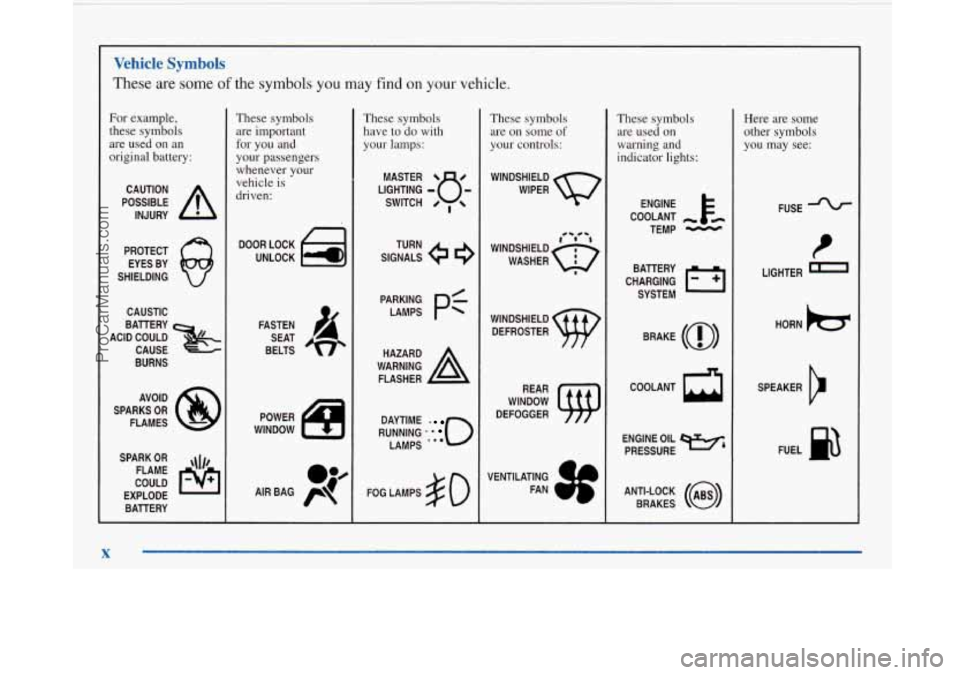
Vehicle Symbols
These are some of the symbols you may find on your vehicle.
For example,
these symbols
are used on an
original battery:
POSSIBLE A
CAUTION
INJURY
PROTECT EYES BY
SHIELDING
CAUSTIC
ACID COULD
&
BAllERY
CAUSE
BURNS
AVOID
SPARKS
OR
FLAMES
SPARK
OR ,\I/,
COULD FLAME
EXPLODE BAllERY
X
These symbols are important
for you and
your passengers
whenever your
vehicle is
driven:
DOOR LOCK
UNLOCK
FASTEN SEAT
BELTS
POWER
WINDOW
These symbols have to do with
your lamps:
SIGNALS 6
TURN
RUNNING
* ' 0
DAYTIME -
LAMPS .'*
FOG LAMPS $0
These symbols
are
on some of
your controls:
WINDSHIELD
WIPER
WINDSHIELD DEFROSTER
WINDOW
DEFOGGER
These symbols are used
on
warning and
indicator lights:
COOLANT -
TEMP -
CHARGING I-1
BAlTERY
SYSTEM
BRAKE
(a)
COOLANT a
ENGINE OIL e,
PRESSURE
ANTI-LOCK
(@)
BRAKES
Here are some
other symbols
you may see:
FUSE
LIGHTER
a
HORN )tr
SPEAKER
IJ
FUEL p3
1 I
ProCarManuals.com
Page 16 of 420
If you press the wrong MEMORY button, or if there is a
third driver, the seat adjuster will still work.
The EXIT button allows for easy exit from the vehicle.
Push and release the EXIT button while in PARK (P)
and the seat will move all the way back. You will hear a
beep when the EXIT button is pressed.
You can also set unique exit positions by moving the
seat to the desired position, and then pushing and
holding the EXIT button for greater than three seconds.
You will hear two beeps to confirm the position has
been set. The exit position will be set for the previously
identified driver. If
the ignition is not in RUN, automatic seat and mirror
movement will occur if the UNLOCK button on the
remote keyless entry transmitter is pressed. Automatic
seat and mirror movement is programmed through the
Driver Information Center (DIC)
so that the driver can
select whether the seat moves to the programmed
driving position, the programmed exit position or does
not move at all. For memory seat and mirror recall
programming instructions, see “DIC Personal Choice
Programming” in the Index.
1-4
ProCarManuals.com
Page 19 of 420
Head Restraints
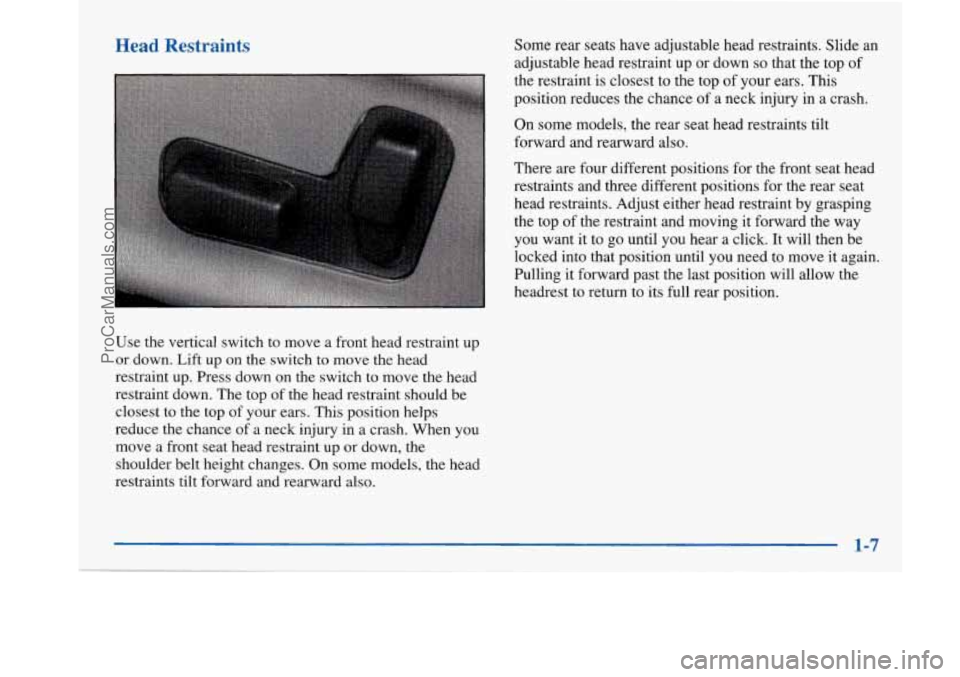
Use the vertical switch to move a front head restraint up
or down. Lift up on the switch to move the head
restraint up. Press down on the switch to move the head
restraint down. The top of the head restraint should be
closest
to the top of your ears. This position helps
reduce the chance of a neck injury in a crash. When you
move a front seat head restraint up or down, the
shoulder belt height changes. On some models, the head
restraints tilt forward and rearward also. Some
rear seats have adjustable head restraints. Slide an
adjustable head restraint up or down
so that the top of
the restraint is closest to the top of your ears. This
position reduces the chance of a neck injury in a crash.
On some models, the rear seat head restraints tilt
forward and rearward also.
There are four different positions for the front seat head
restraints and three different positions for the rear seat
head restraints. Adjust either head restraint by grasping
the top of the restraint and moving it forward the way
you want it to go until you hear a click. It will then be
locked into that position until you need to move it again.
Pulling it forward past the last position will allow the
headrest to return to its full rear position.
ProCarManuals.com
Page 25 of 420
&.’ If I’m a good driver, and I never drive far from
home, why should I wear safety belts?
A: You may be an excellent driver, but if you’re in an
accident
-- even one that isn’t your fault -- you and
your passengers can be hurt. Being a good driver
doesn’t protect you from things beyond your
control, such as bad drivers.
Most accidents occur within
25 miles (40 km) of
home. And the greatest number
of serious injuries
and deaths occur at speeds
of less than 40 mph
(65 kmk).
Safety belts are for everyone.
How to Wear Safety Belts Properly
Adults
This part is only for people of adult size.
Be aware that there are special things to know about safety
belts and children.
And there are different rules for smaller
children and babies.
If a child will be riding in your Buick,
see
the part of this manual called “Children.” Follow those
rules for everyone’s protection.
First, you’ll want to know which restraint systems your vehicle has.
We’ll start with the driver position.
Driver Position
This part describes the driver’s restraint system.
Lap-Shoulder Belt
The driver has a lap-shoulder belt. Here’s how to wear
it properly.
1. Close and lock the door.
2. Adjust the seat (to see how, see “Seats” in the Index)
so you can sit up straight.
1-13
ProCarManuals.com
Page 26 of 420
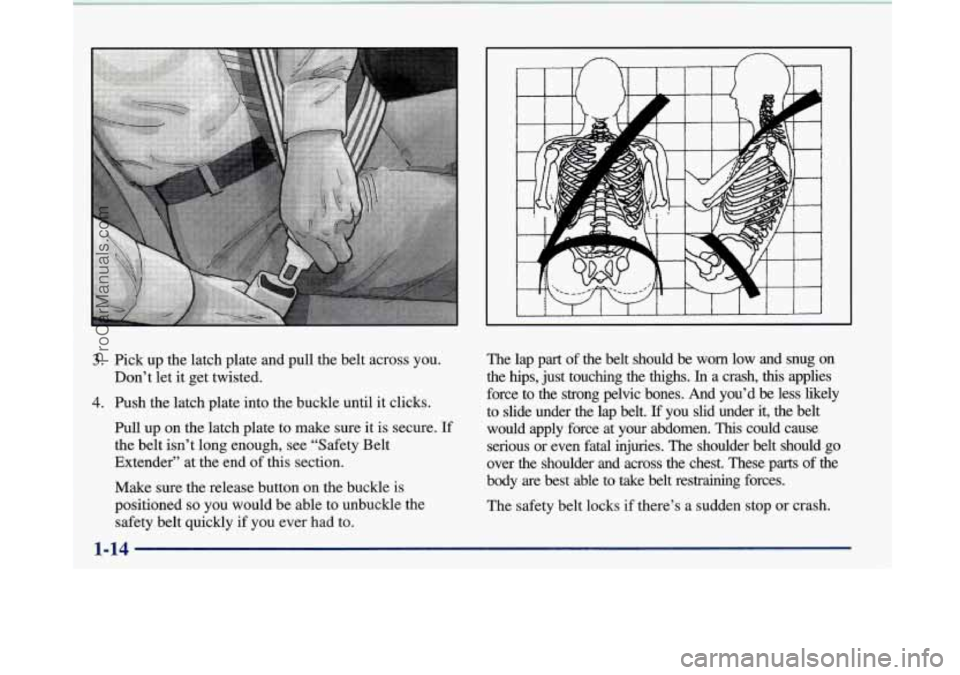
3. Pick up the latch plate and pull the belt across you.
Don’t let it get twisted.
4. Push the latch plate into the buckle until it clicks.
Pull up on the latch plate to make sure it is secure. If
the belt isn’t long enough, see “Safety Belt
Extender” at the end of this section.
Make sure the release button on the buckle is
positioned
so you would be able to unbuckle the
safety belt quickly
if you ever had to.
The lap part of the belt should be worn low and snug on
the hips, just touching the thighs.
In a crash, this applies
force to the strong pelvic bones. And you’d be less likely \
to slide under the lap belt. If you slid under it, the belt
would apply force at your abdomen.
This could cause
serious or even fatal injuries. The shoulder belt should go
over the shoulder
and across the chest. These parts of the
body are best able to take belt restraining forces.
The safety belt locks if there’s a sudden stop or crash.
ProCarManuals.com
Page 32 of 420
The best way to protect the fetus is to protect the
mother. When a safety belt is worn properly, it’s more
likely that the fetus won’t be hurt in a crash. For
pregnant women, as for anyone, the key to making
safety belts effective is wearing them properly.
Right Front Passenger Position
The right front passenger’s safety belt works the same
way
as the driver’s safety belt. See “Driver Position,”
earlier in this section.
When the lap portion of the belt is pulled out all the
way, it will lock. If it does, let it go back all the way and
start again.
If your vehicle has a center passenger position, be sure
to use the correct buckle when buckling your
lap-shoulder belt. If
you find that the latch plate will not
go fully into the buckle, see if you
are using the buckle
for the center passenger position.
Supplemental Restraint System (SRS)
This part explains the Supplemental Restraint System
(SRS) or air bag system.
Your Buick has two air bags
-- one air bag for the driver
and another air bag for the right front passenger.
Here are the most important things to know about the air
bag system:
1
You can be severely injured or killed in a crash if
you aren’t wearing your safety belt -- even if you
have air bags. Wearing your safety belt during a
crash helps reduce your chance of hitting things
inside the vehicle or being ejected from it.
Air
bags are “supplemental restraints” to the safety
belts. All
air bags are designed to work with
safety belts, but don’t replace them. Air bags are
designed to work only in moderate to severe
crashes where the front of your vehicle hits
something. They aren’t designed to inflate at all
in rollover, rear, side or low-speed frontal
crashes. Everyone in your vehicle should wear a
safety belt properly
-- whether or not there’s an
air bag for that person.
1-20
ProCarManuals.com
Page 42 of 420
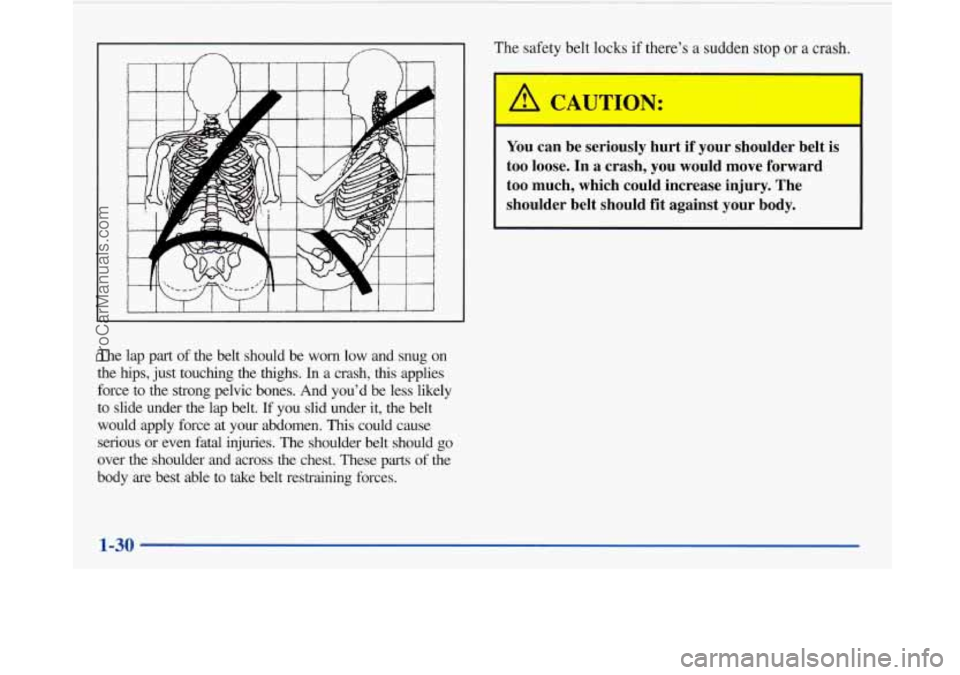
The lap part of the belt should be worn low and snug on
the
hips, just touching the thighs. In a crash, this applies
force to the strong pelvic bones. And you’d be less likely \
to slide under the lap belt.
If you slid under it, the belt
would apply force at your abdomen. This could cause
serious or even fatal injuries. The shoulder belt should go
over the shoulder and across
the chest. These parts of the
body are best able to take belt restraining forces. The
safety belt locks
if there’s
a sudden stop or a crash.
You can be seriously hurt if your shoulder belt is
too loose. In a crash, you would move forward
too much, which could increase injury. The
shoulder belt should fit against your body.
1-30
ProCarManuals.com
Page 55 of 420
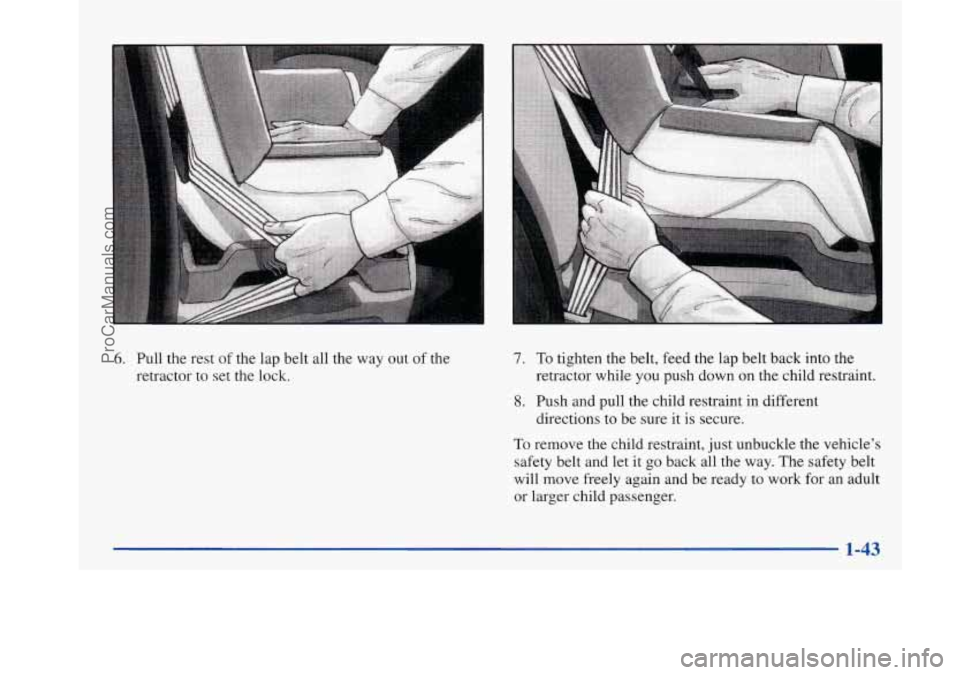
6. Pull the rest of the lap belt all the way out of the
retractor to set the lock. 7. To tighten the belt, feed the lap belt back into the
retractor while you push down on the child restraint.
8. Push and pull the child restraint in different
directions to be sure
it is secure.
To remove the child restraint, just unbuckle the vehicle’s
safety belt and let it go back all the way. The safety belt
will move freely again and be ready to work for an adult
or larger child passenger.
ProCarManuals.com