Page 295 of 406
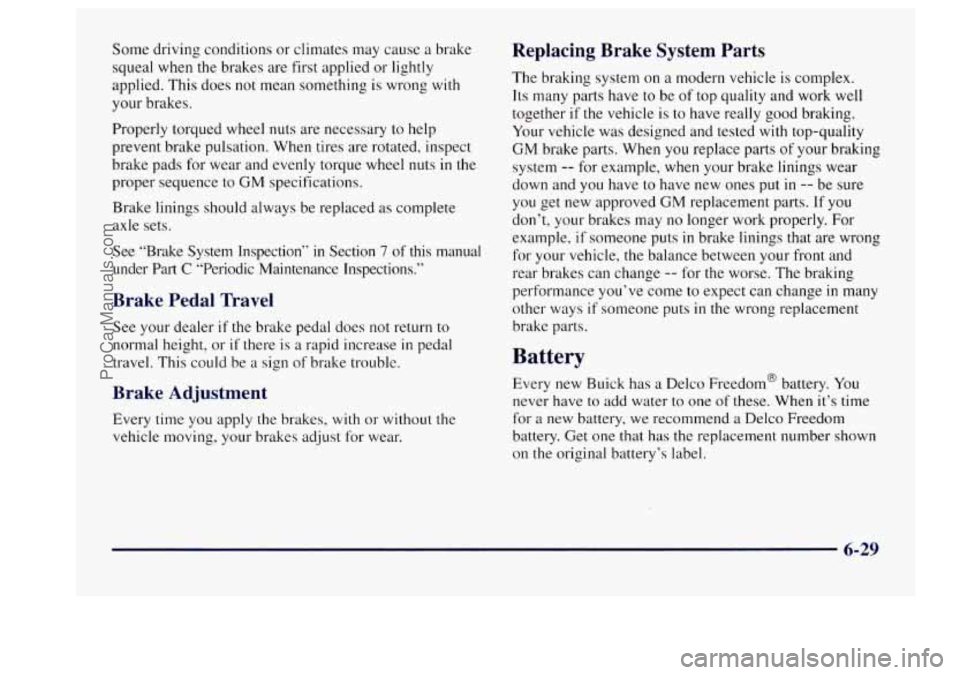
Some driving conditions or climates may cause a brake
squeal when the brakes are first applied or lightly
applied. This does not mean something is wrong with
your brakes.
Properly torqued
wheel nuts are necessary to help
prevent brake pulsation. When tires are rotated, inspect
brake pads for wear and evenly torque wheel
nuts in the
proper sequence to
GM specifications.
Brake linings should always be replaced
as complete
axle sets.
See “Brake System Inspection”
in Section 7 of this manual
under Part
C “Periodic Maintenance Inspections.”
Brake Pedal Travel
See your dealer if the brake pedal does not return to
normal height, or
if there is a rapid increase in pedal
travel. This could be
a sign of brake trouble.
Brake Adjustment
Every time you apply the brakes, with or without the
vehicle moving, your brakes adjust for wear.
Replacing Brake System Parts
The braking system on a modern vehicle is complex.
Its many parts have to be of top quality and work well
together if
the vehicle is to have really good braking.
Your vehicle was designed and tested with top-quality
GM brake parts. When you replace parts
of your braking
system
-- for example, when your brake linings wear
down and you have to have new ones
put in -- be sure
you get new approved GM replacement parts.
If you
don’t, your brakes may no longer work properly. For
example,
if someone puts in brake linings that are wrong
for your vehicle, the balance between your front and
rear brakes can change
-- for the worse. The braking
performance you’ve come to expect can change
in many
other ways
if someone puts in the wrong replacement
brake parts.
Battery
Every new Buick has a Delco Freedom@ battery. You
never have to add water to one of these. When it’s time
for a new battery, we recommend a Delco Freedom
battery. Get one that
has the replacement number shown
on the original battery’s label.
6-29
ProCarManuals.com
Page 310 of 406
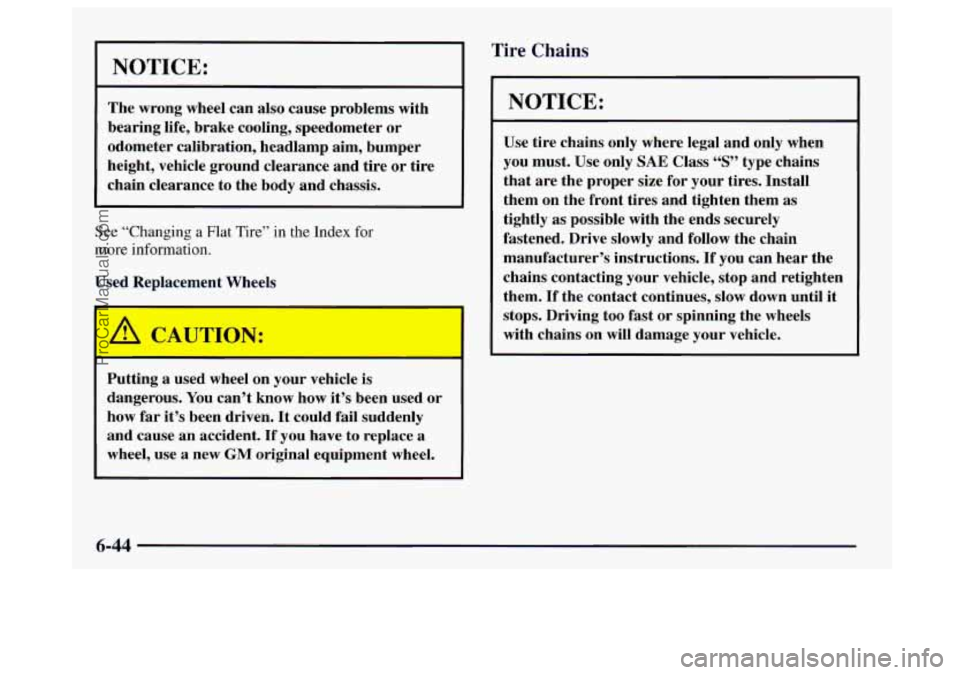
NOTICE:
The wrong wheel can also cause problems with
bearing life, brake cooling, speedometer
or
odometer calibration, headlamp aim, bumper
height, vehicle ground clearance and tire or tire
chain clearance to the body and chassis.
See “Changing a
Flat Tire” in the Index for
more information.
It Wknnls
Putting
a used wheel on your vehicle is
dangerous. You can’t know how it’s been used or
how far it’s been driven. It could fail suddenly
and cause an accident.
If you have to replace a
wheel, use a new GM original equipment wheel.
Tire Chains
NOTICE:
Use tire chains only where legal and only when
you must. Use only
SAE Class “S” type chains
that are the proper size
for your tires. Install
them on the front tires and tighten them as
tightly as possible with the ends securely
fastened. Drive slowly
and follow the chain
manufacturer’s instructions.
If you can hear the
chains contacting your vehicle, stop and retighten
them.
If the contact continues, slow down until it
stops. Driving too fast or spinning the wheels
with chains on will damage your vehicle.
6-44
ProCarManuals.com
Page 325 of 406
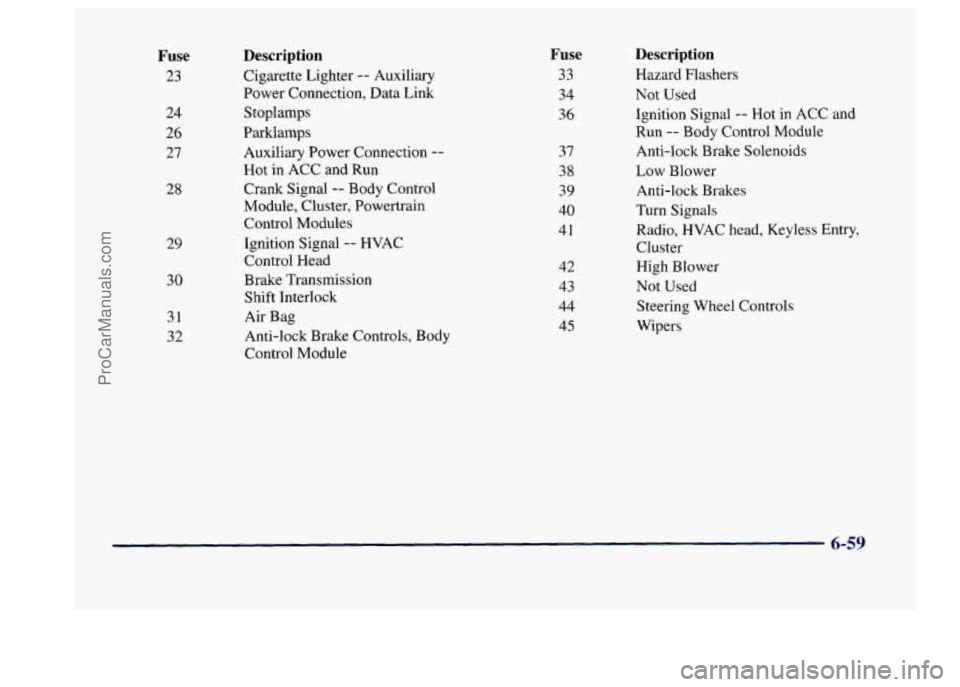
Fuse
23 24
26 27
28
29
30
31
32
Description
Cigarette Lighter -- Auxiliary
Power Connection, Data Link
Stoplamps
Parklamps Auxiliary Power Connection
--
Hot in ACC and Run
Crank Signal
-- Body Control
Module, Cluster, Powertrain
Control
Modules
Ignition Signal -- HVAC
Control Head
Brake Transmission
Shift Interlock
Air Bag
Anti-lock Brake Controls, Body
Control Module
Fuse
33
34
36
37
38
39
40
41
42
43
44
45
Description
Hazard Flashers
Not Used
Ignition Signal
-- Hot in ACC and
Run
-- Body Control Module
Anti-lock Brake Solenoids
Low Blower
Anti-lock Brakes
Turn Signals Radio,
HVAC head, Keyless Entry,
Cluster
High Blower
Not Used
Steering Wheel Controls
Wipers
6-59
ProCarManuals.com
Page 331 of 406
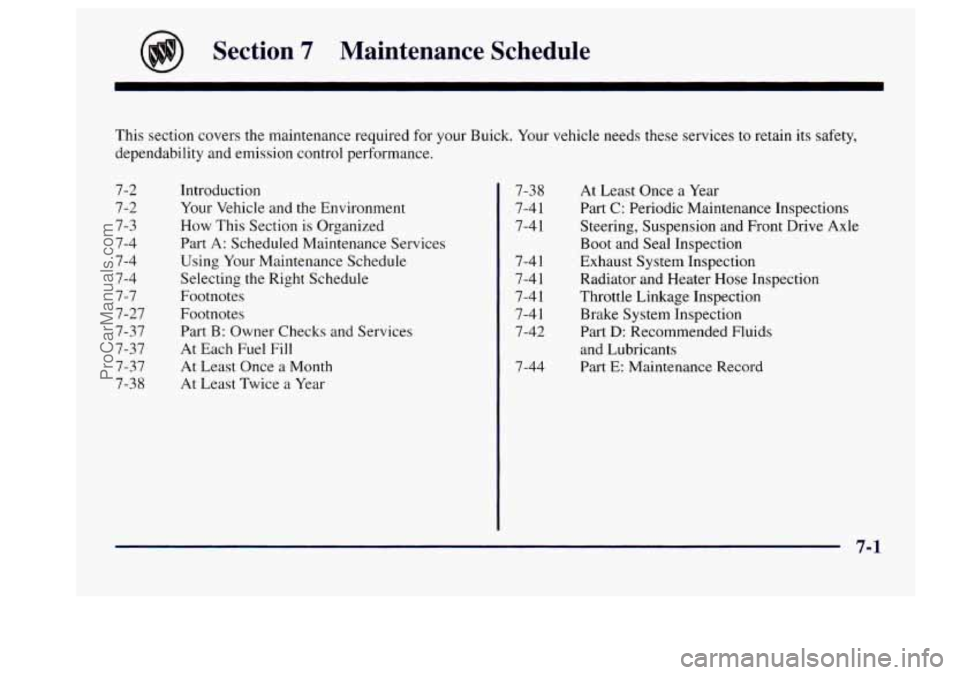
Section 7 Maintenance Schedule
This section covers the maintenance required for your Buick. Your vehicle needs these services to retain its safety,
dependability and emission control performance.
7-2
7-2
7-3 7-4
7-4
7-4
7-7
7-27
7-37
7-37
7-37
7-38 Introduction
Your Vehicle and the Environment
How This Section is Organized
Part
A: Scheduled Maintenance Services
Using Your Maintenance Schedule
Selecting the Right Schedule
Footnotes
Footnotes
Part
B: Owner Checks and Services
At Each
Fuel Fill
At Least Once a Month
At Least Twice
a Year At
Least Once a Year
Part
C: Periodic Maintenance Inspections
Steering, Suspension and Front Drive Axle
Boot and Seal Inspection
Exhaust System Inspection
Radiator and Heater Hose Inspection
Throttle Linkage Inspection
Brake System Inspection
Part
D: Recommended Fluids
and Lubricants
Part
E: Maintenance Record
7-38
7-4 I
7-4 1
7-4 1
7-4 1
7-4 1
7-4 1
7-42
7 -44
7-1
ProCarManuals.com
Page 337 of 406
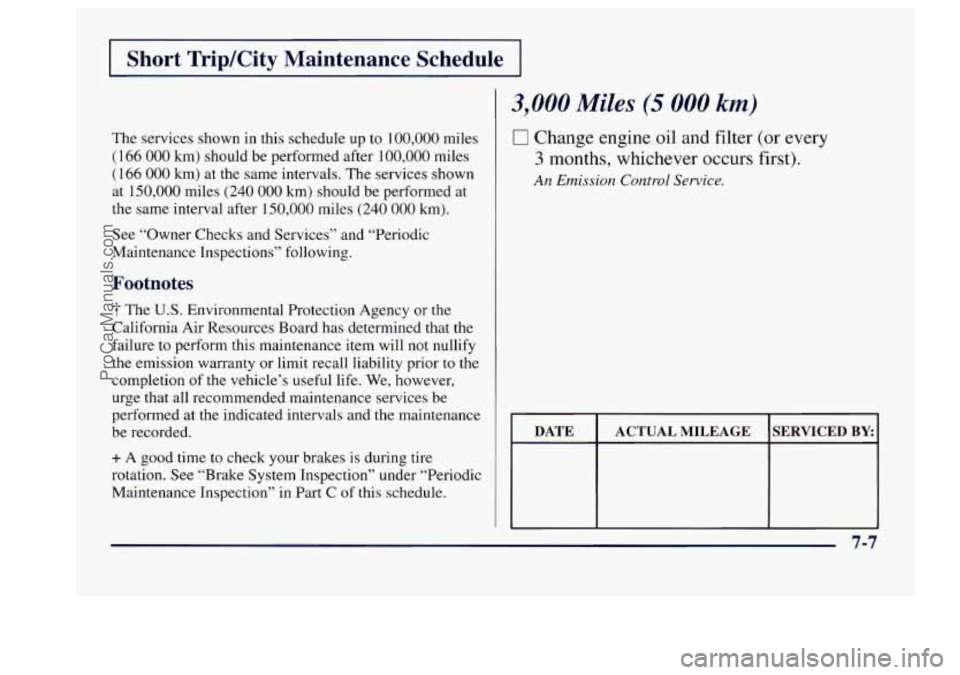
Short TripKity Maintenance Schedule
The services shown in this schedule up to 100,000 miles
(1 66 000 km) should be performed after 100,000 miles
(1 66 000 km) at the same intervals. The services shown
at 150,000 miles
(240 000 km) should be performed at
the same interval after 150,000 miles
(240 000 km).
See “Owner Checks and Services” and “Periodic
Maintenance Inspections” following.
Footnotes
The U.S. Environmental Protection Agency or the
California Air Resources Board
has determined that the
failure to perform this maintenance item will not nullify
the emission warranty or limit recall liability prior to the
completion of the vehicle’s useful life. We, however,
urge that a11 recommended maintenance services be
performed at the indicated intervals and the maintenance
be recorded.
+ A good time to check your brakes is during tire
rotation. See “Brake System Inspection” under “Periodic
Maintenance Inspection” in Part
C of this schedule.
3,000 Miles (5 000 km)
0 Change engine oil and filter (or every
3 months, whichever occurs first).
An Emission Control Service.
DATE
SERVICED BY: ACTUAL MILEAGE
7-7
ProCarManuals.com
Page 357 of 406
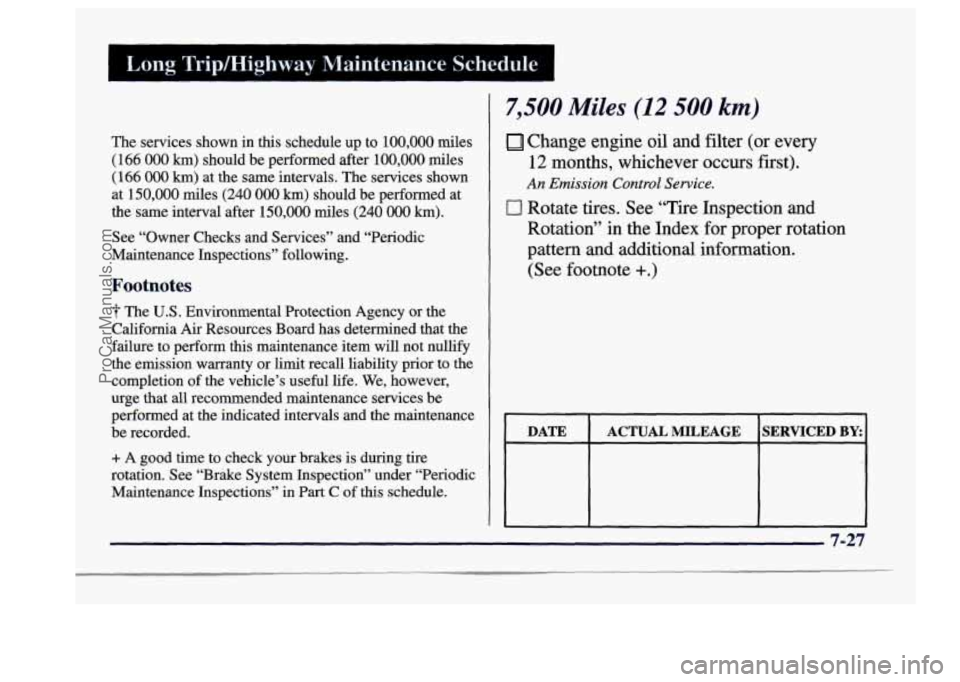
The services shown in this schedule up to 100,000 miles
(166
000 km) should be performed after 100,000 miles
(166 000 km) at the same intervals. The services shown
at
150,000 miles (240 000 km) should be performed at
the same interval after 150,000 miles (240
000 km).
See “Owner Checks and Services” and “Periodic
Maintenance Inspections” following.
Footnotes
The U.S. Environmental Protection Agency or the
California Air Resources Board has determined that the
failure to perform this maintenance item will not nullify
the emission warranty or limit recall liability prior to the
completion
of the vehicle’s useful life. We, however,
urge that all recommended maintenance services be
performed at the indicated intervals and the maintenance
be recorded.
+ A good time to check your brakes is during tire
rotation. See “Brake System Inspection” under “Periodic
Maintenance Inspections’’ in Part
C of this schedule.
7,500 Miles (12 500 km)
Change engine oil and filter (or every
12 months, whichever occurs first).
An Emission Control Service.
0 Rotate tires. See “Tire Inspection and
Rotation” in the Index for proper rotation
pattern and additional information.
(See footnote
+.)
DATE SERVICED BY: ACTUAL MILEAGE
ProCarManuals.com
Page 369 of 406
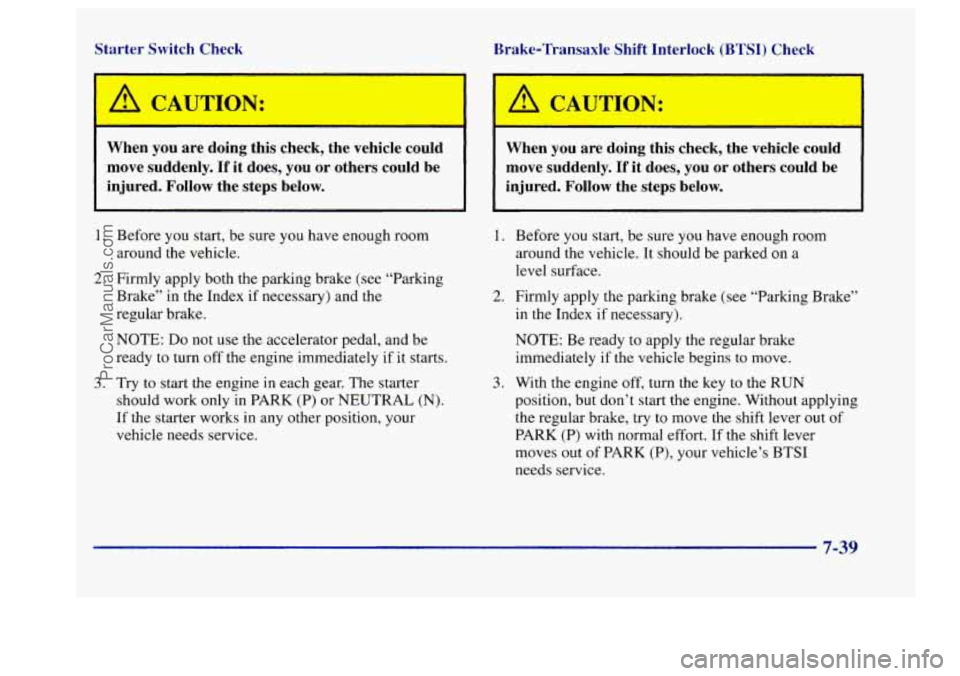
Starter Switch Check Brake-Transaxle Shift Interlock (BTSI) Check
I A CAUTION:
I
A CAUTION:
When you are doing this check, the vehicle could
When you are doing this check, the vehicle could
move suddenly.
If it does, you or others could be move suddenly. If it does, you or others could be
injured. Follow the steps below. injured. Follow the steps below.
1. Before you start, be sure you have enough room
around the vehicle.
2. Firmly apply both the parking brake (see “Parking
Brake” in the Index if necessary) and the
regular brake.
NOTE: Do not use the accelerator pedal, and be
ready to turn off the engine immediately if it starts.
3. Try to start the engine in each gear. The starter
should work only in PARK (P) or NEUTRAL
(N).
If the starter works in any other position, your
vehicle needs service.
1. Before you start, be sure you have enough room
around the vehicle. It should be parked on a
level surface.
2. Firmly apply the parking brake (see “Parking Brake”
in
the Index if necessary).
NOTE: Be ready to apply the regular brake
immediately if the vehicle begins to move.
3. With the engine off, turn the key to the RUN
position, but don’t start the engine. Without applying
the regular brake, try to move the shift lever out of
PARK
(P) with normal effort. If the shift lever
moves out of PARK
(P), your vehicle’s BTSI
needs service.
~~ 7-39
ProCarManuals.com
Page 370 of 406
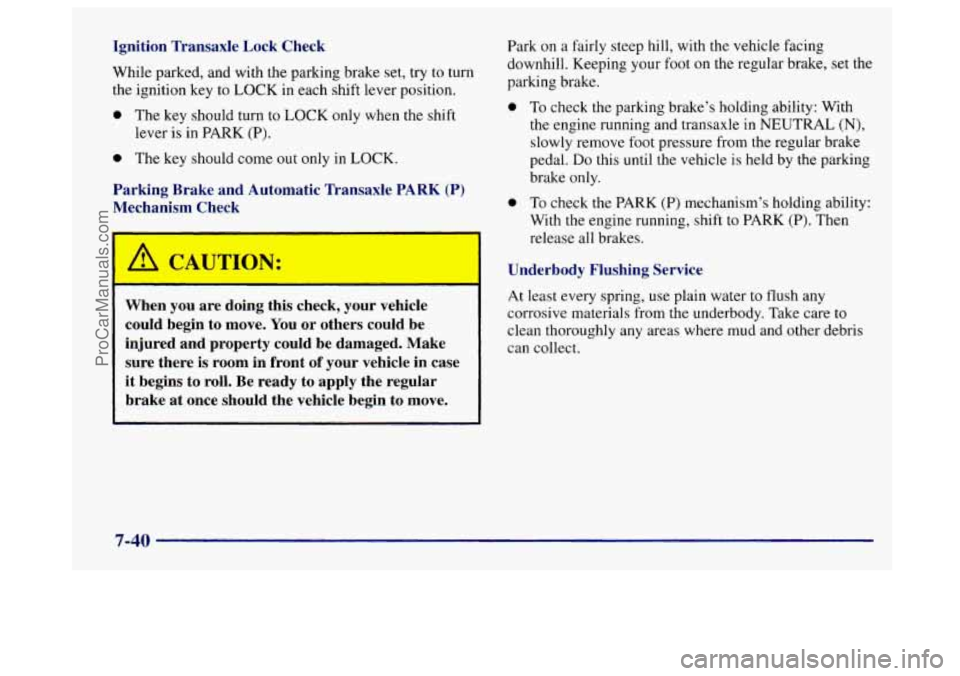
Ignition Transaxle Lock Check
While parked, and with the parking brake set, try to turn
the ignition key to
LOCK in each shift lever position.
0 The key should turn to LOCK only when the shift
lever is
in PARK (P).
0 The key should come out only in LOCK.
Parking Brake and Automatic Transaxle PARK
(P)
Mechanism Check Park on
a fairly steep hill, with the vehicle facing
downhill. Keeping your foot
on the regular brake, set the
parking brake.
0 To check the parking brake’s holding ability: With
the engine running and transaxle in NEUTRAL
(N),
slowly remove foot pressure from the regular brake
pedal. Do this until the vehicle is held by the parking
brake only.
0 To check the PARK (P) mechanism’s holding ability:
With the engine running, shift to PARK
(P). Then
1
release all brakes.
Underbody Flushing Service
When you are doing this check, your vehicle
could begin to move. You or others could be clean thoroughly any areas where mud and other debris
injured and property could be damaged. Make can collect.
sure there is
room in front of your vehicle in case
it begins to roll. Be ready to apply the regular
brake at once should the vehicle begin to move. At
least every spring, use plain water to flush any
corrosive materials from the underbody. Take care to
7-40
ProCarManuals.com