Page 94 of 406
LOCK (B): Before you put the key into the ignition
switch, the switch is in
LOCK. It’s also the only position
from which you
can remove your key. This position
locks your ignition, steering wheel and transaxle. It’s
a
theft-deterrent feature.
OFF (C): This position lets you turn off the engine but
still turn
the steering wheel, It doesn’t lock the steering
wheel like
LOCK. Use OFF if you must have your
vehicle pushed or towed.
RUN (D): This position is where the key returns after you
start your vehicle. With the engine off, you can use RUN
to display some of your warning and indicator lights.
START (E): This position starts your engine.
A warning chime will sound if you open the driver’s
door when the ignition is
in OFF, LOCK or ACC and
the key is in the ignition.
NOTICE:
If your key seems stuck in LOCK and you can’t
turn it, be sure you are using the correct. key; if
so, is it all the way in? If it is, then turn the
steering wheel left and right while you turn the
key hard. But turn the key only with your hand.
Using a tool to force it
could break the key or the
ignition switch.
If none of this works, then your
vehicle needs service.
In case you cannot remove
your key from the ignition,
find the access
slot which is located underneath the
steering column below the lock cylinder.
To use this slot, remove the trim cap. Insert
a key or
screwdriver into the access slot and rotate the lock
cylinder.
You will now be able to remove your key from
the ignition. Be sure to replace the trim cap after use.
2-18
ProCarManuals.com
Page 98 of 406
Automatic Transaxle Operation PARK (P): This locks your front wheels. It’s the best
position to use when you start your engine because your
vehicle can’t move easily.
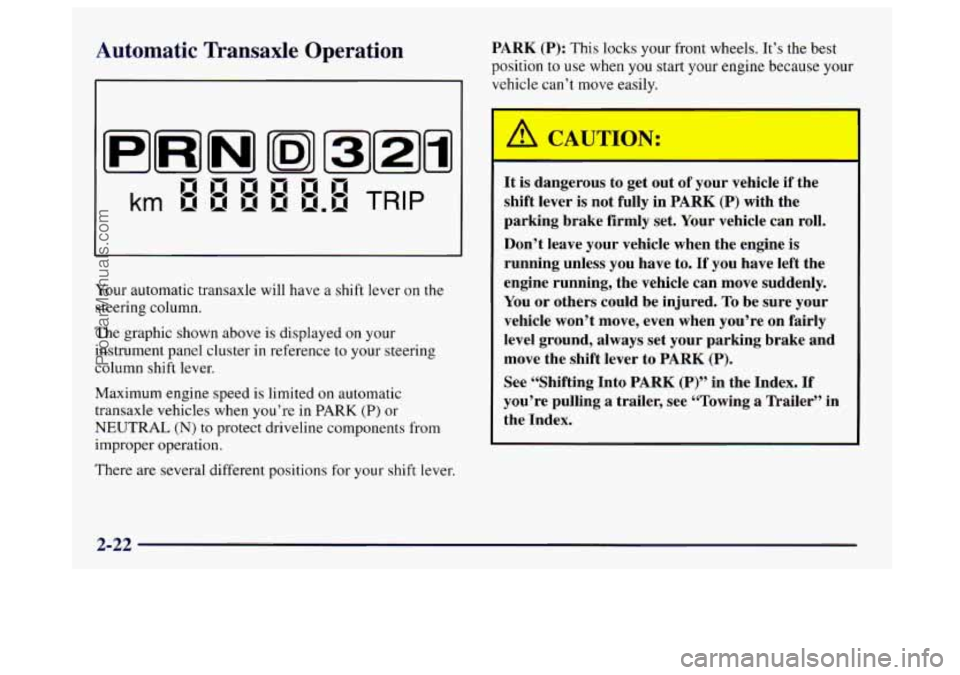
Your automatic transaxle will have
a shift lever on the
steering column.
The graphic shown above is displayed on your
instrument panel cluster
in reference to your steering
column shift lever.
Maximum engine speed is limited on automatic
transaxle vehicles when you’re in
PARK (P) or
NEUTRAL (N) to protect driveline components from
improper operation.
There are several different positions for your shift lever.
L
CAUTIO,. :
It is dangerous to get out of your vehicle if the
shift lever is not fully in
PARK (P) with the
parking brake firmly set. Your vehicle can roll.
Don’t leave your vehicle when the engine is
running unless you have
to. If you have left the
engine running, the vehicle
can move suddenly.
You or others could be injured. To be sure your
vehicle won’t move, even when you’re on fairly
level ground, always set your parking brake and
move the shift lever to
PARK (P).
See “Shifting Into PARK (P)” in the Index. If
you’re pulling a trailer, see “Towing a Trailer” in
the Index.
2-22
ProCarManuals.com
Page 99 of 406
Make sure the shift lever is fully into PARK (P) range
before starting the engine. Your Buick has
a
brake-transaxle shift interlock. You must fully apply
your regular brakes before you can shift from PARK
(P)
when the ignition is in RUN. If you cannot shift out of
PARK (P), ease pressure on the shift lever by pushing it
all the way into PARK (P) while keeping the brake pedal
pushed down. See “Shifting Out of PARK
(P)” in
the Index.
REVERSE (R): Use this gear to back up.
NOTICE:
_____~ ~~ ~~ ~
Shifting to REVERSE (R) while your vehicle is
moving forward could damage your transaxle. Shift to
REVERSE (R) only after your vehicle
is stopped.
To rock your vehicle back and forth to get out of snow,
ice or sand without damaging your transaxle, see
“Stuck:
In Sand, Mud, Ice or Snow” in the Index.
NEUTRAL (N): In this position, your engine
doesn’t connect with the wheels.
To restart when you’re
already moving, use NEUTRAL
(N) only. Also, use
NEUTRAL
(N) when your vehicle is being towed.
Shifting out of
PARK (P) or NEUTRAL (N) while
your engine
is “racing” (running at high speed) is
dangerous. Unless your foot is firmly on the
brake pedal, your vehicle could move very
rapidly. You could lose control and hit people or
objects. Don’t shift out
of PARK (P) or
NEUTRAL (N) while your engine is racing.
NOTICE:
Damage to your transaxle caused by shifting out
of PARK (P) or NEUTRAL (N) with the engine
racing isn’t covered by your warranty.
2-23
ProCarManuals.com
Page 101 of 406
SECOND (2): This position gives you more power but
lower fuel economy. You can use
SECOND (2) on hills.
It can help control your speed as you go down steep
mountain roads, but then you would also want to use
your brakes
off and on.
NOTICE:
Don’t drive in SECOND (2) for more than
25 miles (41 km), or at speeds over 55 mph
(88 km/h), or you can damage your transaxle.
Use AUTOMATIC OVERDRIVE
(@) or
THIRD
(3) as much as possible.
Don’t shift into SECOND
(2) unless you are going
slower than
65 mph (105 km/h), or you can
damage your engine.
FIRST (1): This position gives you even more power
(but lower fuel economy) than
SECOND (2). You can
use it on very steep hills, or in deep snow or mud.
If the
shift lever is put in
FIRST (1)’ the transaxle won’t shift
into first gear until the vehicle is going slowly enough.
NOTICE:
If your front wheels can’t rotate, don’t try to
drive.
This might happen if you were stuck in
very deep sand or mud or were up against a solid
object. You could damage your transaxle.
Also, if you stop when going uphill, don’t hold
your vehicle there with only the accelerator
pedal. This could overheat and damage the
transaxle. Use your brakes or shift into
PARK (P)
to hold your vehicle in position on a hill.
2-25
ProCarManuals.com
Page 109 of 406
Horn Tilt Steering Wheel
A tilt steering wheel allows
you to adjust the steering
wheel before you drive. You
can also raise it
to the
highest level to give your
legs more room when you
exit and enter the vehicle.
To tilt the wheel, hold the steering wheel and pull the
lever. Move the steering wheel to a comfortable level,
Press on or anywhere near the horn symbols on your then release the lever to lock the wheel into place.
steering wheel pad
to sound the horn.
2-33
ProCarManuals.com
Page 114 of 406
When you apply your brakes, the cruise control
shuts
off.
/tl CAC LION:
Setting Cruise Control
Cruise control can be dangerous where you
can't
drive safely at a steady speed. So,
don't use your cruise control on winding
roads or in heavy traffic.
slippery roads. On such roads, fast changes
in tire traction can cause needless wheel
spinning,
and you could lose control. Don't
use cruise control on slippery roads.
Cruise control can be dangerous on
A CAUTION:
If you leave your cruise control switch on when
you're not using cruise, you might hit a button
and
go into cruise when you don't want to. You
could
be startled and even lose control. Keep the
cruise control switch
off until you want to use it.
1. Move the cruise control switch to ON.
2. Get up to the speed you want.
3. Push in the SETKOAST
button at the end
of the
lever
and release it. The
CRUISE light on the
instrument panel will
come on.
'1 1
4. Take your foot off the accelerator pedal.
2-38
ProCarManuals.com
Page 145 of 406

Section 3 Comfort Controls and Audio Systems
In this section, you’ll find out how to operate the comfort control and audio systems offered with your Buick. Be sure
to read about the particular systems supplied with your vehicle.
3-2
3-2
3-4
3-7
3- 10
3-11
3-12
3- 12
3-13
3-15
3-18 Comfort Controls
Manual Single Zone Climate Control
Dual ComforTemp Climate Control
Dual Automatic ComforTemp Climate Control
Ventilation System
Rear Window Defogger
Audio Systems
Setting the Clock
AM-FM Stereo
AM-FM Stereo with Cassette Tape Player
AM-FM Stereo with Cassette Tape Player and
Automatic Tone Control 3-22
3-26
3-3
1
3-33
3-34
3-34
3-35
3-36
3-36
3-37
AM-FM Stereo with Compact Disc Player and
Automatic Tone Control
AM-FM Stereo with Cassette Tape and
Compact Disc Player with Automatic
Tone Control
Theft-Deterrent Feature
Audio Steering Wheel Controls
Understanding Radio Reception
Tips About Your Audio System
Care
of Your Cassette Tape Player
Care of Your Compact Discs
Fixed Mast Antenna
Backglass Antenna
3-1
ProCarManuals.com
Page 177 of 406
Disabling the Theft-Deterrent Feature
Enter your secret code as follows; pause no more than
15 seconds between steps:
1. Turn the ignition to ACCESSORY or RUN.
2. Turn the radio off.
3. Press the 1 and 4 buttons together. Hold them down
4. Press MTN and 000 will appear on the display.
5. Press MIN again to make the last two digits agree
6. Press HRS to make the first one or two digits agree
7. Press AM-FM after you have confirmed that the
until
SEC shows on the display.
with your code.
with your code.
code matches the secret code
you have written down.
The display will show
---, indicating that the radio is
no longer secured.
If the code entered is incorrect, SEC will appear on the
display. The radio will remain secured
until the correct
code is entered.
When battery power is removed and later applied to a
secured radio, the radio won’t turn
on and LOC will
appear on the display.
To unlock a secured radio see “Unlocking the
Theft-Deterrent Feature After a Power
Loss” earlier in
this section.
Audio Steering Wheel Controls
(If Equipped)
If your vehicle has this feature, you can control certain
radio functions using the buttons on your steering wheel.
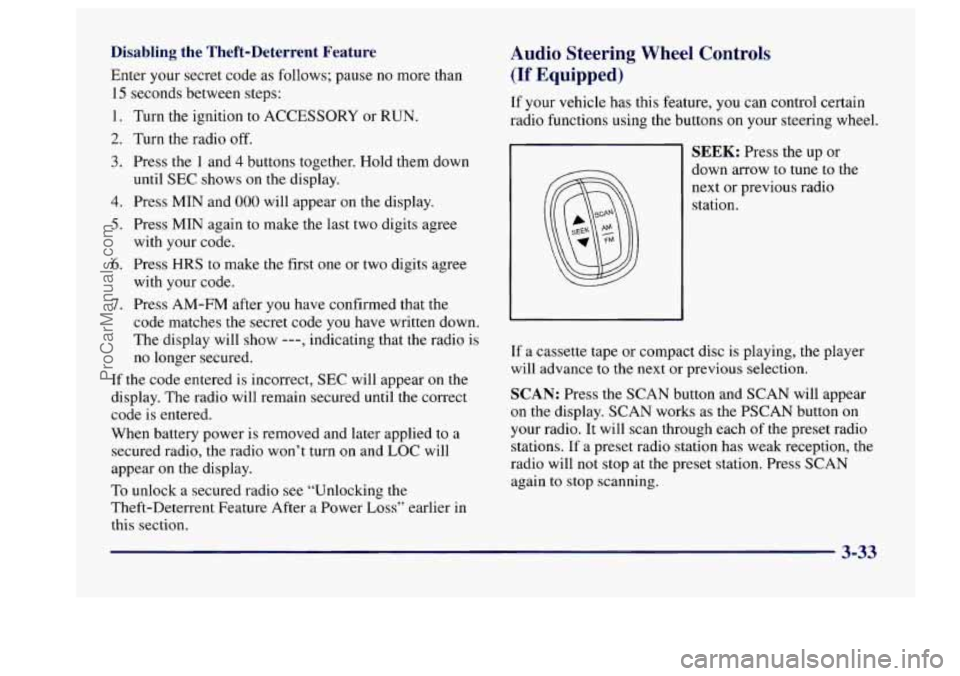
SEEK: Press the up or
down arrow to tune to the
next or previous radio
station.
If a cassette tape or compact disc is playing, the player
will advance to the next or previous selection.
SCAN: Press the SCAN button and SCAN will appear
on the display. SCAN works as the PSCAN button on
your radio. It will scan through each of the preset radio
stations. If a preset radio station has weak reception, the
radio will not stop at the preset station. Press SCAN
again to stop scanning.
3-33
ProCarManuals.com