1997 BUICK CENTURY air condition
[x] Cancel search: air conditionPage 153 of 406
FRONT This setting brings in outside air and
directs most of
the air through the defrost vent. Some
of the air also goes
to the floor ducts and the side
window defogger outlets. The indicator on the button
will light and WINDSHIELD will be lit in the display.
The air conditioning compressor will run automatically
in this setting unless the outside temperature is below
40°F (4°C).
VENT This pushbutton turns the air conditioning
compressor
on and off. The indicator lights when
the compressor is turned
off. Recirculation is not
permitted when
the compressor is off. The system
will try
to control the temperature automatically, but
without the compressor.
RECIRC: This setting recirculates much of the
air inside your vehicle. This setting is not permitted
in FRONT defrost mode and is only permitted in
WINDSHIELD/FLOOR mode if the compressor is
turned on. The indicator light will be
lit when
Recirculation is engaged, but will light for
one second
and then turn off if selected when not permitted.
Air Conditioning
On very hot days, open the windows long enough to let
hot, inside air escape. This reduces the time for the
vehicle to cool down.
For a quick cool-down on very hot days, use MAX with
the temperature knob all the way in the blue area. If this
setting
is used for long periods of time, the air in your
vehicle may become too dry.
For normal cooling on hot days, use NORM with the
temperature knob
in the blue area. The system will bring
in outside air and cool it.
On cool, but sunny days, the sun may warm your upper
body, but your lower body may
not be warm enough.
You can use BI-LEV and set the temperature knob to a
comfortable setting. The system will bring
in outside air
and direct it to your upper body, while sending slightly
warmed air
to your lower body. You may notice this
temperature difference more
at some times than others.
3-9
ProCarManuals.com
Page 154 of 406
Heating Ventilation System
On cold days, use HTR with the temperature knob all
the way in the red area. The system will bring in outside
air, heat it and send it to the floor ducts.
If your vehicle has an engine coolant heater, you can
use
it to help your system provide warm air faster when it’s
cold outside
(0°F (-18°C) or lower). An engine coolant
heater warms the coolant your engine and heating
system use to provide heat. See “Engine Coolant
Heater” in the Index.
Defogging and Defrosting
Your system has two settings for clearing the front and
side windows.
To defrost the windows quickly, use
FRONT and full hot (90°F (32°C)). Driver sets
temperature and selects high fan speed.
To warm
passengers while keeping the windows clear, push the
AIR FLOW button until WINDSHIELD/FLOOR
appears in the display. Select fan speed for comfort and
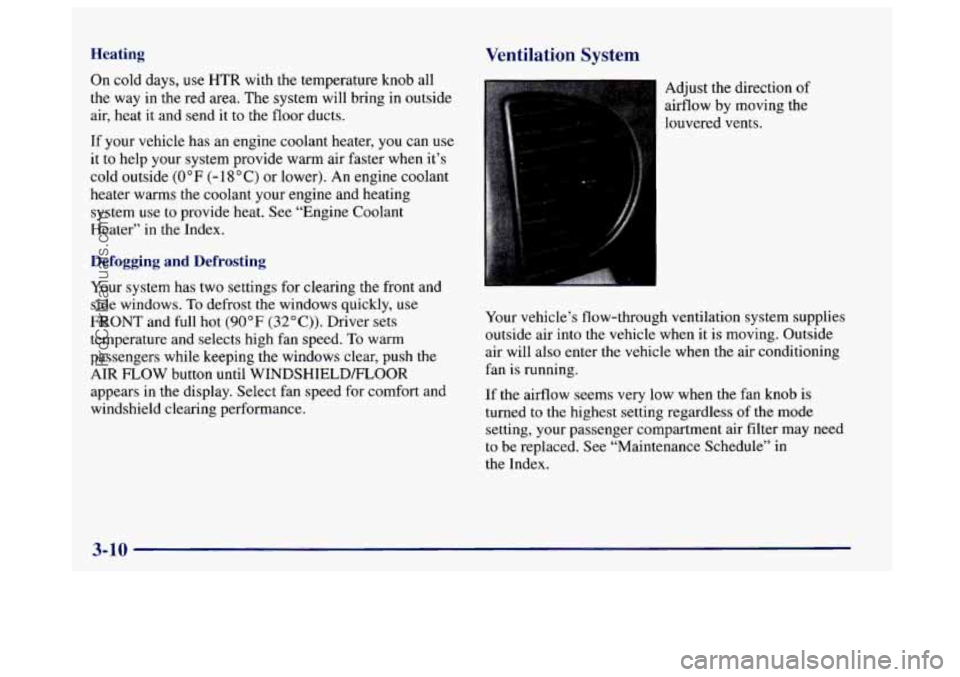
windshield clearing performance. Adjust the direction
of
airflow
by moving the
louvered vents.
Your vehicle’s flow-through ventilation system supplies
outside air into the vehicle when it is moving. Outside
air will also enter the vehicle when the air conditioning
fan is running.
If the airflow seems very low when the fan knob is
turned to the highest setting regardless of the mode
setting, your passenger compartment air filter may need
to be replaced. See “Maintenance Schedule” in
the Index.
3-10
ProCarManuals.com
Page 200 of 406
If your vehicle starts to slide, ease your foot off the
accelerator pedal and quickly steer the way you want the
vehicle to go. If you start steering quickly enough, your
vehicle may straighten out. Always be ready for a
second skid if it occurs.
Of course, traction is reduced when water, snow, ice,
gravel or other material is on the road. For safety, you’ll
want to slow down and adjust your driving
to these
conditions. It is important to slow down on slippery
surfaces because stopping distance will be longer and
vehicle control more limited.
While driving on a surface with reduced traction, try
your best to avoid sudden steering, acceleration or
braking (including engine braking by shifting to a lower
gear). Any sudden changes could cause the tires
to
slide. You may not realize the surface is slippery until
your vehicle is skidding. Learn to recognize warning
clues
-- such as enough water, ice or packed snow on
the road to make a “mirrored surface’’
-- and slow
down when you have any doubt.
Remember: Any anti-lock brake system (ABS) helps
avoid only the braking skid.
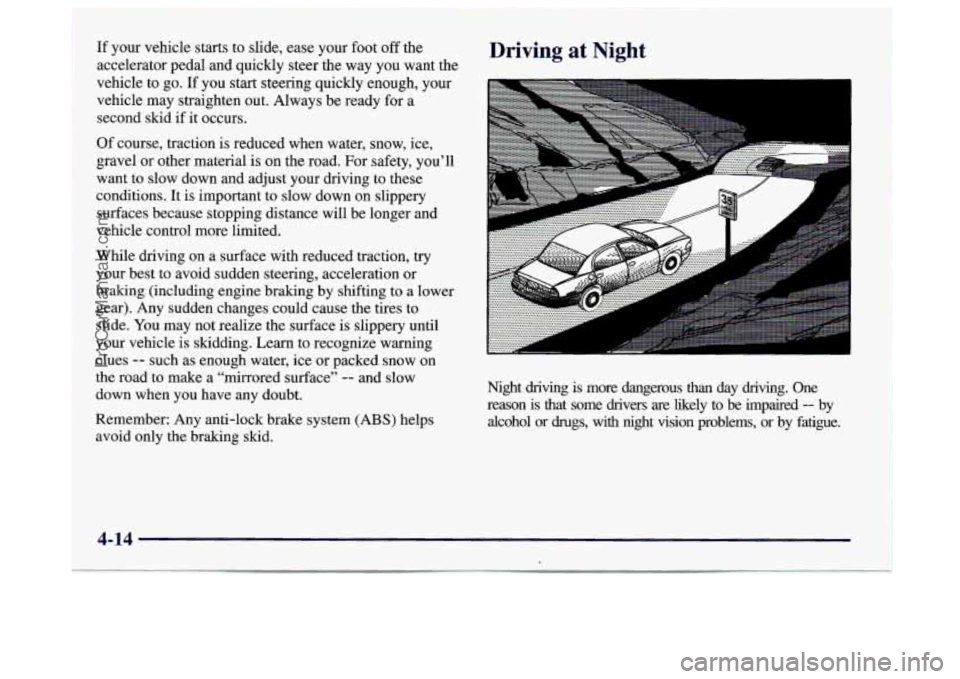
Driving at Night
Night driving is more dangerous than day driving. One
reason is that some drivers
are likely to be impaired -- by
alcohol or
drugs, with night vision problems, or by fatigue.
4-14 1
ProCarManuals.com
Page 242 of 406
NOTICE:
If you get the overheat warning with no sign of steam,
try this for a minute or so:
1. Turn off your air conditioner.
If your engine catches fire because you keep
driving with no coolant, your vehicle can be
badly damaged. The costly repairs would not be
covered by your warranty.
3. If you’re in a traffic jam, shift to NEUTRAL (N);
2. Turn on your heater to full hot at the highest fan
speed and open the window as necessary.
otherwise, shift to the highest gear while
driving
-- AUTOMATIC OVERDRIVE (a).
If No Steam Is Coming From Your Engine
If you get the overheat warning but see or hear no
steam, the problem may not be too serious. Sometimes
the engine can get a little too hot when you:
Climb a long hill on a hot day.
0 Stop after high-speed driving.
0 Idle for long periods in traffic.
0 Tow a trailer. If you
no longer have the overheat warning, you can
drive. Just
to be safe, drive slower for about 10 minutes.
If the warning doesn’t come back on, you can
drive normally.
If
the warning continues, pull over, stop, and park your
vehicle right away.
If there’s still no sign
of steam, you can idle the engine
for two or three minutes while you’re parked,
to see if
the warning stops. But then, if you still have the
warning,
turn ofthe engine and get everyone out of the
vehicle
until it cools down.
You may decide not to lift the hood but
to get service
help right away.
5-16
ProCarManuals.com
Page 267 of 406

Section 6 Service and Appearance Care
Here you will find information about the care of your Buick. This section begins with service and fuel information,
and then
it shows how to check important fluid and lubricant levels. There is also technical information about your
vehicle, and a part devoted
to its appearance care.
6-2
6-3
6-5
6-
5
6-7
6- 10
6-15
6-17
6-20
6-24
6-25
6-26
6-29
6-30
6-37 6-45
6-45
6-48
6-49 Service
Fuel
Fuels in Foreign Countries
Filling Your Tank
Checking Things Under the Hood
Engine Oil
Air Cleaner
Automatic Transaxle Fluid
Engine Coolant
Power Steering Fluid
Windshield Washer Fluid
Brakes
Battery
Bulb Replacement
Tires
Appearance Care
Cleaning the Inside of Your Buick
Cleaning the Built-in Child Restraint
Care
of Safety Belts and Built-in Child
Restraint Harness 6-49
6-49
6-50
6-50
6-5 1
6-52
6-52 6-52
6-5
3
6-53
6-54
6-55
6-55
6-56 6-62
6-62
6-63
6-63
6-63 Cleaning
Glass Surfaces
Cleaning the Outside
of the Windshield and
Wiper Blades
Weatherstrips
Cleaning the Outside of Your Buick
Cleaning Aluminum Wheels
Cleaning Tires
Sheet Metal Damage
Finish Damage
Underbody Maintenance
Chemical Paint Spotting
Appearance Care Materials Chart
Vehicle Identification Number
(VIN)
Service Parts Identification Label
Electrical System Replacement Bulbs
Capacities and Specifications
Vehicle Dimensions
Normal Maintenance Replacement Parts
Air Conditioning Refrigerants
6-1
ProCarManuals.com
Page 269 of 406
Adding Equipment to the Outside of
Your Vehicle
Things you might add to the outside of your vehicle can
affect the airflow around it. This may cause wind noise
and affect windshield washer performance. Check with
your Buick dealer before adding equipment
to the
outside
of your vehicle.
Fuel
Use regular unleaded gasoline rated at 87 octane or
higher. At a minimum, it should meet specifications
ASTM D4814 in the United States and CGSB 3.5-M93
in Canada. Improved gasoline specifications have been
developed by the American Automobile Manufacturers
Association (AAMA) for better vehicle performance
and engine protection. Gasolines meeting the AAMA
specification could provide improved driveability and
emission control system protection compared
to
other gasolines.
Be sure the posted octane is at least
87. If the octane is
less than
87, you may get a heavy knocking noise when
you drive. If it’s bad enough, it can damage your engine. If
you’re using fuel rated
at 87 octane or higher and you
hear heavy knocking, your engine needs service. But
don’t worry if
you hear a little pinging noise when
you’re accelerating or driving up a hill. That’s normal,
and you don’t have to buy a higher octane fuel
to get rid
of pinging. It’s the heavy, constant knock that means
you have a problem.
If your vehicle
is certified to meet California Emission
Standards (indicated on the underhood emission control
label), it is designed to operate on
fuels that meet
California specifications. If such fuels are not available
in states adopting California emissions standards, your
vehicle will operate satisfactorily on fuels meeting
federal specifications, but emission control system
performance may be affected. The malfunction indicator
lamp on your instrument panel may turn
on and/or
your vehicle may fail a smog-check
test. If this occurs,
return
to your authorized Buick dealer for diagnosis
to determine the cause of failure. In the event it is
determined that the cause of the condition is the type of
fuels used, repairs may
not be covered by your warranty.
6-3
ProCarManuals.com
Page 309 of 406

Wheel Alignment and Tire Balance
The wheels on your vehicle were aligned and balanced
carefully at the factory to give
you the longest tire life
and best overall performance.
Scheduled wheel alignment and wheel balancing are
not
needed. However, if you notice unusual tire wear or
your vehicle pulling one way or the other, the alignment
may need to be reset. If
you notice your vehicle
vibrating when driving
on a smooth road, your wheels
may need
to be rebalanced.
Wheel Replacement
Replace any wheel that is bent, cracked, or badly rusted
or corroded. If wheel
nuts keep coming loose, the wheel,
wheel bolts and wheel nuts should be replaced.
If the
wheel leaks air, replace
it (except some aluminum
wheels, which can sometimes be repaired). See your
Buick dealer if any
of these conditions exist. Your
dealer will know the kind
of wheel you need.
Each new wheel should have the same load-carrying
capacity, diameter, width, offset and be mounted the
same way
as the one it replaces.
If you need
to replace any of your wheels, wheel bolts
or wheel nuts, replace them only with new
GM original
equipment parts. This way, you will be sure to have
the right wheel, wheel bolts and wheel nuts for your
Buick model.
I--
I /! CAUTION:
1
Using the wrong replacement wheels, wheel
bolts or wheel nuts on your vehicle can be
dangerous. It could affect the braking and
handling of your vehicle, make your tires lose air
and make you lose control. You could have a
collision in which you or others could be injured.
Always use the correct wheel, wheel bolts and
wheel nuts for replacement.
6-43
ProCarManuals.com
Page 319 of 406
Underbody Maintenance
Chemicals used for ice and snow removal and dust control
can collect on the underbody. If these
are not removed,
accelerated corrosion (rust) can occur
on the underbody
parts such as fuel lines, frame, floor pan and exhaust
system even though they have corrosion protection.
At least every spring, flush these materials from the
underbody with plain water. Clean any areas where mud
and other debris can collect. Dirt packed in closed areas
of the frame should be loosened before being flushed.
Your dealer or an underbody car washing system can do
this for you.
Chemical Paint Spotting
Some weather and atmospheric conditions can create a
chemical fallout. Airborne pollutants can fall upon and
attack painted surfaces on your vehicle. This damage
can take two forms: blotchy, ringlet-shaped
discolorations, and small irregular dark spots etched into
the paint surface.
Although
no defect in the paint job causes this, Buick
will repair, at
no charge to the owner, the surfaces of
new vehicles damaged by this fallout condition within
12 months or 12,000 miles (20 000 km) of purchase,
whichever occurs first.
6-53
ProCarManuals.com