1996 TOYOTA SUPRA check engine
[x] Cancel search: check enginePage 146 of 188
144You can be confident that your Toyota
dealer's service department performs the
best
job to meet the maintenance require-
ments on your vehicleÐreliably and eco-
nomically.
Your copy of the repair order is proof that
all required maintenance has been per-
formed for warranty coverage. And if any
problems should arise with your vehicle
while under warranty, your Toyota dealer
will promptly take care of it. Again, be sure
to keep a copy of the repair order for any
service performed on your Toyota.
What about do-it-yourself mainte- nance?
Many of the maintenance items are easy
to do yourself if you have a little mechani-
cal ability and a few basic automotive
tools. Simple instructions for how to per-
form them are presented in Part 7.
If you are a skilled do-it-yourself me-
chanic, the Toyota service manuals are recommended. Please be aware that do-
it-yourself maintenance can affect your
warranty coverage. See Owner's Guide,
Owner 's Manual Supplement or W arranty
Booklet for the details. Listed
below are the general maintenance
items that should be performed as fre- quently as specified. In addition to check-
ing the items listed, if you notice any un-
usual noise, smell or vibration, you should
investigate the cause or take your vehicle
to your T oyota dealer or a qualified service
shop immediately. It is recommended thatany problem you notice be brought to theattention of your dealer or the qualified service shop for their advice.
Make these checks only where
adequate ventilation can be ob-
tained if you run the engine. CAUTION
!
OUTSIDE THE VEHICLE
Items listed below should be per-
formed from time to time, unless other-
wise specified.
Tire pressure Check the pressure with a gauge every
two weeks, or at least once a month. See Chapter 7-2 for additional information. Tire surface and wheel nuts Check the tires carefully
for cuts, damage
or excessive wear. See Chapter 7-2 for
additional information. When checking the tires, make sure no nuts are missing,
and check the nuts for looseness. T ighten
them if necessary. Fluid leaks Check underneath for leaking fuel, oil, wa-
ter or other fluid after the vehicle has been
parked for a while. If you smell fuel fumes
or notice any leak, have the cause found
and corrected immediately. Doors and engine hood
Check that all doors including back door
operate smoothly and all latches lock se-
curely. M ake sure the engine hood secon-
dary latch secures the hood from opening
when the primary latch is released. INSIDE THE VEHICLE Items listed below should be checked
regularly, e.g. while performing period-
ic services, cleaning the vehicle, etc. Lights Make sure the headlights, stop lights, tail lights, turn signal lights, and other lights are all working. Check headlight aim.
General maintenance
Page 147 of 188

145
Service reminder indicators and
warn-
ing buzzers Check that all service reminder indicators
and warning buzzers function properly. Steering wheel
Be alert for changes in steering condition, such as hard steering or strange noise. Seats Check that all front seat controls such as
seat adjusters, seatback recliner, etc. op- erate smoothly and that all latches lock
securely in any position. For folding-down
rear seatback, check that the latches lock
securely. Make sure the front headrestsare firmly secured. Seat belts
Check that the seat belt system such as
buckles, retractors and anchors operate
properly and smoothly. Make sure the belt
webbing is not cut, frayed, worn or dam- aged. Accelerator pedal Check the pedal for smooth operation and
uneven pedal effort or catching. Clutch pedal Check the pedal for smooth operation. Brake pedal Check
the pedal for smooth operation and
that the pedal has the proper clearance. Check the brake booster function. Brakes
At a safe place, check that the brakes do not pull to one side when applied. Parking brake Check that the lever has the proper travel and that, on a safe incline, your vehicle is
held securely with only the parking brake applied.
Automatic transmission Parkº mech-
anismCheck the lock release button of the selec-
tor lever for proper and smooth operation.
On a safe incline, check that your vehicle is held securely with the selector lever inPº position and all brakes released.
IN THE ENGINE COMPARTMENT Items listed below should be checked
from time to time , e.g. each time when
refueling.
Washer fluid
Make sure there is sufficient fluid in the
tank. See Chapter 7-3 for additional infor-
mation.
Engine coolant level Make sure the coolant level is between
the FULLº and LOWº lines on the see-
through reservoir when the engine is cold.
See Chapter 7-2 for additional informa-tion. Battery electrolyte level Make sure the electrolyte level of all bat-
tery cells is correct. Add only distilled wa-
ter when replenishing. See Chapter 7-3
for additional information. Brake fluid level
Make sure the brake fluid level is correct. See Chapter 7-2 for additional informa- tion.
Engine oil level
Check the l
evel on the dipstick with the en-
gine turned off and the vehicle parked on
a level spot. See Chapter 7-2 for addition-
al information. Power steering fluid level Check the level on the dipstick. The level
should be in the HOTº or COLDº range
depending on the fluid temperature. See Chapter 7-2 for additional information. Exhaust system
If you notice any change in the sound of
the exhaust or smell exhaust fumes, have the cause located and corrected immedi-
ately. (See engine exhaust cautions in
Part 2.)
Page 148 of 188
146Be on the alert for changes in perfor-
mance, sounds, and visual tip-offs
that in-
dicate service is needed. Some important
clues are as follows: Engine missing, stumbling, or pinging
Appreciable loss of power
Strange engine noises
A leak under the vehicle (however, wa-
ter dripping from the air conditioning
after use is normal.)
Change in exhaust sound (This may
indicate a dangerous carbon monox-
ide leak. Drive with the windows open
and have the exhaust system checked
immediately.)
Flat-looking tire; excessive tire squeal
when cornering; uneven tire wear
Vehicle pulls to one side when driving straight on a level road
Strange noises related to suspensionmovement
Loss of brake effectiveness; spongy
feeling brake or clutch pedal; pedal al-
most touches floor; vehicle pulls to one
side when braking
Engine coolant temperature continual-
ly higher than normal If you notice any of these clues, take your
vehicle to your Toyota dealer as soon as
possible. It probably needs adjustment or
repair.
Do not continue driving with the
vehicle unchecked. It could result
in serious vehicle damage and
pos-
sibly personal injury. CAUTION
!
Does your vehicle need repairing?
Page 153 of 188
151
When the engine is running, keep
hands, clothing, and tools away
from the moving fan and engine
drive belts. (Removing rings,
watches, and ties is advisable.)
Right after driving, the engine
compartmentÐthe engine, radia-
tor, exhaust manifold, power
steering fluid reservoir and spark
plug boots, etc.Ðwill be hot. So be
careful not to touch them. Oil,
fluids and spark plugs may also be
hot.
If the engine is hot, do not remove
the radiator cap or loosen the
drain plugs to prevent burning yourself.
Do not smoke, cause sparks or al-
low open flames around fuel or
the battery. Their fumes are flam- mable.
Be extremely cautious when
working on the battery. It contains
poisonous and corrosive sulfuricacid.
Do not get under your vehicle with
just the body jack supporting it.
Always use automotive jack
stands or other solid supports. CAUTION
!
Be sure that the ignition is off if you
work near the electric cooling fans
or radiator grille. With the ignition
on, the electric cooling fan will au-
tomatically start to run if the engine
coolant temperature is high and/or
the air conditioning is on.
Use eye protection whenever you
work on or under your vehicle
where you may be exposed to fly-
ing or falling material, fluid spray,etc.
Used engine oil contains potential-
ly harmful contaminants which
may cause skin disorders such as
inflammation or skin cancer, so
care should be taken to avoid pro-
longed and repeated contact with
it. To remove used engine oil from
your skin, wash thoroughly with
soap and water.
Do not leave used oil within the reach of children.
Dispose of used oil and filter only
in a safe and acceptable manner.
Do not dispose of used oil and fil-
ter in household trash, in sewers
or onto the ground. Call your deal-
er or a service station for informa-
tion concerning recycling or dis- posal.
Remember that battery and igni-
tion cables carry high currents or
voltages. Be careful of accidental-
ly causing a short circuit.
Add only demineralized or dis-tilled water to fill the radiator. And
if you spill some of the coolant, besure to wash it off with water to
prevent it from damaging the
parts or paint.
Do not overfill automatic trans-mission fluid, or the transmission
could be damaged.
Do not drive with the air cleaner fil-ter removed, or excessive enginewear could result. Also backfiringcould cause a fire in the engine
compartment.
Be careful not to scratch the glasssurface with the wiper frame.
When closing the engine hood,
check to see that you have not for-
gotten any tools, rags, etc.
NOTICE
Page 154 of 188

152Here is a list of parts and tools you will
need on performing do-it-yourself main-
tenance. Remember all Toyota parts are
designed in metric sizes, so your tools
must be metric. Checking the engine oil level Parts (if level is low):
Engine oil API SH, Energy-Conserv-
ing IIº multigrade or ILSAC multigrade
having viscosity proper for your cli-mate
Tools: Rag or paper towel
Funnel (only for adding oil)
Checking the engine coolant level Parts (if level is low): Ethylene-glycol antifreeze
Demineralized or distilled water
Tools: Funnel (only for adding coolant)
Checking brake fluid Parts (if level is low): SAE J1703 or FMVSS No. 116 DOT 3 brake fluid
Tools: Rag or paper towel
Funnel (only for adding fluid) Checking power steering fluid Parts (if level is low):
Automatic transmission fluid DEXRON )
-II or -III
Tools: Rag or paper towel
Funnel (only for adding fluid)
Checking battery condition Non-maintenance batteriesÐ
Tools: Warm water
Baking soda
Grease
Conventional wrench (for terminal clamp bolts)
Maintenance type batteriesÐ Parts (if level is low): Distilled water
Tools: Warm water
Baking soda
Grease
Conventional wrench (for terminal clamp bolts)
Coin (for vent plugs)
Funnel (only for adding distilled water) Checking and replacing fuses Parts (if replacement is necessary):
Fuse with same amperage rating as original
Adding washer fluid Parts: Water
Washer fluid containing antifreeze (for winter use)
Tools: Funnel
Replacing light bulbs Parts: Bulb with same number and wattage rating as original (See charts in Re-
placing light bulbsº in Chapter 7-3.)
Tools: Screwdriver
Parts and tools
Page 155 of 188
Part 7Checking the engine oil level
153
DO-IT-YOURSELF MAINTENANCEÐ
Chapter 7-2 Engine and Chassis
Checking the engine oil level
Checking the engine coolant level
Checking brake fluid
Checking power steering fluid
Checking tire pressure
Checking and replacing tires
Rotating tires
Installing snow tires and chains
Replacing wheels
Aluminum wheel precautions
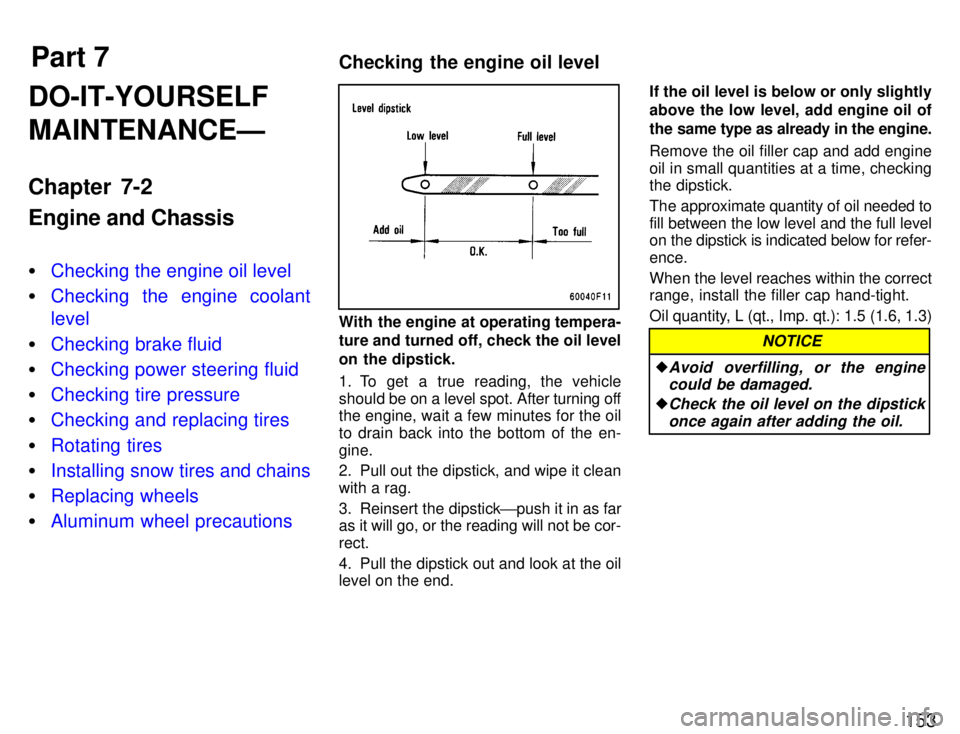
With the engine at operating tempera- ture and turned off, check the oil level
on the dipstick.
1. To get a true reading, the vehicle
should be on a
level spot. After turning off
the engine, wait a few minutes for the oil
to drain back into the bottom of the en-gine.
2. Pull out the dipstick, and wipe it clean with a rag.
3. Reinsert the dipstick 'push it in as far
as it will go, or the reading will not be cor- rect.
4. Pull the dipstick out and look at the oil level on the end. If the oil level is below or only slightly
above the low level, add engine oil of
the same type as already in the engine. Remove the oil filler cap and add engine
oil in small quantities at a time, checking the dipstick.
The approximate quantity of oil needed to fill between the low level and the full level
on the dipstick is indicated below for refer- ence.
When the level reaches within the correct range, install the filler cap hand-tight.
Oil quantity, L (qt., Imp. qt.): 1.5 (1.6, 1.3)
Avoid overfilling, or the enginecould be damaged.
Check the oil level on the dipstick
once again after adding the oil.
NOTICE
Page 157 of 188
155
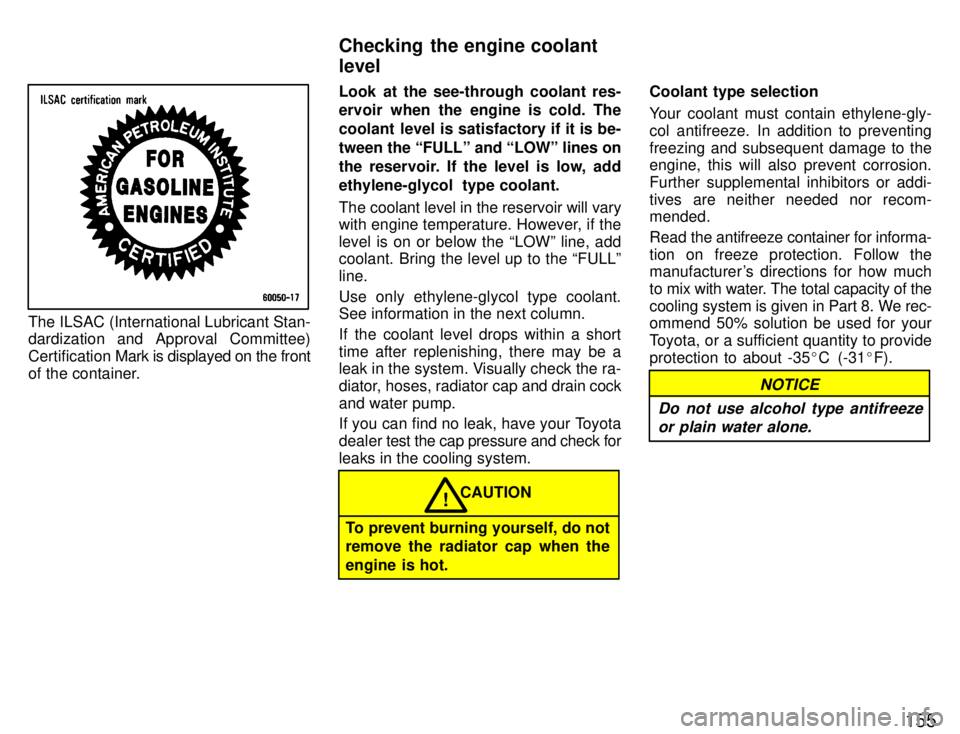
The ILSAC (International Lubricant Stan-
dardization and Approval Committee) Certification Mark is displayed on the front
of the container. Look at the see-through coolant res-
ervoir when the engine is cold. The
coolant level is satisfactory if it is be-
tween the FULLº and LOWº lines on
the reservoir. If the level is low, add
ethylene-glycol type coolant.
The coolant level in the reservoir will vary
with engine temperature. However, if the
level is on or below the LOWº line, add
coolant. Bring the level up to the FULLº line. Use only ethylene-glycol type coolant. See information in the next column.
If the coolant level drops within a short
time after replenishing, there may be a
leak in the system. Visually check the ra-
diator, hoses, radiator cap
and drain cock
and water pump.
If you can find no leak, have your Toyota
dealer test the cap pressure and check for
leaks in the cooling system.
To prevent burning yourself, do not remove the radiator cap when the
engine is hot.
CAUTION! Coolant type selection
Your coolant must contain ethylene-gly-
col antifreeze. In addition to preventingfreezing and subsequent damage to the
engine, this will also prevent corrosion. Further supplemental inhibitors or addi-
tives are neither needed nor recom- mended.
Read
the antifreeze container for informa-
tion on freeze protection. Follow the
manufacturer 's directions for how much
to mix with water. The total capacity of the
cooling system is given in Part 8. We rec- ommend 50% solution be used for your
Toyota, or a sufficient quantity to provideprotection to about -35 C (-31 F).
Do not use alcohol type antifreeze
or plain water alone.
NOTICE
Checking the engine coolant level
Page 158 of 188
156
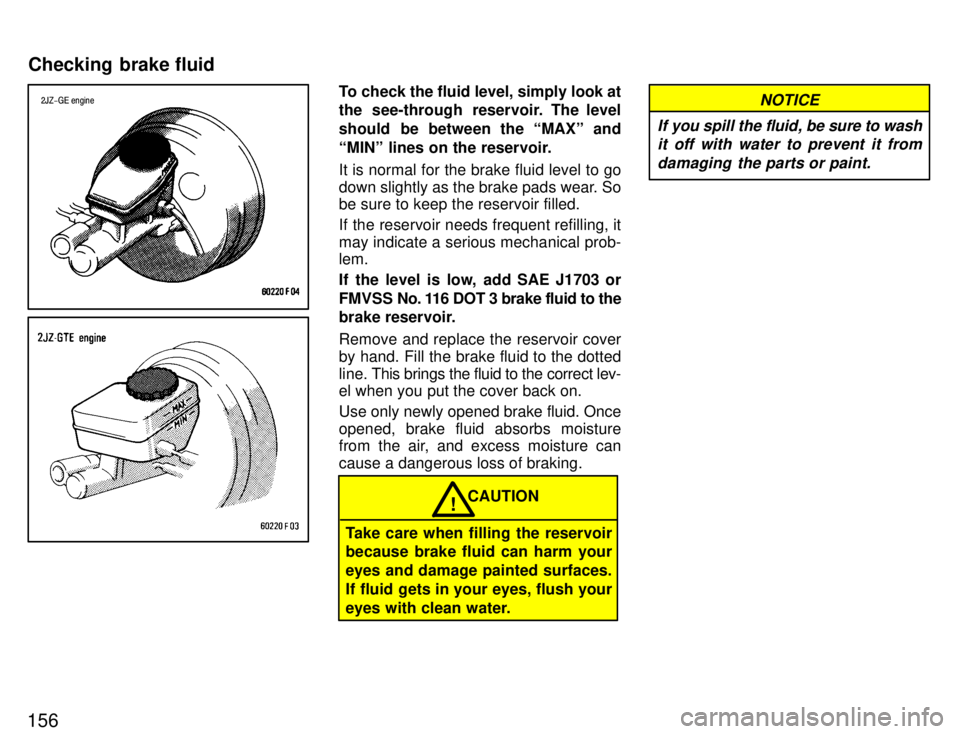
2JZGE engineTo check the fluid level, simply look at
the see-through reservoir. The level
should be between the MAXº and
MINº lines on the reservoir. It is normal for the brake fluid level to go
down slightly as the brake pads wear. So be sure to keep the reservoir filled.
If the reservoir needs frequent refilling, it may indicate a serious mechanical prob- lem.
If the level is low, add SAE J1703 or
FMVSS No. 116 DOT 3 brake fluid to the
brake reservoir. Remove and replace the reservoir cover
by hand. Fill the brake fluid to the dotted
line. This brings the fluid to the correct lev-
el when you put the cover back on. Use only newly opened brake fluid. Once
opened, brake fluid absorbs moisture
from the air, and excess moisture can cause a dangerous loss of braking.
CAUTION
Take care when filling the reservoir
because brake fluid can harm your
eyes and damage painted surfaces.
If fluid gets in your eyes, flush your
eyes with clean water.!
NOTICE
If you spill the fluid, be sure to wash it off with water to prevent it from
damaging the parts or paint.
Checking brake fluid