1996 TOYOTA PASEO steering
[x] Cancel search: steeringPage 129 of 165

126IN THE ENGINE COMPARTMENT Items listed below should be checked
from
time to time , e.g. each time when
refueling.
Washer fluid
Make sure there is sufficient fluid in the
tank. See Chapter 7-3 for additional infor-
mation.
Engine coolant level Make sure the coolant level is between
the FULLº and LOWº lines on the see-
through reservoir. See Chapter 7-2 for
additional information. Battery electrolyte level Make sure the electrolyte level of all bat-
tery cells is between upper and lower level
lines on the case. Add only distilled water
when replenishing. See Chapter 7-3 for
additional information. Brake fluid level
Make sure the brake fluid level is correct. See Chapter 7-2 for additional informa- tion.
Engine oil level
Check the l evel on the dipstick with the en-
gine turned off and the vehicle parked on
a level spot. See Chapter 7-2 for addition-
al information. Power steering fluid level Check
the level through the reservoir. The
level should be in the HOTº or COLDº
range depending on the fluid t emperature.
See Chapter 7-2 for additional informa-tion.
Exhaust system
If you notice any change in the sound of
the exhaust or smell exhaust fumes, have the cause located and corrected immedi-
ately. (See engine exhaust cautions in
Part 2.) Be on the alert for changes in perfor-
mance, sounds, and visual tip-offs
that in-
dicate service is needed. Some important
clues are as follows: Engine missing, stumbling, or pinging
Appreciable loss of power
Strange engine noises
A leak under the vehicle (however, wa-
ter dripping from the air conditioning
after use is normal.)
Change in exhaust sound (This may
indicate a dangerous carbon monox-
ide leak. Drive with the windows open
and have the exhaust system checked
immediately.)
Flat-looking tire; excessive tire squeal
when cornering; uneven tire wear
Vehicle pulls to one side when driving straight on a level road
Strange noises related to suspensionmovement
Loss of brake effectiveness; spongy
feeling brake or clutch pedal; pedal al-
most touches floor; vehicle pulls to one
side when braking
Engine coolant temperature continual-
ly higher than normal
Does your vehicle needrepairing?
Page 133 of 165

1301. Power steering fluid reservoir
2. Engine oil filler cap
3. Engine oil level dipstick
4. Brake fluid reservoir
5. Fuse blocks
6. Windshield washer fluid tank
7. Battery
8. Engine coolant reservoir
9. Electric cooling fans
Engine compartment overview
Page 137 of 165

134Here is a list of parts and tools you will
need on performing do-it-yourself main-
tenance. Remember all Toyota parts are
designed in metric sizes, so your tools
must be metric. Checking the engine oil level Parts (if level is low):
Engine oil API SH, Energy-Conserv-
ing IIº multigrade or ILSAC multigrade
having viscosity proper for your cli-mate
Tools: Rag or paper towel
Funnel (only for adding oil)
Checking the engine coolant level Parts (if level is low): Ethylene-glycol antifreeze
Demineralized or distilled water
Tools: Funnel (only for adding coolant)
Checking brake fluid Parts (if level is low): SAE J1703 or FMVSS No. 116 DOT 3 brake fluid
Tools: Rag or paper towel
Funnel (only for adding fluid) Checking power steering fluid Parts (if level is low):
Automatic transmission fluid DEX- RON [
-II or-III
Tools: Rag or paper towel
Funnel (only for adding fluid)
Checking battery condition Non-maintenance batteriesÐ
Tools: Warm water
Baking soda
Grease
Conventional wrench (for terminal clamp bolts)
Maintenance type batteriesÐ Parts (if level is low): Distilled water
Tools: Warm water
Baking soda
Grease
Conventional wrench (for terminal clamp bolts)
Coin (for vent plugs)
Funnel (only for adding distilled water) Checking and replacing fuses Parts (if replacement is necessary):
Fuse with same amperage rating as original
Tools: Conventional wrench (for instrument
lower panel nut)
Adding washer fluid Parts: Water
Washer fluid containing antifreeze (for winter use)
Tools: Funnel
Replacing light bulbs Parts: Bulb with same number and wattage rating as original (See charts in Re-
placing light bulbsº in Chapter 7-3.)
Tools: Screwdriver
Parts and tools
Page 138 of 165
Part 7Checking the engine oil level
135
DO-IT-YOURSELF MAINTENANCEÐ
Chapter 7-2 Engine and Chassis
Checking the engine oil level
Checking the engine coolant level
Checking brake fluid
Checking power steering fluid
Checking tire pressure
Checking and replacing tires
Rotating tires
Installing snow tires and chains
Replacing wheels
Aluminum wheel precautions
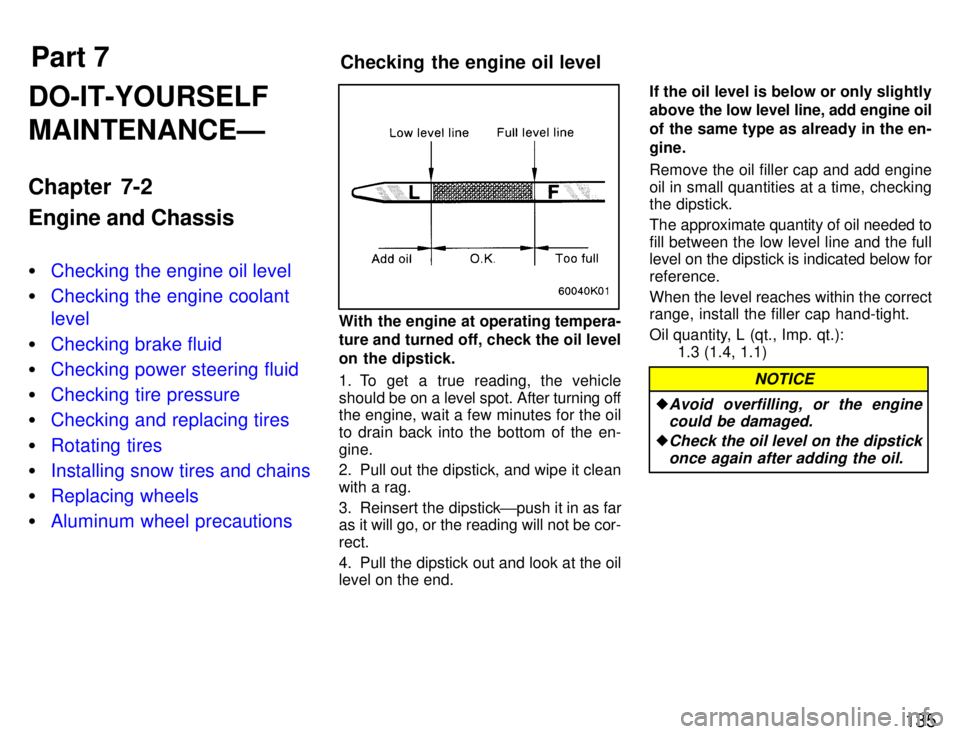
With the engine at operating tempera- ture and turned off, check the oil level
on the dipstick.
1. To get a true reading, the vehicle
should be on a
level spot. After turning off
the engine, wait a few minutes for the oil
to drain back into the bottom of the en-gine.
2. Pull out the dipstick, and wipe it clean with a rag.
3. Reinsert the dipstick 'push it in as far
as it will go, or the reading will not be cor- rect.
4. Pull the dipstick out and look at the oil level on the end. If the oil level is below or only slightly
above
the low level line, add engine oil
of the same type as already in the en- gine. Remove the oil filler cap and add engine oil in small quantities at a time, checking the dipstick.
The approximate quantity of oil needed to
fill between the low level line and the full
level on the dipstick is indicated below for reference. When the level reaches within the correct range, install the filler cap hand-tight.
Oil quantity, L (qt., Imp. qt.): 1.3 (1.4, 1.1)
Avoid overfilling, or the engine could be damaged.
Check the oil level on the dipstick
once again after adding the oil.
NOTICE
Page 141 of 165
138To check the fluid level, simply look at
the see-through reservoir. The level
should be between the MAXº and
MINº lines on the reservoir. It is normal for the brake fluid level to go
down slightly as the brake pads wear. So be sure to keep the reservoir filled.
If the reservoir needs frequent refilling, it may indicate a serious mechanical prob- lem.
If the level is low, add SAE J1703 or
FMVSS No. 116 DOT 3 brake fluid to the
brake reservoir. Remove and replace the reservoir cover
by hand. Fill the brake fluid to the dotted
line.
This brings the fluid to the correct lev-
el when you put the cover back on. Use only newly opened brake fluid. Once
opened, brake fluid absorbs moisture
from the air, and excess moisture can cause a dangerous loss of braking.
CAUTION
Take care when filling the reservoir
because brake fluid can harm your
eyes and damage painted surfaces. If
fluid gets in your eyes, flush your
eyes with clean water.!
If you spill the fluid, be sure to wash
it off with water to prevent it from
damaging the parts or paint.
NOTICE
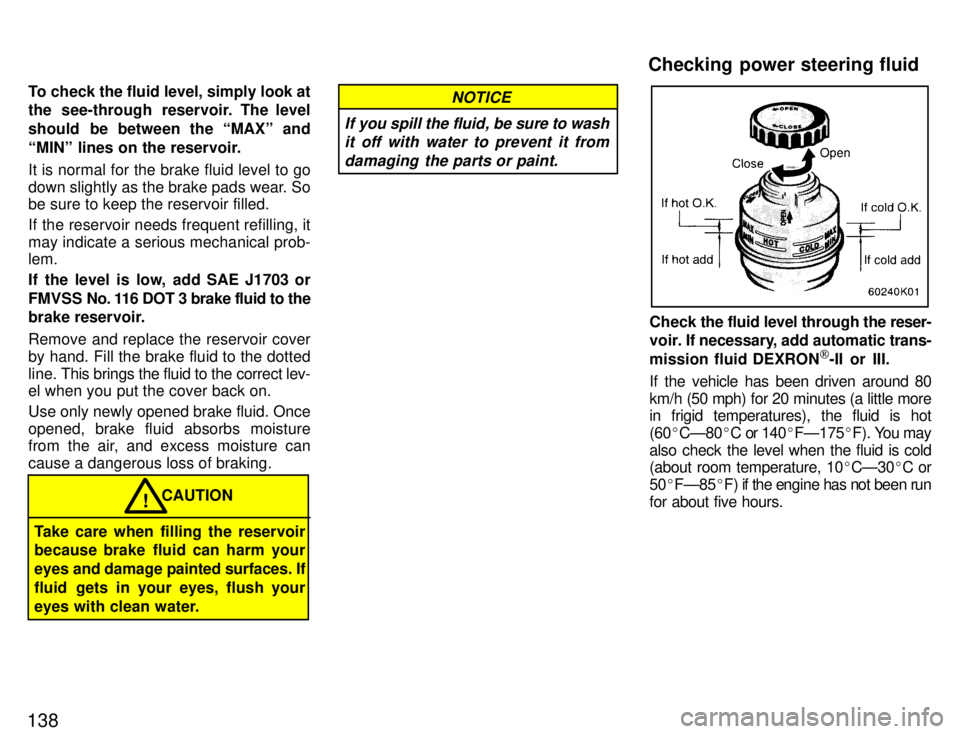
Check the fluid level through the reser-
voir. If necessary, add automatic trans-
mission fluid DEXRON [
-II or III.
If the vehicle has been driven around 80
km/h (50 mph) for 20 minutes (a little more
in frigid temperatures), the fluid is hot
(60 CÐ80 C or 140 FÐ175 F). You may
also check the level when the fluid is cold
(about room temperature, 10 CÐ30 C or
50 FÐ85 F) if the engine has not been run
for about five hours.
Checking power steering fluid
Page 142 of 165
139
Clean all dirt from outside of the reservoir
tank and look at the fluid level. If the fluid is cold, the level should be in the COLDº
range. Similarly, if it is hot, the fluid level
should be in the HOTº range. If the level
is at the low side of either range, add auto-
matic transmission fluid DEXRON
-II or
-III to bring the level within the range.
To remove the filler cap, turn it counter-
clockwise and lift up. To reinstall it, turn it clockwise. After replacing the filler cap,
visually check the steering box case, vane
pump and hose connections for leaks or damage.
CAUTION
The reservoir tank may be hot so be
careful not to burn yourself.!
Avoid overfilling, or the power steering could be damaged.
NOTICE
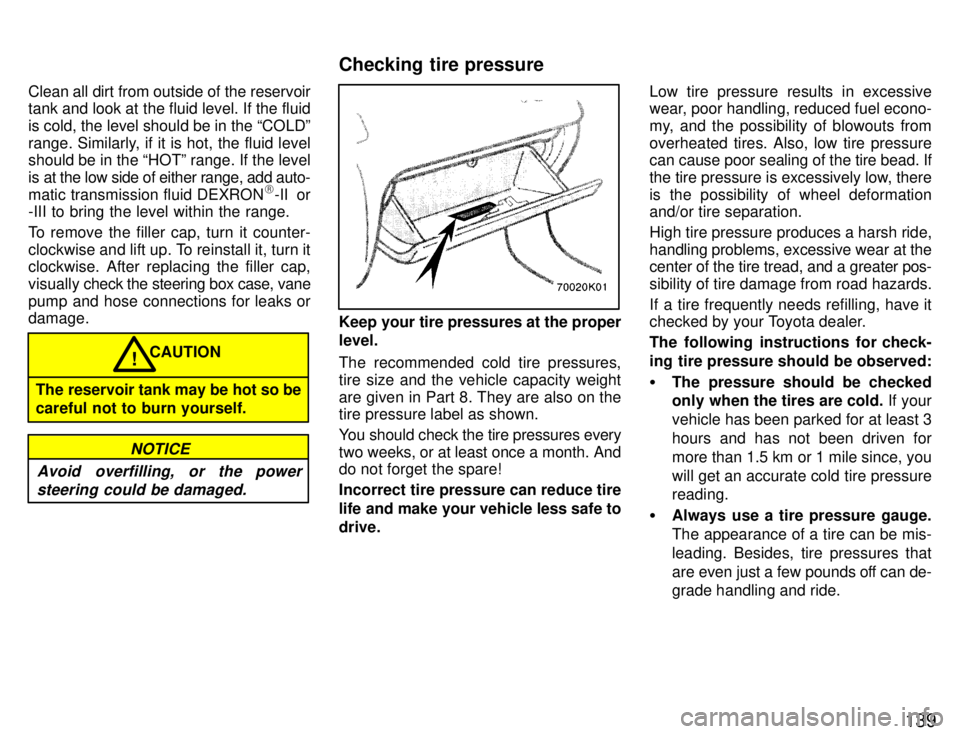
Keep your tire pressures at the proper level.
The recommended cold tire pressures,
tire size and the vehicle capacity weight
are given in Part 8. They are also on the tire pressure label as shown.
You should check the tire pressures every
two weeks, or at least once a month. And
do not forget the spare!
Incorrect tire pressure can reduce tire
life and make your vehicle less safe to drive. Low tire pressure results in excessive
wear, poor handling, reduced fuel econo-
my, and the possibility of blowouts fromoverheated tires. Also, low tire pressure
can cause poor sealing of the tire bead. If
the tire pressure is excessively low, there
is the possibility of wheel deformation and/or tire separation.
High tire pressure produces a harsh ride,
handling problems, excessive wear at the center of the tire tread, and a greater
pos-
sibility of tire damage from road hazards.
If a tire frequently needs refilling, have it
checked by your Toyota dealer.
The following instructions for check-
ing tire pressure should be observed: The pressure should be checked
only when the tires are cold. If your
vehicle has been parked for at least 3 hours and has not been driven formore than 1.5 km or 1 mile since, you
will get an accurate cold tire pressure reading.
Always use a tire pressure gauge.
The appearance of a tire can be mis-
leading. Besides, tire pressures that
are even just a few pounds off can de-
grade handling and ride.
Checking tire pressure
Page 160 of 165

157
BATTERY Open voltage* at 20
5C (68 5F):
12.7 V Fully charged
12.3 V Half charged
11.9 V Discharged
*: Voltage that is checked 20 minutes after the key is removed with all the
lights turned off
Charging rates: 5 A max
CLUTCH
Pedal freeplay, mm (in.):
5' 15 (0.2 '0.6)
Fluid type: SAE J1703 or FMVSS No. 116 DOT 3
MANUAL TRANSAXLE
Oil capacity, L (qt., Imp. qt.): 1.9 (2.0, 1.6)
Oil type: Multipurpose gear oil API GL- 4 or GL- 5
Recommended oil viscosity:
SAE 75W-90
AUTOMATIC TRANSAXLE Fluid capacity (drain and refill), L (qt., Imp. qt.): Up to 3.1 (3.3, 2.7) Fluid type:
Automatic transmission fluidDEXRON [
-
II
BRAKES Minimum pedal clearance when de- pressed with the pressure of 490 N (50 kgf,
110 lbf) with the engine running, mm (in.):
With anti-lock brake system
60 (2.4)
Without anti-lock brake system 55 (2.2)
Pedal freeplay, mm (in.): 1Ð6 (0.04Ð0.24)
Pad wear limit, in. (mm):
1.0 (0.04)
Lining wear limit, in. (mm): 1.0 (0.04)
Parking brake adjustment when pulledwith the force of 196 N (20 kgf, 44 lbf): 5Ð8 clicks
Fluid type: SAE J1703 or FMVSS No. 116 DOT 3
STEERING Wheel freeplay:
Less than 30 mm (1.2 in.)
Power steering fluid type:
Automatic transmission fluid DEXRON [
-
II or -III Tire size:
Spare tireWith anti-lock brake systemT105/70D16
Without anti-lock brake system
T115/70D14
Except spare tire P185/60R14 82H
Tire pressure, kPa (kgf/cm 2
or bar, psi):
Spare tire 420 (4.2, 60)
Except spare tire
183 (1.83, 26)
Wheel size: Spare tire With anti-lock brake system16 x 4T
Without anti-lock brake system
14 x 4T
Except spare tire Aluminum wheels 14 x 5.5JJ
Except aluminum wheels 14 x 5.5J
Wheel nut torque, N Vm (kgf Vm, ft Vlbf):
103 (10.5, 76)
Tires