Page 10 of 195
Part 1Keys (sedan)
7
OPERATION OF
INSTRUMENTS
AND CONTROLSÐ
Chapter 1-2
Keys and Doors
�Keys
�Side doors
�Power windows
�Trunk lid
�Back door
�Hood
�Theft deterrent system
�Fuel tank cap
�Electric sun roof
The master key works in every lock.
The subkey will not work in the trunk.
To protect things locked in the trunk when
you have your vehicle parked, leave the
subkey with the attendant.
Since the doors and trunk lid can be
locked without a key, you should always
carry a spare master key in case you acci-
dentally lock your keys inside the vehicle.Keep the key number plate in a safe
place such as your wallet, not in the
vehicle.
If you should lose your keys or if you need
additional keys, duplicates can be made
by a Toyota dealer using the key number.
You should also put a copy of the key
number with your important papers.
ProCarManuals.com
Page 13 of 195
10
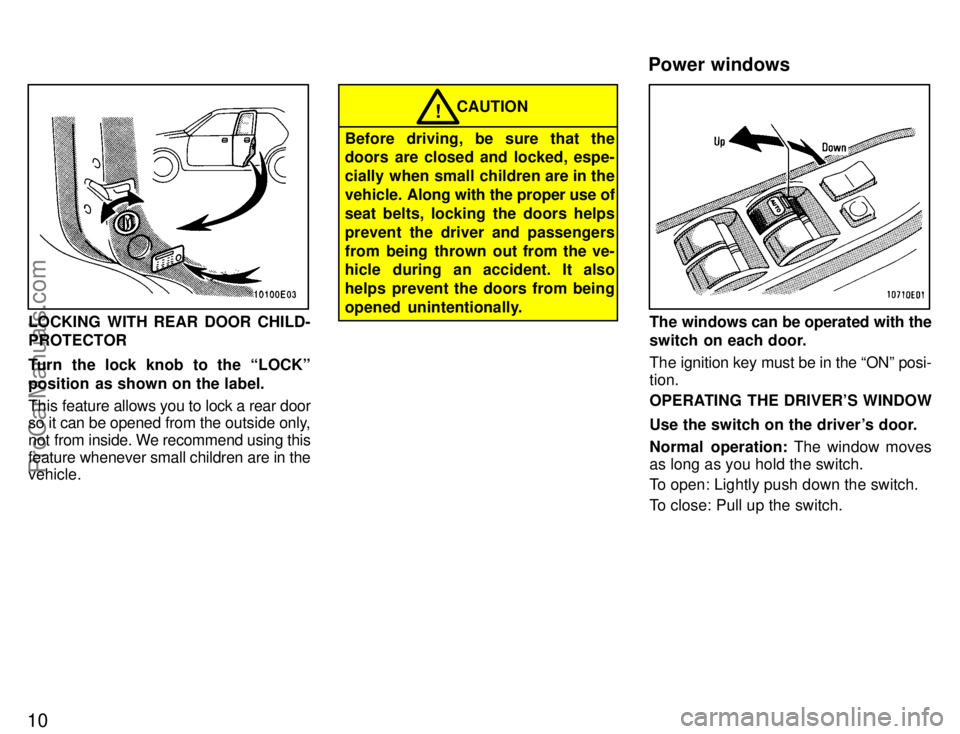
LOCKING WITH REAR DOOR CHILD-
PROTECTOR
Turn the lock knob to the LOCKº
position as shown on the label.
This feature allows you to lock a rear door
so it can be opened from the outside only,
not from inside. We recommend using this
feature whenever small children are in the
vehicle.
CAUTION!
Before driving, be sure that the
doors are closed and locked, espe-
cially when small children are in the
vehicle. Along with the proper use of
seat belts, locking the doors helps
prevent the driver and passengers
from being thrown out from the ve-
hicle during an accident. It also
helps prevent the doors from being
opened unintentionally.
The windows can be operated with the
switch on each door.
The ignition key must be in the ONº posi-
tion.
OPERATING THE DRIVER'S WINDOW
Use the switch on the driver's door.
Normal operation: The window moves
as long as you hold the switch.
To open: Lightly push down the switch.
To close: Pull up the switch.
Power windows
ProCarManuals.com
Page 15 of 195

12
CAUTION!
To avoid serious personal injury,
you must do the following.
�Always make sure the head, hands
and other parts of the body of all oc-
cupants are kept completely inside
the vehicle before you close the
power windows. If someone's neck,
head or hands gets caught in a clos-
ing window, it could result in a seri-
ous injury. When anyone closes the
power windows, be sure that they
operate the windows safely.
�When small children are in the ve-
hicle, never let them use the power
window switches without supervi-
sion. Use the window lock button
to prevent them from making unex-
pected use of the switches.
�Never leave small children alone in
the vehicle, especially with the
ignition key still inserted. They
could use the power window
switches and get trapped in a win-
dow. Unattended children can be-
come involved in serious acci-
dents.
To open the trunk lid from the outside,
insert the master key and turn it clock-
wise.
See ºLuggage stowage precautionsº in
Part 2 for precautions to observe in load-
ing luggage.
To close the trunk lid, lower it and press
down on it. After closing the trunk lid, try
pulling it up to make sure it is securely
closed.
CAUTION!
Keep the trunk lid closed while driv-
ing. This not only keeps the luggage
from being thrown out but also pre-
vents exhaust gases from entering
the vehicle.
To open the trunk lid from the driver's
seat, pull up on the lock release lever.
Trunk lid (sedan)Ð ÐLock release lever
ProCarManuals.com
Page 151 of 195

146Be on the alert for changes in perfor-
mance, sounds, and visual tip-offs that in-
dicate service is needed. Some important
clues are as follows:
�Engine missing, stumbling, or pinging
�Appreciable loss of power
�Strange engine noises
�A leak under the vehicle (however, wa-
ter dripping from the air conditioning
after use is normal.)
�Change in exhaust sound (This may
indicate a dangerous carbon monox-
ide leak. Drive with the windows open
and have the exhaust system checked
immediately.)
�Flat-looking tire; excessive tire squeal
when cornering; uneven tire wear
�Vehicle pulls to one side when driving
straight on a level road
�Strange noises related to suspension
movement
�Loss of brake effectiveness; spongy
feeling brake or clutch pedal; pedal al-
most touches floor; vehicle pulls to one
side when braking
�Engine coolant temperature continual-
ly higher than normalIf you notice any of these clues, take your
vehicle to your Toyota dealer as soon as
possible. It probably needs adjustment or
repair.
Do not continue driving with the ve-
hicle unchecked. It could result in
serious vehicle damage and possi-
bly personal injury.CAUTION
! Does your vehicle need
repairing?
ProCarManuals.com
Page 190 of 195

185
Fuses (type A)
1. CIG & RADIO 20 A: Cigarette lighter,
digital clock display, air conditioning sys-
tem, radio, cassette tape player, power
rear view mirrors, automatic transmission
shift lock system, theft deterrent system,
SRS airbags
2. TAIL 15 A: Tail lights, parking lights, li-
cense plate lights, instrument panel lights,
daytime running light system
3. IGN 10 A: Multiport fuel injection sys-
tem/sequential multiport fuel injection
system, discharge warning light, SRS air-
bags
4. ECU-B 10 A: Daytime running light
system, cruise control system5. DEF-I/UP 7.5 A: Multiport fuel injec-
tion system/sequential multiport fuel in-
jection system
6. STOP 15 A: Stop lights, high mounted
stoplight, cruise control system, automat-
ic transmission shift lock system, anti-
lock brake system
7. TURN 7.5 A: Turn signal lights
8. ECU-IG 15 A: Starting system, anti-
lock brake system, automatic transmis-
sion shift lock system9. GAUGE 10 A: Gauges and meters,
service reminder indicators (except dis-
charge and open door warning lights),
back-up light, air conditioning system,
daytime running light system, electroni-
cally controlled automatic transmission
system
10. WIP 20 A: Windshield wipers and
washer, rear window wiper and washer
11. A/C 15 A: Air conditioning system
12. DOME 20 A: Interior light, luggage
compartment light, trunk light, clock, open
door warning light, radio, cassette tape
player, anti-lock brake system, theft de-
terrent system, electric sun roof
13. HAZ-HORN 20 A: Emergency flash-
ers, horns
Fuses
ProCarManuals.com
Page 191 of 195

186
14. FAN-I/UP 7.5 A: Multiport fuel injec-
tion system/sequential multiport fuel in-
jection system
15. SPARE 7.5 A: Spare fuse
16. SPARE 15 A: Spare fuse
17. SPARE 20 A: Spare fuse
18. HEAD (RH) 15 A: Right-hand head-
light
19. HEAD (LH) 15 A: Left-hand headlight
20. ALT-S 7.5 A: Charging system
21. EFI, F-HTR 15 A: Multiport fuel injec-
tion system/sequential multiport fuel in-
jection system, electronically controlled
automatic transmission system
22. DRL 7.5 A: Daytime running light sys-
tem23. HEAD (LH-UPR) 10 A: Left-hand
headlight (high beam)
24. HEAD (LH-LWR) 10 A: Left-hand
headlight (low beam)
25. HEAD (RH-UPR) 10 A: Right-hand
headlight (high beam)
26. HEAD (RH-LWR) 10 A: Right-hand
headlight (low beam)
27. OBD 7.5 A: On-board diagnosis sys-
tem
28. EFI 15 A: Multiport fuel injection sys-
tem/sequential multiport fuel injection
system, electronically controlled auto-
matic transmission systemFuses (type B)
29. POWER 30 A: Power windows, pow-
er door lock system, electric sun roof
30. DEF 30 A: Rear window defogger
31. HEATER 40 A: Air conditioning sys-
tem
32. AM 2 30 A: Starting system and IGNº
fuse
33. FAN 30 A: Electric cooling fan and
FAN-I/UPº fuse
34. CDS 30 A: Electric cooling fan
ProCarManuals.com