Page 161 of 226
155
1. Get the tool bag, jack and spare tire.
To prepare yourself for an emergency,
you should familiarize yourself with the
use of the jack, each of the tools and their
storage locations.When removing the jack, turn the joint by
hand towards the CONTRACT direction
until the jack is free. When storing, turn
the joint by hand towards the EXPAND di-
rection until the jack is firmly secured to
prevent it from flying forward during a col-
lision or sudden braking.To remove the spare tire:
1. Loosen the nut and remove it.
2. Remove the spare tire cover.
3. Loosen and remove the bolt and
spacer.
4. Take the spare tire out of the vehicle.
When storing the spare tire, put it in place
with the outer side of the wheel facing up.
Then secure the tire by repeating the
above removal steps in reverse order to
prevent it from flying forward during a col-
lision or sudden braking.
ÐRequired tools and spare
tire (sedan and coupe)
ProCarManuals.com
Page 162 of 226
156
1. Get the tool bag, jack and spare tire.
To prepare yourself for an emergency,
you should familiarize yourself with the
use of the jack, each of the tools and their
storage locations.When removing the jack, turn the joint by
hand towards the CONTRACT direction
until the jack is free. When storing, turn
the joint by hand towards the EXPAND di-
rection until the jack is firmly secured to
prevent it from flying forward during a col-
lision or sudden braking.To remove the spare tire:
1. Loosen the nut and remove it.
2. Remove the spare tire cover.
ÐRequired tools and spare
tire (wagon with third seat)
ProCarManuals.com
Page 163 of 226
157
3. Loosen and remove the bolt.
4. Take the spare tire out of the vehicle.
When storing the spare tire, put it in place
with the inner side of the wheel facing in-
ward. Then secure the tire by repeating
the above removal steps in reverse order
to prevent it from flying forward during a
collision or sudden braking.1. Get the tool bag, jack and spare tire.
To prepare yourself for an emergency,
you should familiarize yourself with the
use of the jack, each of the tools and their
storage locations.When removing the jack, turn the joint by
hand towards the CONTRACT direction
until the jack is free. When storing, turn
the joint by hand towards the EXPAND di-
rection until the jack is firmly secured to
prevent it from flying forward during a col-
lision or sudden braking.
ÐRequired tools and spare tire
(wagon without third seat)
ProCarManuals.com
Page 168 of 226
162
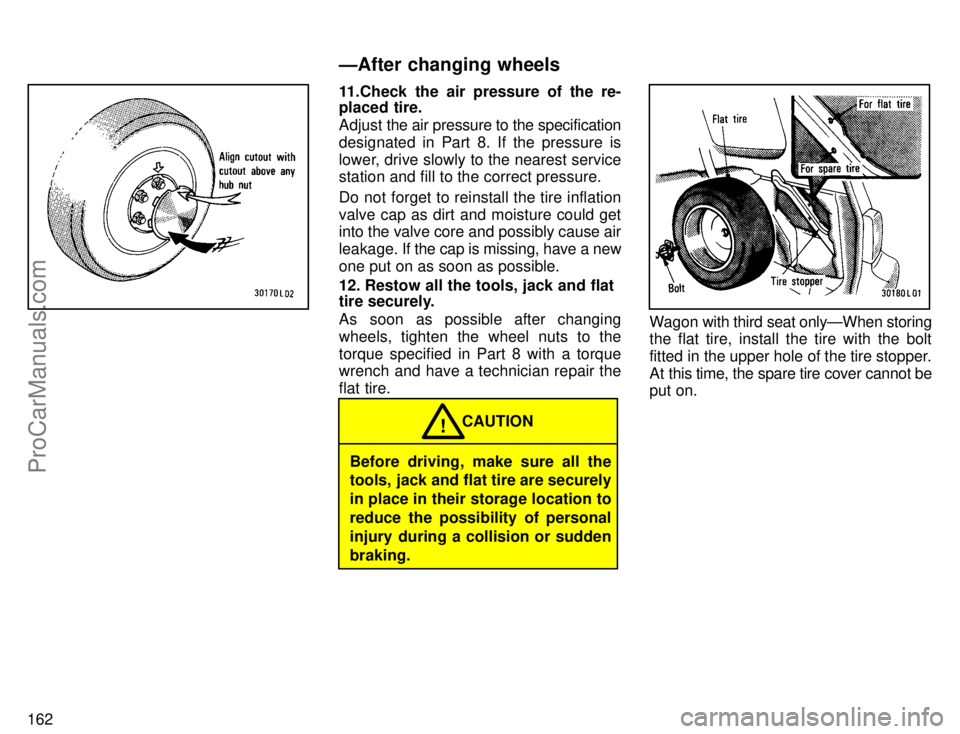
11.Check the air pressure of the re-
placed tire.
Adjust the air pressure to the specification
designated in Part 8. If the pressure is
lower, drive slowly to the nearest service
station and fill to the correct pressure.
Do not forget to reinstall the tire inflation
valve cap as dirt and moisture could get
into the valve core and possibly cause air
leakage. If the cap is missing, have a new
one put on as soon as possible.
12. Restow all the tools, jack and flat
tire securely.
As soon as possible after changing
wheels, tighten the wheel nuts to the
torque specified in Part 8 with a torque
wrench and have a technician repair the
flat tire.
Before driving, make sure all the
tools, jack and flat tire are securely
in place in their storage location to
reduce the possibility of personal
injury during a collision or sudden
braking.CAUTION
!
Wagon with third seat onlyÐWhen storing
the flat tire, install the tire with the bolt
fitted in the upper hole of the tire stopper.
At this time, the spare tire cover cannot be
put on.
ÐAfter changing wheels
ProCarManuals.com
Page 169 of 226

163
If towing is necessary, we recommend
you have it done by your Toyota dealer
or a commercial tow truck service.
Proper equipment will help ensure that
your vehicle is not damaged while being
towed. Commercial operators are gener-
ally aware of the state/provincial and local
laws pertaining to towing.
Your vehicle can be damaged if it is towed
incorrectly. Although most operators
know the correct procedure, it is possible
to make a mistake. To avoid damage to
your vehicle, make sure the following few
precautions are observed. If necessary,
show this page to the tow truck driver.
TOWING PRECAUTIONS:
Use a safety chain system for all towing,
and abide by the state/provincial and local
laws. The wheels and axle on the ground
must be in good condition. If they are
damaged, use a towing dolly.
(a) Using flat bed truck
Toyota recommends this as the best
method for your vehicle.
(b) Towing with wheel lift type truck
From frontÐRelease the parking brake.From rearÐ
�Manual transmission:
We recommend using a towing dolly
under the front wheels. If you do not
use a towing dolly, place the ignition
key in the ACCº position and put the
transmission in neutral.
NOTICE
Do not tow with the key removed or
in the LOCKº position when tow-
ing from the rear without a towing
dolly. The steering lock mechanism
is not strong enough to hold the
front wheels straight.
�Automatic transmission:
Use a towing dolly under the front
wheels.
NOTICE
Never tow a vehicle with an auto-
matic transmission from the rear
with the front wheels on the ground,
as this may cause serious damage
to the transmission.
If your vehicle needs to be
towedÐ
ProCarManuals.com
Page 170 of 226
164
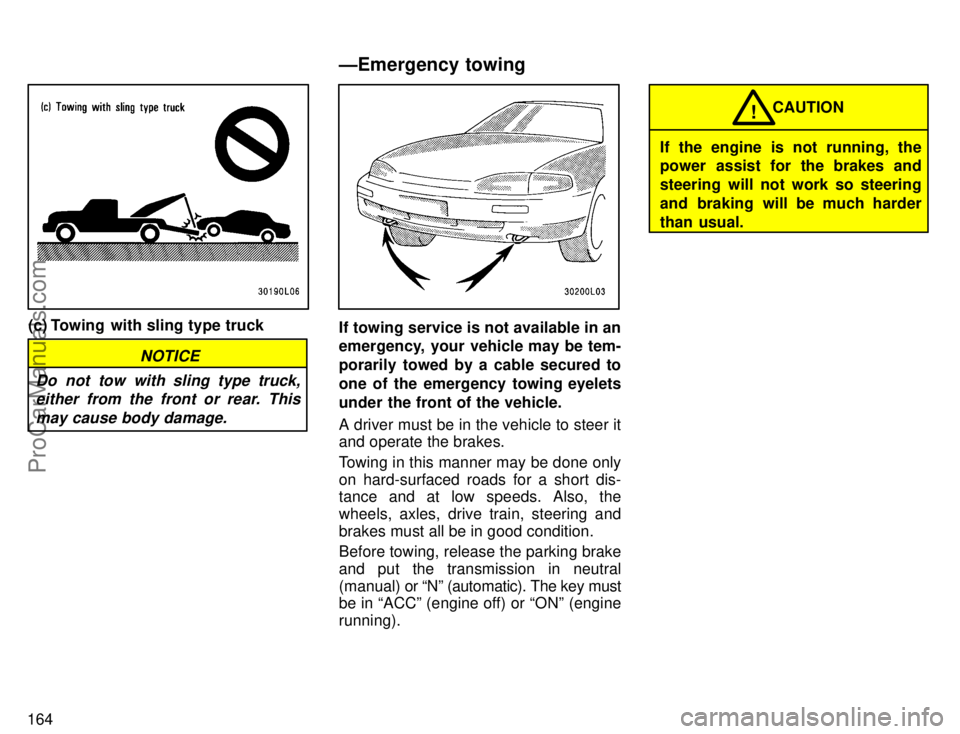
(c) Towing with sling type truck
NOTICE
Do not tow with sling type truck,
either from the front or rear. This
may cause body damage.
If towing service is not available in an
emergency, your vehicle may be tem-
porarily towed by a cable secured to
one of the emergency towing eyelets
under the front of the vehicle.
A driver must be in the vehicle to steer it
and operate the brakes.
Towing in this manner may be done only
on hard-surfaced roads for a short dis-
tance and at low speeds. Also, the
wheels, axles, drive train, steering and
brakes must all be in good condition.
Before towing, release the parking brake
and put the transmission in neutral
(manual) or Nº (automatic). The key must
be in ACCº (engine off) or ONº (engine
running).
CAUTION!
If the engine is not running, the
power assist for the brakes and
steering will not work so steering
and braking will be much harder
than usual.
ÐEmergency towing
ProCarManuals.com
Page 175 of 226
169 4. To prevent water spots, dry the vehicle
using a clean soft cotton towel. Do not rub
or press hardÐyou might scratch the
paint.
Automatic car wash
Your vehicle may be washed in an auto-
matic car wash, but remember that the
paint can be scratched by some type of
brushes, unfiltered washing water, or the
washing process itself. Scratching re-
duces paint durability and gloss, especial-
ly on darker colors. The manager of the
car wash should be able to advise you
whether the process is safe for the paint
on your vehicle.
Waxing your Toyota
Polishing and waxing is recommend-
ed to maintain the original beauty of
your Toyota's finish.
1. Always wash and dry the vehicle be-
fore you begin waxing, even if you are us-
ing a combined cleaner and wax.
2. Use a good quality polish and wax. If
the finish has become extremely weath-
ered, use a car-cleaning polish, followed
by a separate wax. Carefully follow the
manufacturer 's instructions and precau-
tions. Be sure to polish and wax the
chrome trim as well as the paint.3. Wax the vehicle again when water
does not bead but remains on the surface
in large patches.
Always remove the plastic bumpers
if your vehicle is re-painted and
placed in a high heat paint waxing
booth. High temperatures could
damage the bumpers.
NOTICE
CAUTION!
Do not wash the vehicle floor with wa-
ter, or allow water to get onto the floor
when cleaning the vehicle interior or
exterior. Water may get into audio
components or other electrical com-
ponents above or under the floor car-
pet (or mat) and cause a malfunction;
and it may cause body corrosion.
Vinyl interior
The vinyl upholstery may be easily
cleaned with a mild soap or detergent
and water.
First vacuum over the upholstery to remove
loose dirt. Then, using a sponge or soft cloth,
apply the soap solution to the vinyl. After al-
lowing it to soak in for a few minutes to loos -
en the dirt, remove the dirt and wipe off the
soap with a clean damp cloth. If all the dirt
does not come off, repeat the procedure.
Commercial foaming- type vinyl cleaners
are also available which work well. Follow
the manufacturer 's instructions.
NOTICE
Do not use solvent, thinner,
gasoline or window cleaner on the
interior.
Carpets
Use a good foam-type shampoo to
clean the carpets.
Cleaning the interior
ProCarManuals.com
Page 189 of 226

183
NOTICE
�Remember that battery and igni-
tion cables carry high currents or
voltages. Be careful of accidental-
ly causing a short circuit.
�Add only demineralized or dis-
tilled water to fill the radiator. And
if you spill some of the coolant, be
sure to wash off with water to pre-
vent it from damaging the parts or
paint.
�Do not allow dirt or anything else
to fall through the spark plug
holes.
�Use only spark plugs of the speci-
fied type. Using other types will
cause engine damage, loss of per-
formance or radio noise.
�Do not reuse platinum-tipped
spark plugs by cleaning or regap-
ping.
�Do not overfill automatic trans-
mission fluid, or the transmission
could be damaged.
�Do not drive with the air cleaner
filter removed, or excessive en-
gine wear could result. Also back-
firing could cause a fire in the en-
gine compartment.
�Be careful not to scratch the glass
surface with the wiper frame.
�When closing the engine hood,
check to see that you have not for-
gotten any tools, rags, etc.
Here is a list of parts and tools you will
need on performing do-it-yourself main-
tenance. Remember all Toyota parts are
designed in metric sizes, so your tools
must be metric.
Checking the engine oil level
Parts (if level is low):
�Engine oil API SH, Energy-Conserv-
ing IIº multigrade or ILSAC multigrade
having viscosity proper for your cli-
mate
Tools:
�Rag or paper towel
�Funnel (only for adding oil)
Checking the engine coolant level
Parts (if level is low):
�Ethylene-glycol antifreeze
�Demineralized or distilled water
Tools:
�Funnel (only for adding coolant)
Checking brake fluid
Parts (if level is low):
�SAE J1703 or FMVSS No. 116 DOT 3
brake fluid
Tools:
�Rag or paper towel
�Funnel (only for adding fluid)
Parts and tools
ProCarManuals.com