Page 39 of 226
34
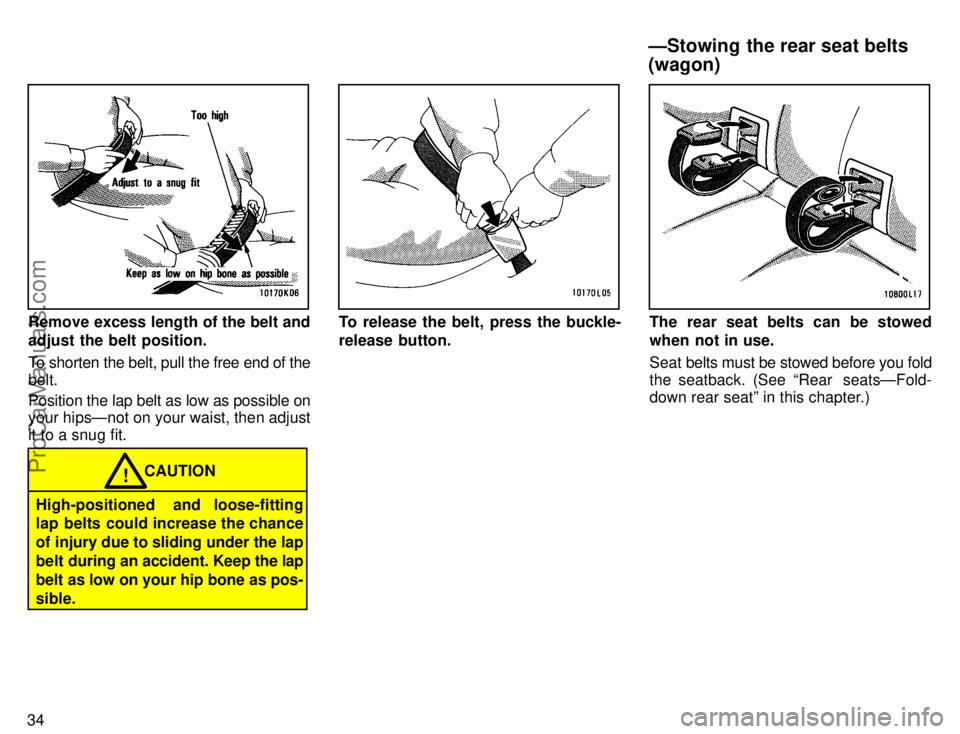
Remove excess length of the belt and
adjust the belt position.
To shorten the belt, pull the free end of the
belt.
Position the lap belt as low as possible on
your hipsÐnot on your waist, then adjust
it to a snug fit.
CAUTION!
High-positioned and loose-fitting
lap belts could increase the chance
of injury due to sliding under the lap
belt during an accident. Keep the lap
belt as low on your hip bone as pos-
sible.
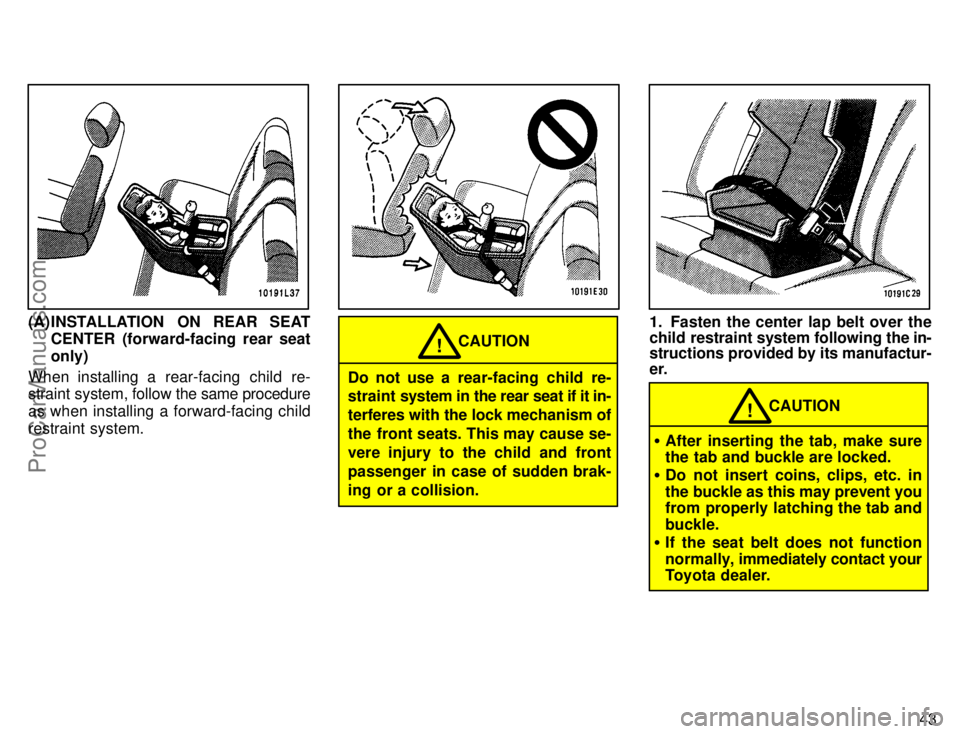
To release the belt, press the buckle-
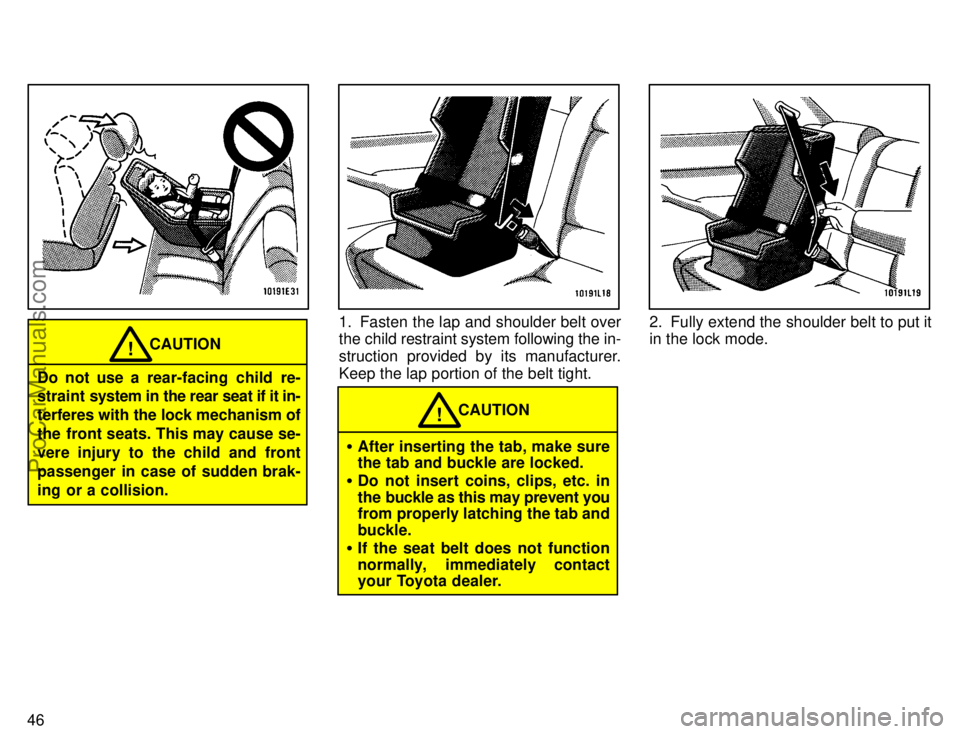
release button.The rear seat belts can be stowed
when not in use.
Seat belts must be stowed before you fold
the seatback. (See Rear seatsÐFold-
down rear seatº in this chapter.)
ÐStowing the rear seat belts
(wagon)
ProCarManuals.com
Page 40 of 226
35
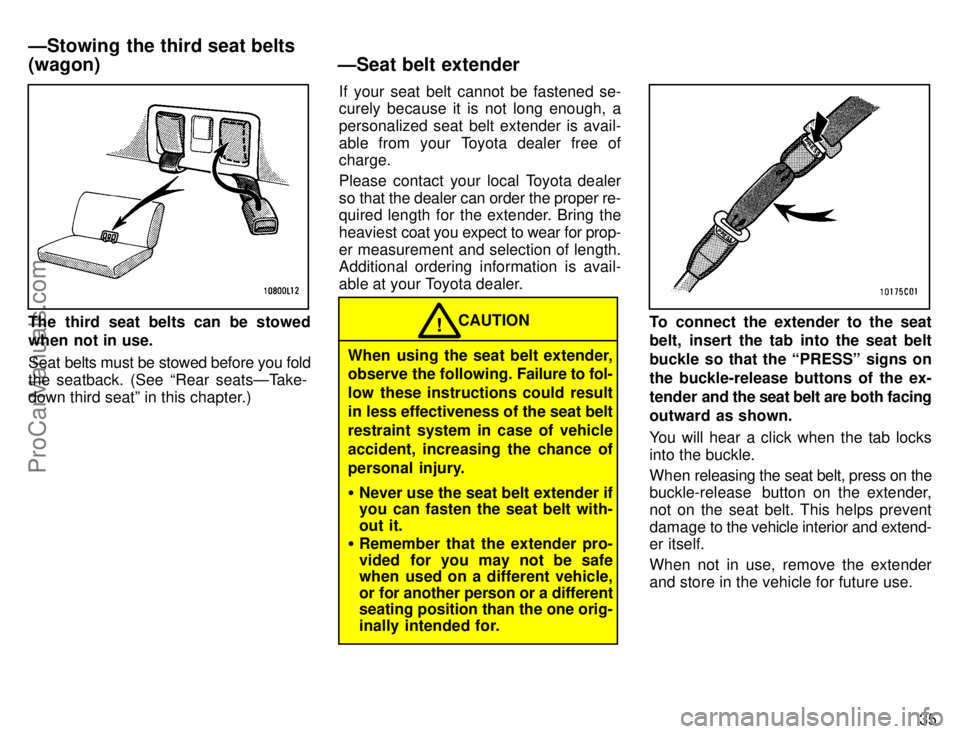
The third seat belts can be stowed
when not in use.
Seat belts must be stowed before you fold
the seatback. (See Rear seatsÐTake-
down third seatº in this chapter.)If your seat belt cannot be fastened se-
curely because it is not long enough, a
personalized seat belt extender is avail-
able from your Toyota dealer free of
charge.
Please contact your local Toyota dealer
so that the dealer can order the proper re-
quired length for the extender. Bring the
heaviest coat you expect to wear for prop-
er measurement and selection of length.
Additional ordering information is avail-
able at your Toyota dealer.
When using the seat belt extender,
observe the following. Failure to fol-
low these instructions could result
in less effectiveness of the seat belt
restraint system in case of vehicle
accident, increasing the chance of
personal injury.
�Never use the seat belt extender if
you can fasten the seat belt with-
out it.
�Remember that the extender pro-
vided for you may not be safe
when used on a different vehicle,
or for another person or a different
seating position than the one orig-
inally intended for.
CAUTION!To connect the extender to the seat
belt, insert the tab into the seat belt
buckle so that the PRESSº signs on
the buckle-release buttons of the ex-
tender and the seat belt are both facing
outward as shown.
You will hear a click when the tab locks
into the buckle.
When releasing the seat belt, press on the
buckle-release button on the extender,
not on the seat belt. This helps prevent
damage to the vehicle interior and extend-
er itself.
When not in use, remove the extender
and store in the vehicle for future use.
ÐStowing the third seat belts
(wagon) ÐSeat belt extender
ProCarManuals.com
Page 48 of 226
43
(A) INSTALLATION ON REAR SEAT
CENTER (forward-facing rear seat
only)
When installing a rear-facing child re-
straint system, follow the same procedure
as when installing a forward-facing child
restraint system.
CAUTION!
Do not use a rear-facing child re-
straint system in the rear seat if it in-
terferes with the lock mechanism of
the front seats. This may cause se-
vere injury to the child and front
passenger in case of sudden brak-
ing or a collision.
1. Fasten the center lap belt over the
child restraint system following the in-
structions provided by its manufactur-
er.
CAUTION!
�After inserting the tab, make sure
the tab and buckle are locked.
�Do not insert coins, clips, etc. in
the buckle as this may prevent you
from properly latching the tab and
buckle.
�If the seat belt does not function
normally, immediately contact your
Toyota dealer.
ProCarManuals.com
Page 51 of 226
46
Do not use a rear-facing child re-
straint system in the rear seat if it in-
terferes with the lock mechanism of
the front seats. This may cause se-
vere injury to the child and front
passenger in case of sudden brak-
ing or a collision.
CAUTION!
1. Fasten the lap and shoulder belt over
the child restraint system following the in-
struction provided by its manufacturer.
Keep the lap portion of the belt tight.
CAUTION!
�After inserting the tab, make sure
the tab and buckle are locked.
�Do not insert coins, clips, etc. in
the buckle as this may prevent you
from properly latching the tab and
buckle.
�If the seat belt does not function
normally, immediately contact
your Toyota dealer.
2. Fully extend the shoulder belt to put it
in the lock mode.
ProCarManuals.com
Page 142 of 226
136When stowing luggage or cargo in the ve-
hicle, observe the following:
�Put luggage or cargo in the trunk or
luggage compartment when at all pos-
sible. Be sure all items are secured in
place.
�Be careful to keep the vehicle bal-
anced. Locating the weight as far
forward as possible helps maintain
this.
�For better fuel economy, do not carry
unneeded weight.
CAUTION!
�To prevent luggage or packages
from sliding forward during brak-
ing, do not stack anything in the
enlarged trunk room or the lug-
gage compartment higher than
the seatbacks. Keep luggage or
packages low, as close to the floor
as possible.
�Never allow anyone to ride in the
enlarged trunk room or the lug-
gage compartment. It is not de-
signed for passengers. They
should ride in their seats with their
seat belts properly fastened.
Otherwise, they are much more
likely to suffer serious bodily inju-
ry, in the event of sudden braking
or a collision.
�Do not place anything on the filler
panel behind the rear seatback or
luggage cover. Such items may be
thrown about and possibly injure
people in the vehicle during sud-
den braking or an accident.
�Do not drive with objects left on
top of the instrument panel. They
may interfere with the driver's field
of view. Or they may move during
sharp vehicle acceleration or turn-
ing, and impair the driver's control
of the vehicle. In an accident they
may injure the vehicle occupants.
NOTICE
Do not load the vehicle beyond the
vehicle capacity weight specified in
Part 8.
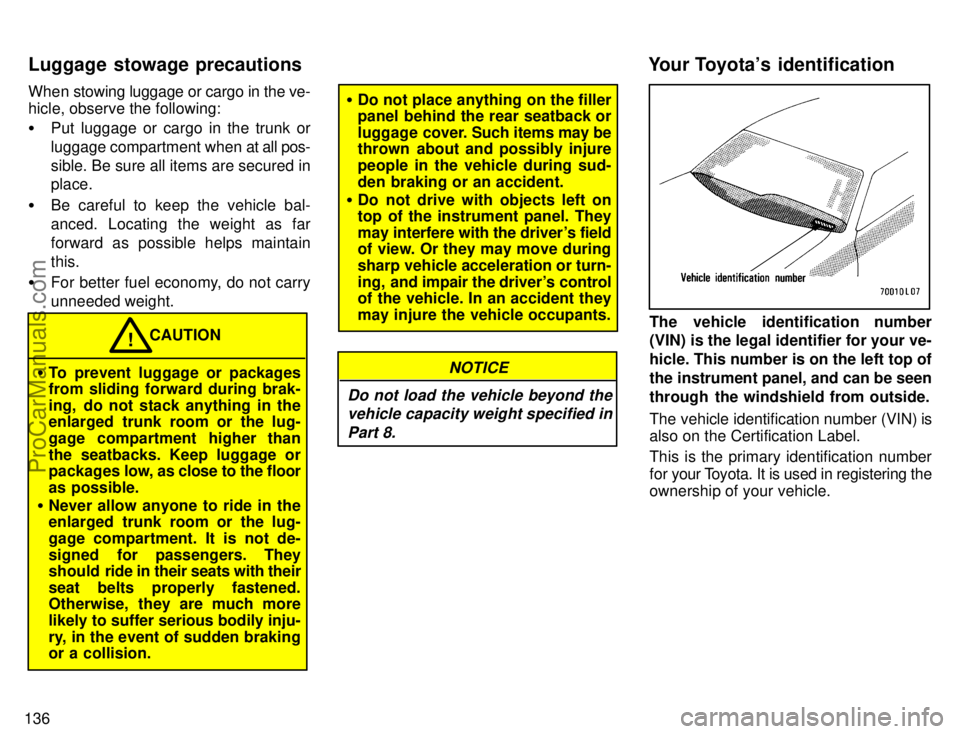
The vehicle identification number
(VIN) is the legal identifier for your ve-
hicle. This number is on the left top of
the instrument panel, and can be seen
through the windshield from outside.
The vehicle identification number (VIN) is
also on the Certification Label.
This is the primary identification number
for your Toyota. It is used in registering the
ownership of your vehicle.
Luggage stowage precautions Your Toyota's identification
ProCarManuals.com
Page 179 of 226

173 Tire surface and wheel nuts
Check the tires carefully for cuts, damage
or excessive wear. See Chapter 7-2 for
additional information. When checking
the tires, make sure no nuts are missing,
and check the nuts for looseness. Tighten
them if necessary.
Tire rotation
Rotate the tires every 12000 km (7500
miles). See Chapter 7-2 for additional in-
formation.
Fluid leaks
Check underneath for leaking fuel, oil, wa-
ter or other fluid after the vehicle has been
parked for a while. If you smell fuel fumes
or notice any leak, have the cause found
and corrected immediately.
Doors and engine hood
Check that all doors including trunk lid op-
erate smoothly and all latches lock se-
curely. Make sure the engine hood secon-
dary latch secures the hood from opening
when the primary latch is released.
INSIDE THE VEHICLE
Items listed below should be checked
regularly, e.g. while performing peri-
odic services, cleaning the vehicle,
etc.Lights
Make sure the headlights, stop lights, tail
lights, turn signal lights, and other lights
are all working. Check headlight aim.
Service reminder indicators and warn-
ing buzzers
Check that all service reminder indicators
and warning buzzers function properly.
Steering wheel
Be alert for changes in steering condition,
such as hard steering or strange noise.
Seats
Check that all front seat controls such as
seat adjusters, seatback recliner, etc. op-
erate smoothly and that all latches lock
securely in any position. Check that the
head restraints move up and down
smoothly and that the locks hold securely
in any latched position. For folding-down
or swing-up rear seatbacks or rear seat
cushion, check that the latches lock se-
curely.
Seat belts
Check that the seat belt system such as
buckles, retractors and anchors operate
properly and smoothly. Make sure that the
belt webbing is not cut, frayed, worn or
damaged.Accelerator pedal
Check the pedal for smooth operation and
uneven pedal effort or catching.
Clutch pedal
Check the pedal for smooth operation.
Brake pedal
Check the pedal for smooth operation and
that the pedal has the proper clearance.
Check the brake booster function.
Brakes
At a safe place, check that the brakes do
not pull to one side when applied.
Parking brake
Check that the lever (lever type) or pedal
(pedal type) has the proper travel and
that, on a safe incline, your vehicle is held
securely with only the parking brake ap-
plied.
Automatic transmission Parkº mech-
anism
Check the lock release button of the se-
lector lever for proper and smooth opera-
tion. On a safe incline, check that your ve-
hicle is held securely with the selector
lever in Pº position and all brakes re-
leased.ProCarManuals.com