Page 164 of 217
161
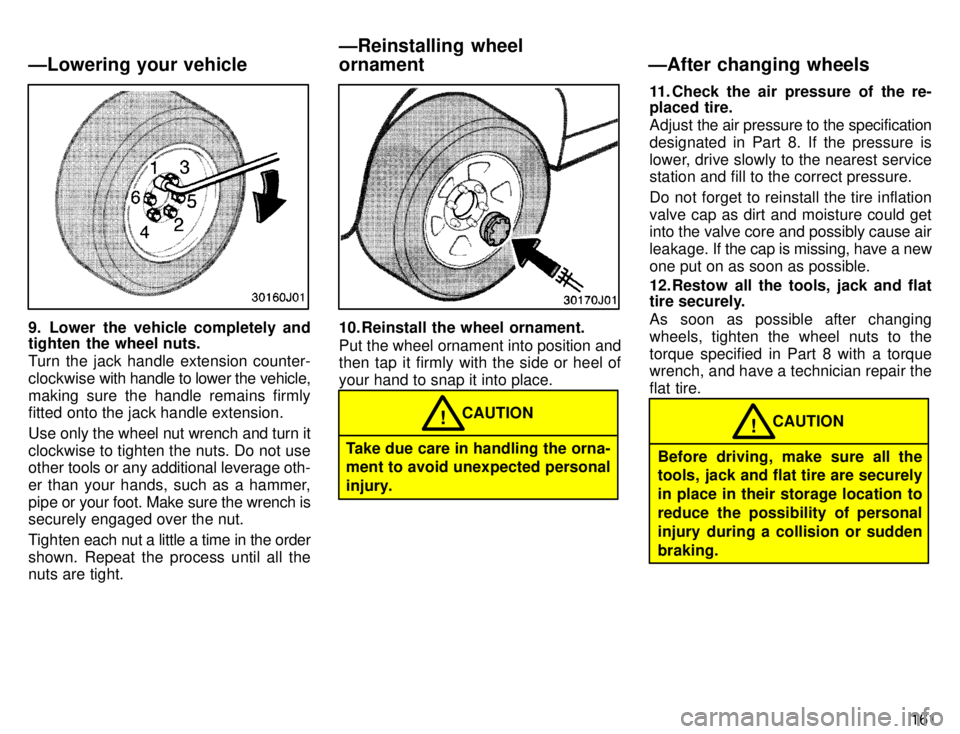
9. Lower the vehicle completely and
tighten the wheel nuts.
Turn the jack handle extension counter-
clockwise with handle to lower the vehicle,
making sure the handle remains firmly
fitted onto the jack handle extension.
Use only the wheel nut wrench and turn it
clockwise to tighten the nuts. Do not use other tools or any additional leverage oth-
er than your hands, such as a hammer,
pipe or your foot. Make sure the wrench is
securely engaged over the nut.
Tighten each nut a little a time in the order
shown. Repeat the process until all the
nuts are tight.10. Reinstall the wheel ornament.
Put the wheel ornament into position and
then tap it firmly with the side or heel of your hand to snap it into place.
Take due care in handling the orna- ment to avoid unexpected personal
injury. CAUTION
! 11. Check the air pressure of the re-
placed tire.
Adjust
the air pressure to the specification
designated in Part 8. If the pressure is
lower, drive slowly to the nearest service station and fill to the correct pressure.
Do not forget to reinstall the tire inflation valve cap as dirt and moisture could get into the valve core and possibly cause air
leakage. If the cap is missing, have a new
one put on as soon as possible.
12. Restow all the tools, jack and flat
tire securely.
As soon as possible after changing
wheels, tighten the wheel nuts to thetorque specified in Part 8 with a torque wrench, and have a technician repair the flat tire.
Before driving, make sure all the
tools, jack and flat tire are securely in place in their storage location to
reduce the possibility of personal
injury during a collision or suddenbraking. CAUTION
!
ÐLowering your vehicle
ÐReinstalling wheel
ornament ÐAfter changing wheels
Page 193 of 217
190Remove and replace the reservoir cover by hand. Use only newly opened brake fluid. Once
opened, brake fluid absorbs moisture
from the air, and excess moisture can cause a dangerous loss of braking.
CAUTION!
Take care when filling the reservoir
because brake fluid can harm your
eyes and damage painted surfaces.If fluid gets in your eyes, flush your
eyes with clean water.
NOTICE
If you spill the fluid, be sure to wash it off with water to prevent it from
damaging the parts or paint.
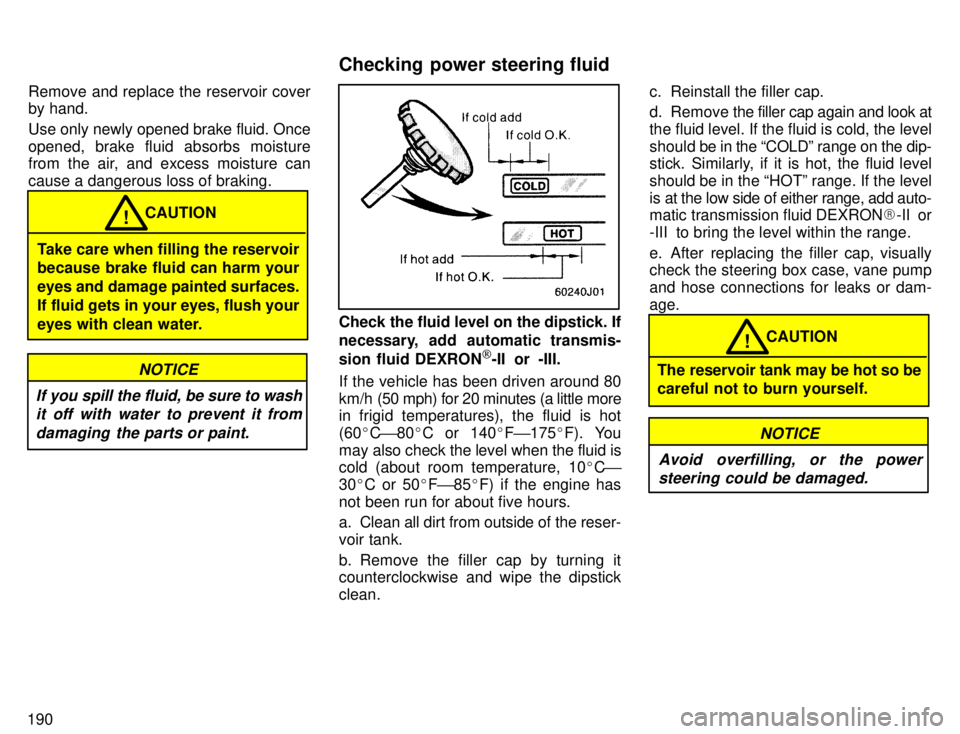
Check the fluid level on the dipstick. If
necessary, add automatic transmis-
sion fluid DEXRON [
-II or -III.
If the vehicle has been driven around 80
km/h (50 mph) for 20 minutes (a little more
in frigid temperatures), the fluid is hot(60 C ' 80 C or 140 F ' 175 F). You
may also check the level when the fluid is
cold (about room temperature, 10 C '
30 C or 50 F ' 85 F) if the engine has
not been run for about five hours.
a. Clean all dirt from outside of the reser- voir tank.
b. Remove the filler cap by turning it
counterclockwise and wipe the dipstick clean. c. Reinstall the filler cap.
d. Remove
the filler cap again and look at
the fluid level. If the fluid is cold, the level
should be in the COLDº range on the dip-
stick. Similarly, if it is hot, the fluid level
should be in the HOTº range. If the level
is at the low side of either range, add auto-
matic transmission fluid DEXRON -II or
-III to bring the level within the range.
e. After replacing the filler cap, visually check the steering box case, vane pump
and hose connections for leaks or dam-age.CAUTION!
The reservoir tank may be hot so be
careful not to burn yourself.
NOTICE
Avoid overfilling, or the power steering could be damaged.
Checking power steering fluid
Page 213 of 217

210
Engine compartment (U.S.A.) Fuses (type A)
1. DEFOG 15 A: Back window defogger
2. STOP 10 A: Stop lights, high-
mounted stoplight
3. ALT-S 7.5 A: Charging system
4. OBD 7.5 A: On-board diagnosis sys-
tem
5. EFI 15 A: Multiport fuel injection sys-
tem/sequential multiport fuel injection systemEngine compartment (Canada)
6. HORN 15 A: Horns
7. DOME 15 A: Interior lights, personal
lights, luggage compartment light
8. TAIL 10 A: Tail lights, parking lights, li-
cense plate lights
9. A.C 10 A: Air conditioning control sys-
tem
10. RR HTR 10 A: Rear air conditioning
control system
11. HEAD (RH) 10 A: Right-hand head-
light
12. HEAD (LH) 10 A: Left-hand headlightInstrument panel
13. DRL 7.5 A: Daytime running light sys-
tem
14. HEAD (HI RH) 10 A: Right-hand
headlight (high beam)
15. HEAD (HI LH) 10 A: Left-hand head-
light (high beam)
16. HEAD (LO RH) 10 A: Right-hand
headlight (low beam)
17. HEAD (LO LH) 10 A: Left-hand head-
light (low beam)
18. ACC 15 A: Car audio system, power
antenna, clock, power rear view mirror control
Fuses