1996 PONTIAC BONNEVILLE low beam
[x] Cancel search: low beamPage 85 of 387

Turn Signal/Multifunction Lever
The lever on the left side of the steering column
includes
your:
0 Turn Signal and Lane Change Signals
0 Headlamp HighLow Beam Changer
Flash-to-Pass
Windshield Wipers
0 Windshield Washer
Cruise Control
Turn and Lane Change Signals
The turn signal has two upward (for right) and two
downward (for left) positions. These positions allow
you
to signal a turn or a lane change.
To signal
a tum, move the lever all the way up or down.
When the turn is finished, the lever will return automatically.
An mow on the instrument
panel will flash
in the
direction
of the turn or
lane change.
To signal a lane change, just raise or lower the lever
until the arrow starts to flash. Hold it there until you
complete your lane change. The lever will
return by
itself when you release it.
2-34
ProCarManuals.com
Page 86 of 387
As you signal a turn or a lane change, if the arrows don’t
flash but just stay on, a signal bulb may be burned out
and other drivers won’t see your turn signal. If you have
the Driver Information Center, it
will tell you if you
have a burned out bulb. See “Driver Information
Center” in the Index.
If a bulb is burned out, replace it to help avoid an
accident.
If the arrows don’t go on at all when you
signal a turn, check the fuse and for burned-out bulbs.
See “Fuses and Circuit Breakers” in the Index.
nrn Signal On Chime
If your turn signal is left on for more than 3/4 of a mile
(1.2 km), a chime will sound at each flash of the turn
signal. To turn
off the chime, move the turn signal lever
to the
off position.
Headlamp HighlLow Beam Changer
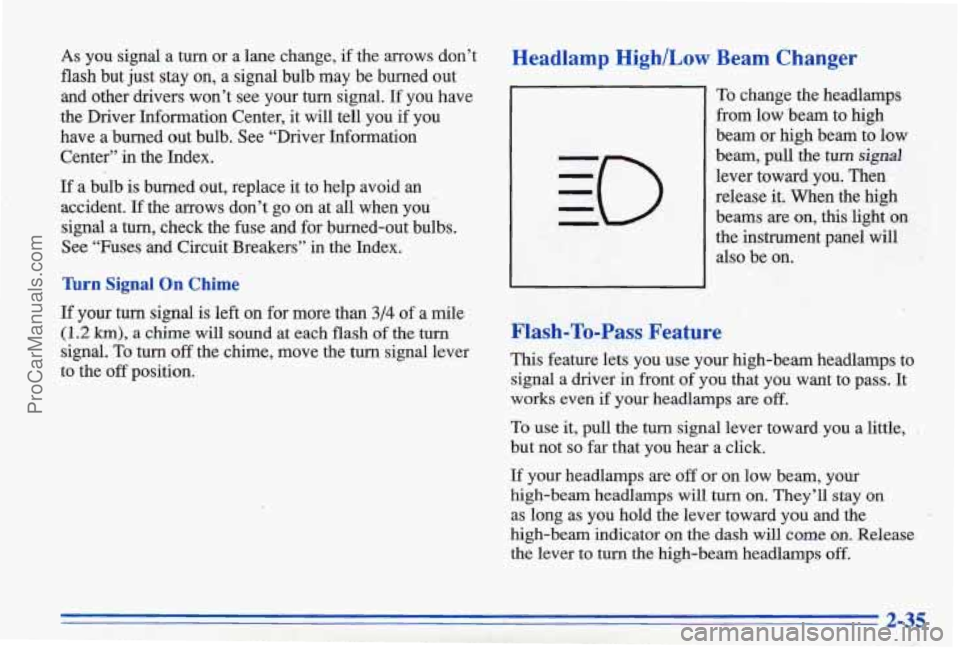
To change the headlamps
from
low b’eam to high
beam or high beam
to low
beam, pull the turn
signal
lever toward you. Then
release it. When the high
beams are
on, this light 011.
the instrument panel will also be on.
Flash-To-Pass Feature
This feature lets you use your high-beam headlamps to
signal a driver
in front of you that you want to pass. It
works even if your headlamps are off.
To use it, pull the turn signal lever toward you a little,
but not
so far that you hear a click.
If your headlamps are off or on low beam, your
high-beam headlamps
will turn on. They’ll stay on -
as long as you hold the lever toward you and the
high-beam indicator
on the dash will come on. Release
the lever to turn the high-beam headlamps
off.
I-
ProCarManuals.com
Page 93 of 387
Daytime Running Lamps
Daytime Running Lamps (Dm) can make it easier for
others to see the front of your vehicle during the day.
DRL can be helpful in many different driving
conditions, but they can
be especially helpful in the
short periods after dawn and before sunset.
A light sensor on top of the instrument panel monitors
the exterior light level for the operation
of DlU and
twilight sentinel,
so .be sure it isn’t covered. The DRL
system will make your low-beam headlamps come on at
a reduced brightness when:
The ignition is on,
0 The headlamp switch is OFF and
The transaxle is not in PARK (P).
When the DRL are on, only your low-beam headlamps
will
be on. The taillamps, sidemarker and other lamps
won’t be on.
Your instrument panel won’t be lighted either.
When it’s
dark enough outside, your low-beam
headlamps
will change to full brightness. The other
lamps that come on with your headlamps will also come
on. When it’s bright
enough outside, the regular lamps
will
go off, and your low-beam headlamps change to the
reduced brightness
of DRL.
To idle your vehicle with the DIU off, shift the
transaxle into
PARK (P). The DRL will’ stay off until
YOU Shift Out Qf PARK (P).
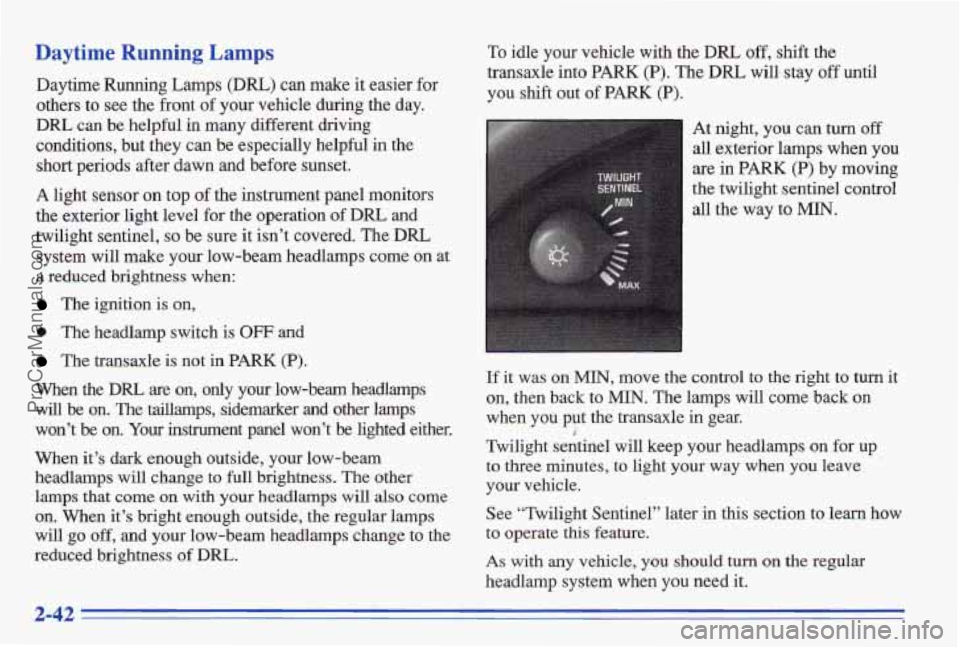
At night, you can turn off
all exterior lamps when you
are in PARK (P) by moving
the twilight sentinel control
all the way to
MIN.
If it was on MIN, move the control to the right to turn it
on, then back to
“4. The lamps will come back on
when you put the transaxle
in gear.
Twilight sentinel will keep your headlamps on for up to three minutes, to light your way when you leave
YOU vehicle.
See “Twilight Sentinel” later
in this section to learn how
to operate this feature.
As with any vehicle, you should turn on the regular
headlamp system when you need it.
3
2-42
ProCarManuals.com
Page 94 of 387
Fog Lamps
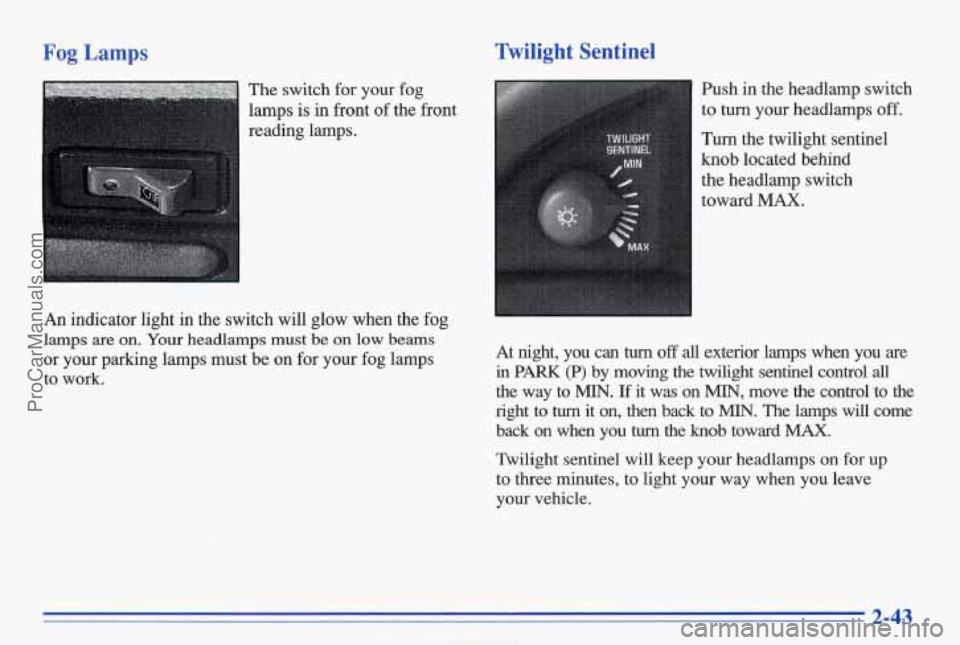
The switch for your fog
lamps is in front
of the front
reading lamps.
An indicator light in the switch will glow when the fog
lamps are on. Your headlamps must be on low beams
or your parking lamps must be on for your fog lamps
to work.
Twilight Sentinel
Push in the headlamp switch
to
turn your headlamps off.
Turn the twilight sentinel
knob located behind
the headlamp switch
toward
MAX.
At night, you can turn off all exterior lamps when you are
in
PARK (P) by moving the twilight sentinel control all
the way to MIN. If it was on MIN, move the control to the
right to
turn it on, then back to MIN. The lamps will come
back on when you
turn the knob toward MAX.
Twilight sentinel will keep your headlamps on for up
to three minutes, to light your way when you leave your vehicle.
2-43
ProCarManuals.com
Page 127 of 387
Head-Up. Display (Opth)
If the HUD image is too bright, or too high in
.your field
of view, it may take you more time to
see things
you need to see when it's dark outside.
Be sure to keep
the HUD image dim and placed
low
in your field of view.
If you have the optional Head-Up Display (HUD), you
can see some
of the driver information also mailable on
your instrument panel cluster. The infomation may be
displayed in English or metric units and appears
as a
reflection on the wjndshield. The
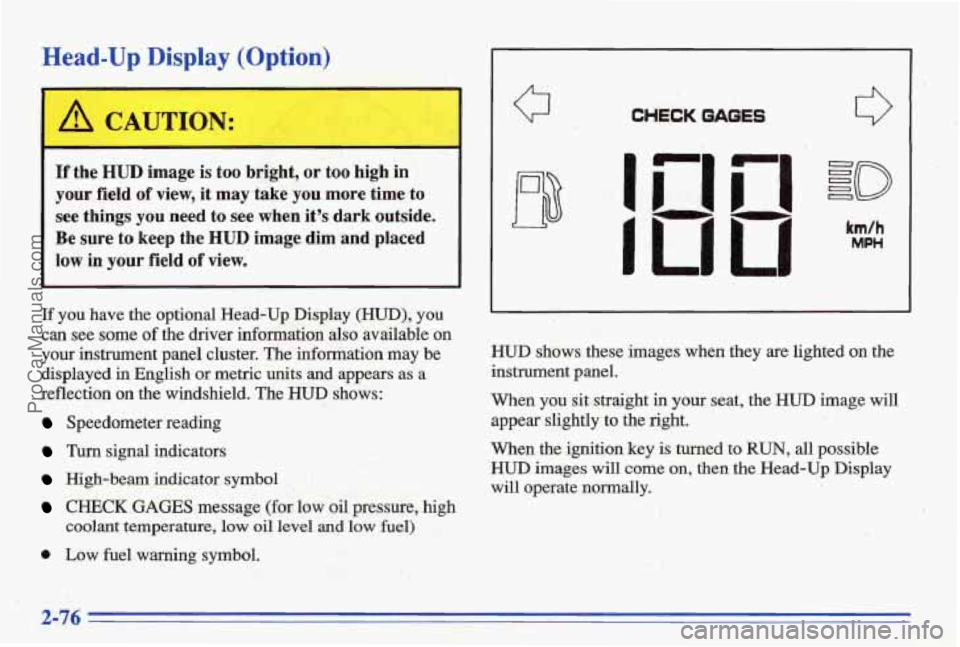
HUD shows:
Speedometer reading
Turn signal indicators
High-beam indicator symbol
CHECK GAGES message (for law oil pressure, high
coolant temperature,
low oil level and low fuel)
0 Low fuel warning symbol.
Q CHECK GAGES
I
I
km/h
MPH
HWD shows these images when they are lighted on the
instrument
panel.
When you sit straight in your seat, the HUD image will
appear slightly to the right.
When
the ignition key is turned to RUN, all possible
HUD images will come on, then the Head-Up Display
will operate
normally,,
2-76
ProCarManuals.com
Page 131 of 387
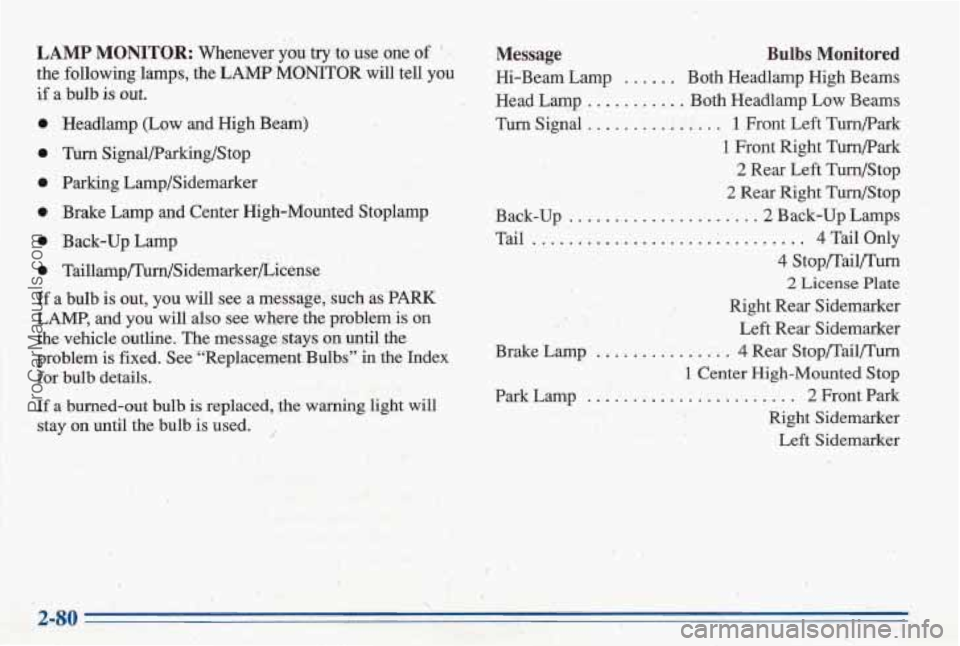
LAMP MONITOR: Whenever YOU try to use one of
the following lamps, the LAMP MONITOR will tell you
if a bulb is out.
0
0
0
e
..
0
Headlamp (Low and High Beam)
tun^ Signal/Parking/Stop ,
Parking Lampsidemkker
Brake Lamp and Center High-Mounted Stoplamp
qE2ack-Up Lamp
Taillarnp/Turn/Sidemarker/license
If a bulb is out, you will see a message, such as 'PARK
LAMB, and you will also see where the problem is on
the vehicle outline. The message stays on until the
problem is fixed. See "Replacement Bulbs"
in the Index
for bulb details.
If a burned-out bulb is replaced, the warning light will
. stay on until the bulb is used. ,
i: ,
Message Bulbs Monitored
Hi-Beam Lamp ...... Both Headlamp High Beams
Head Lamp
........... Both Headlamp Low Beams
Turn Signal
............... 1 Front Left Turnpark
1 Front Right Turnpark
2 Rear Left Turdstop
2 Rear Right Turn/Stop
Back-up
.................... .2 Back-Up Lamps
Tail
.............................. 4TailOnly
2 License Plate
Right Rear Sidemarker Left Rear Sidemarker
Brake Lamp
............... 4 Rear Stop/Tail/Turn
1 Center High-Mounted Stop
Right Sidemarker Left Sidemarker
4 Stop/Tail/Turn
Park Lamp
....................... 2 Front Park
.- ' 8. I L.
ProCarManuals.com
Page 183 of 387

Night Vision
No one c8n see as well at night as in the-daytime. But as
we get older these differences increase. A 50-year-old
driver may require at least twice
as much light to see the
same thing at night as a 20-year-old.
What you
do in the daytime can also afTect your night
vision.
For example, if you spend the day in bright
sunshine you are wise to wear sunglasses.
Your eyes will
have less trouble adNsting to night. But if you're
driving,
don't wear sunglasses at night. They may cut
down on.glare from headlamps, but they also. make a lot
of things invisible. Keep
you windshield
and all the glass on your vehicle
clean
- inside and out. Glare at night is made much
worse
by dirt on the glass. Even the inside of the glass
can build up a film caused by dust. Dirty glass makes
lights dazzle
and flash more than clean glass would,
making the pupils of your eyes contract repeatedly.
Remember that your headlamps light
up farless of a
roadway when you are
in a turn or curve. Keep your
eyes
moving; that way, it's easier to pick out dimly
lighted objects. Just as your headlamps should be
checked regularly for proper
aim, so should your eyes
be examined regularly. Some drivers suffer from night
blindness -- the inability to see in dim light - and .
You can be temporarily blinddby approaching. aren't even aware of it.
headlamps. It can take a second or two, or even several
seconds, for
your eyes to readjust to the dark. when you
are faced with severe glare (as fkom a driver who doesn't
lower
the high beams, or a vehicle with mished '
headlamps), slow down a little. Avoid staring directly
into the approaching headlamps.
ProCarManuals.com
Page 186 of 387

Hydroplaning
Hydroplaning is dangerous. So much water can build up
under your tires that they can actually ride on the water.
This can happen if the road is wet enough and you’re
going fast enough. When your vehicle
is hydroplaning,
it has little or no contact with the road.
Hydroplaning doesn’t happen often. But it can if your
tires haven’t much tread or if the pressure in one or
more is low. It can happen
if a lot of water is standing on
the road.
If you can see reflections from trees, telephone
poles or other vehicles, and raindrops “dimple” the
water’s surface, there could be hydroplaning.
Hydroplaning usually happens at higher speeds. There
just isn’t a hard and fast rule about hydroplaning. The
best advice is to slow down when it
is raining.
Driving Through Deep Standing Water
NOTICE:
~~~~~~~~
If you drive too quickly through deep puddles or
standing water, water can come in through your
engine’s air intake and badly damage your
engine. Never drive through water that is slightly
lower than the underbody of your vehicle. If you
can’t avoid deep puddles or standing water, drive
through them very slowly.
I
some Other Ralg Weather Tips
Turn on your low-beam headlamps -- not just
your parking lamps
-- to help make you more visible
to others.
Besides slowing down, allow some extra following
distance. And be especially careful when you pass
another vehicle. Allow yourself more clear room ahead, and be prepared to have your view restricted
by
road spray.
Have good tires with proper tread depth. (See “Tires”
in the Index.)
4-19
ProCarManuals.com