1996 NISSAN QUEST steering
[x] Cancel search: steeringPage 135 of 235
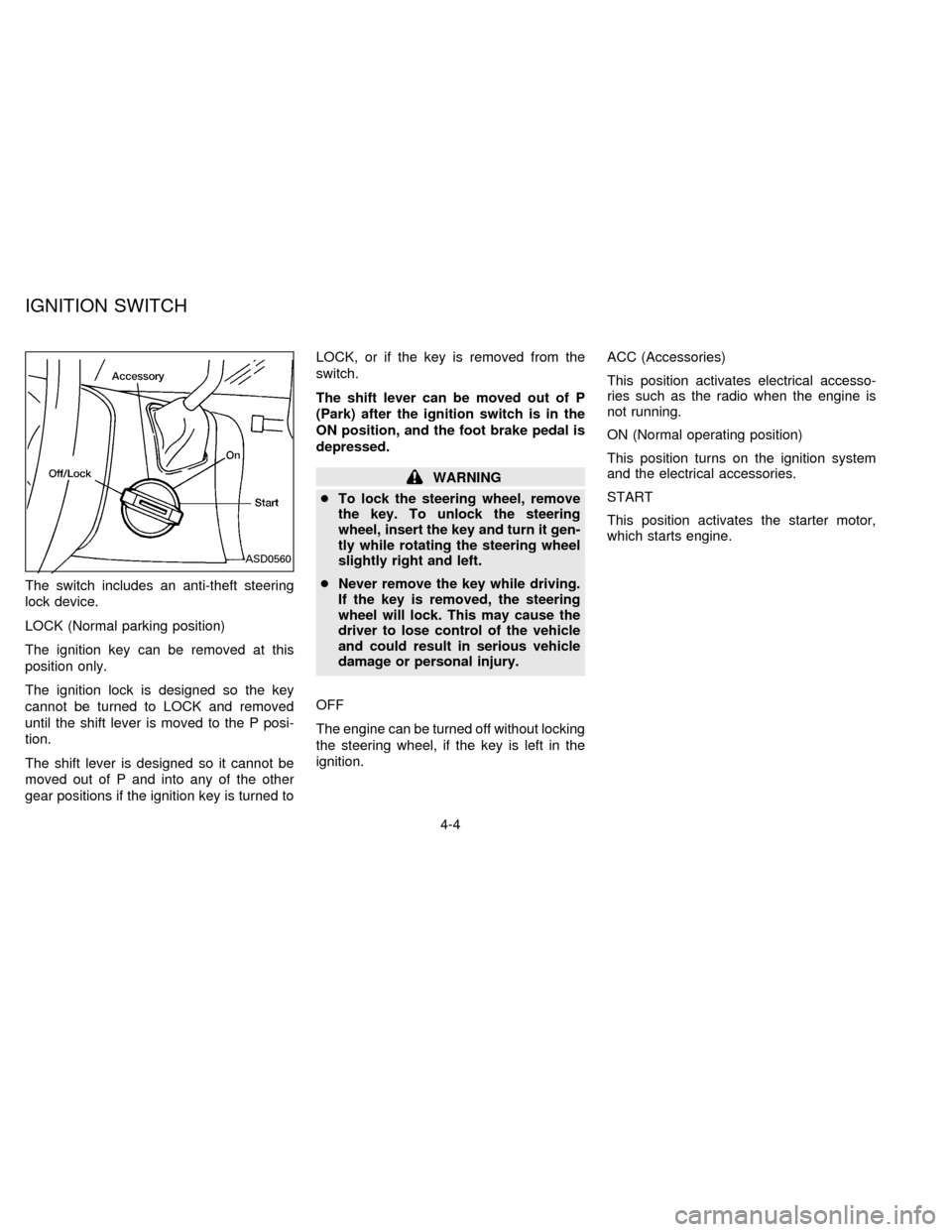
The switch includes an anti-theft steering
lock device.
LOCK (Normal parking position)
The ignition key can be removed at this
position only.
The ignition lock is designed so the key
cannot be turned to LOCK and removed
until the shift lever is moved to the P posi-
tion.
The shift lever is designed so it cannot be
moved out of P and into any of the other
gear positions if the ignition key is turned toLOCK, or if the key is removed from the
switch.
The shift lever can be moved out of P
(Park) after the ignition switch is in the
ON position, and the foot brake pedal is
depressed.
WARNING
cTo lock the steering wheel, remove
the key. To unlock the steering
wheel, insert the key and turn it gen-
tly while rotating the steering wheel
slightly right and left.
cNever remove the key while driving.
If the key is removed, the steering
wheel will lock. This may cause the
driver to lose control of the vehicle
and could result in serious vehicle
damage or personal injury.
OFF
The engine can be turned off without locking
the steering wheel, if the key is left in the
ignition.ACC (Accessories)
This position activates electrical accesso-
ries such as the radio when the engine is
not running.
ON (Normal operating position)
This position turns on the ignition system
and the electrical accessories.
START
This position activates the starter motor,
which starts engine.
ASD0560
IGNITION SWITCH
4-4
ZX
Page 141 of 235

cMove the selector lever to N (Neutral).
The CRUISE light goes out.
To reset at a faster cruising speed,use
one of the following three methods:
a) Depress the accelerator pedal. When the
vehicle attains the desired speed, push
and release the COAST/SET switch.
b) Push and hold the RES/ACCEL switch.
When the vehicle attains the speed you
desire, release the switch.
c) Push, then quickly release the
RES/ACCEL switch. Each time you do
this, the set speed increases by about 1
MPH (1.6 km/h).
To reset at a slower cruising speed,use
one of the following three methods:
a) Lightly tap the brake pedal. When the
vehicle attains the desired speed, push
the COAST/SET switch and release it.
b) Push and hold the COAST/SET switch.
Release the switch when the vehicle
slows down to the desired speed.
c) Push, then quickly release the
COAST/SET switch. Each time you dothis, the set speed decreases by about 1
MPH (1.6 km/h).
To resume the preset speed,push and
release the RES/ACCEL switch. The ve-
hicle resumes the last set cruising speed
when the vehicle speed is over 30 MPH (48
km/h).
Precautions
cIf the cruise control system malfunctions,
it cancels automatically. The CRUISE
indicator in the instrument cluster then
blinks to warn the driver.
cWhen the cruise indicator blinks, turn the
cruise control switch (main switch) OFF
and have the system checked by your
NISSAN dealer.
cThe cruise indicator may blink when the
cruise control main switch is turned ON
while pushing either the RES/ACCEL,
COAST/SET, or the CANCEL switch (lo-
cated on the steering wheel). To properly
set the cruise control system perform the
steps above in the order indicated.
Avoid using the cruise control when
driving under the following conditions:cwhen it is not possible to keep the vehicle
at a set speed.
cin heavy traffic or in traffic that varies in
speed.
con winding or hilly roads.
con slippery roads (rain, snow, ice, etc.).
cin very windy areas.
4-10
ZX
Page 144 of 235

cDriving with vacuum assisted brake:
The brake booster aids braking by using
engine vacuum. If the engine stops, you
can stop the vehicle by depressing the
brake pedal. However, greater foot pres-
sure on the brake pedal is required to
stop the vehicle and the stopping dis-
tance is longer.
cDriving with the power assisted steer-
ing:
The power assisted steering is designed
to use a hydraulic pump, driven by the
engine, to assist steering.
If the engine stops or the drive belt
breaks, you still have control of the ve-
hicle. However, much greater steering
effort is needed, especially in sharp turns
or at low speeds.
cWet brakes:
When the vehicle is washed or driven
through water, the brakes may get wet.
As a result, your braking distance is
longer and the vehicle may pull to one
side during braking.
To dry brakes, drive the vehicle at a safe
speed while lightly pressing the brakepedal to heat up the brakes. Do this until
the brakes return to normal. Avoid driving
the vehicle at high speeds until the
brakes function correctly.
cAvoid resting your foot on the brake
pedal while driving. This overheats the
brakes, wears out the brake linings and
pads faster and reduces gas mileage.
cTo help save the brakes and to prevent
the brakes from overheating, reduce
speed and downshift to a lower gear
before going down a slope or long grade.
Overheated brakes may reduce braking
performance and could result in loss of
vehicle control.
cWhile driving on a slippery surface, be
careful when braking, accelerating or
downshifting. Abrupt braking actions or
sudden acceleration could cause the
wheels to skid.The anti-lock brake system controls the
brakes at each wheel so the wheels do not
lock when braking abruptly or when braking
on slippery surfaces. The system detects the
rotation speed at each wheel and varies the
brake fluid pressure to prevent each wheel
from locking and sliding. By preventing wheel
lockup, the system helps the driver maintain
steering control and helps to minimize swerv-
ing and spinning on slippery surfaces.
Using the system
Depress the brake pedal and hold it down.
It is not necessary to pump the brake
pedal.
Doing so may result in increased stopping
distances.
Normal operation
The anti-lock brake system does not oper-
ate at speeds below 3 to 6 MPH (5 to 10
km/h) to completely stop the vehicle. (The
speeds vary according to road conditions.)
When the anti-lock system senses one or
more wheels are close to locking up, the
actuator (under the hood) rapidly applies
and releases hydraulic pressure (like pump-
ing the brakes very quickly). While the ac-
PRECAUTIONS WHEN
DRIVINGANTI-LOCK BRAKE SYSTEM
(If so equipped)
4-13
ZX
Page 147 of 235
Never install tire chains on T-type and small
size spare tires. Do not use the chains on
dry roads.
Special winter equipment
It is recommended that the following items
be carried in the vehicle during winter:
1. A scraper and stiff-bristled brush to re-
move ice and snow from the windows
and wiper blades.
2. A sturdy, flat board to be placed under
the jack to give it firm support.
3. A shovel to dig the vehicle out of snow-
drifts.
4. Extra window washer fluid to refill the
reservoir tank.
Driving on snow or ice
cWet ice (32ÉF, 0ÉC and freezing rain),
very cold snow or ice can be slick and
very hard to drive on. The vehicle will
have a lot less traction or ``grip'' under
these conditions. Try to avoid driving on
wet ice until the road is salted or sanded.
cWhatever the condition, drive with cau-
tion and accelerate gently. If acceleratedtoo fast, the drive wheels spin and lose
even more traction.
cAllow more stopping distance under
these conditions. Braking should be
started sooner than on dry pavement.
cAllow greater following distances on slip-
pery roads.
cWatch for slippery spots (glare ice).
These may appear on an otherwise clear
road in shaded areas. If a patch of ice is
seen ahead, brake before reaching it. Try
not to brake while actually on the ice, and
avoid any sudden steering maneuvers.
Engine block heater
WARNING
Do not use your heater (if so equipped)
with an ungrounded electrical system
or two-pronged (cheater) adapters. You
can be injured by an electrical shock if
you use an ungrounded connection.
4-16
ZX
Page 158 of 235
When towing your vehicle, all state (provin-
cial in Canada) and local regulations for
towing must be followed. Incorrect towing
equipment could damage your vehicle.
Towing instructions are available from your
NISSAN dealer. Local service operators are
generally familiar with the applicable laws
and procedures for towing. To assure
proper towing and to prevent accidental
damage to your vehicle, NISSAN recom-
mends that you have a service operator tow
your vehicle. It is advisable to have the
service operator carefully read the following
precautions.
CAUTION
cWhen towing, make sure that the
transmission, axles, steering system
and powertrain are in working con-
dition. If any unit is damaged, dollies
must be used.
cNever use a tow bar that attaches to
the bumper when you tow your ve-
hicle. It may damage the bumper and
cause damage to the transmission.cWhen towing with the front wheels
on dollies:
Turn the ignition key to the OFF
position and secure the steering
wheel in a straight-ahead position
with a rope or similar device. Never
place the ignition key in the LOCK
position. This will result in damage
to the steering lock mechanism.
Move the gearshift lever to the N
(Neutral) position.
cWhen towing with the rear wheels on
the ground, release the parking
brake.
cAttach safety chains for all towing.
TOW TRUCK TOWING
5-11
ZX
Page 160 of 235
Towing the vehicle with rear wheels
raised (with front wheels on the
ground)
CAUTION
Never tow the vehicle with the rear
wheels raised (with the front wheels on
the ground)as this may cause serious
and expensive damage to the transmis-
sion. If it is necessary to tow the vehicle
with the rear wheels raised, always use
towing dollies under the front wheels.
If you have to tow the vehicle with
four wheels on ground
Observe the following restricted towing
speeds and distances.
cSpeed: Below 30 MPH (50 km/h)
cDistance: Less than 40 miles (65 km)
CAUTION
Never tow the vehicle from the rear (i.e.,
backward) with four wheels on the
ground as this may cause serious and
expensive damage to the transmission.cDo not tow with a sling type truck,
either from the front or the rear. It
may cause body damage.
cNever utilize the rear tie down brack-
ets or slots to tow another vehicle as
this may cause body damage.
VEHICLE RECOVERY (Freeing a
stuck vehicle)
cTow chains or cables must only be at-
tached to the main structual members of
the vehicle.
cPulling devices should be routed so they
do not touch any part of the suspension,
steering, brake or cooling systems.
cAlways pull the cable straight out from
the front or rear of the vehicle. Never pull
on the vehicle at a sideways angle.
cPulling devices such as ropes or canvas
straps are not recommended for use in
vehicle towing or recovery.
5-13
ZX
Page 168 of 235

7 Do-it-yourself operations
Maintenance precautions ..................................... 7-2
Engine compartment check locations .................. 7-3
Engine cooling system ......................................... 7-4
Engine oil ............................................................ 7-5
Automatic transmission fluid ................................ 7-8
Power steering fluid.............................................. 7-9
Brake fluid .......................................................... 7-10
Window washer fluid .......................................... 7-10
Battery ................................................................ 7-11
Drive belts .......................................................... 7-12Spark plug replacement ..................................... 7-12
Air cleaner housing filter .................................... 7-13
Wiper blades ...................................................... 7-14
Parking brake check........................................... 7-16
Brake pedal ........................................................ 7-16
Brake booster ..................................................... 7-17
Fuses .................................................................. 7-17
Fusible links........................................................ 7-18
Light bulbs .......................................................... 7-19
Wheels and tires ................................................ 7-24
ZX
Page 176 of 235
3. Check the fluid level with the engine
idling.
4. Remove the dipstick and wipe it clean
with lint-free paper.
5. Reinsert the dipstick into the charging
pipe as far as it goes.
6. Remove the dipstick and note the read-
ing. If the level is at the low side of either
range, add fluid to the charging pipe.
DO NOT OVERFILL.
Use ONLY Nissan Matic `D' (Continen-
tal U.S. and Alaska) or Genuine Nis-
san Automatic Transmission Fluid
(Canada). Dexronž III/Merconž or
equivalent may also be used. Outside
the continental United States and
Alaska contact a Nissan dealership
for more information regarding suit-
able fluids, including recommended
brand(s) of Dexronž III/Merconž or
Dexronž IIE/Merconž Automatic
Transmission Fluid.
NOTE:
If the vehicle has been driven for a long
time at high speeds, or in city traffic in
hot weather, or if it is being used to pulla trailer, the accurate fluid level cannot
be read. You should wait until the fluid
has cooled down (about 30 minutes).
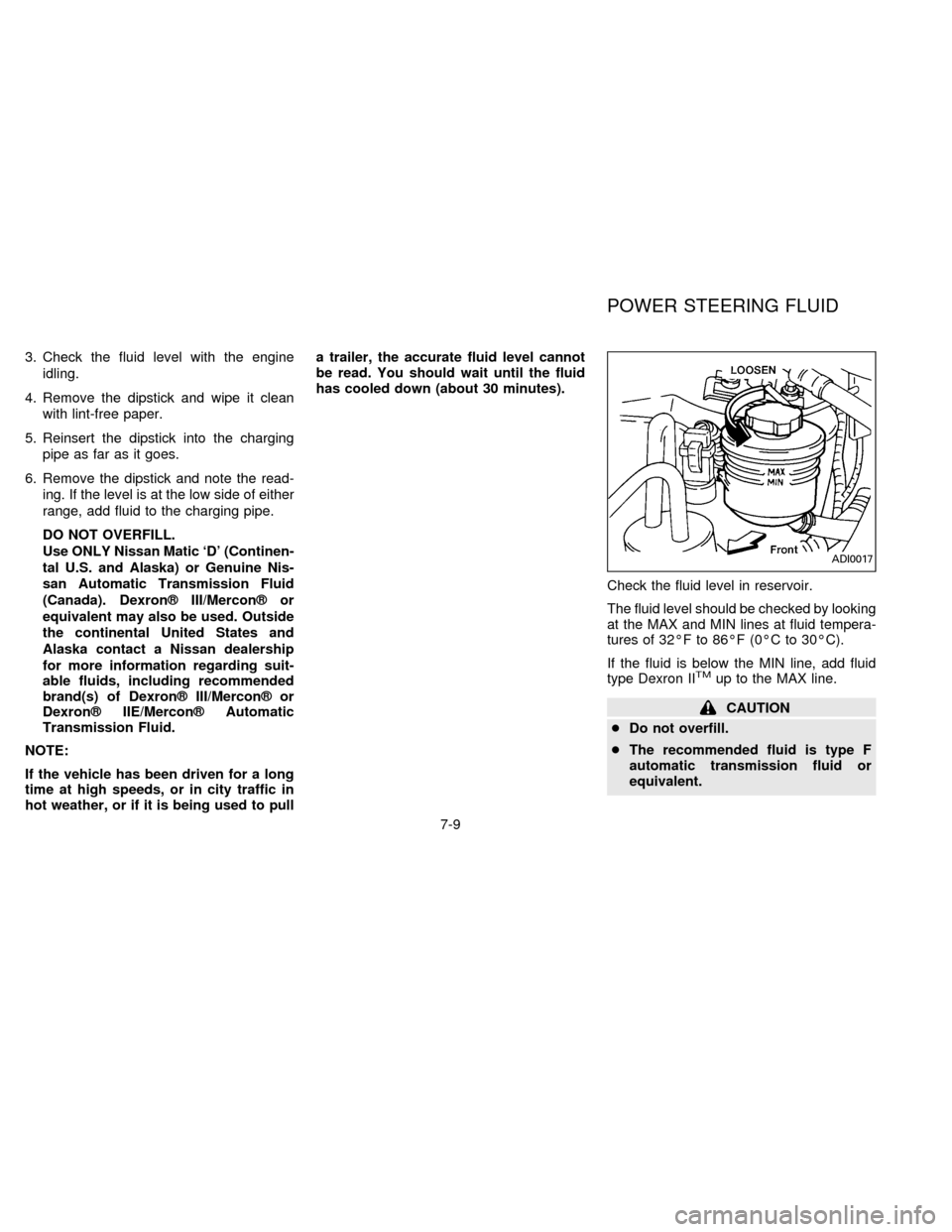
Check the fluid level in reservoir.
The fluid level should be checked by looking
at the MAX and MIN lines at fluid tempera-
tures of 32ÉF to 86ÉF (0ÉC to 30ÉC).
If the fluid is below the MIN line, add fluid
type Dexron II
TMup to the MAX line.
CAUTION
cDo not overfill.
cThe recommended fluid is type F
automatic transmission fluid or
equivalent.
ADI0017
POWER STEERING FLUID
7-9
ZB13-DX