1996 NISSAN QUEST steering
[x] Cancel search: steeringPage 200 of 235

make sure no nuts are missing, and check
for any loose nuts. Tighten if necessary.
Tire rotation*Ð Tires should be rotated
every 7,500 miles (12,000 km).
Wheel alignment and balanceÐIfthe
vehicle should pull to either side while driv-
ing on a straight and level road, or if you
detect uneven or abnormal tire wear, there
may be a need for wheel alignment.
If the steering wheel or seat vibrates at
normal highway speeds, wheel balancing
may be needed.
Windshield wiper blades*Ð Check for
cracks or wear if they do not wipe properly.
Doors and engine hoodÐ Check that all
doors and the engine hood operate prop-
erly. Also ensure that all latches lock se-
curely. Lubricate hinges, latches, rollers and
links if necessary. Make sure the secondary
latch keeps the hood from opening when
the primary latch is released.
When driving in areas using road salt or
other corrosive materials, check lubrication
frequently.INSIDE THE VEHICLE
The maintenance items listed here should
be checked on a regular basis, such as
when performing periodic maintenance,
cleaning the vehicle, etc.
Lights*Ð Make sure the headlights, stop
lights, tail lights, turn signal lights, and other
lights are all operating properly and installed
securely. Also check headlight aim.
Warning lights and buzzers/chimesÐ
Make sure all warning lights and
buzzers/chimes are operating properly.
Windshield wiper and washer*Ð Check
that the wipers and washer operate properly
and that the wipers do not streak.
Windshield defrosterÐ Check that the air
comes out of the defroster outlets properly
and in sufficient quantity when operating the
heater or air conditioner.
Steering wheelÐ Check for changes in
the steering conditions, such as excessive
freeplay, hard steering or strange noises.
SeatsÐ Check seat position controls such
as seat adjusters, seatback recliner, etc. to
ensure they operate smoothly and all
latches lock securely in every position.Check that the head restraints move up and
down smoothly and the locks hold securely
in all latched positions. Check that the seat
leg latches lock securely in every anchor
position for the folding down rear seat and
detachable rear seat (if so equipped).
Seat beltsÐ Check that all parts of the seat
belt system (e.g. buckles, anchors, adjust-
ers and retractors) operate properly and
smoothly, and are installed securely. Check
the belt webbing for cuts, fraying, wear or
damage.
Accelerator pedalÐ Check the pedal for
smooth operation and make sure the pedal
does not catch or require uneven effort.
Keep the floor mats away from the pedal.
BrakesÐ Check that the brakes do not pull
the vehicle to one side when applied.
Brake pedal*Ð Check the pedal for
smooth operation and make sure it has the
proper distance under it when depressed
fully. Check the brake booster function. Be
certain to keep floor mats away from the
pedal.
Parking brake*Ð Check that the pedal is
adjusted to specification and confirm that
your vehicle is held securely on a fairly
8-3
ZX
Page 201 of 235

steep hill with only the parking brake ap-
plied.
Automatic transmission ``Park'' mecha-
nismÐ On a fairly steep hill check that your
vehicle is held securely with the selector
lever in the P (Park) position without apply-
ing any brakes.
UNDER THE HOOD AND
VEHICLE
The maintenance items listed here should
be checked periodically, for example, each
time you check the engine oil or refuel.
Windshield washer fluid* ÐCheck that
there is adequate fluid in the tank.
Engine coolant level*Ð Check the cool-
ant level when the engine is cold.
Radiator and hosesÐ Check the front of
the radiator and clean off any dirt, insects,
leaves, etc., that may have accumulated.
Make sure the hoses have no cracks, de-
formation, rot, or loose connections.
Brake fluid level*Ð Make sure the brake
fluid level is between the MAX and MIN
lines on the reservoir.
Battery*Ð Check the fluid level in eachcell. It should be between the MAX and MIN
lines.
Engine drive belts*Ð Make sure no belts
are frayed, worn, cracked or oily.
Engine oil level*Ð Check the level after
parking the vehicle on a level surface and
turning off the engine.
Power steering fluid level* and linesÐ
Check the level when the fluid is cold and
the engine is turned off. Check the lines for
proper attachment, leaks, cracks, etc.
Automatic transmission fluid level*Ð
Check the level after putting the selector
lever in P (Park) with the engine idling.
Exhaust systemÐ Make sure there are no
cracks, holes, loose joints or supports. If the
sound of the exhaust seems unusual or
there is a smell of exhaust fumes, immedi-
ately have the exhaust system inspected by
a qualified individual. (See the carbon mon-
oxide warning in the ``Starting and driving''
section.)
UnderbodyÐ The underbody is frequently
exposed to corrosive substances such as
those used on icy roads or to control dust. It
is very important to remove these sub-stances, otherwise rust forms on the floor
pan, frame, fuel lines and around the ex-
haust system. At the end of winter, the
underbody should be thoroughly flushed
with plain water, being careful to clean
those areas where mud and dirt may accu-
mulate. See the ``Appearance and interior
care'' section for additional information.
Fluid leaksÐ Check under the vehicle for
fuel, oil, water or other fluid leaks after the
vehicle has been parked for a while. Water
dripping from the air conditioner after use is
normal. If you should notice any leaks or if
gasoline fumes are evident, check for the
cause and have it corrected immediately.
8-4
ZX
Page 204 of 235
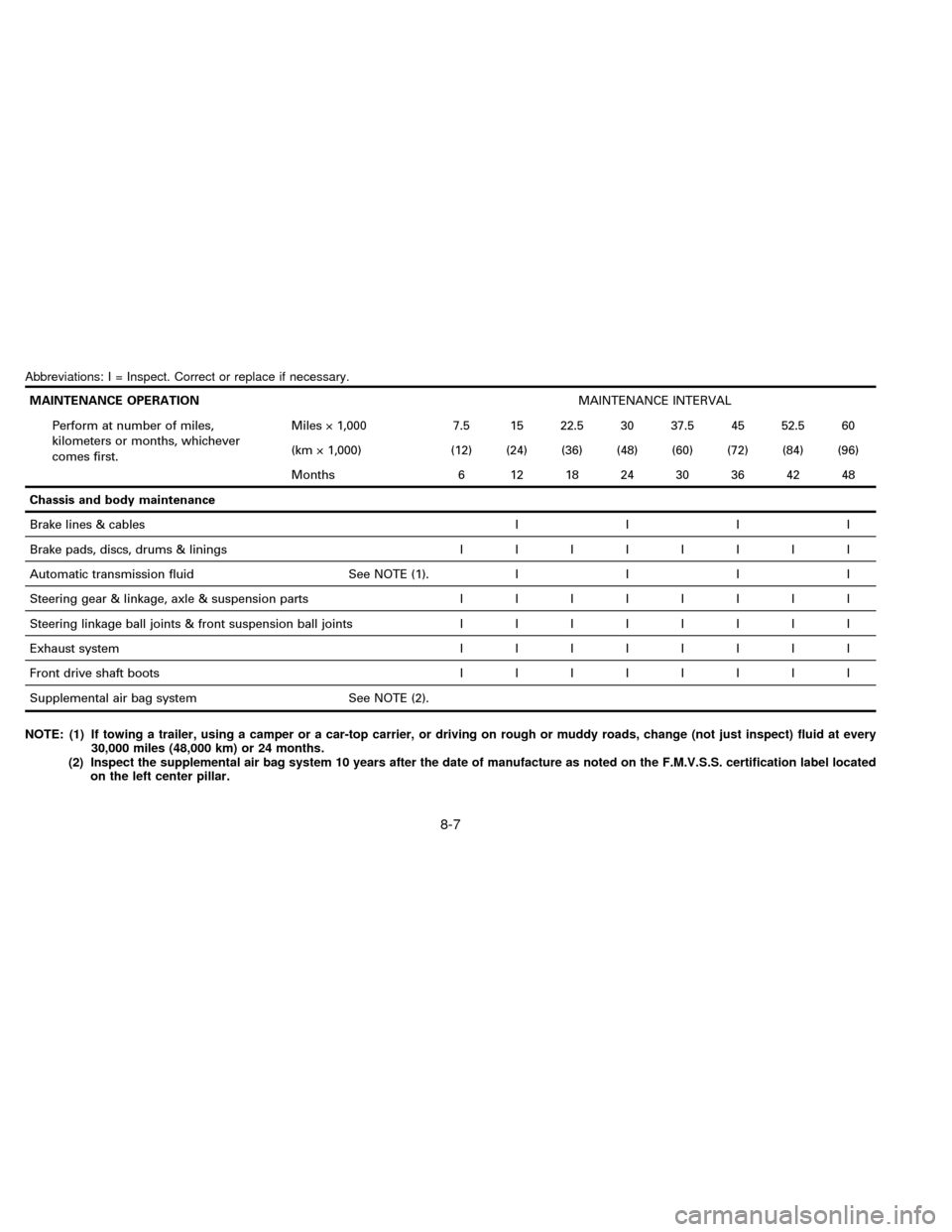
Abbreviations: I = Inspect. Correct or replace if necessary.
MAINTENANCE OPERATIONMAINTENANCE INTERVAL
Perform at number of miles,
kilometers or months, whichever
comes first.Miles ý 1,000 7.5 15 22.5 30 37.5 45 52.5 60
(km ý 1,000) (12) (24) (36) (48) (60) (72) (84) (96)
Months 6 12 18 24 30 36 42 48
Chassis and body maintenance
Brake lines & cablesIIII
Brake pads, discs, drums & liningsIIIIIIII
Automatic transmission fluid See NOTE (1).IIII
Steering gear & linkage, axle & suspension partsIIIIIIII
Steering linkage ball joints & front suspension ball jointsIIIIIIII
Exhaust systemIIIIIIII
Front drive shaft bootsIIIIIIII
Supplemental air bag system See NOTE (2).
NOTE: (1) If towing a trailer, using a camper or a car-top carrier, or driving on rough or muddy roads, change (not just inspect) fluid at every
30,000 miles (48,000 km) or 24 months.
(2) Inspect the supplemental air bag system 10 years after the date of manufacture as noted on the F.M.V.S.S. certification label located
on the left center pillar.
8-7
ZX
Page 206 of 235
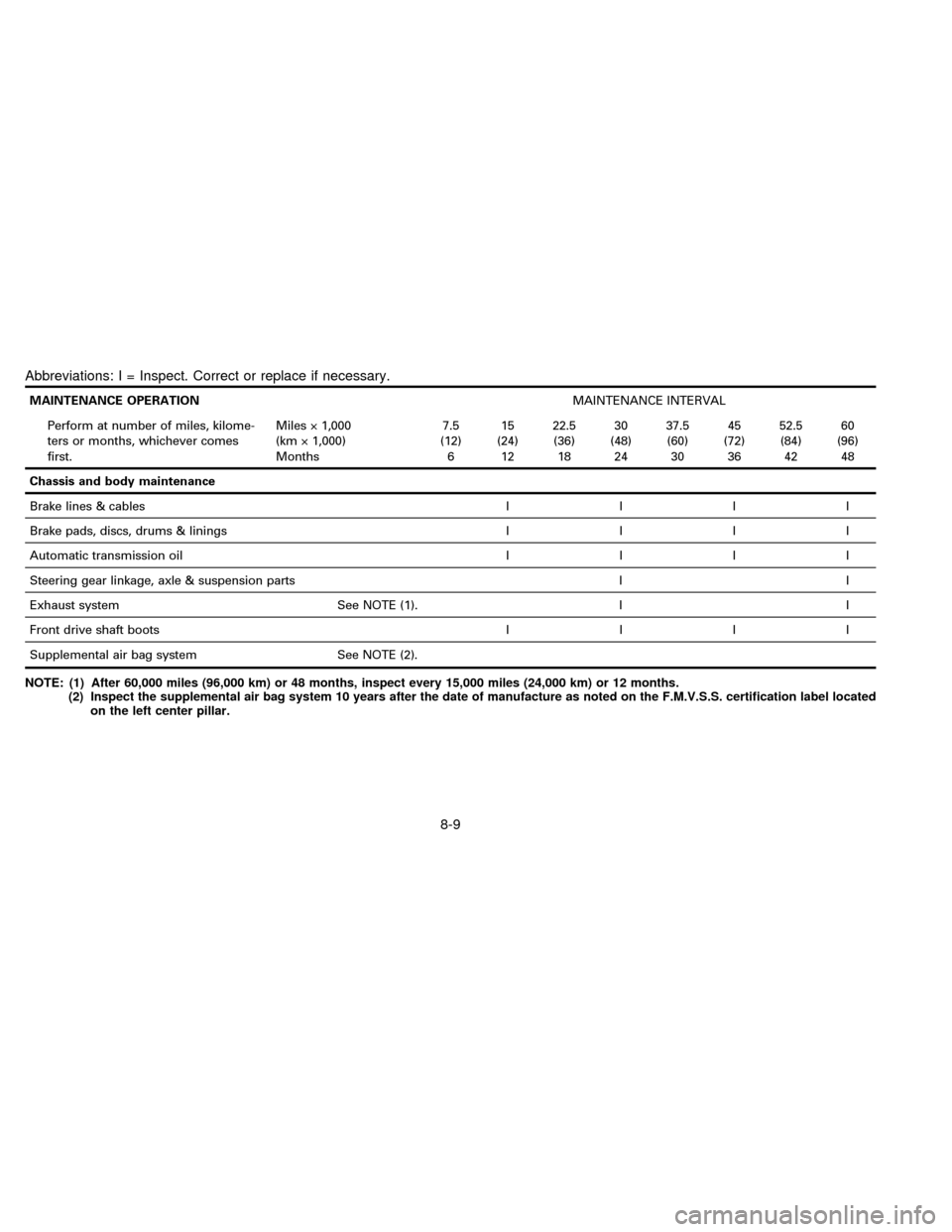
Abbreviations: I = Inspect. Correct or replace if necessary.
MAINTENANCE OPERATIONMAINTENANCE INTERVAL
Perform at number of miles, kilome-
ters or months, whichever comes
first.Miles ý 1,000
(km ý 1,000)
Months7.5
(12)
615
(24)
1222.5
(36)
1830
(48)
2437.5
(60)
3045
(72)
3652.5
(84)
4260
(96)
48
Chassis and body maintenance
Brake lines & cablesIIII
Brake pads, discs, drums & liningsIIII
Automatic transmission oilIIII
Steering gear linkage, axle & suspension parts I I
Exhaust system See NOTE (1). I I
Front drive shaft bootsIIII
Supplemental air bag system See NOTE (2).
NOTE: (1) After 60,000 miles (96,000 km) or 48 months, inspect every 15,000 miles (24,000 km) or 12 months.
(2) Inspect the supplemental air bag system 10 years after the date of manufacture as noted on the F.M.V.S.S. certification label located
on the left center pillar.
8-9
ZX
Page 207 of 235

EXPLANATION OF
MAINTENANCE ITEMS
Additional information on the following
items with ``*'' is found in the ``Do-it-
yourself operations'' section.
Emission control system mainte-
nance
Drive belts* ÐCheck drive belts for wear,
fraying or cracking and also for proper ten-
sion. Replace the drive belts if found dam-
aged.
Air cleaner filter ÐUnder normal driving
conditions, the air cleaner filter should be
replaced in accordance with the mainte-
nance schedule. However, driving the ve-
hicle in dusty areas may cause more rapid
clogging of the element. Consequently, the
element may have to be replaced more
frequently.
Vapor lines ÐCheck vapor lines and con-
nections for failure or looseness. If leaks are
found, replace them.
Fuel lines ÐCheck the fuel hoses, piping
and connections for leaks, looseness or
deterioration. Replace any parts if they are
damaged.Fuel filter ÐIf the vehicle is operated
under extremely adverse weather condi-
tions or in areas where ambient tempera-
tures are either extremely low or extremely
high, the filter might become clogged. In
such an event, replace the filter immedi-
ately.
Engine coolant* ÐChanging engine cool-
ant can be performed by your NISSAN
dealer or procedures can be found in the
Service Manual. Improper air relief after
changing coolant can result in reduced
heater performance and overheating.
Engine oil & oil filter* ÐUnder normal
driving conditions, the engine oil and oil filter
should be replaced in accordance with the
maintenance schedule. However, under se-
vere driving conditions, they may have to be
replaced more frequently.
Spark plugs* ÐReplace with new plugs
having the correct heat range.
Timing belt ÐReplace the timing belt for
driving the camshaft.
Chassis and body maintenance
Brake lines & cables ÐCheck the brake
lines and hoses (including brake boostervacuum hoses, connections & check valve)
and parking brake cables for proper attach-
ment, leaks, cracks, chafing, abrasion, de-
terioration, etc.
Brake pads, discs, drums & linings Ð
Check these and the other neighboring
brake components for wear, deterioration
and leaks. Under severe driving conditions,
they may have to be inspected more fre-
quently.
Automatic transmission fluid* ÐCheck
the fluid level and visually inspect for signs
of leakage.
Under severe driving conditions, the fluid
should be replaced at the specified interval.
Steering gear & linkage, axle & suspen-
sion parts, and drive shaft boots Ð
Check for damage, looseness and leakage
of oil or grease. Under severe driving con-
ditions, more frequent inspection should be
performed.
Steering linkage ball joints & front sus-
pension ball joints ÐCheck the ball joints
for damage, looseness and grease leakage.
8-10
ZX
Page 211 of 235
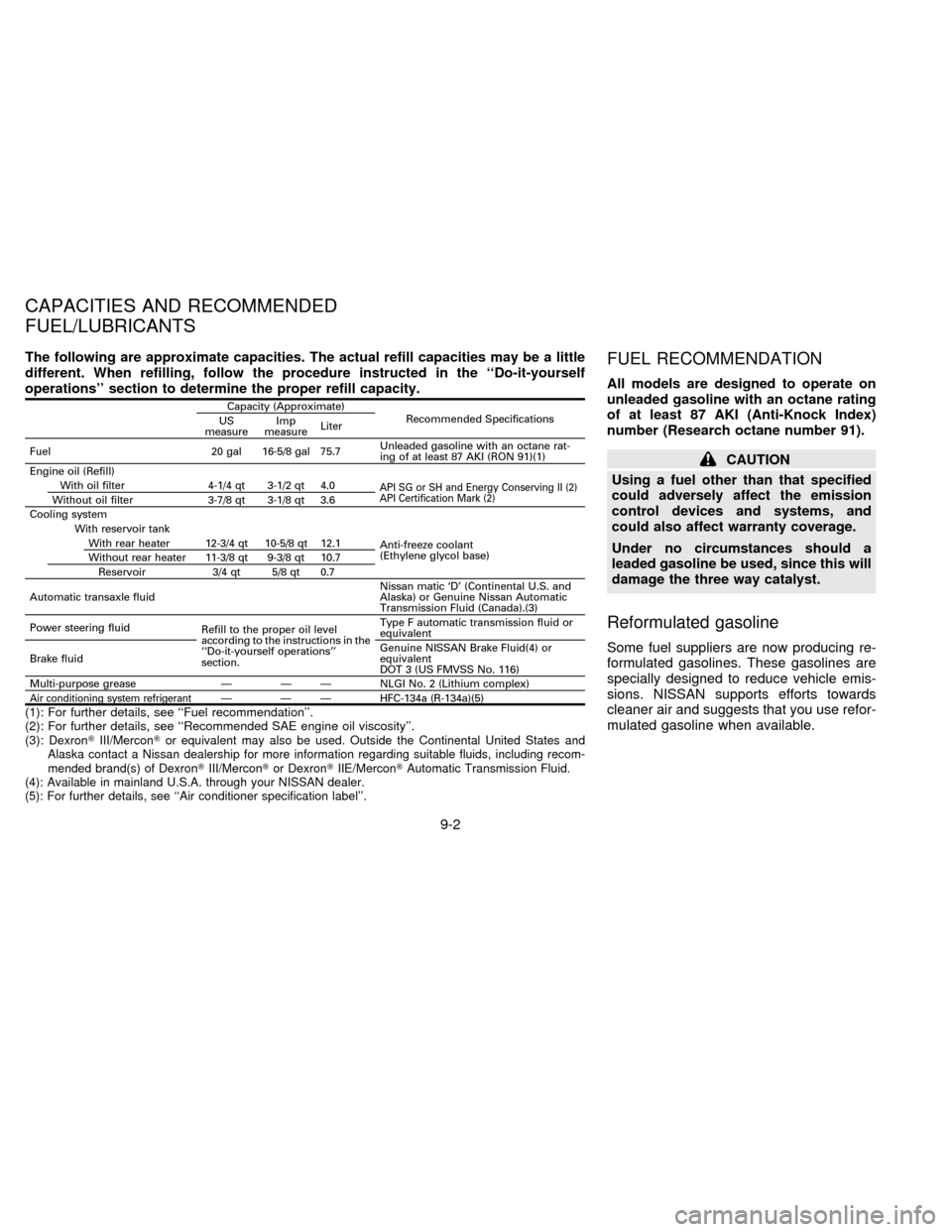
The following are approximate capacities. The actual refill capacities may be a little
different. When refilling, follow the procedure instructed in the ``Do-it-yourself
operations'' section to determine the proper refill capacity.
Capacity (Approximate)
Recommended Specifications
US
measureImp
measureLiter
Fuel 20 gal 16-5/8 gal 75.7Unleaded gasoline with an octane rat-
ing of at least 87 AKI (RON 91)(1)
Engine oil (Refill)
With oil filter 4-1/4 qt 3-1/2 qt 4.0
API SG or SH and Energy Conserving II (2)
API Certification Mark (2)Without oil filter 3-7/8 qt 3-1/8 qt 3.6
Cooling system
With reservoir tank
With rear heater 12-3/4 qt 10-5/8 qt 12.1
Anti-freeze coolant
(Ethylene glycol base)
Without rear heater 11-3/8 qt 9-3/8 qt 10.7
Reservoir 3/4 qt 5/8 qt 0.7
Automatic transaxle fluidNissan matic `D' (Continental U.S. and
Alaska) or Genuine Nissan Automatic
Transmission Fluid (Canada).(3)
Power steering fluid
Refill to the proper oil level
according to the instructions in the
``Do-it-yourself operations''
section.Type F automatic transmission fluid or
equivalent
Brake fluidGenuine NISSAN Brake Fluid(4) or
equivalent
DOT 3 (US FMVSS No. 116)
Multi-purpose grease Ð Ð Ð NLGI No. 2 (Lithium complex)
Air conditioning system refrigerantÐ Ð Ð HFC-134a (R-134a)(5)(1): For further details, see ``Fuel recommendation''.
(2): For further details, see ``Recommended SAE engine oil viscosity''.
(3):
DexronTIII/MerconTor equivalent may also be used. Outside the Continental United States and
Alaska contact a Nissan dealership for more information regarding suitable fluids, including recom-
mended brand(s) of DexronTIII/MerconTor DexronTIIE/MerconTAutomatic Transmission Fluid.
(4): Available in mainland U.S.A. through your NISSAN dealer.
(5): For further details, see ``Air conditioner specification label''.
FUEL RECOMMENDATION
All models are designed to operate on
unleaded gasoline with an octane rating
of at least 87 AKI (Anti-Knock Index)
number (Research octane number 91).
CAUTION
Using a fuel other than that specified
could adversely affect the emission
control devices and systems, and
could also affect warranty coverage.
Under no circumstances should a
leaded gasoline be used, since this will
damage the three way catalyst.
Reformulated gasoline
Some fuel suppliers are now producing re-
formulated gasolines. These gasolines are
specially designed to reduce vehicle emis-
sions. NISSAN supports efforts towards
cleaner air and suggests that you use refor-
mulated gasoline when available.
CAPACITIES AND RECOMMENDED
FUEL/LUBRICANTS
9-2
ZX
Page 216 of 235
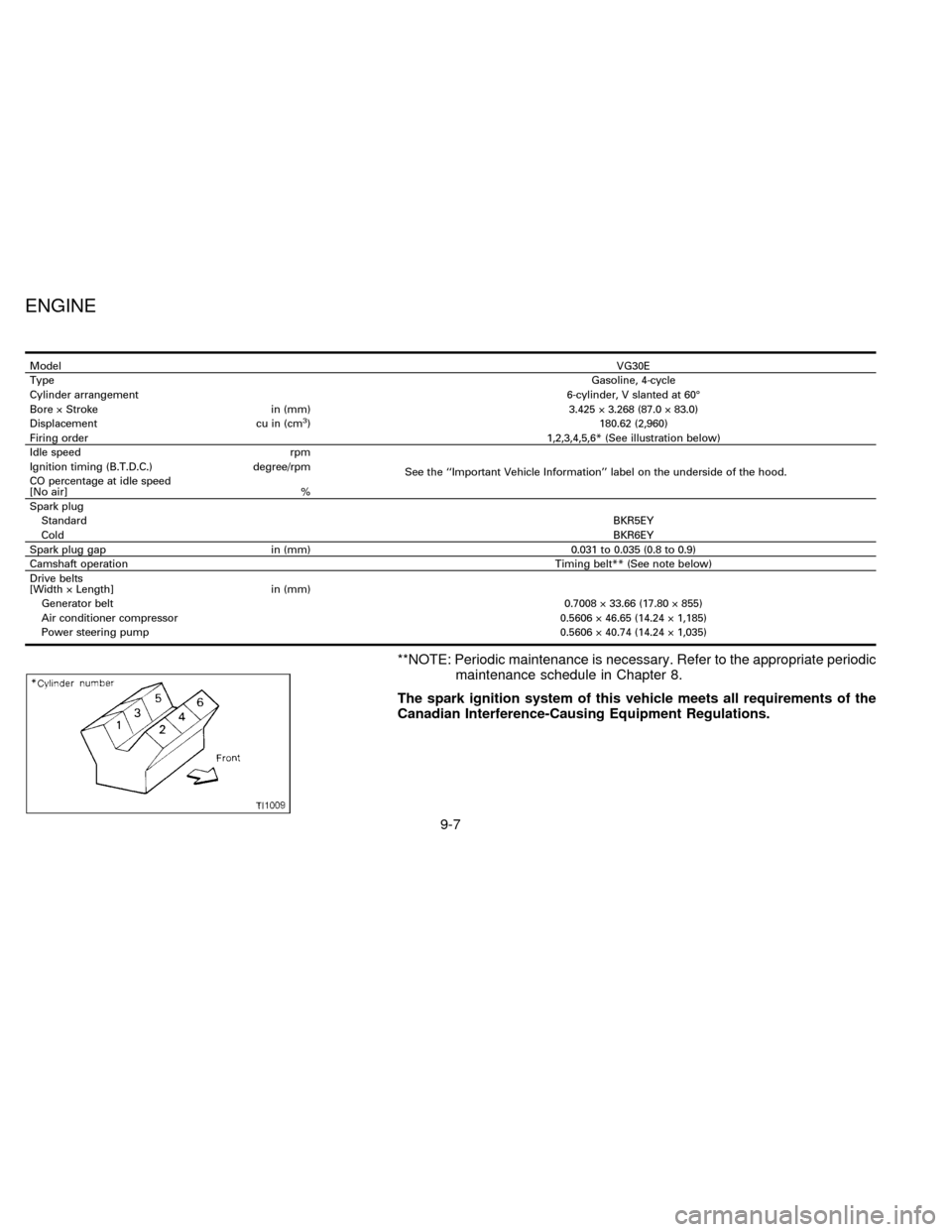
ModelVG30E
TypeGasoline, 4-cycle
Cylinder arrangement6-cylinder, V slanted at 60É
Bore ý Stroke in (mm) 3.425 ý 3.268 (87.0 ý 83.0)
Displacement cu in (cm
3) 180.62 (2,960)
Firing order1,2,3,4,5,6* (See illustration below)
Idle speed rpm
See the ``Important Vehicle Information'' label on the underside of the hood. Ignition timing (B.T.D.C.) degree/rpm
CO percentage at idle speed
[No air] %
Spark plug
StandardBKR5EY
ColdBKR6EY
Spark plug gap in (mm) 0.031 to 0.035 (0.8 to 0.9)
Camshaft operationTiming belt** (See note below)
Drive belts
[Width ý Length] in (mm)
Generator belt0.7008 ý 33.66 (17.80 ý 855)
Air conditioner compressor0.5606 ý 46.65 (14.24 ý 1,185)
Power steering pump0.5606 ý 40.74 (14.24 ý 1,035)
**NOTE: Periodic maintenance is necessary. Refer to the appropriate periodic
maintenance schedule in Chapter 8.
The spark ignition system of this vehicle meets all requirements of the
Canadian Interference-Causing Equipment Regulations.
ENGINE
9-7
ZX
Page 222 of 235
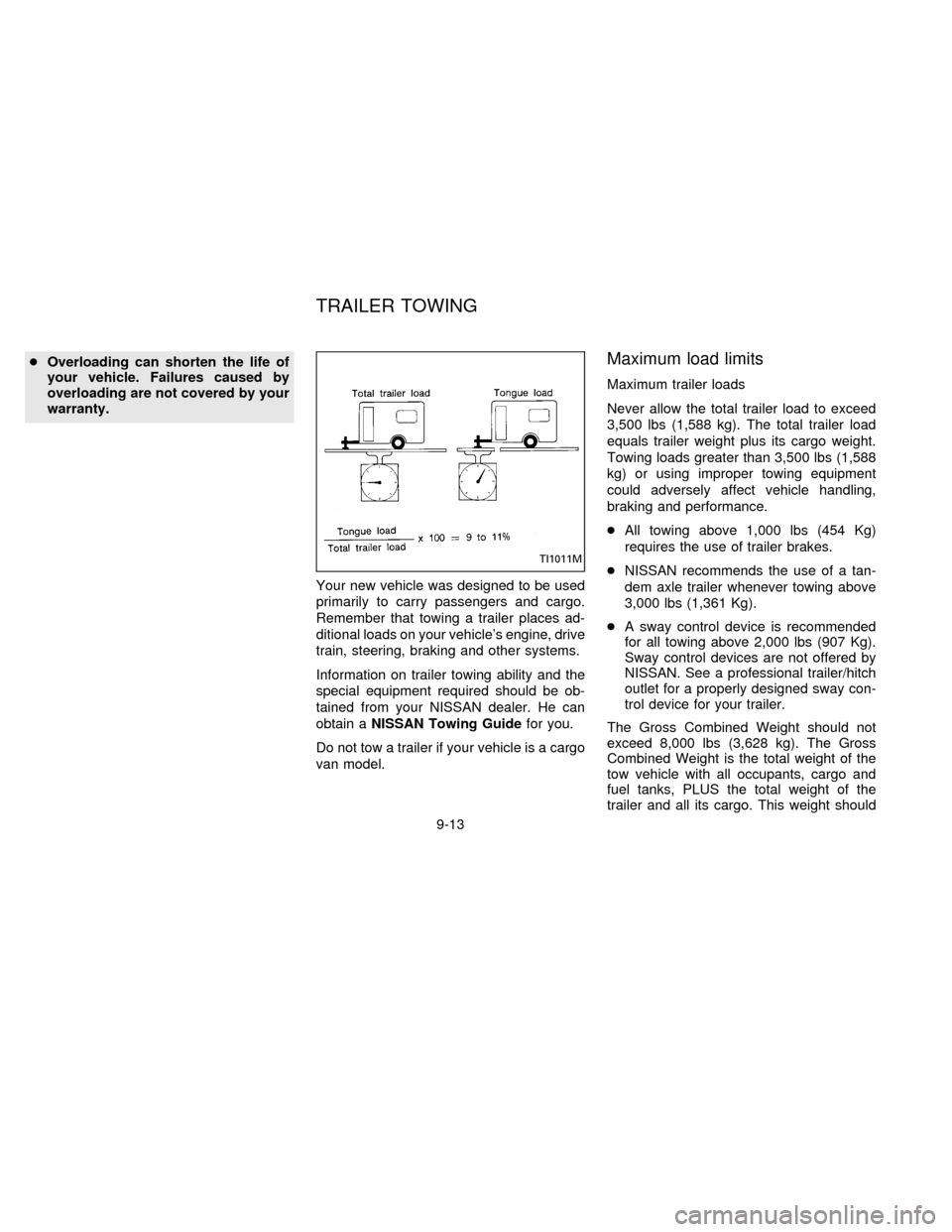
cOverloading can shorten the life of
your vehicle. Failures caused by
overloading are not covered by your
warranty.
Your new vehicle was designed to be used
primarily to carry passengers and cargo.
Remember that towing a trailer places ad-
ditional loads on your vehicle's engine, drive
train, steering, braking and other systems.
Information on trailer towing ability and the
special equipment required should be ob-
tained from your NISSAN dealer. He can
obtain aNISSAN Towing Guidefor you.
Do not tow a trailer if your vehicle is a cargo
van model.Maximum load limits
Maximum trailer loads
Never allow the total trailer load to exceed
3,500 lbs (1,588 kg). The total trailer load
equals trailer weight plus its cargo weight.
Towing loads greater than 3,500 lbs (1,588
kg) or using improper towing equipment
could adversely affect vehicle handling,
braking and performance.
cAll towing above 1,000 lbs (454 Kg)
requires the use of trailer brakes.
cNISSAN recommends the use of a tan-
dem axle trailer whenever towing above
3,000 lbs (1,361 Kg).
cA sway control device is recommended
for all towing above 2,000 lbs (907 Kg).
Sway control devices are not offered by
NISSAN. See a professional trailer/hitch
outlet for a properly designed sway con-
trol device for your trailer.
The Gross Combined Weight should not
exceed 8,000 lbs (3,628 kg). The Gross
Combined Weight is the total weight of the
tow vehicle with all occupants, cargo and
fuel tanks, PLUS the total weight of the
trailer and all its cargo. This weight should
TI1011M
TRAILER TOWING
9-13
ZX