Page 154 of 223

7 Do-it-yourself operations
Precautions ............................................................ 7-2
Engine cooling system ........................................... 7-4
Engine oil ............................................................... 7-7
Automatic transmission fluid .................................. 7-9
Power steering fluid ............................................. 7-11
Brake and clutch fluid .......................................... 7-11
Window washer fluid ............................................ 7-12
Battery .................................................................. 7-13
Drive belts ............................................................ 7-14
Spark plug replacement ....................................... 7-14
Air cleaner filter .................................................... 7-16
Wiper blade .......................................................... 7-17
Parking brake ....................................................... 7-18
Brake pedal .......................................................... 7-19
Brake booster ....................................................... 7-20
Clutch pedal ......................................................... 7-20
Fuses ................................................................... 7-20
Light bulbs ............................................................ 7-22
Wheels and tires .................................................. 7-26
Clutch housing ........................................... 7-30
Z01.2.1/R50-DX
Page 162 of 223

CHANGING OIL FILTER
1. Park the vehicle on a level surface and
apply the parking brake.
2. Turn the engine off.
3. Loosen the oil filter with an oil filter wrench.
(A specialcap-typewrench will assist with
oil filter removal on models with the V6
engine. This tool can be purchased from
your NISSAN dealer.) Then remove the oil
filter by turning it by hand.
Be careful not to burn yourself, as the
engine oil may be hot.
4. Wipe the engine oil filter mounting surface
with a clean rag.
Be sure to remove any old rubber gasket
remaining on the mounting surface of the
engine.
5. Coat the rubber gasket on the new filter
with engine oil.
6. Screw in the oil filter until a slight resistance
is felt, then tighten an additional 2/3 turn.
7. Start the engine and check for leakage
around the oil filter. Correct as required.
8. Turn the engine off and wait several min-
utes. Check the oil level. Add engine oil if
necessary.
IWhen engine is running, keep hands
and clothing away from any moving
parts such as fan and drive belt.
IAutomatic transmission fluid is poi-
sonous and should be stored care-
fully in marked containers out of the
reach of children.
The fluid level should be checked using the
ªHOTº range (ªLº & ªHº marks) on the dipstick
SDI0417SDI0421
AUTOMATIC TRANSMISSION
FLUID
7-9
Z01.2.1/R50-DX
Page 164 of 223
Check the fluid level.
The fluid level should be checked using the
ªHOTº range on the dipstick at fluid tempera-
tures of 122 to 176ÉF (50 to 80ÉC) or using the
ªCOLDº range on the dipstick at fluid tempera-
tures of 32 to 86ÉF (0 to 30ÉC).
IDo not overfill.
IUse type DEXRONTMII, DEXRONTMIII
or equivalent.
Check the fluid level in the reservoir. If the fluid
level is below the Min. line or the brake warn-
ing light comes on, add DOT 3 fluid up to the
Max. line.
If fluid is added frequently, the system should
be thoroughly checked by your
NISSAN dealer.
IUse only new fluid. Old, inferior or
contaminated fluid may damage the
brake and clutch systems. The use of
improper fluids can damage thebrake system and affect the vehicle's
stopping ability.
IDo not spill the fluid on any painted
surfaces. This will damage the paint.
If fluid is spilled, wash with water.
DI0187MSDI0422
POWER STEERING FLUID BRAKE AND CLUTCH FLUID
7-11
Z01.2.1/R50-DX
Page 165 of 223
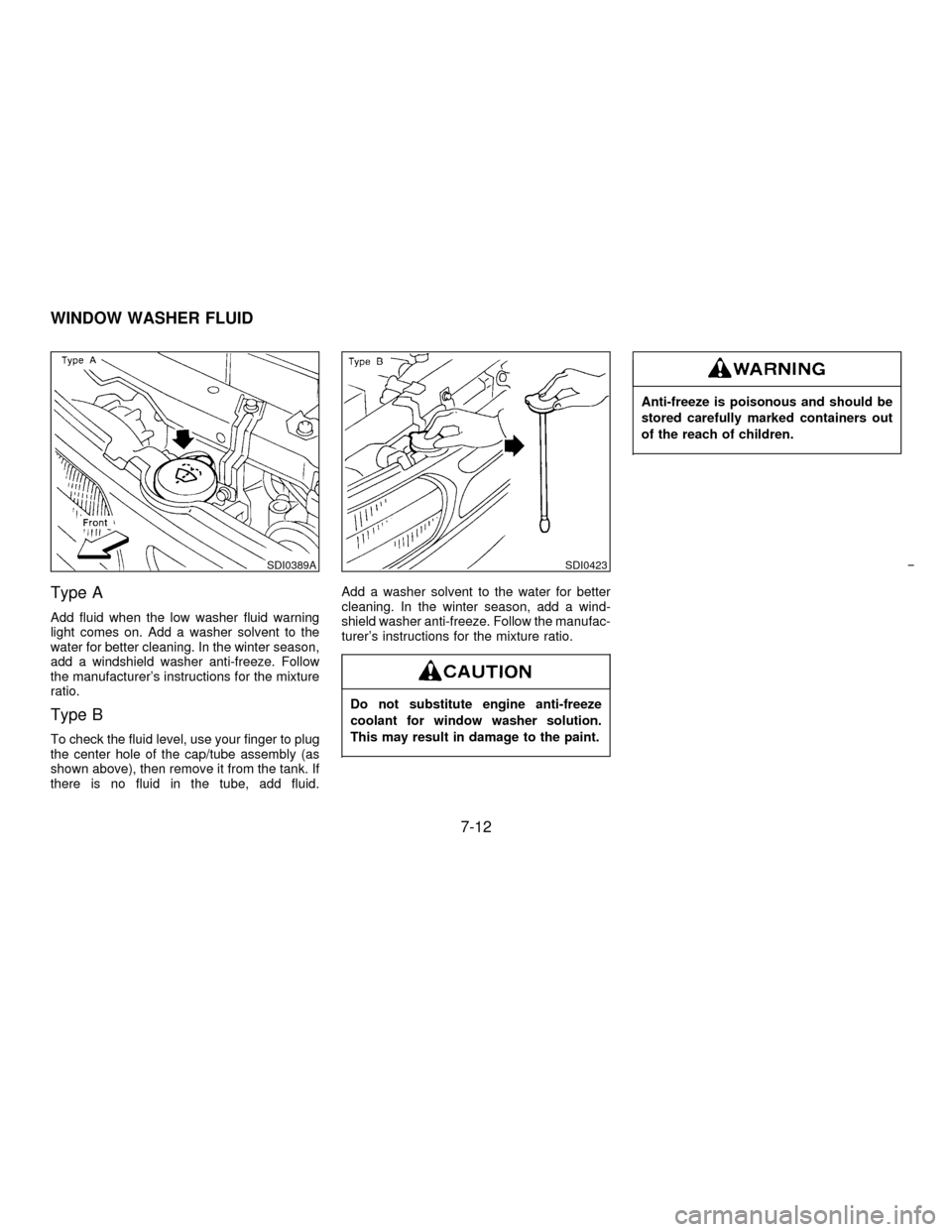
Type A
Add fluid when the low washer fluid warning
light comes on. Add a washer solvent to the
water for better cleaning. In the winter season,
add a windshield washer anti-freeze. Follow
the manufacturer's instructions for the mixture
ratio.
Type B
To check the fluid level, use your finger to plug
the center hole of the cap/tube assembly (as
shown above), then remove it from the tank. If
there is no fluid in the tube, add fluid.Add a washer solvent to the water for better
cleaning. In the winter season, add a wind-
shield washer anti-freeze. Follow the manufac-
turer's instructions for the mixture ratio.
Do not substitute engine anti-freeze
coolant for window washer solution.
This may result in damage to the paint.
Anti-freeze is poisonous and should be
stored carefully marked containers out
of the reach of children.
SDI0389ASDI0423
WINDOW WASHER FLUID
7-12
Z01.2.1/R50-DX
Page 172 of 223

With the engine running, check distance A
between the upper surface of the pedal and
the dash lower panel.
Distance A
M/T models
2-1/2 in (65 mm) or more
A/T models
2-3/4 in (70 mm) or more
If it is out of the range shown above, see your
NISSAN dealer.
See your NISSAN dealer and have it
checked if the brake pedal height does
not return to normal.
Brake pad wear indicators
The disc brake pads on your vehicle have
audible wear indicators. When a brake pad
requires replacement, it will make a high
pitched scraping or screeching sound when
the vehicle is in motion whether or not the
brake pedal is depressed. Have the brakes
checked as soon as possible if the wear indi-
cator sound is heard.
Under some driving or climate conditions, oc-
casional brake squeak, squeal or other noise
may be heard. Occasional brake noise during
light to moderate stops is normal and does not
affect the function or performance of the brake
system.
The rear drum brakes (if so equipped) do not
have audible wear indicators. Should you ever
hear an unusually loud noise from the rear
drum brakes, have them inspected as soon as
possible by your NISSAN dealer.
Proper brake inspection intervals shouldbe followed.For more information regarding
brake inspections, see the appropriate main-
tenance schedule information in the ªMainte-
nance Scheduleº section of this manual.
DI0453
BRAKE PEDAL
7-19
Z01.2.1/R50-DX
Page 173 of 223

Check the brake booster function with the
following steps:
1. With the engine off, press and release the
brake pedal several times. When brake
pedal movement (distance of travel) re-
mains the same from one pedal application
to the next, continue on to the next step.
2. While depressing the brake pedal, start the
engine. The pedal height should drop a
little.
3. With the brake pedal depressed, stop the
engine. Keeping the pedal depressed for
about 30 seconds, the pedal height should
not change.
4. Run the engine for one minute without
depressing the brake pedal, then turn it off.
Depress the brake pedal several times. The
pedal travel distance will decrease gradu-
ally with each depression as the vacuum is
released from the booster.
If the brakes do not operate properly, have the
brake checked by your NISSAN dealer.Press the pedal by hand and be sure the free
travel is within the above limit. If free travel is
out of the range shown above, see your NIS-
SAN dealer.
Engine compartment (Headlight
fuses)
If any electrical equipment does not operate,
check for an open fuse.
1. Be sure the ignition key and the headlight
switch are ªOFFº.
2. Open the engine hood.
3. Remove the fusible link cover.
4. Remove the fuse with the fuse puller.
5. If the fuse is open, replace it with a new
fuse.
DI0070-BSDI0395
BRAKE BOOSTER CLUTCH PEDAL FUSES
7-20
Z01.2.1/R50-DX
Page 174 of 223
Never use a fuse of higher amperage rating
than that specified on the fuse box cover.
6. If a new fuse opens again, have the elec-
trical system checked and repaired by your
NISSAN dealer.
Passenger compartment
If any electrical equipment does not operate,
check for an open fuse.
1. Be sure the ignition key and the headlight
switch are ªOFFº.
2. Pull to open the fuse box cover/coin tray.
3. Pull the fuse box cover/coin tray horizon-
tally to remove it.
4. Remove the fuse with the fuse puller.
5. If the fuse is open, replace it with a new
fuse.Never use a fuse of higher amperage rating
than that specified on the fuse box cover.
6. If a new fuse opens again, have the elec-
trical system checked and repaired by your
NISSAN dealer.
SDI0447
7-21
Z01.2.1/R50-DX
Page 175 of 223

HEADLIGHTS
Semi-sealed beam type
The headlight is a semi-sealed beam type
which uses a replaceable headlight (halogen)
bulb. A bulb can be replaced inside the engine
compartment without removing the headlight
assembly.
High pressure halogen gas is sealed
inside the halogen bulb. The bulb may
break if the glass envelope is scratchedor the bulb is dropped.
Hold the plastic base when handling the
bulb. Never touch the glass envelope.
Removing the headlight bulb
1. Disconnect the battery negative cable.
2. Disconnect the electrical connector from
the rear end of the bulb.
3. Turn the bulb retaining ring counterclock-
wise until it is free from the headlight reflec-
tor, then remove it.
4. Remove the headlight bulb. Do not shake
or rotate the bulb when removing it.
Replacing the headlight bulb
1. Insert the bulb into the headlight reflector
with the flat side of the plastic base facing
upward.
2. Install the bulb retaining ring and turn it
clockwise until it stops.
3. Push the electrical connector into the bulb
plastic base until it snaps and stops.
4. Connect the battery negative cable.
DO NOT TOUCH THE BULB.
IUse the same number and wattage as
originally installed:
Wattage 65/45
Bulb no. 9004
IAiming is not necessary after replac-
ing the bulb. When aiming adjust-
ment is necessary, contact your NIS-
SAN dealer.
IDo not leave the bulb out of the head-
light reflector for a long period of time
as dust, moisture, and smoke may
enter the headlight body and affect
the performance of the headlight.
DI0156
LIGHT BULBS
7-22
Z01.2.1/R50-DX