Page 70 of 223
and use. When purchasing a child
restraint, be sure to select one which
will fit your child and vehicle. It may
not be possible to properly install
some types of child restraints in your
vehicle.
Improper use of a child restraint can
result in increased injuries for both
the infant or child and other occu-
pants in the vehicle.
IWhen your child restraint is not in
use, store it in the trunk or keep it
secured with a seat belt to prevent it
from being thrown forward in case of
a sudden stop or accident.
IAfter attaching a child restraint, test
the restraint before you place the
child in it. Tilt it from side to side. Try
to tug it forward and check to see if
the belt holds it in place. If the re-
straint is not secure, tighten the belt
as necessary, or put the restraint in
another seat and test it again.
IIf the child restraint is not anchored
properly, the risk of a child being
injured in a collision or a sudden stop
greatly increases.IAdjustable seatbacks should be posi-
tioned to fit the child restraint, but as
upright as possible.
IRemember that a child restraint left in
a closed vehicle can become very
hot. Check the seating surface and
buckles before placing your child in
the child restraint.
IAll U.S. states and provinces of
Canada require that infants and small
children be restrained in approved
child restraints at all times while the
vehicle is being operated.
IFor a front facing child restraint, if the
seat position where it is installed has
a 3-point type lap/shoulder belt,
check to make sure the shoulder belt
does not go in front of the child's face
or neck. If it does, put the shoulder
belt behind the child restraint.
Installation on rear seat
Center lap belt
Secure the child restraint with the lap belt as
illustrated. Remove all slack in the lap belt for
a very tight fit by pulling forcefully on the lap
belt adjustment.
After attaching the child restraint, test it before
you place the child in it. Tilt the restraint from
side to side. If it is not secure, try to tighten the
belt again, or put the restraint in another seat.
SPA0276
2-31
Z01.2.1/R50-DX
Page 71 of 223
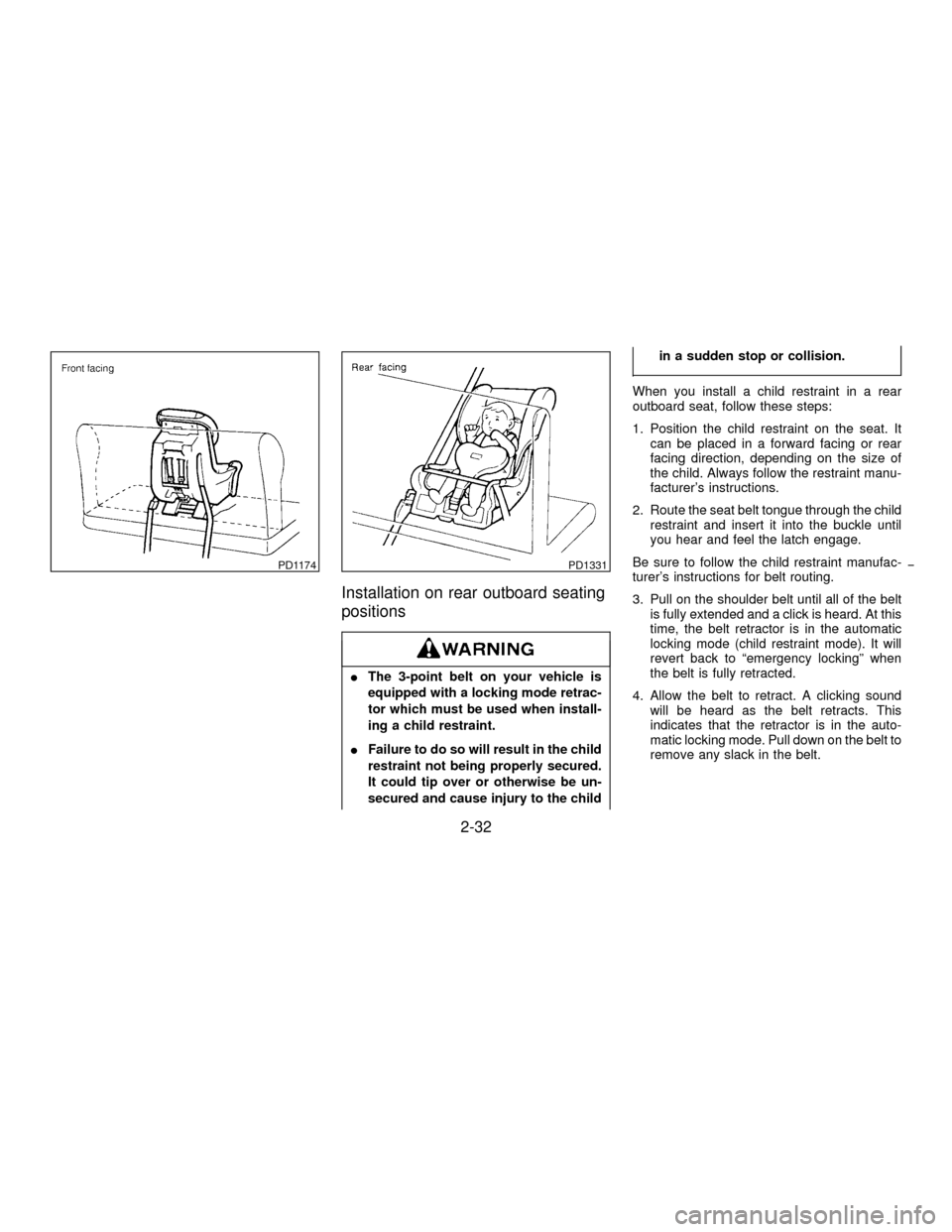
Installation on rear outboard seating
positions
IThe 3-point belt on your vehicle is
equipped with a locking mode retrac-
tor which must be used when install-
ing a child restraint.
IFailure to do so will result in the child
restraint not being properly secured.
It could tip over or otherwise be un-
secured and cause injury to the childin a sudden stop or collision.
When you install a child restraint in a rear
outboard seat, follow these steps:
1. Position the child restraint on the seat. It
can be placed in a forward facing or rear
facing direction, depending on the size of
the child. Always follow the restraint manu-
facturer's instructions.
2. Route the seat belt tongue through the child
restraint and insert it into the buckle until
you hear and feel the latch engage.
Be sure to follow the child restraint manufac-
turer's instructions for belt routing.
3. Pull on the shoulder belt until all of the belt
is fully extended and a click is heard. At this
time, the belt retractor is in the automatic
locking mode (child restraint mode). It will
revert back to ªemergency lockingº when
the belt is fully retracted.
4. Allow the belt to retract. A clicking sound
will be heard as the belt retracts. This
indicates that the retractor is in the auto-
matic locking mode. Pull down on the belt to
remove any slack in the belt.
PD1174PD1331
2-32
Z01.2.1/R50-DX
Page 72 of 223
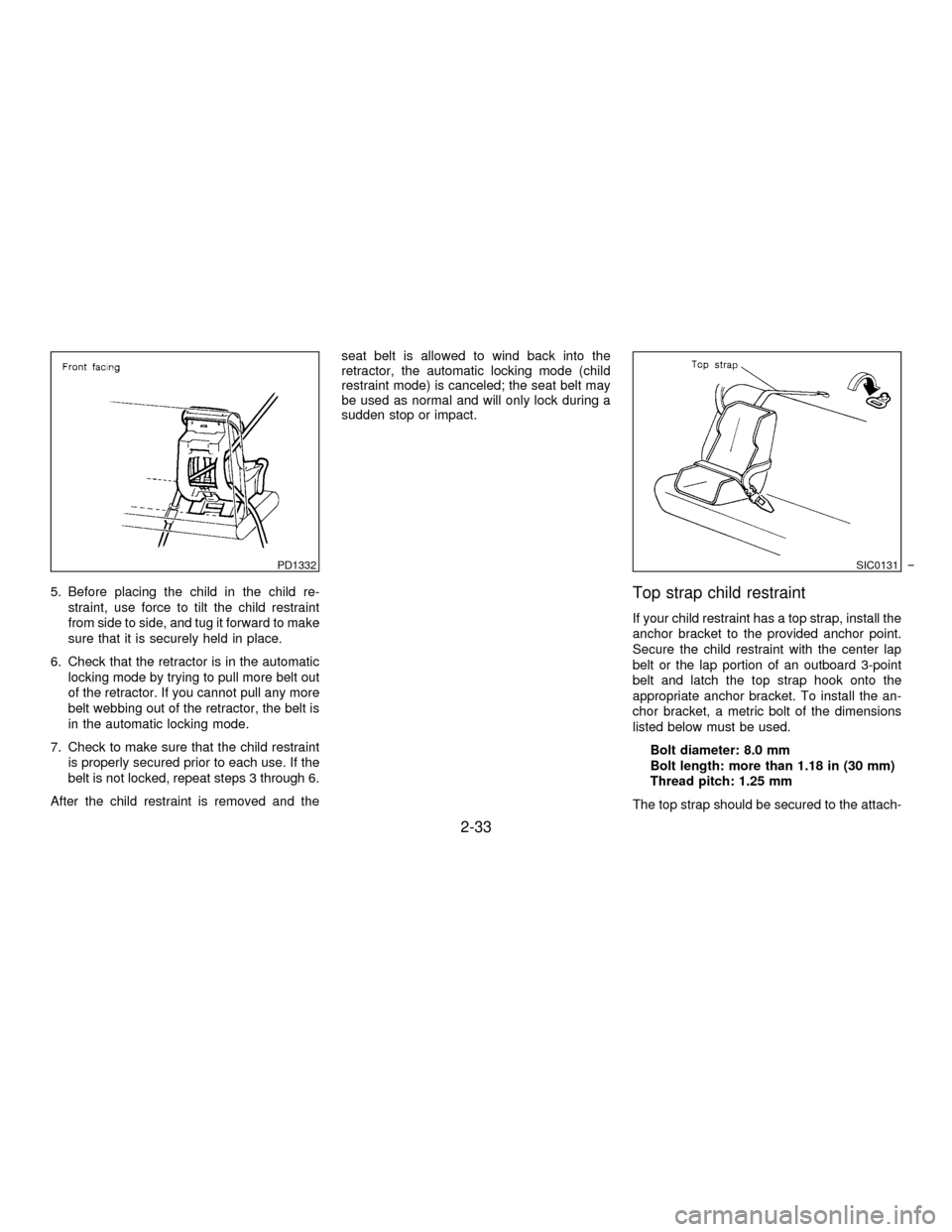
5. Before placing the child in the child re-
straint, use force to tilt the child restraint
from side to side, and tug it forward to make
sure that it is securely held in place.
6. Check that the retractor is in the automatic
locking mode by trying to pull more belt out
of the retractor. If you cannot pull any more
belt webbing out of the retractor, the belt is
in the automatic locking mode.
7. Check to make sure that the child restraint
is properly secured prior to each use. If the
belt is not locked, repeat steps 3 through 6.
After the child restraint is removed and theseat belt is allowed to wind back into the
retractor, the automatic locking mode (child
restraint mode) is canceled; the seat belt may
be used as normal and will only lock during a
sudden stop or impact.Top strap child restraint
If your child restraint has a top strap, install the
anchor bracket to the provided anchor point.
Secure the child restraint with the center lap
belt or the lap portion of an outboard 3-point
belt and latch the top strap hook onto the
appropriate anchor bracket. To install the an-
chor bracket, a metric bolt of the dimensions
listed below must be used.
Bolt diameter: 8.0 mm
Bolt length: more than 1.18 in (30 mm)
Thread pitch: 1.25 mm
The top strap should be secured to the attach-
PD1332SIC0131
2-33
Z01.2.1/R50-DX
Page 74 of 223
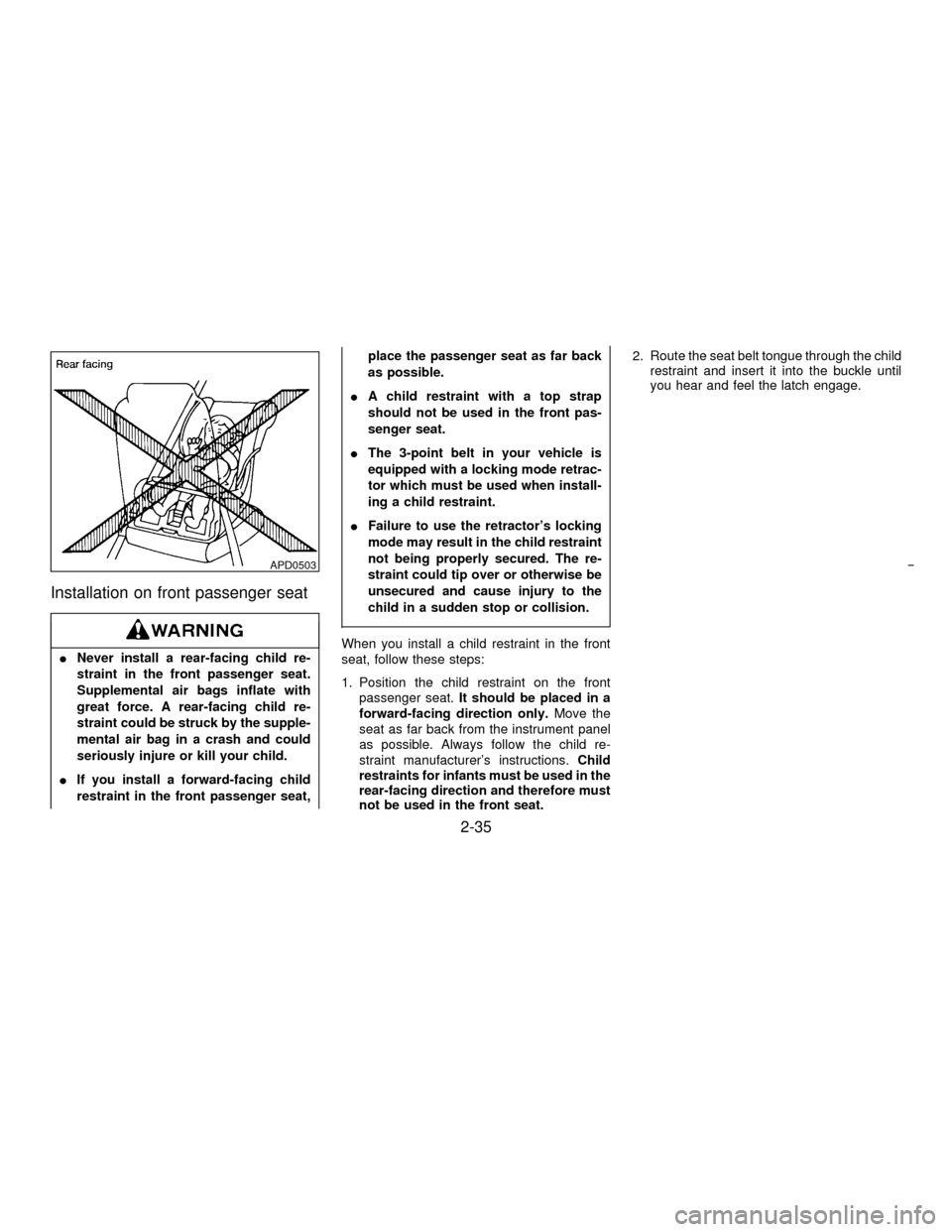
Installation on front passenger seat
INever install a rear-facing child re-
straint in the front passenger seat.
Supplemental air bags inflate with
great force. A rear-facing child re-
straint could be struck by the supple-
mental air bag in a crash and could
seriously injure or kill your child.
IIf you install a forward-facing child
restraint in the front passenger seat,place the passenger seat as far back
as possible.
IA child restraint with a top strap
should not be used in the front pas-
senger seat.
IThe 3-point belt in your vehicle is
equipped with a locking mode retrac-
tor which must be used when install-
ing a child restraint.
IFailure to use the retractor's locking
mode may result in the child restraint
not being properly secured. The re-
straint could tip over or otherwise be
unsecured and cause injury to the
child in a sudden stop or collision.When you install a child restraint in the front
seat, follow these steps:
1. Position the child restraint on the front
passenger seat.It should be placed in a
forward-facing direction only.Move the
seat as far back from the instrument panel
as possible. Always follow the child re-
straint manufacturer's instructions.Child
restraints for infants must be used in the
rear-facing direction and therefore must
not be used in the front seat.2. Route the seat belt tongue through the child
restraint and insert it into the buckle until
you hear and feel the latch engage.
APD0503
2-35
Z01.2.1/R50-DX
Page 75 of 223
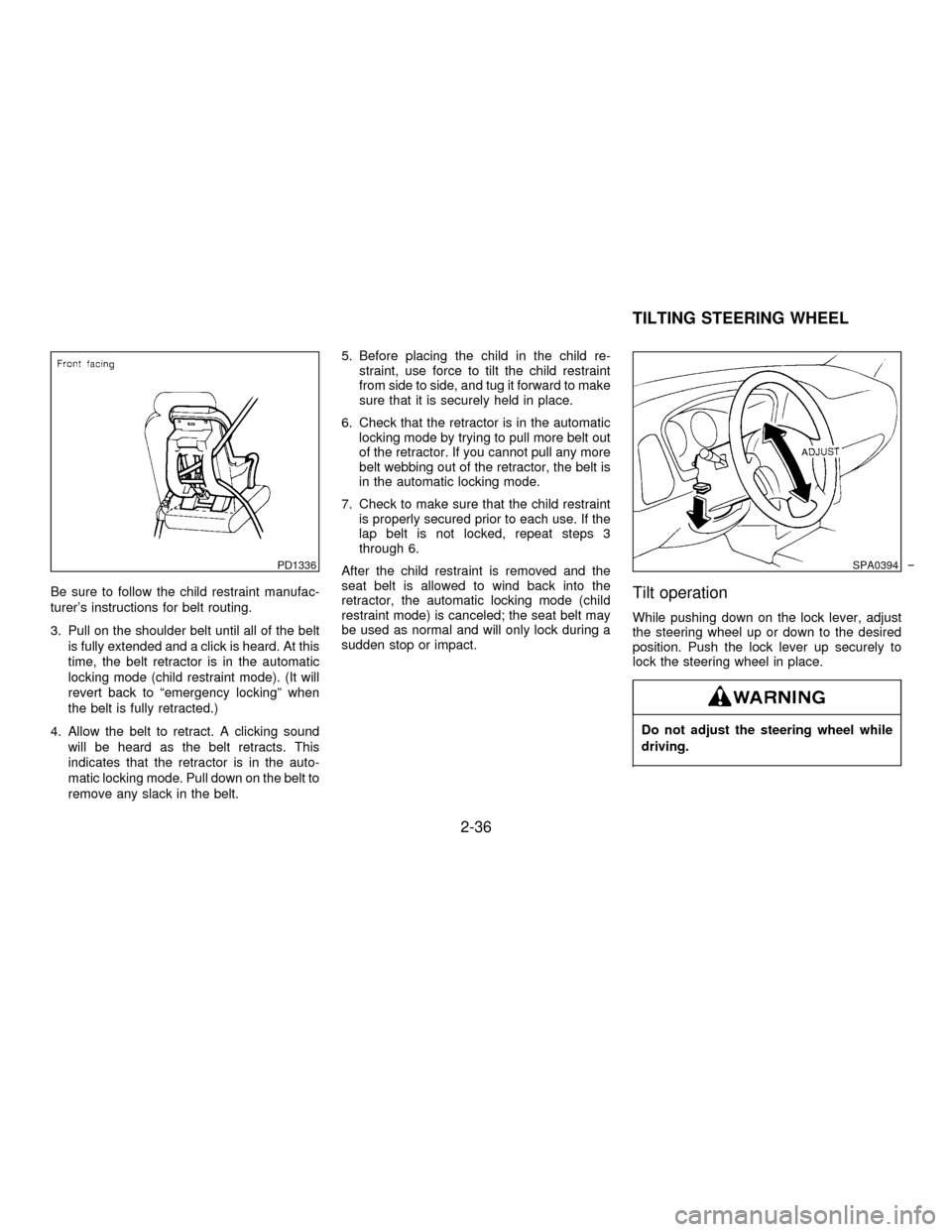
Be sure to follow the child restraint manufac-
turer's instructions for belt routing.
3. Pull on the shoulder belt until all of the belt
is fully extended and a click is heard. At this
time, the belt retractor is in the automatic
locking mode (child restraint mode). (It will
revert back to ªemergency lockingº when
the belt is fully retracted.)
4. Allow the belt to retract. A clicking sound
will be heard as the belt retracts. This
indicates that the retractor is in the auto-
matic locking mode. Pull down on the belt to
remove any slack in the belt.5. Before placing the child in the child re-
straint, use force to tilt the child restraint
from side to side, and tug it forward to make
sure that it is securely held in place.
6. Check that the retractor is in the automatic
locking mode by trying to pull more belt out
of the retractor. If you cannot pull any more
belt webbing out of the retractor, the belt is
in the automatic locking mode.
7. Check to make sure that the child restraint
is properly secured prior to each use. If the
lap belt is not locked, repeat steps 3
through 6.
After the child restraint is removed and the
seat belt is allowed to wind back into the
retractor, the automatic locking mode (child
restraint mode) is canceled; the seat belt may
be used as normal and will only lock during a
sudden stop or impact.Tilt operation
While pushing down on the lock lever, adjust
the steering wheel up or down to the desired
position. Push the lock lever up securely to
lock the steering wheel in place.
Do not adjust the steering wheel while
driving.
PD1336SPA0394
TILTING STEERING WHEEL
2-36
Z01.2.1/R50-DX
Page 78 of 223
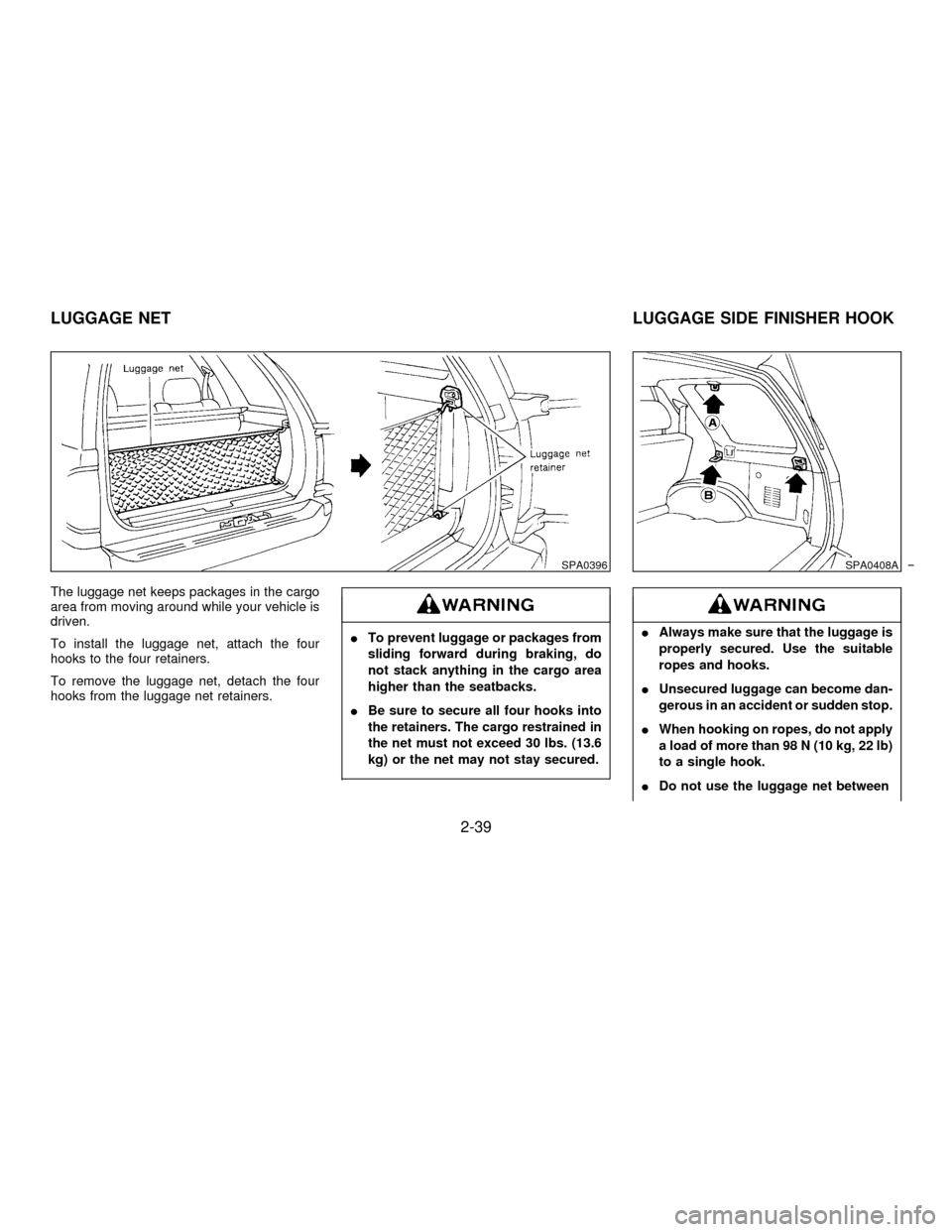
The luggage net keeps packages in the cargo
area from moving around while your vehicle is
driven.
To install the luggage net, attach the four
hooks to the four retainers.
To remove the luggage net, detach the four
hooks from the luggage net retainers.
ITo prevent luggage or packages from
sliding forward during braking, do
not stack anything in the cargo area
higher than the seatbacks.
IBe sure to secure all four hooks into
the retainers. The cargo restrained in
the net must not exceed 30 lbs. (13.6
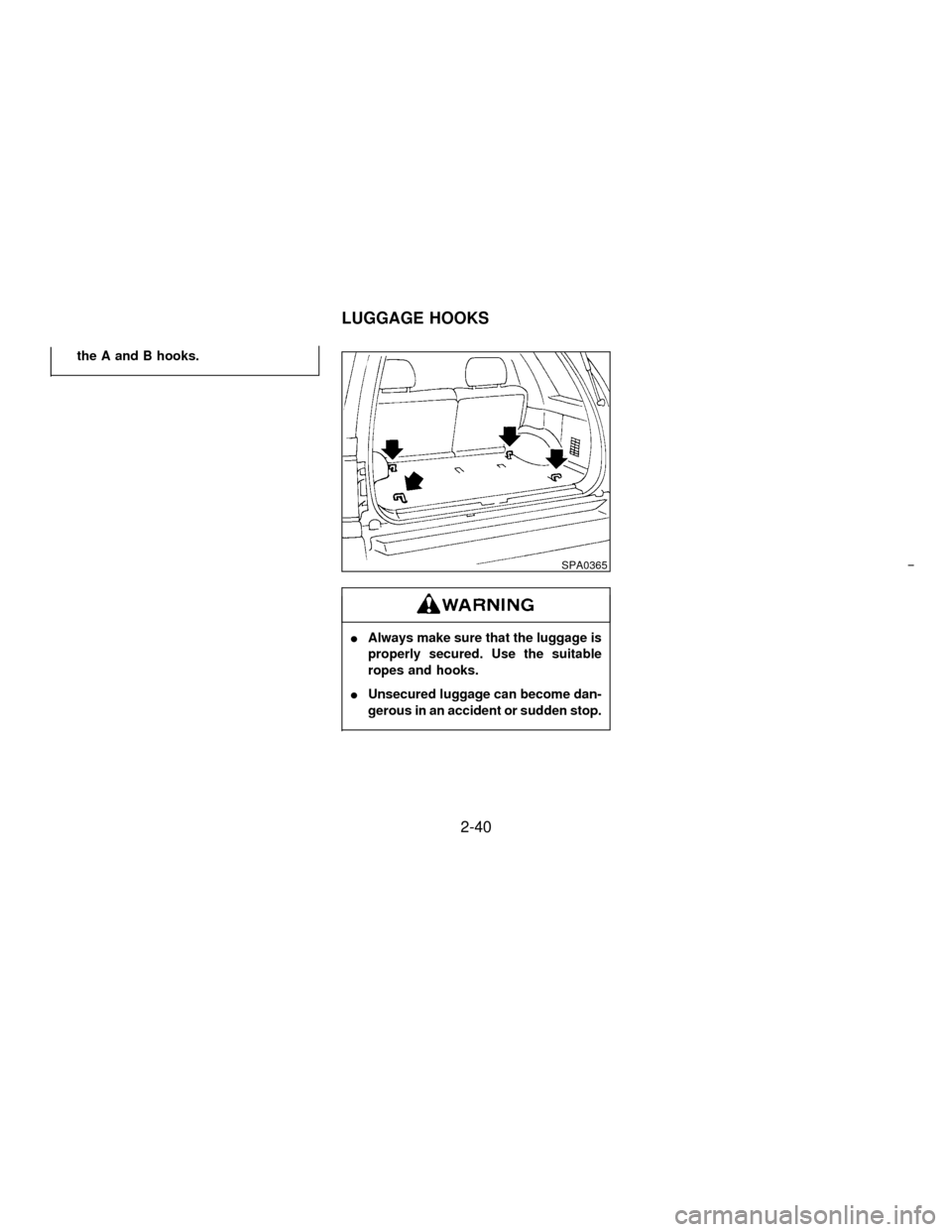
kg) or the net may not stay secured.IAlways make sure that the luggage is
properly secured. Use the suitable
ropes and hooks.
IUnsecured luggage can become dan-
gerous in an accident or sudden stop.
IWhen hooking on ropes, do not apply
a load of more than 98 N (10 kg, 22 lb)
to a single hook.
IDo not use the luggage net between
SPA0396SPA0408A
LUGGAGE NET LUGGAGE SIDE FINISHER HOOK
2-39
Z01.2.1/R50-DX
Page 79 of 223
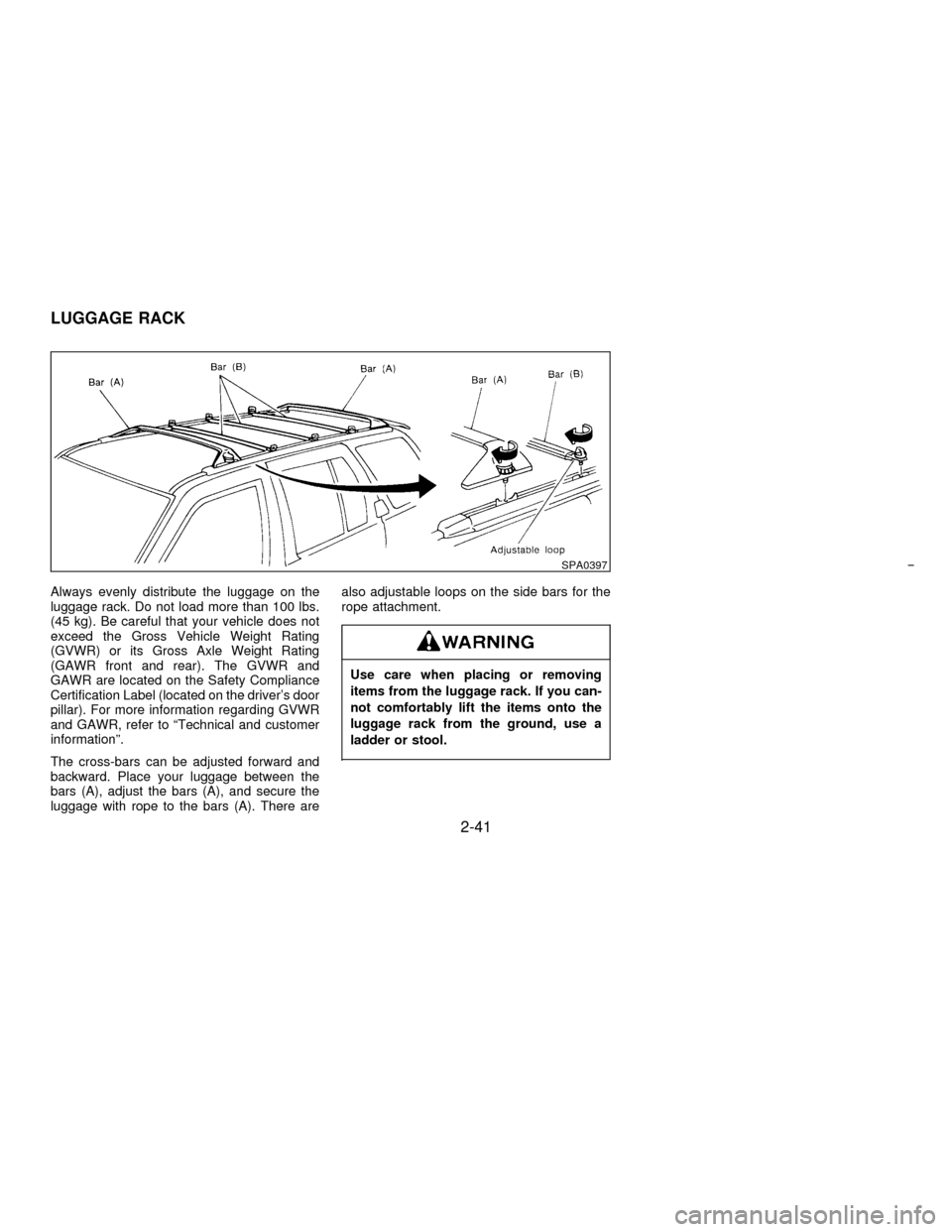
the A and B hooks.
IAlways make sure that the luggage is
properly secured. Use the suitable
ropes and hooks.
IUnsecured luggage can become dan-
gerous in an accident or sudden stop.
SPA0365
LUGGAGE HOOKS
2-40
Z01.2.1/R50-DX
Page 80 of 223
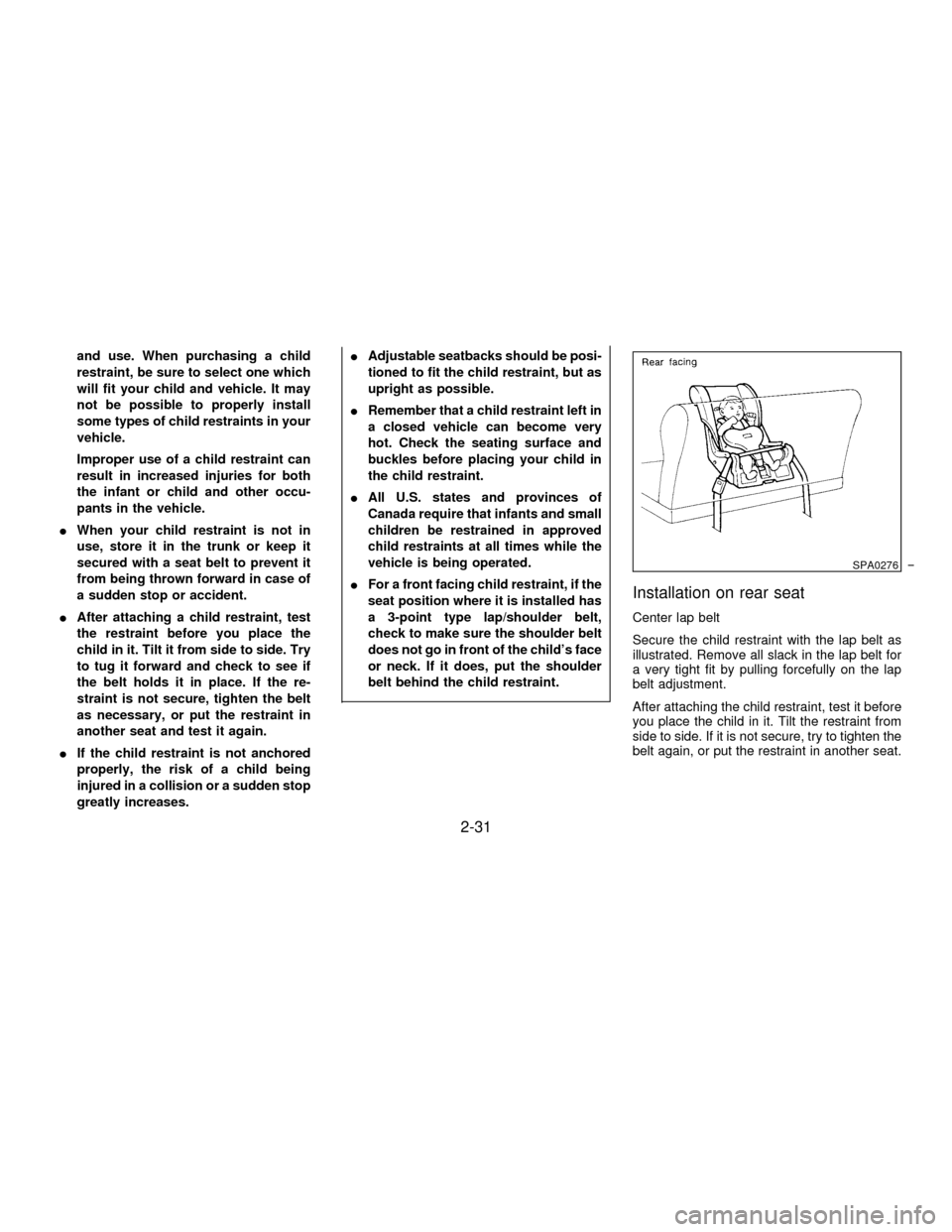
Always evenly distribute the luggage on the
luggage rack. Do not load more than 100 lbs.
(45 kg). Be careful that your vehicle does not
exceed the Gross Vehicle Weight Rating
(GVWR) or its Gross Axle Weight Rating
(GAWR front and rear). The GVWR and
GAWR are located on the Safety Compliance
Certification Label (located on the driver's door
pillar). For more information regarding GVWR
and GAWR, refer to ªTechnical and customer
informationº.
The cross-bars can be adjusted forward and
backward. Place your luggage between the
bars (A), adjust the bars (A), and secure the
luggage with rope to the bars (A). There arealso adjustable loops on the side bars for the
rope attachment.
Use care when placing or removing
items from the luggage rack. If you can-
not comfortably lift the items onto the
luggage rack from the ground, use a
ladder or stool.
SPA0397
LUGGAGE RACK
2-41
Z01.2.1/R50-DX