1996 NISSAN MAXIMA transmission oil
[x] Cancel search: transmission oilPage 95 of 197
IMake sure the area around the vehicle is
clear.
IMaintenance items listed here should be
checked periodically, e.g., each time you
check engine oil.
ICheck that all windows and lights are clean.
IVisually inspect tires for their appearance
and condition. Also check tires for proper
inflation.
ILock all doors.
IPosition seat and adjust head restraints.
IAdjust inside and outside mirrors.
IFasten seat belts and ask all passengers to
do likewise.
ICheck the operation of warning lights when
key is turned to the ªON (3)º position.The automatic transmission in your vehicle (if
so equipped) is electronically controlled by a
microcomputer to produce maximum power
and smooth operation.
Shown on the following pages are the recom-
mended operating procedures for this trans-
mission. Follow these procedures for maxi-
mum vehicle performance and driving
enjoyment.
Starting the vehicle
IAfter starting the engine, fully depress the
foot brake pedal and push the shift lever
button before shifting the selector lever to
the ªRº, ªNº, ªDº, ª2º or ª1º position. Be sure
the vehicle is fully stopped before attempt-
ing to shift the selector lever.
This automatic transmission is designed
so that the foot brake pedal MUST be de-
pressed before shifting from ªPº to any
drive position while the ignition switch is
ªONº.
The shift lever cannot be moved out of ªPº
and into any of the other gear positions if
the key is turned to the ªLOCKº position or
if the key is removed from the switch.
1. Keep the foot brake pedal depressed and
push the shift lever button to shift into a
driving gear.2. Release the parking brake and foot brake,
then gradually start the vehicle in motion.
When the battery charge is low, the shift
lever can be moved if the ignition switch is
in the ªACCº position.
ICold engine idle speed is high, so use
caution when shifting into a forward
or reverse gear before the engine has
warmed up.
IAvoid revving up the engine while the
vehicle is stopped. This could cause
unexpected vehicle movement.
Driving precautions
To help prevent transmission damage:
IDo not depress the accelerator pedal
while shifting from ªPº or ªNº to ªRº,
ªDº, ª2º or ª1º. Always depress the
brake pedal until shifting is completed.
INever shift to ªPº or ªRº while vehicle is
moving.
IWhen stopping the vehicle on an uphill
grade, do not hold the vehicle by de-
BEFORE STARTING THE ENGINE
DRIVING WITH AUTOMATIC
TRANSMISSION
4-6
Z01.2.1/A32-DX
Page 128 of 197
7 Do-it-yourself operations
Precautions ............................................................... 7-2
Engine cooling system .............................................. 7-4
Engine oil .................................................................. 7-6
Automatic transmission fluid ..................................... 7-9
Power steering fluid ................................................ 7-10
Brake and clutch fluid ............................................. 7-11
Window washer fluid ............................................... 7-11
Battery ..................................................................... 7-12
Drive belts ............................................................... 7-13
Spark plug replacement .......................................... 7-14
Air cleaner filter ....................................................... 7-16
Wiper blades ........................................................... 7-17
Parking brake .......................................................... 7-18
Brake pedal ............................................................. 7-19
Brake booster .......................................................... 7-20
Clutch pedal ............................................................ 7-20
Fuses....................................................................... 7-20
Fusible links ............................................................ 7-22
Light bulbs ............................................................... 7-22
Wheels and tires ..................................................... 7-29
Z01.2.1/A32-DX
Page 129 of 197
When performing any inspection or mainte-
nance work on your vehicle, always take care
to prevent serious accidental injury to yourself
or damage to the vehicle. The following are
general precautions which should be closely
observed.
IPark the vehicle on a level surface, apply
the parking brake securely and block the
wheels to prevent the vehicle from mov-
ing. Move the transmission control lever
to neutral (ªNº).
IBe sure the ignition key is ªOFFº or
ªLOCKº when performing any replace-
ment or repair.
When the ignition key is in the ªONº or
ªACCº position, the cooling fan may
start to operate suddenly even when the
engine is not running.
IDo not work under the hood while the
engine is hot. Turn off the engine and
wait until it cools down.
IIf you must work with the engine run-
ning, keep your hands, clothing, hair
and tools away from moving fans, belts
and any other moving parts.
IIt is advisable to remove ties and any
jewelry, such as rings, watches, etc.
before working on your vehicle.IIf you must run the engine in an en-
closed space such as a garage, be sure
there is proper ventilation for exhaust
gases.
INever get under the vehicle while it is
supported only by a jack. If it is neces-
sary to work under the vehicle, support
it with safety stands.
IKeep smoking materials, flame and
sparks away from fuel and battery.
INever connect or disconnect either the
battery or any transistorized component
connector while the ignition is on.
IOn gasoline engine models with the Mul-
tiport fuel injection system, the fuel filter
or fuel lines should be serviced by a
NISSAN dealer because the fuel lines
are under high pressure even when the
engine is off.
IFailure to follow these or other common
sense guidelines may lead to serious
injury or vehicle damage.
IImproperly disposed motor oil and/or
other vehicle fluids can hurt the environ-
ment. Always conform to local regula-
tions for disposal of vehicle fluid.
This ªDo-it-yourself operationsº section givesinstructions regarding only those items which
are relatively easy for an owner to perform.
You should be aware that incomplete or im-
proper servicing may result in operating diffi-
culties or excessive emissions, and could af-
fect your warranty coverage.If in doubt about
any servicing, have it done by your NISSAN
dealer.
PRECAUTIONS
7-2
Z01.2.1/A32-DX
Page 136 of 197
Be careful not to burn yourself, as the
engine oil may be hot.
4. Wipe the engine oil filter mounting surface
with a clean rag.
Be sure to remove any old rubber gasket
remaining on the mounting surface of the
engine.
5. Coat the rubber gasket on the new filter
with clean engine oil.
6. Screw in the oil filter until a slight resistance
is felt, then tighten additionally more than
2/3 turn.
Oil filter tightening torque:
10.85 to 15.19 ft-lb
(14.7 to 20.6 )
7. Start the engine and check for leakage
around the oil filter. Correct as required.
8. Turn the engine off and wait several min-
utes. Check the oil level. Add engine oil if
necessary.
When engine is running, keep hands
and clothing away from any moving
parts such as fan drive belt.
IAutomatic transmission fluid is poi-
sonous and should be stored care-
fully in marked containers out of the
reach of children.
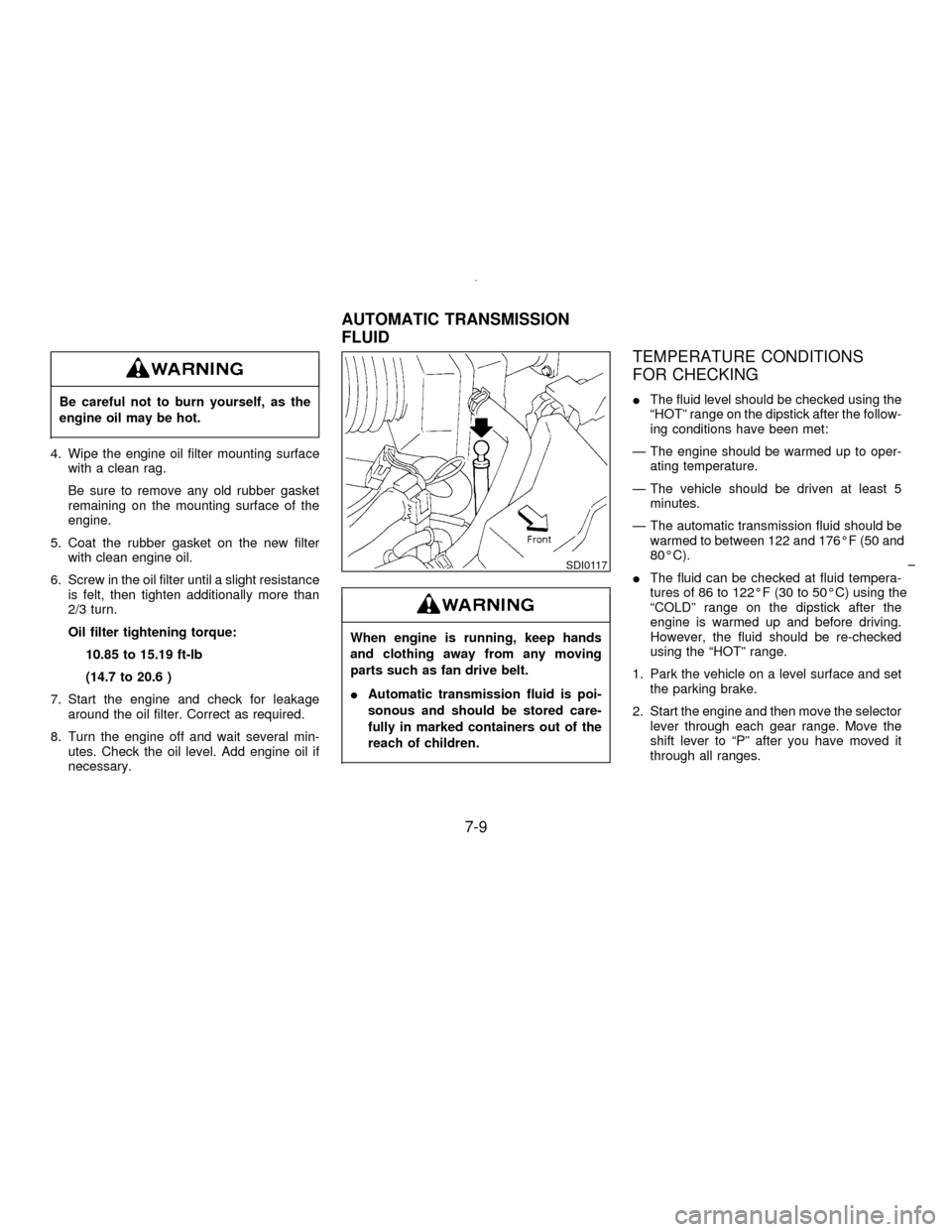
TEMPERATURE CONDITIONS
FOR CHECKING
IThe fluid level should be checked using the
ªHOTº range on the dipstick after the follow-
ing conditions have been met:
Ð The engine should be warmed up to oper-
ating temperature.
Ð The vehicle should be driven at least 5
minutes.
Ð The automatic transmission fluid should be
warmed to between 122 and 176ÉF (50 and
80ÉC).
IThe fluid can be checked at fluid tempera-
tures of 86 to 122ÉF (30 to 50ÉC) using the
ªCOLDº range on the dipstick after the
engine is warmed up and before driving.
However, the fluid should be re-checked
using the ªHOTº range.
1. Park the vehicle on a level surface and set
the parking brake.
2. Start the engine and then move the selector
lever through each gear range. Move the
shift lever to ªPº after you have moved it
through all ranges.
SDI0117
AUTOMATIC TRANSMISSION
FLUID
7-9
Z01.2.1/A32-DX
Page 173 of 197
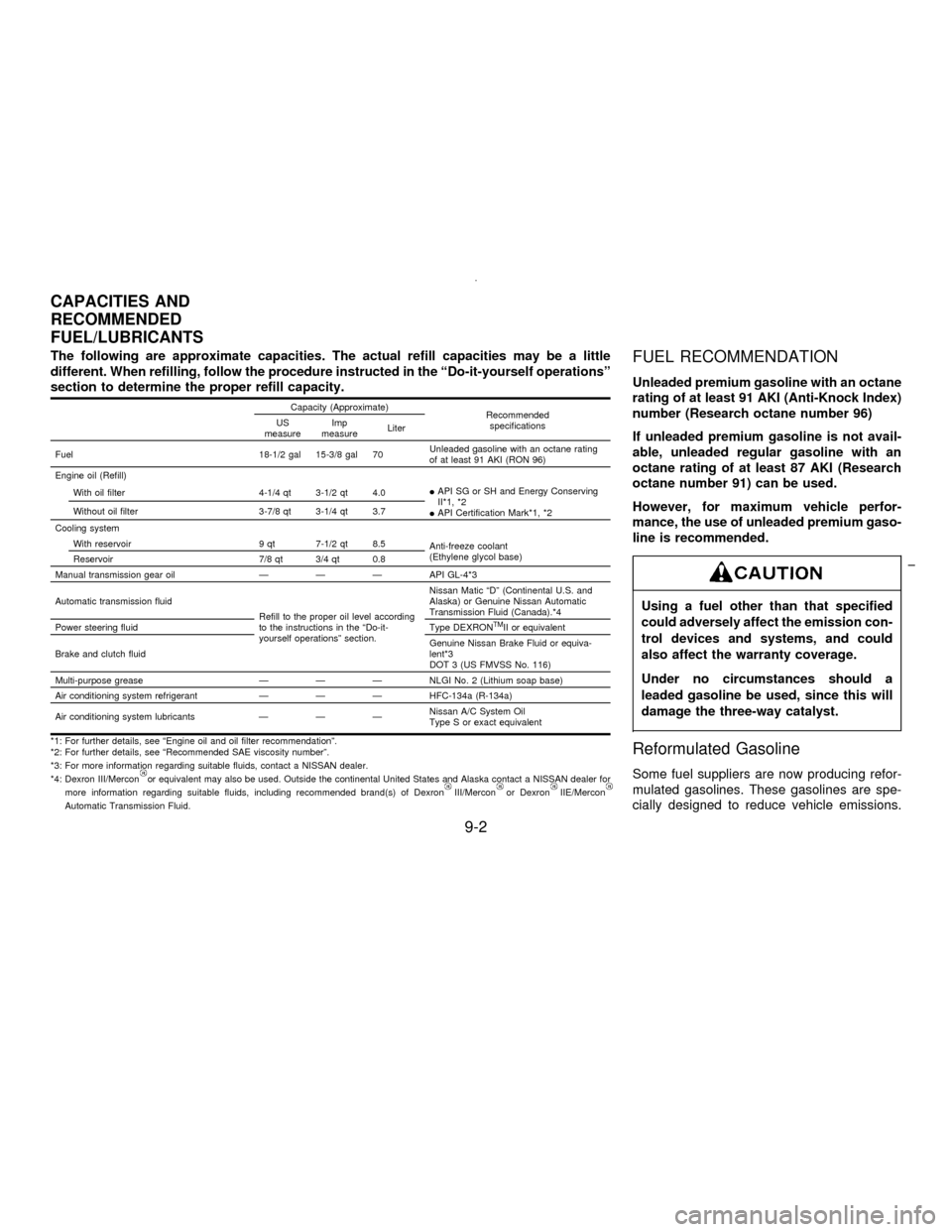
The following are approximate capacities. The actual refill capacities may be a little
different. When refilling, follow the procedure instructed in the ªDo-it-yourself operationsº
section to determine the proper refill capacity.
Capacity (Approximate)
Recommended
specifications US
measureImp
measureLiter
Fuel 18-1/2 gal 15-3/8 gal 70Unleaded gasoline with an octane rating
of at least 91 AKI (RON 96)
Engine oil (Refill)
With oil filter 4-1/4 qt 3-1/2 qt 4.0IAPI SG or SH and Energy Conserving
II*1, *2
IAPI Certification Mark*1, *2 Without oil filter 3-7/8 qt 3-1/4 qt 3.7
Cooling system
With reservoir 9 qt 7-1/2 qt 8.5
Anti-freeze coolant
(Ethylene glycol base)
Reservoir 7/8 qt 3/4 qt 0.8
Manual transmission gear oilÐ Ð Ð API GL-4*3
Automatic transmission fluid
Refill to the proper oil level according
to the instructions in the ªDo-it-
yourself operationsº section.Nissan Matic ªDº (Continental U.S. and
Alaska) or Genuine Nissan Automatic
Transmission Fluid (Canada).*4
Power steering fluid Type DEXRON
TMII or equivalent
Brake and clutch fluidGenuine Nissan Brake Fluid or equiva-
lent*3
DOT 3 (US FMVSS No. 116)
Multi-purpose greaseÐ Ð Ð NLGI No. 2 (Lithium soap base)
Air conditioning system refrigerantÐ Ð Ð HFC-134a (R-134a)
Air conditioning system lubricants Ð Ð ÐNissan A/C System Oil
Type S or exact equivalent
*1: For further details, see ªEngine oil and oil filter recommendationº.
*2: For further details, see ªRecommended SAE viscosity numberº.
*3: For more information regarding suitable fluids, contact a NISSAN dealer.
*4: Dexron III/Mercon
or equivalent may also be used. Outside the continental United States and Alaska contact a NISSAN dealer for
more information regarding suitable fluids, including recommended brand(s) of DexronIII/Merconor DexronIIE/MerconAutomatic Transmission Fluid.
FUEL RECOMMENDATION
Unleaded premium gasoline with an octane
rating of at least 91 AKI (Anti-Knock Index)
number (Research octane number 96)
If unleaded premium gasoline is not avail-
able, unleaded regular gasoline with an
octane rating of at least 87 AKI (Research
octane number 91) can be used.
However, for maximum vehicle perfor-
mance, the use of unleaded premium gaso-
line is recommended.
Using a fuel other than that specified
could adversely affect the emission con-
trol devices and systems, and could
also affect the warranty coverage.
Under no circumstances should a
leaded gasoline be used, since this will
damage the three-way catalyst.
Reformulated Gasoline
Some fuel suppliers are now producing refor-
mulated gasolines. These gasolines are spe-
cially designed to reduce vehicle emissions.
CAPACITIES AND
RECOMMENDED
FUEL/LUBRICANTS
9-2
Z01.2.1/A32-DX
Page 187 of 197
the transmission to a lower gear and reduce
speed to reduce chances of engine over-
loading and/or overheating.
IIf the engine coolant rises to an extremely
high temperature when the air conditioning
system is on, turn off the air conditioner.
Coolant heat can be additionally vented by
opening the windows, switching the fan
control to high and setting the temperature
control to the ªHOTº position.
ITrailer towing requires more fuel than nor-
mal circumstances.
IAvoid towing a trailer for the first 500 miles
(800 km).
IHave your vehicle serviced more often than
at intervals specified in the recommended
Maintenance Schedule.
IWhen making a turn, your trailer wheels will
be closer to the inside of the turn than your
vehicle wheels. To compensate for this,
make a larger than normal turning radius
during the turn.
ICrosswinds and rough roads will adversely
affect vehicle/trailer handling, possibly
causing vehicle sway. When being passed
by larger vehicles, be prepared for possible
changes in crosswinds that could affect
vehicle handling. If swaying does occur,firmly grip the steering wheel, steer straight
ahead, and immediately (but gradually) re-
duce vehicle speed. This combination will
help stabilize the vehicle. Never increase
speed.
IBe careful when passing other vehicles.
Passing while towing a trailer requires con-
siderably more distance than normal pass-
ing. Remember the length of the trailer
must also pass the other vehicle before you
can safely change lanes.
ITo maintain engine braking efficiency and
electrical charging performance, do not use
fifth gear (manual transmission) or over-
drive (automatic transmission).
IAvoid holding the brake pedal down too
long or too frequently. This could cause the
brakes to overheat, resulting in reduced
braking efficiency.
When towing a trailer, change oil in the
transmission more frequently.
See the Maintenance schedule.
9-16
Z01.2.1/A32-DX
Page 192 of 197

10 Index
A
Air bag warning light ....................................... 2-21
Air cleaner filter ............................................... 7-16
Air conditioner
Air conditioner operation ............................. 3-5
Air conditioner specification label.............. 9-11
Automatic air conditioner............................. 3-9
Air flow chart ..................................................... 3-6
AM-FM radio with cassette player .................. 3-12
AM-FM radio with cassette player and compact
disc player (Bose audio system) .................... 3-16
Antenna........................................................... 3-22
Anti-lock brake system ................................... 4-17
Automatic
Automatic air conditioner............................. 3-9
Automatic transmission fluid ....................... 7-9
Driving with automatic transmission............ 4-6
Avoiding collision and rollover .......................... 4-3
B
Battery............................................................. 7-12
Battery replacement.......................................... 2-7
Before starting the engine ................................ 4-6
Brake
Anti-lock brake system .............................. 4-17
Brake and clutch fluid................................ 7-11
Brake booster ............................................ 7-20Brake pedal ............................................... 7-19
Brake wear indicators ........................ 1-8, 7-19
Parking brake ................................... 4-11, 7-18
Break-in schedule ........................................... 4-13
C
Capacities and recommended fuel/lubricants... 9-2
Caution and warning labels ............................ 2-21
CB radio or car phone .................................... 3-23
Changing
Changing engine coolant ............................ 7-5
Changing engine oil .................................... 7-7
Changing oil filter ........................................ 7-8
Checking engine coolant level .......................... 7-4
Checking engine oil level .................................. 7-6
Child restraints for infants and small children .... 2-
29
Child safety ..................................................... 2-23
Child safety rear door lock................................ 2-3
Cigarette lighter and ash trays ....................... 1-17
Cleaning exterior and interior ........................... 6-2
Clock ............................................................... 1-21
Clutch pedal .................................................... 7-20
Cold weather driving cautions ........................ 4-18
Compact disc (CD) player operation .............. 3-21
Controls............................................................. 3-3
Coolant
Changing engine coolant ............................ 7-5
Checking engine coolant level .................... 7-4Engine coolant temperature gauge ............. 1-4
Cornering light ................................................ 1-14
Corrosion protection ......................................... 6-5
Cruise control.................................................. 4-12
Cup and card holders ..................................... 1-18
DDefogger switch
Rear window and outside mirror defogger
switch......................................................... 1-12
Dimensions and weights ................................... 9-8
Door lock operation .......................................... 2-6
Door locks ......................................................... 2-2
Door unlock operation ...................................... 2-6
Drinking alcohol/drugs and driving ................... 4-4
Drive belts ....................................................... 7-13
Driving
Cold weather driving cautions ................... 4-18
Drinking alcohol/drugs and driving .............. 4-4
Driving with automatic transmission............ 4-6
Driving with manual transmission ............... 4-9
Precautions when driving .......................... 4-16
Precautions when starting and driving ........ 4-2
E
Economy hints ................................................ 4-14
Emission control information label .................. 9-10
Emission control system warranty .................. 9-18
Z01.2.1/A32-DX
Page 193 of 197
Engine ............................................................... 9-7
Before starting the engine ........................... 4-6
Changing engine coolant ............................ 7-5
Changing engine oil .................................... 7-7
Checking engine coolant level .................... 7-4
Checking engine oil level ............................ 7-6
Engine coolant temperature gauge ............. 1-4
Engine cooling system ................................ 7-4
Engine oil..................................................... 7-6
Engine oil and oil filter
recommendation .......................................... 9-4
Engine serial number ................................ 9-10
Starting the engine .................................... 4-10
Exhaust gas (Carbon monoxide) ...................... 4-2
Explanation of maintenance items.................. 8-10
F
Flat tire .............................................................. 5-2
Fluid
Automatic transmission fluid ....................... 7-9
Brake and clutch fluid................................ 7-11
Power steering fluid................................... 7-10
Window washer fluid ................................. 7-11
F.M.V.S.S. certification label........................... 9-10
Foldable outside mirrors ................................. 2-36
Front fog light switch ...................................... 1-15
Front personal light ......................................... 1-22
Fuel
Capacities and recommended
fuel/lubricants .............................................. 9-2
Fuel filler cap ............................................. 2-10
Fuel filler lid lock ....................................... 2-10
Fuel gauge .................................................. 1-5Fuel recommendation.................................. 9-2
Fuses .............................................................. 7-20
Fusible links .................................................... 7-22
G
Gauge
Engine coolant temperature gauge ............. 1-4
Fuel gauge .................................................. 1-5
Meters and gauges ..................................... 1-3
General maintenance ....................................... 8-3
Glove box lock .................................................. 2-8
H
Hazard warning flasher switch........................ 1-15
Head restraint ................................................. 2-15
Headlight and turn signal switch..................... 1-13
Headlights ....................................................... 7-22
Heated seat .................................................... 1-16
Heater operation ............................................... 3-4
Hood release .................................................... 2-8
I
If your vehicle overheats .................................. 5-8
Ignition switch ................................................... 4-4
Inside mirror .................................................... 2-36
Installing license plate .................................... 9-11
Instrument brightness control ......................... 1-14
Interior light ..................................................... 1-21J
Jump starting ........................................... 5-6, 7-13
K
Key .................................................................... 2-2
L
License plate
Installing license plate ............................... 9-11
Light
Air bag warning light ................................. 2-21
Cigarette lighter and ash trays .................. 1-17
Cornering light ........................................... 1-14
Front fog light switch ................................. 1-15
Front personal light ................................... 1-22
Headlight and turn signal switch ............... 1-13
Headlights.................................................. 7-22
Interior light................................................ 1-21
Light bulbs ................................................. 7-22
Trunk light.................................................. 1-23
Vanity mirror light ...................................... 1-22
Warning/indicator light and buzzer.............. 1-6
Lock
Anti-lock brake system .............................. 4-17
Child safety rear door lock .......................... 2-3
Clock.......................................................... 1-21
Door lock operation ..................................... 2-6
Door locks ................................................... 2-2
Door unlock operation ................................. 2-6
Fuel filler lid lock ....................................... 2-10
Glove box lock............................................. 2-8
10-2
Z01.2.1/A32-DX