1996 NISSAN MAXIMA child seat
[x] Cancel search: child seatPage 1 of 197

Foreword
Welcome to the growing family of new NISSAN owners. This vehicle is delivered to you with confidence. It was produced using the latest techniques
and strict quality control.
This manual was prepared to help you understand the operation and maintenance of your vehicle so that you may enjoy many miles of driving
pleasure. Please read through this manual before operating your vehicle.
A separate ªWarranty Information bookletº explains details about the warranties covering your vehicle.
Your NISSAN dealer knows your vehicle best. When you require any service or have any questions, he will be glad to assist you with the extensive
resources available to him.
IMPORTANT SAFETY INFORMATION
REMINDERS FOR SAFETY!
Follow these five important driving rules to help ensure a safe and
complete trip for you and your passengers!
INEVER drive under the influence of alcohol or drugs.
IALWAYS observe posted speed limits and never drive too fast
for conditions.
IALWAYS use your seat belts and appropriate child restraint
systems.
IALWAYS provide information about the proper use of vehicle
safety features to all occupants of the vehicle.
IALWAYS review this Owner's Manual for important safety
information.
1995 NISSAN MOTOR CO., LTD.
TOKYO, JAPAN
NOTES ON THE INFORMATION CONTAINED IN THIS
OWNER'S MANUAL
This owner's manual contains descriptions and operating instruc-
tions for all systems, features and optional equipment that might
appear in any model of this vehicle built for any destination in
North America, including the continental United States, Canada
and Hawaii. Therefore, you may very well find information in this
manual that does not apply to your vehicle.
MODIFICATION OF YOUR VEHICLE
This vehicle should not be modified. Modification could affect its
performance, safety or durability, and may even violate governmental
regulations. In addition, damage or performance problems resulting
from modification may not be covered under NISSAN warranties.
All information, specifications and illustrations in this manual are those
in effect at the time of printing. NISSAN reserves the right to change
specifications or design without notice and without obligation.
Z01.2.1/A32-DX
Page 30 of 197

2 Pre-driving checks and adjustments
Key ............................................................................ 2-2
Door locks ................................................................. 2-2
Multi-remote control system ...................................... 2-5
Hood release ............................................................. 2-8
Glove box lock .......................................................... 2-8
Trunk lid lock ............................................................. 2-9
Fuel filler lid lock ..................................................... 2-10
Seats ....................................................................... 2-12
Supplemental restraint system
(Air bag system) ...................................................... 2-17
Caution and warning labels..................................... 2-21
Air bag warning light ............................................... 2-21
Seat belts ................................................................ 2-23
Child restraints for infants and small children......... 2-29
Tilting steering wheel .............................................. 2-35
Outside mirror remote control ................................. 2-36
Foldable outside mirrors.......................................... 2-36
Inside mirror ............................................................ 2-36
Z01.2.1/A32-DX
Page 32 of 197

Locking the doors without key
To lock from the outside without a key, move
the inside lock knob to the ªLOCKº position.
Then close the door.
When locking the door this way, be certain not
to leave the key inside the vehicle.
The inside lock knob cannot be set to the
ªLOCKº position with the front doors open and
with the key in the ignition.
IAlways have the doors locked while
driving. Along with the use of seat
belts, this provides greater safety in
the event of an accident by helping to
prevent persons from being thrown
from the vehicle. This also helps keep
children and others from unintention-
ally opening the doors, and will help
keep out intruders.
IBefore opening any door, always look
for and avoid oncoming traffic.
CHILD SAFETY REAR DOOR
LOCK
Child safety locking helps prevent doors from
being opened accidentally, especially when
small children are in the vehicle.
When the lever is in the lock position, the rear
door can be opened only from the outside.
SPA0085SPA0086
2-3
Z01.2.1/A32-DX
Page 42 of 197
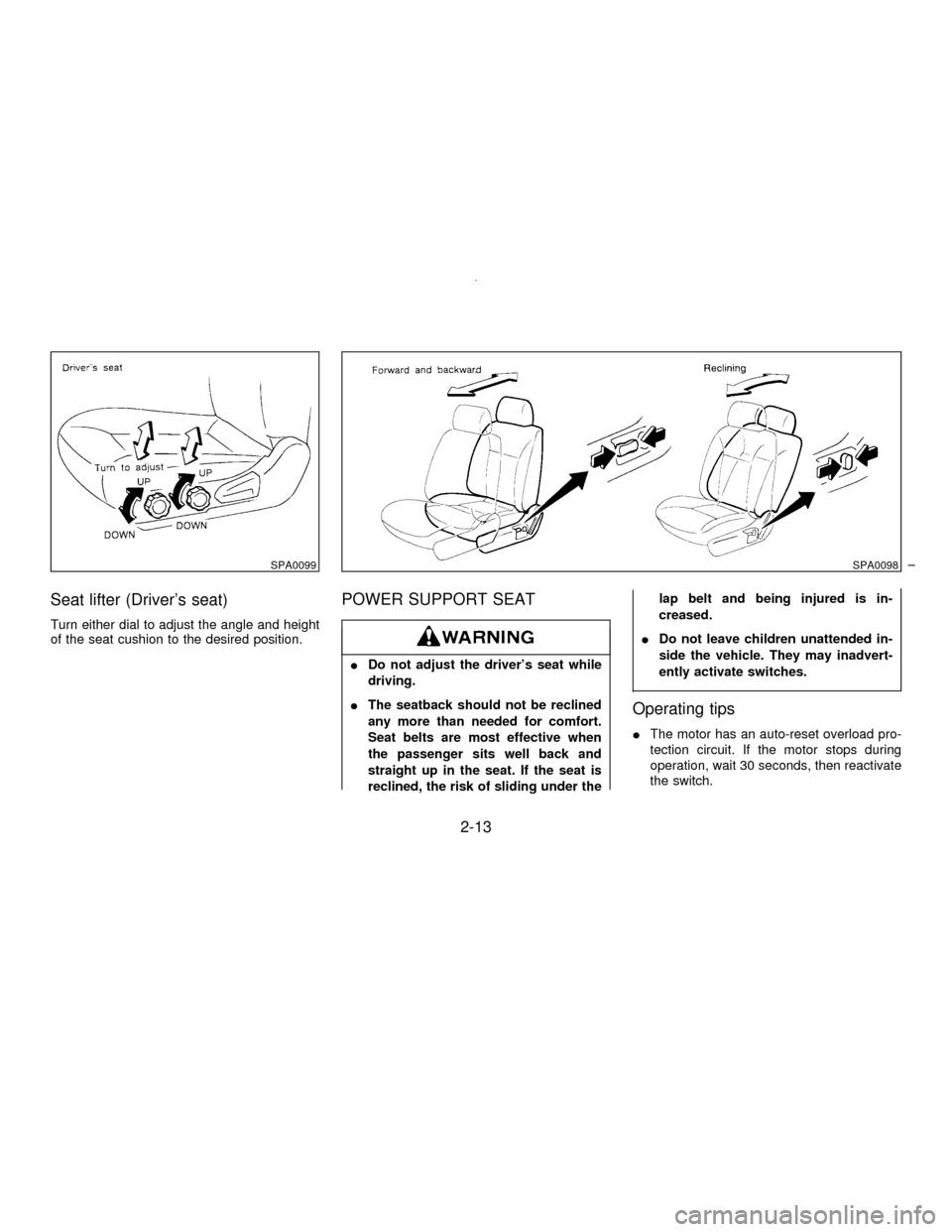
Seat lifter (Driver's seat)
Turn either dial to adjust the angle and height
of the seat cushion to the desired position.
POWER SUPPORT SEAT
IDo not adjust the driver's seat while
driving.
IThe seatback should not be reclined
any more than needed for comfort.
Seat belts are most effective when
the passenger sits well back and
straight up in the seat. If the seat is
reclined, the risk of sliding under thelap belt and being injured is in-
creased.
IDo not leave children unattended in-
side the vehicle. They may inadvert-
ently activate switches.
Operating tips
IThe motor has an auto-reset overload pro-
tection circuit. If the motor stops during
operation, wait 30 seconds, then reactivate
the switch.
SPA0099SPA0098
2-13
Z01.2.1/A32-DX
Page 47 of 197
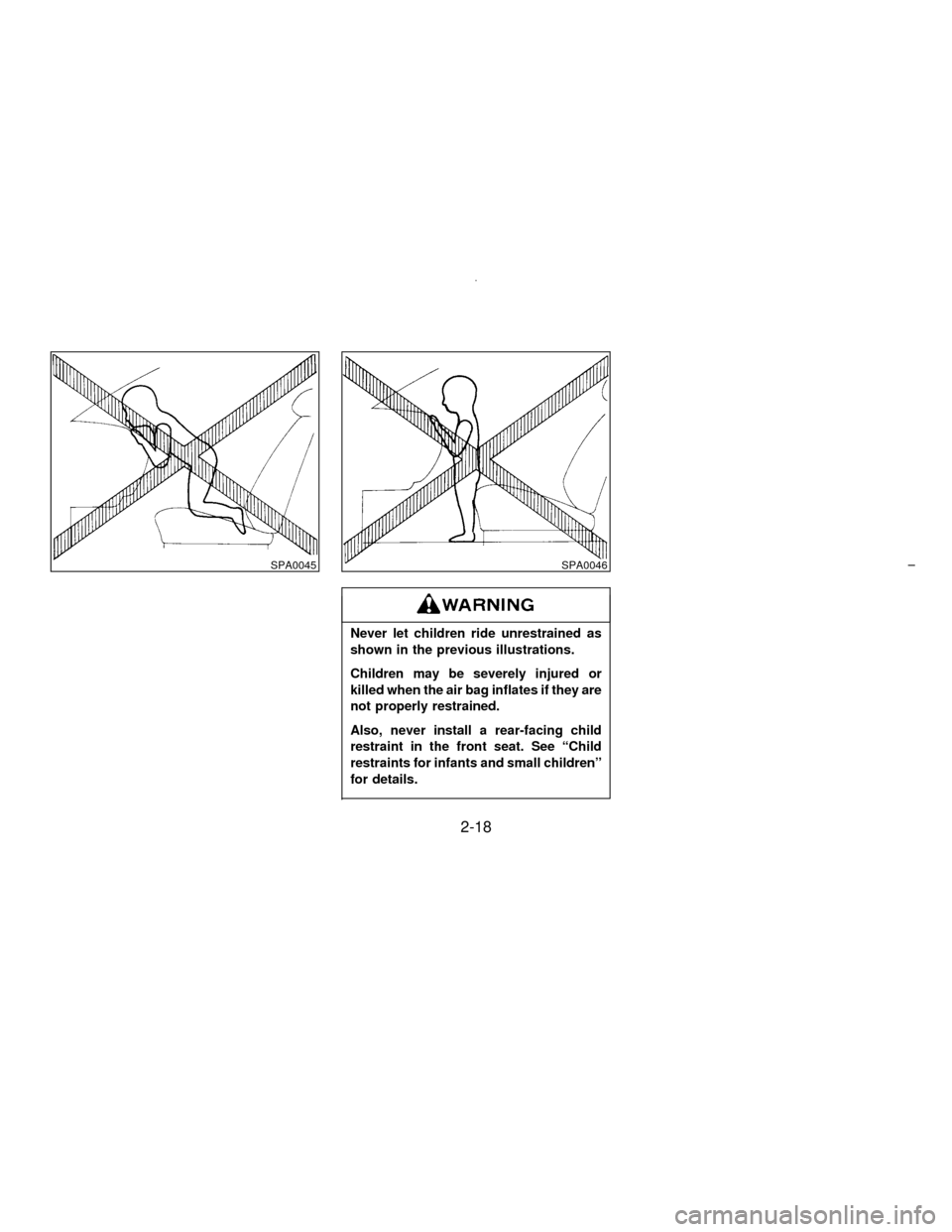
Never let children ride unrestrained as
shown in the previous illustrations.
Children may be severely injured or
killed when the air bag inflates if they are
not properly restrained.
Also, never install a rear-facing child
restraint in the front seat. See ªChild
restraints for infants and small childrenº
for details.
SPA0045SPA0046
2-18
Z01.2.1/A32-DX
Page 52 of 197

PRECAUTIONS ON SEAT BELT
USAGE
Your chances of being injured or killed in an
accident and/or the severity of injury may be
greatly reduced if you are wearing your seat
belt and it is properly adjusted. NISSAN
strongly encourages you and all of your pas-
sengers to buckle up every time you drive,
even if your seating position includes an air
bag.
Some states, provinces or territories re-
quire that seat belts be worn at all times
when a vehicle is being driven.
IEvery person who drives or rides in
this vehicle should use a seat belt at
all times. Children should be in ap-
propriate child restraints.
IThe belt should be adjusted properly
and to a snug fit. Failure to do so will
reduce the effectiveness of the entire
restraint system and increase the
chance or severity of injury in an
accident.
IDo not wear the belt inside out ortwisted. Be sure the seat belt tongue
is securely fastened to the proper
buckle.
IDo not allow more than one person to
use the same belt.
IAll seat belt assemblies including re-
tractors and attaching hardware
should be inspected by your NISSAN
dealer after any collision. NISSAN
recommends that all seat belt assem-
blies in use during a collision be
replaced unless the collision was mi-
nor and the belts show no damage
and continue to operate properly.
Seat belt assemblies not in use dur-
ing a collision should also be in-
spected and replaced if either dam-
age or improper operation is noted.
INever carry more people in the ve-
hicle than there are seat belts.
If the seat belt warning lamp glows con-
tinuously while the ignition is turned
ªONº with all doors closed and all seat
belts fastened, it may indicate a mal-
function in the system. Have the system
checked by your NISSAN dealer.Be sure to observe the following cau-
tions when using seat belts. Failure to
do so could increase the chance and/or
severity of injury in an accident.
IAlways route the shoulder belt over
your shoulder and across your chest.
Never run the belt under your arm or
across your neck. The belt should be
away from your face and neck, but
not falling off your shoulder.
IPosition the lap belt as low as pos-
sible AROUND THE HIPS, NOT THE
WAIST.
ISerious injury or death can occur if
the seat belt is not worn properly.
CHILD SAFETY
Children need adults to help protect them.
All U.S. states and provinces of Canada re-
quire the use of approved child restraints for
infants and small children. (See ªChild re-
straints for infants and small childrenº later in
this section.)
In addition, there are many types of child
restraints available for larger children which
should be used for maximum protection.
SEAT BELTS
2-23
Z01.2.1/A32-DX
Page 53 of 197

Infant or small child
NISSAN recommends that infants or small
children be placed in child restraint systems
that comply with Federal Motor Vehicle Safety
Standards or Canadian Motor Vehicle Safety
Standards. You should choose a child restraint
system that fits your vehicle and always follow
the manufacturer's instructions for installation
and use.
Children
Children who are too large for child restraint
systems should be seated and restrained by
the seat belts which are provided.
NISSAN recommends that children sit in the
rear seat if possible. According to accident
statistics, children are safer when properly
restrained in the rear seat than in the front
seat.
If the child's seating position has a shoulder
belt that fits close to the face or neck, the use
of a booster seat (commercially available) may
help overcome this. The booster seat should
raise the child so that the shoulder belt is
properly positioned across the top, middle
portion of the shoulder and the lap belt is low
on the hips. The booster seat should fit the
vehicle seat and have a label certifying that it
complies with Federal Motor Vehicle SafetyStandards or Canadian Motor Vehicle Safety
Standards. Once the child has grown so the
shoulder belt is no longer on or near the face
and neck, use the shoulder belt without the
booster seat.
Never let a child stand or kneel on any seat
and do not allow a child in the cargo areas
while the vehicle is moving.
Pregnant women
NISSAN recommends that pregnant women
use seat belts. Contact your doctor for specific
recommendations. The lap belt should be
worn snug and positioned as low as possible
around the hips, not the waist.
Injured persons
NISSAN recommends that injured persons
use seat belts, depending on the injury. Check
with your doctor for specific recommendations.
2-24
Z01.2.1/A32-DX
Page 55 of 197

3-point seat belts have a cinching mechanism
for child seat installation. It is referred to as the
automatic locking mode.
When the cinching mechanism is activated the
seat belt cannot be withdrawn again until the
seat belt tongue is detached from the buckle
and fully retracted. Refer to ªChild restraints for
infants and small childrenº later in this section
for more information.
IThe automatic locking mode should
be used only for child seat installa-
tion. During normal seat belt use by a
passenger, the locking mode should
not be activated. If it is activated it
may cause uncomfortable seat belt
tension.
Unfastening the belts
To unfasten the belt, press the button on the
buckle. The seat belt will automatically retract.
Checking seat belt operation
(3-point type with retractor)
Your seat belt retractors are designed to lock
belt movement using two separate methods:
1) When the belt is pulled quickly from the
retractor.
2) When the vehicle slows down rapidly.
You can check their operation as follows:
IGrasp the shoulder belt and pull quickly
forward. The retractor should lock and re-
strict further belt movement.
If the retractor does not lock during this check
or if you have any questions about belt opera-
tion, see your NISSAN dealer.
Shoulder belt height adjustment
(For front seats)
The shoulder belt anchor height should be
adjusted to the position best for you. (See
ªPrecautions on seat belt usageº.) To adjust,
push the release button, and then move it to
the desired position, so that the belt passes
over the center of the shoulder. The belt
should be away from your face and neck, but
not falling off of your shoulder.
PD1321
2-26
Z01.2.1/A32-DX