1996 NISSAN ALTIMA transmission
[x] Cancel search: transmissionPage 124 of 183
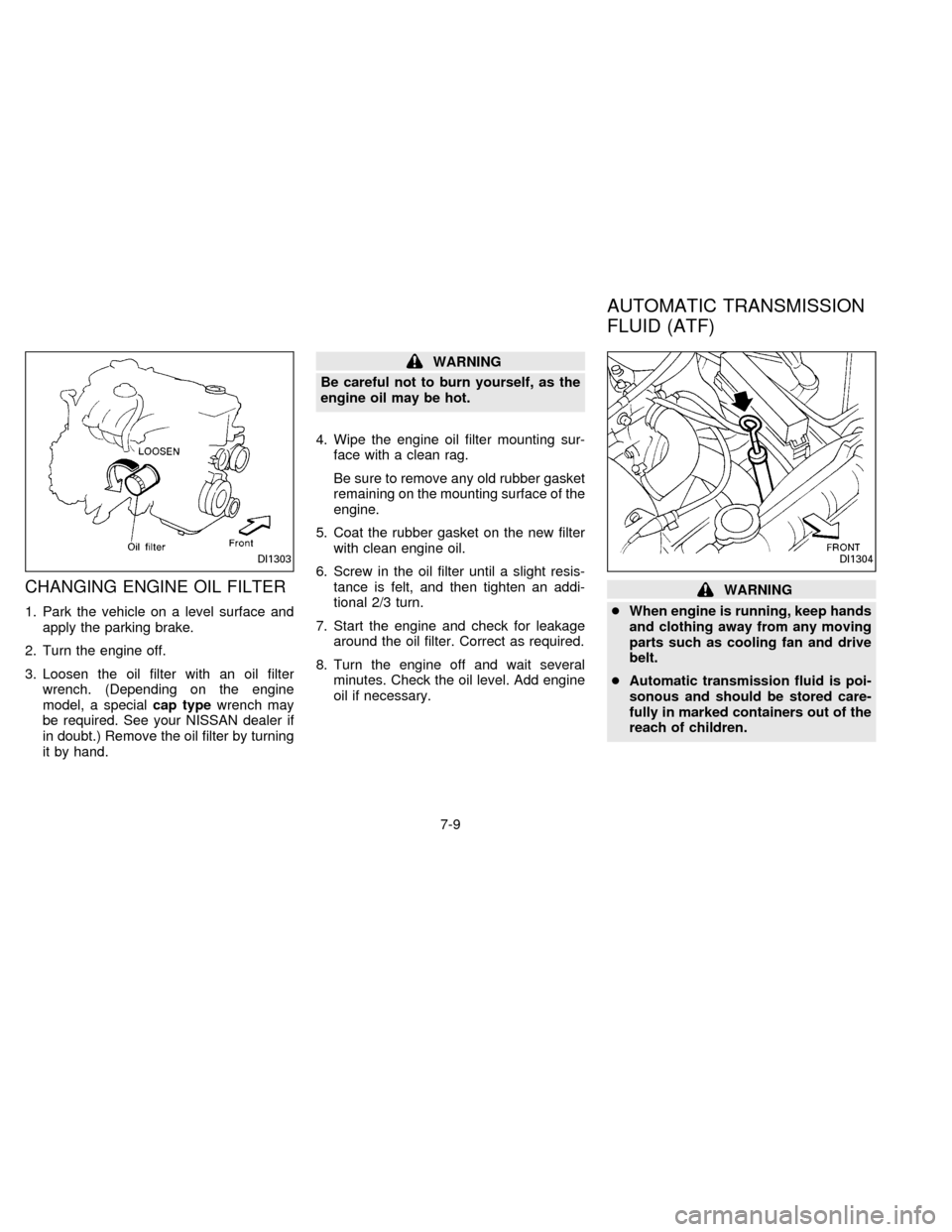
CHANGING ENGINE OIL FILTER
1. Park the vehicle on a level surface and
apply the parking brake.
2. Turn the engine off.
3. Loosen the oil filter with an oil filter
wrench. (Depending on the engine
model, a specialcap typewrench may
be required. See your NISSAN dealer if
in doubt.) Remove the oil filter by turning
it by hand.
WARNING
Be careful not to burn yourself, as the
engine oil may be hot.
4. Wipe the engine oil filter mounting sur-
face with a clean rag.
Be sure to remove any old rubber gasket
remaining on the mounting surface of the
engine.
5. Coat the rubber gasket on the new filter
with clean engine oil.
6. Screw in the oil filter until a slight resis-
tance is felt, and then tighten an addi-
tional 2/3 turn.
7. Start the engine and check for leakage
around the oil filter. Correct as required.
8. Turn the engine off and wait several
minutes. Check the oil level. Add engine
oil if necessary.
WARNING
cWhen engine is running, keep hands
and clothing away from any moving
parts such as cooling fan and drive
belt.
cAutomatic transmission fluid is poi-
sonous and should be stored care-
fully in marked containers out of the
reach of children.
DI1303DI1304
AUTOMATIC TRANSMISSION
FLUID (ATF)
7-9
ZX
Page 125 of 183
TEMPERATURE CONDITIONS
FOR CHECKING ATF
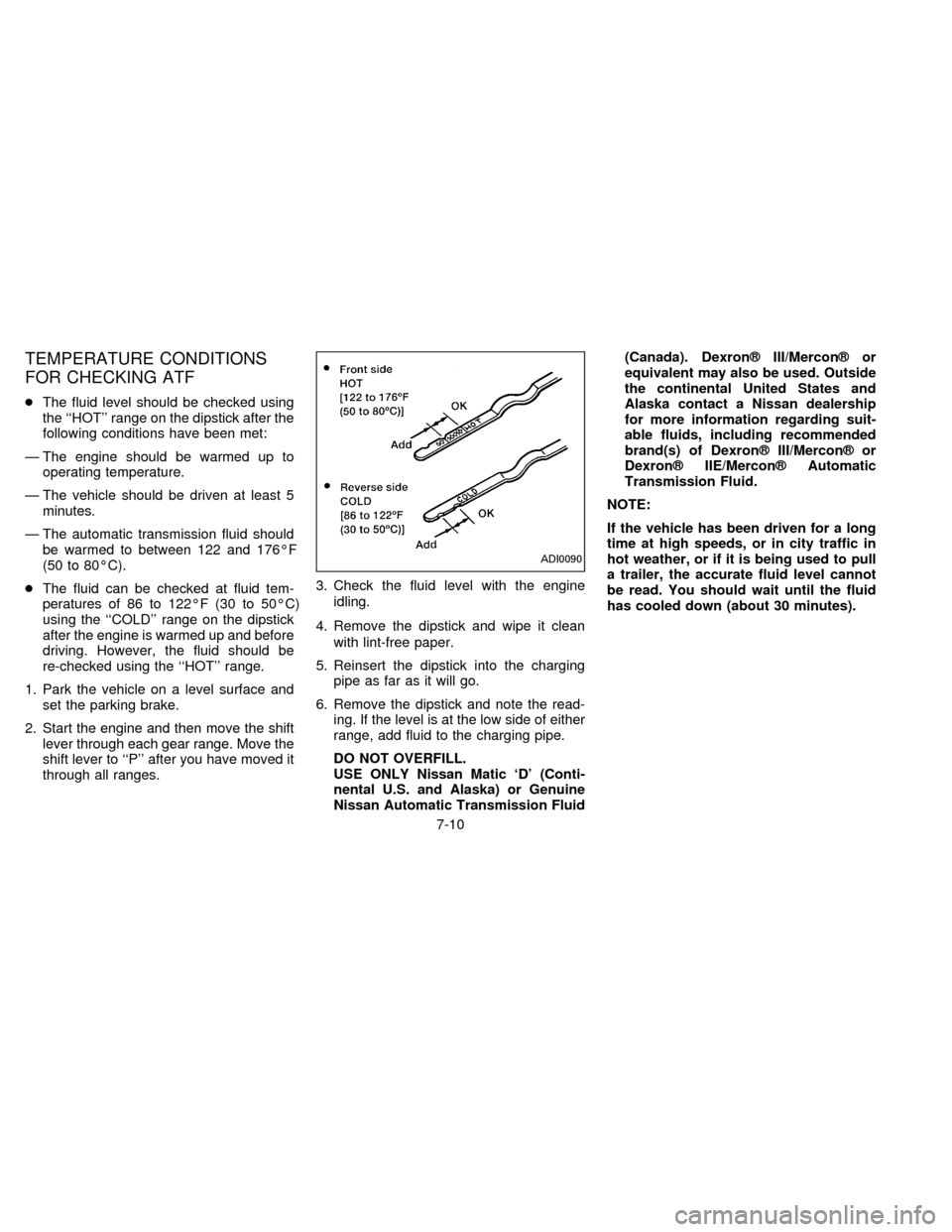
cThe fluid level should be checked using
the ``HOT'' range on the dipstick after the
following conditions have been met:
Ð The engine should be warmed up to
operating temperature.
Ð The vehicle should be driven at least 5
minutes.
Ð The automatic transmission fluid should
be warmed to between 122 and 176ÉF
(50 to 80ÉC).
cThe fluid can be checked at fluid tem-
peratures of 86 to 122ÉF (30 to 50ÉC)
using the ``COLD'' range on the dipstick
after the engine is warmed up and before
driving. However, the fluid should be
re-checked using the ``HOT'' range.
1. Park the vehicle on a level surface and
set the parking brake.
2. Start the engine and then move the shift
lever through each gear range. Move the
shift lever to ``P'' after you have moved it
through all ranges.3. Check the fluid level with the engine
idling.
4. Remove the dipstick and wipe it clean
with lint-free paper.
5. Reinsert the dipstick into the charging
pipe as far as it will go.
6. Remove the dipstick and note the read-
ing. If the level is at the low side of either
range, add fluid to the charging pipe.
DO NOT OVERFILL.
USE ONLY Nissan Matic `D' (Conti-
nental U.S. and Alaska) or Genuine
Nissan Automatic Transmission Fluid(Canada). Dexronž III/Merconž or
equivalent may also be used. Outside
the continental United States and
Alaska contact a Nissan dealership
for more information regarding suit-
able fluids, including recommended
brand(s) of Dexronž III/Merconž or
Dexronž IIE/Merconž Automatic
Transmission Fluid.
NOTE:
If the vehicle has been driven for a long
time at high speeds, or in city traffic in
hot weather, or if it is being used to pull
a trailer, the accurate fluid level cannot
be read. You should wait until the fluid
has cooled down (about 30 minutes).
ADI0090
7-10
ZX
Page 146 of 183
Improper service for a T-type spare tire
may result in serious personal injury. If
it is necessary to repair the T-type
spare tire, contact your NISSAN dealer.Changing tires and wheels
When replacing a tire, use the same size,
speed rating and load carrying capacity as
originally equipped. Recommended types
and sizes are shown in ``Wheels and tires''
in the ``Technical and consumer informa-
tion'' section. The use of tires other than
those recommended or the mixed use of
tires of different brands, construction (bias,
bias-belted or radial), or tread patterns can
adversely affect the ride, braking, handling,
ground clearance, body-to-tire clearance,
tire chain clearance, speedometer calibra-
tion, headlight aim and bumper height.
Some of these effects may lead to acci-
dents and could result in serious per-
sonal injury.
If the wheels are changed for any reason,
always replace with wheels which have the
same offset dimension. Wheels of a differ-
ent offset could cause early tire wear, pos-
sibly degraded vehicle handling character-
istics and/or interference with the brake
discs/ drums. Such interference can lead to
decreased braking efficiency and/or early
brake pad/shoe wear.
WARNING
Do not install a deformed wheel or tire
even if it has been repaired. Such
wheels or tires could have structural
damage and could fail without warning.
Wheel balance
Unbalanced wheels may affect vehicle han-
dling and tire life. Even with regular use,
wheels can get out of balance. Therefore,
they should be balanced as required.
Wheel balance service should be performed
with the wheels off the vehicle. Spin balanc-
ing the front wheels on the vehicle could
lead to transmission damage.
Care of wheels
cWash the wheels when washing the ve-
hicle to maintain their appearance.
cClean the inner side of the wheels when
the wheel is changed or the underside of
the vehicle is washed.
cDo not use abrasive cleaners when
washing the wheels.
cInspect wheel rims regularly for dents or
7-31
ZX
Page 151 of 183
Automatic transmission ``Park'' mecha-
nismÐ On a fairly steep hill check that your
vehicle is held securely with the gearshift
lever in the ``P'' position without applying
any brakes.
UNDER THE HOOD AND
VEHICLE
The maintenance items listed here should
be checked periodically, such as each time
you check the engine oil or refuel.
Additional information on the items
marked with ª*º can be found in the
ªDo-It-Yourself operationsº section.
Windshield washer fluid*Ð Check that
there is adequate fluid in the tank.
Engine coolant level*Ð Check the cool-
ant level when the engine is cold.
Radiator and hosesÐ Check the front of
the radiator and clean off any dirt, insects,
leaves, etc., that may have accumulated.
Make sure the hoses have no cracks, de-
formation, rot or loose connections.
Brake and clutch fluid levels*Ð Make
sure that the brake and clutch fluid level is
between the ``MAX'' and ``MIN'' lines on the
reservoir.Battery*Ð Check the fluid level in each
cell. It should be between the ``MAX'' and
``MIN'' lines.
Engine drive belts*Ð Make sure that no
belt is frayed, worn, cracked or oily.
Engine oil level*Ð Check the level after
parking the vehicle on a level spot and
turning off the engine.
Power steering fluid level* and linesÐ
Check the level when the fluid is cold and
the engine is turned off. Check the lines for
proper attachment, leaks, cracks, etc.
Automatic transmission fluid level*Ð
Check the level after putting the shift lever in
``P'' with the engine idling.
Exhaust systemÐ Make sure there are no
cracks, holes, loose joints or supports. If the
sound of the exhaust seems unusual or
there is a smell of exhaust fumes, immedi-
ately have the exhaust system inspected by
a qualified individual. (See the carbon mon-
oxide warning in the ``Starting and driving''
section.)
UnderbodyÐ The underbody is frequently
exposed to corrosive substances such as
those used on icy roads or to control dust. Itis very important to remove these sub-
stances, otherwise rust will form on the floor
pan, frame, fuel lines and around the ex-
haust system. At the end of winter, the
underbody should be thoroughly flushed
with plain water, being careful to clean
those areas where mud and dirt may accu-
mulate. See the ``Appearance and interior
care'' section for additional information.
Fluid leaksÐ Check under the vehicle for
fuel, oil, water or other fluid leaks after the
vehicle has been parked for a while. Water
dripping from the air conditioner after use is
normal. If you should notice any leaks or if
gasoline fumes are evident, check for the
cause and have it corrected immediately.
8-4
ZX
Page 154 of 183
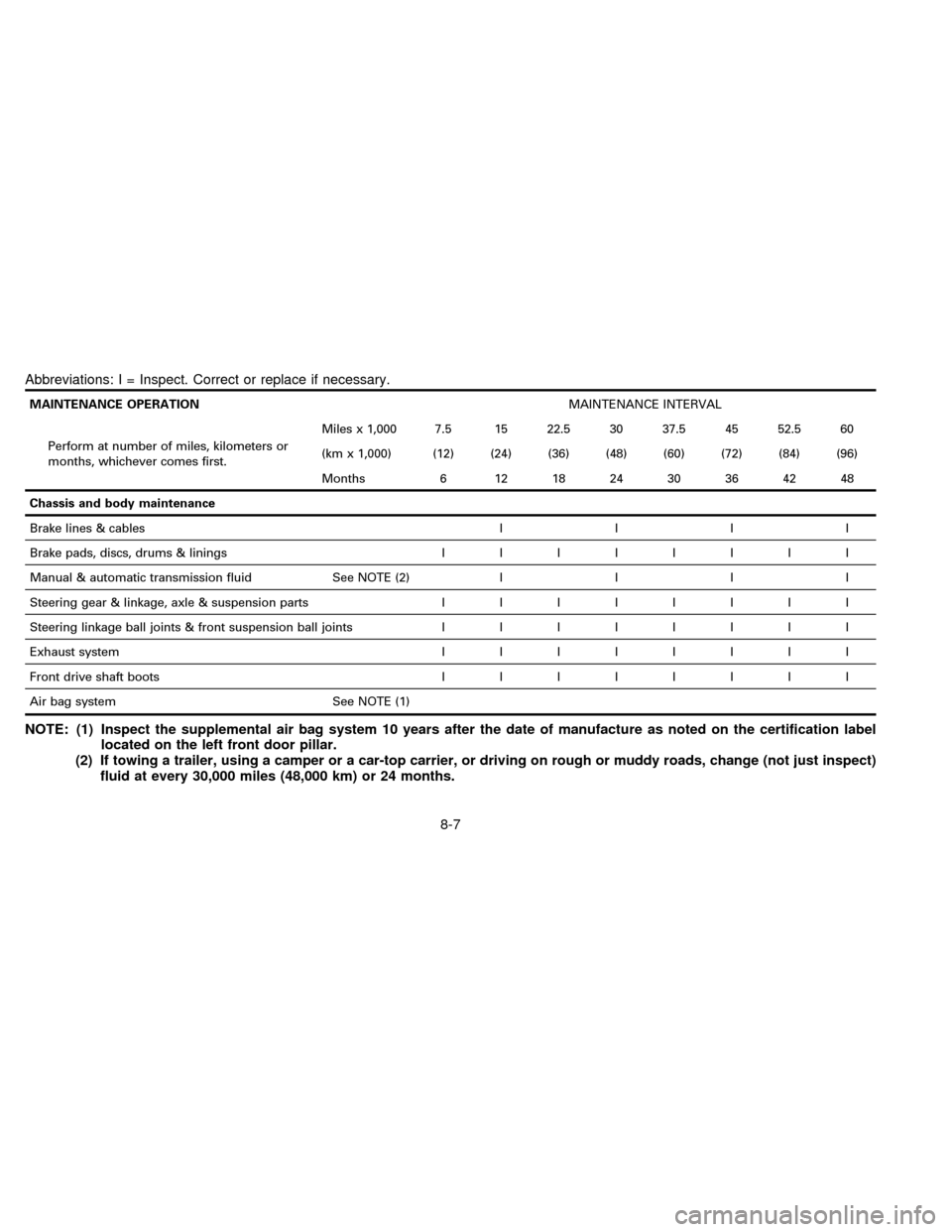
Abbreviations: I = Inspect. Correct or replace if necessary.
MAINTENANCE OPERATIONMAINTENANCE INTERVAL
Perform at number of miles, kilometers or
months, whichever comes first.Miles x 1,000 7.5 15 22.5 30 37.5 45 52.5 60
(km x 1,000) (12) (24) (36) (48) (60) (72) (84) (96)
Months 6 12 18 24 30 36 42 48
Chassis and body maintenance
Brake lines & cablesIIII
Brake pads, discs, drums & liningsIIIIIIII
Manual & automatic transmission fluid See NOTE (2)IIII
Steering gear & linkage, axle & suspension partsIIIIIIII
Steering linkage ball joints & front suspension ball jointsIIIIIIII
Exhaust systemIIIIIIII
Front drive shaft bootsIIIIIIII
Air bag system See NOTE (1)
NOTE: (1) Inspect the supplemental air bag system 10 years after the date of manufacture as noted on the certification label
located on the left front door pillar.
(2) If towing a trailer, using a camper or a car-top carrier, or driving on rough or muddy roads, change (not just inspect)
fluid at every 30,000 miles (48,000 km) or 24 months.
8-7
ZX
Page 156 of 183
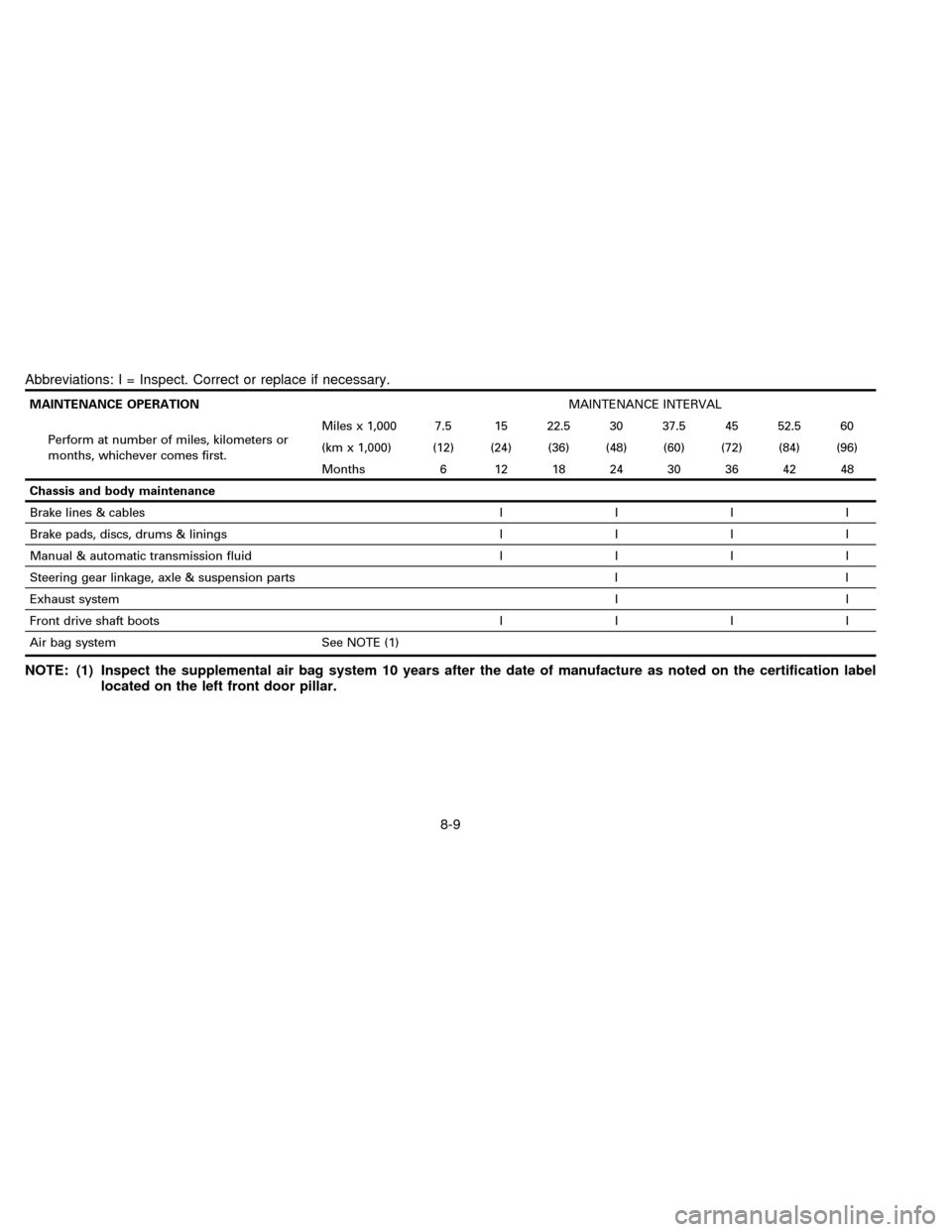
Abbreviations: I = Inspect. Correct or replace if necessary.
MAINTENANCE OPERATIONMAINTENANCE INTERVAL
Perform at number of miles, kilometers or
months, whichever comes first.Miles x 1,000 7.5 15 22.5 30 37.5 45 52.5 60
(km x 1,000) (12) (24) (36) (48) (60) (72) (84) (96)
Months 6 12 18 24 30 36 42 48
Chassis and body maintenance
Brake lines & cablesIIII
Brake pads, discs, drums & liningsIIII
Manual & automatic transmission fluidIIII
Steering gear linkage, axle & suspension parts I I
Exhaust systemII
Front drive shaft bootsIIII
Air bag system See NOTE (1)
NOTE: (1) Inspect the supplemental air bag system 10 years after the date of manufacture as noted on the certification label
located on the left front door pillar.
8-9
ZX
Page 157 of 183
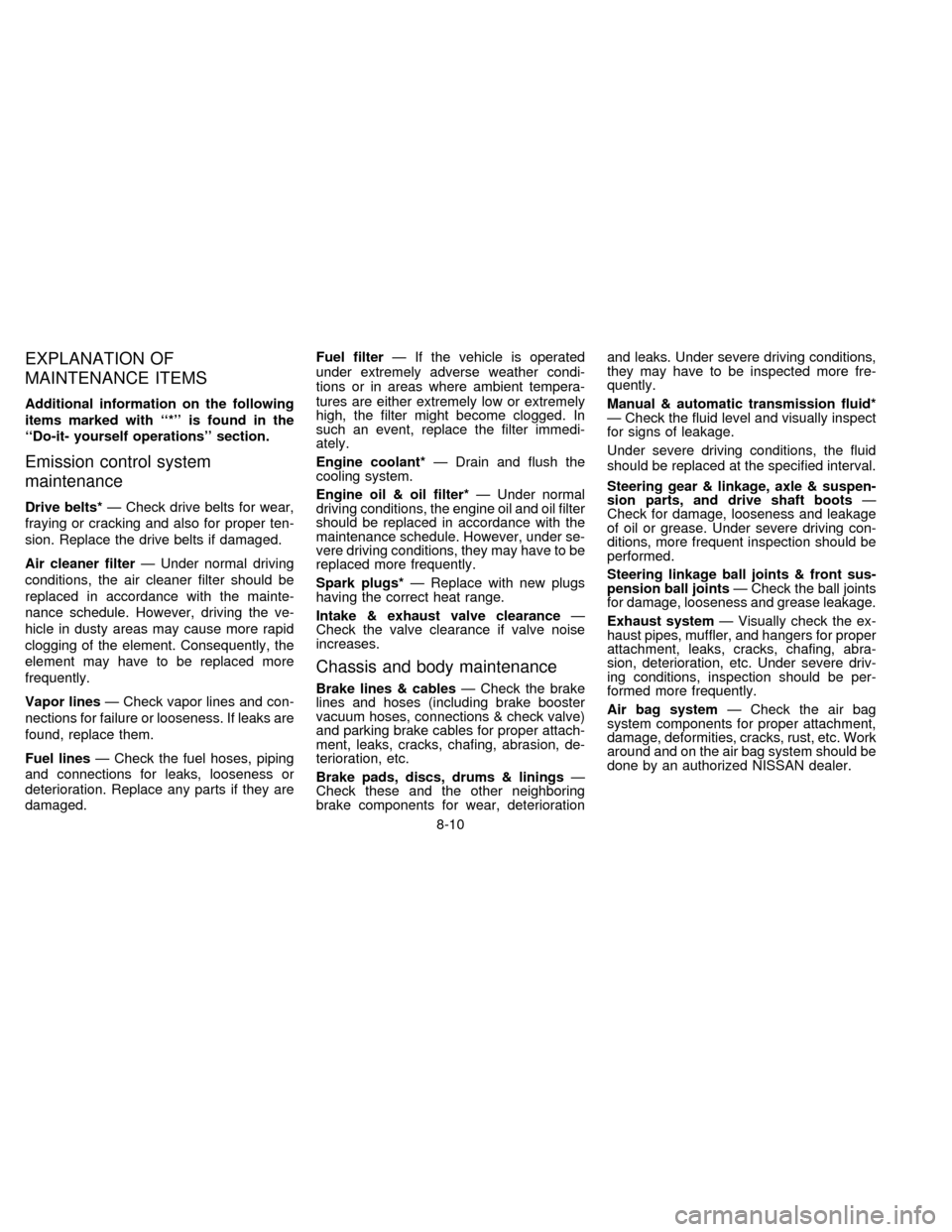
EXPLANATION OF
MAINTENANCE ITEMS
Additional information on the following
items marked with ``*'' is found in the
``Do-it- yourself operations'' section.
Emission control system
maintenance
Drive belts*Ð Check drive belts for wear,
fraying or cracking and also for proper ten-
sion. Replace the drive belts if damaged.
Air cleaner filterÐ Under normal driving
conditions, the air cleaner filter should be
replaced in accordance with the mainte-
nance schedule. However, driving the ve-
hicle in dusty areas may cause more rapid
clogging of the element. Consequently, the
element may have to be replaced more
frequently.
Vapor linesÐ Check vapor lines and con-
nections for failure or looseness. If leaks are
found, replace them.
Fuel linesÐ Check the fuel hoses, piping
and connections for leaks, looseness or
deterioration. Replace any parts if they are
damaged.Fuel filterÐ If the vehicle is operated
under extremely adverse weather condi-
tions or in areas where ambient tempera-
tures are either extremely low or extremely
high, the filter might become clogged. In
such an event, replace the filter immedi-
ately.
Engine coolant*Ð Drain and flush the
cooling system.
Engine oil & oil filter*Ð Under normal
driving conditions, the engine oil and oil filter
should be replaced in accordance with the
maintenance schedule. However, under se-
vere driving conditions, they may have to be
replaced more frequently.
Spark plugs*Ð Replace with new plugs
having the correct heat range.
Intake & exhaust valve clearanceÐ
Check the valve clearance if valve noise
increases.
Chassis and body maintenance
Brake lines & cablesÐ Check the brake
lines and hoses (including brake booster
vacuum hoses, connections & check valve)
and parking brake cables for proper attach-
ment, leaks, cracks, chafing, abrasion, de-
terioration, etc.
Brake pads, discs, drums & liningsÐ
Check these and the other neighboring
brake components for wear, deteriorationand leaks. Under severe driving conditions,
they may have to be inspected more fre-
quently.
Manual & automatic transmission fluid*
Ð Check the fluid level and visually inspect
for signs of leakage.
Under severe driving conditions, the fluid
should be replaced at the specified interval.
Steering gear & linkage, axle & suspen-
sion parts, and drive shaft bootsÐ
Check for damage, looseness and leakage
of oil or grease. Under severe driving con-
ditions, more frequent inspection should be
performed.
Steering linkage ball joints & front sus-
pension ball jointsÐ Check the ball joints
for damage, looseness and grease leakage.
Exhaust systemÐ Visually check the ex-
haust pipes, muffler, and hangers for proper
attachment, leaks, cracks, chafing, abra-
sion, deterioration, etc. Under severe driv-
ing conditions, inspection should be per-
formed more frequently.
Air bag systemÐ Check the air bag
system components for proper attachment,
damage, deformities, cracks, rust, etc. Work
around and on the air bag system should be
done by an authorized NISSAN dealer.
8-10
ZX
Page 159 of 183
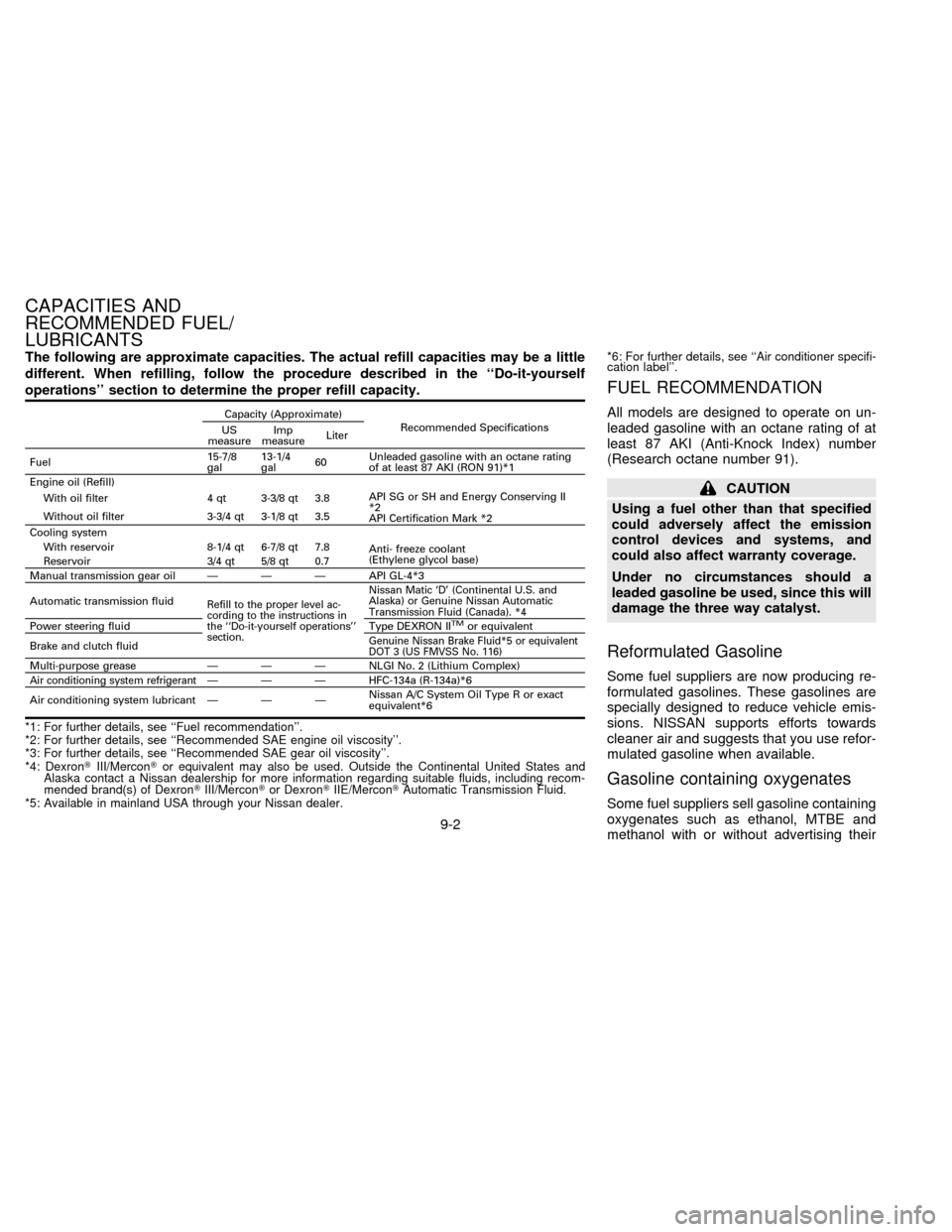
The following are approximate capacities. The actual refill capacities may be a little
different. When refilling, follow the procedure described in the ``Do-it-yourself
operations'' section to determine the proper refill capacity.
Capacity (Approximate)
Recommended Specifications
US
measureImp
measureLiter
Fuel15-7/8
gal13-1/4
gal60Unleaded gasoline with an octane rating
of at least 87 AKI (RON 91)*1
Engine oil (Refill)
With oil filter 4 qt 3-3/8 qt 3.8API SG or SH and Energy Conserving II
*2
API Certification Mark *2 Without oil filter 3-3/4 qt 3-1/8 qt 3.5
Cooling system
With reservoir 8-1/4 qt 6-7/8 qt 7.8
Anti- freeze coolant
(Ethylene glycol base)
Reservoir 3/4 qt 5/8 qt 0.7
Manual transmission gear oilÐ Ð Ð API GL-4*3
Automatic transmission fluid
Refill to the proper level ac-
cording to the instructions in
the ``Do-it-yourself operations''
section.Nissan Matic `D' (Continental U.S. and
Alaska) or Genuine Nissan Automatic
Transmission Fluid (Canada). *4
Power steering fluid Type DEXRON IITMor equivalent
Brake and clutch fluidGenuine Nissan Brake Fluid*5 or equivalent
DOT 3 (US FMVSS No. 116)
Multi-purpose greaseÐ Ð Ð NLGI No. 2 (Lithium Complex)Air conditioning system refrigerantÐ Ð Ð HFC-134a (R-134a)*6
Air conditioning system lubricant Ð Ð ÐNissan A/C System Oil Type R or exact
equivalent*6
*1: For further details, see ``Fuel recommendation''.
*2: For further details, see ``Recommended SAE engine oil viscosity''.
*3: For further details, see ``Recommended SAE gear oil viscosity''.
*4: DexronTIII/MerconTor equivalent may also be used. Outside the Continental United States and
Alaska contact a Nissan dealership for more information regarding suitable fluids, including recom-
mended brand(s) of DexronTIII/MerconTor DexronTIIE/MerconTAutomatic Transmission Fluid.
*5: Available in mainland USA through your Nissan dealer.*6: For further details, see ``Air conditioner specifi-
cation label''.
FUEL RECOMMENDATION
All models are designed to operate on un-
leaded gasoline with an octane rating of at
least 87 AKI (Anti-Knock Index) number
(Research octane number 91).
CAUTION
Using a fuel other than that specified
could adversely affect the emission
control devices and systems, and
could also affect warranty coverage.
Under no circumstances should a
leaded gasoline be used, since this will
damage the three way catalyst.
Reformulated Gasoline
Some fuel suppliers are now producing re-
formulated gasolines. These gasolines are
specially designed to reduce vehicle emis-
sions. NISSAN supports efforts towards
cleaner air and suggests that you use refor-
mulated gasoline when available.
Gasoline containing oxygenates
Some fuel suppliers sell gasoline containing
oxygenates such as ethanol, MTBE and
methanol with or without advertising their
CAPACITIES AND
RECOMMENDED FUEL/
LUBRICANTS
9-2
ZX