1996 NISSAN ALTIMA maintenance
[x] Cancel search: maintenancePage 152 of 183

To ensure smooth, trouble-free, safe and
economical driving, NISSAN provides two
different maintenance schedules that may
be used, depending upon the conditions in
which you usually drive. These schedules
contain both distance and time intervals, up
to 60,000 miles (96,000 km)/48 months. For
most people, the odometer reading will in-
dicate when service is needed. However, if
you drive very little, your vehicle should be
serviced at the regular time intervals shown
in the schedule.After 60,000 miles (96,000
km) or 48 months, continue periodic
maintenance at the same mileage/time
intervals.
SCHEDULE 1
Follow Periodic Maintenance Schedule 1 if
your driving habits frequently include one or
more of the following driving conditions:
cRepeated short trips of less than 5
miles (8 km).
cRepeated short trips of less than 10
miles (16 km) with outside tempera-
tures remaining below freezing.
cOperating in hot weather in stop-
and-go ``rush hour'' traffic.cExtensive idling and/or low speed
driving for long distances, such as
police, taxi or door-to-door delivery
use.
cDriving in dusty conditions.
cDriving on rough, muddy, or salt
spread roads.
cTowing a trailer, using a camper or a
car-top carrier.
SCHEDULE 2
Follow Periodic Maintenance Schedule 2 if
none of the driving conditions shown in
Schedule 1 apply to your driving habits.
PERIODIC MAINTENANCE
SCHEDULES
8-5
ZX
Page 153 of 183
![NISSAN ALTIMA 1996 U13 / 1.G Owners Manual SCHEDULE 1
Abbreviations: R = Replace I = Inspect. Correct or replace if necessary. [ ]: At the mileage intervals only
MAINTENANCE OPERATIONMAINTENANCE INTERVAL
Perform at number of miles,
kilometers](/manual-img/5/594/w960_594-152.png "NISSAN ALTIMA 1996 U13 / 1.G Owners Manual SCHEDULE 1
Abbreviations: R = Replace I = Inspect. Correct or replace if necessary. [ ]: At the mileage intervals only
MAINTENANCE OPERATIONMAINTENANCE INTERVAL
Perform at number of miles,
kilometers")
SCHEDULE 1
Abbreviations: R = Replace I = Inspect. Correct or replace if necessary. [ ]: At the mileage intervals only
MAINTENANCE OPERATIONMAINTENANCE INTERVAL
Perform at number of miles,
kilometers or months,
whichever comes first.Miles x 1,000 3.75 7.5 11.25 15 18.75 22.5 26.25 30 33.75 37.5 41.25 45 48.75 52.5 56.25 60
(km x 1,000) (6) (12) (18) (24) (30) (36) (42) (48) (54) (60) (66) (72) (78) (84) (90) (96)
Months 3 6 9 12 15 18 21 24 27 30 33 36 39 42 45 48
Emission control system maintenance
Drive belts See NOTE (1)I*
Air cleaner filter See NOTE (2) [R] [R]
Vapor linesI* I*
Fuel linesI* I*
Fuel filter See NOTE (3)*
Engine coolant See NOTE (4)*R*
Engine oilRRRRRRRRRRRRRRRR
Engine oil filter
(Use Nissan PREMIUM type or equivalent.)RRRRRRRRRRRRRRRR
Spark plugs[R] [R]
Intake & exhaust valve clearance See NOTE (5)
NO TE: (1) After 60,000 miles (96,000 km) or 48 months, inspect every 15,000 miles (24,000 km) or 12 months.
(2) If operating mainly in dusty conditions, more frequent maintenance may be required.
(3) If vehicle is operated under extremely adverse weather conditions or in areas where ambient temperatures are either
extremely low or extremely high, the filters might become clogged. In such an event, replace them immediately.
(4) After 60,000 miles (96,000 km) or 48 months, replace every 30,000 miles (48,000 km) or 24 months.
(5) If valve noise increases, inspect valve clearance.
* Maintenance items and intervals marked with ``*'' are recommended by NISSAN for reliable vehicle operation. The
owner need not perform such maintenance in order to maintain the emission warranty or manufacturer recall liability.
Other maintenance items and intervals are required.
8-6
ZX
Page 154 of 183
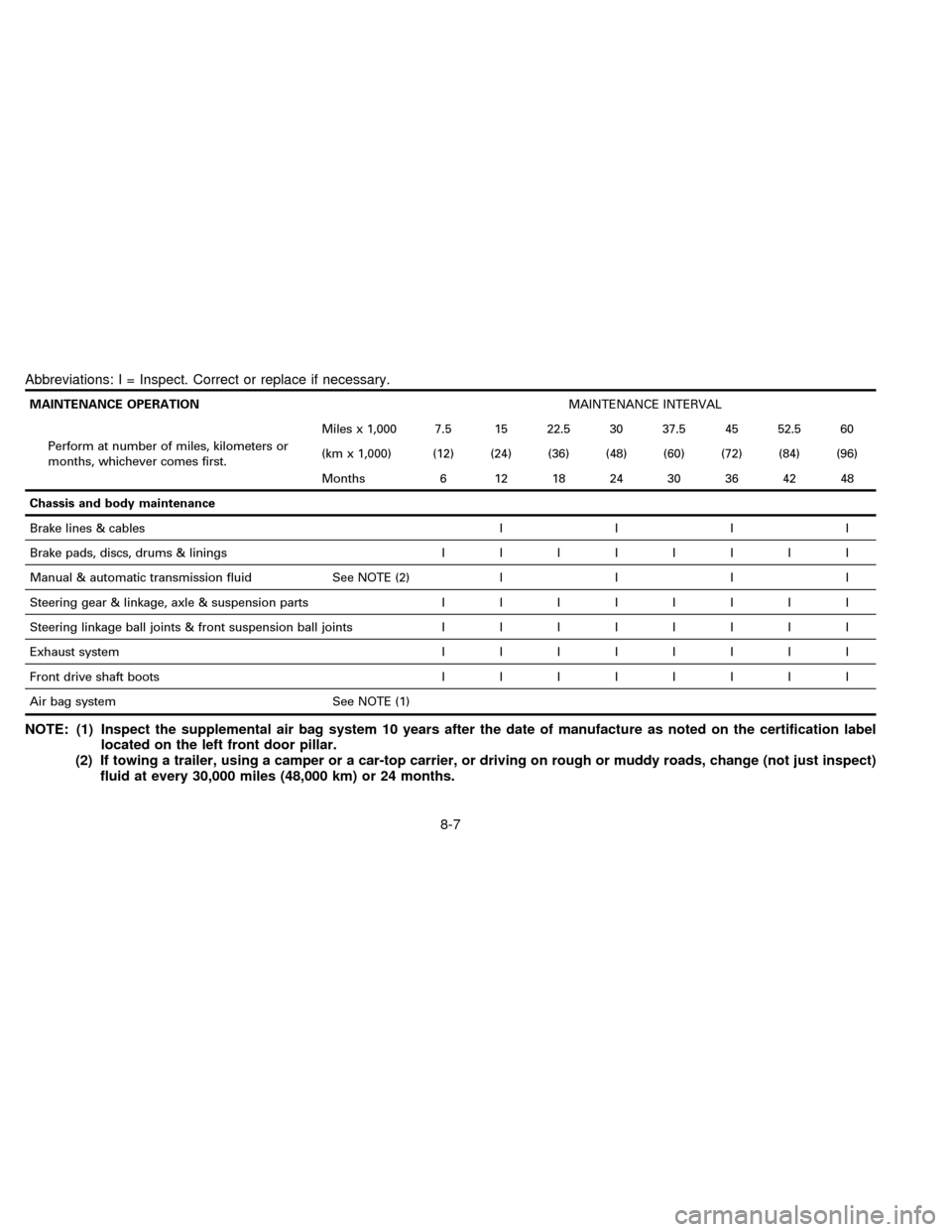
Abbreviations: I = Inspect. Correct or replace if necessary.
MAINTENANCE OPERATIONMAINTENANCE INTERVAL
Perform at number of miles, kilometers or
months, whichever comes first.Miles x 1,000 7.5 15 22.5 30 37.5 45 52.5 60
(km x 1,000) (12) (24) (36) (48) (60) (72) (84) (96)
Months 6 12 18 24 30 36 42 48
Chassis and body maintenance
Brake lines & cablesIIII
Brake pads, discs, drums & liningsIIIIIIII
Manual & automatic transmission fluid See NOTE (2)IIII
Steering gear & linkage, axle & suspension partsIIIIIIII
Steering linkage ball joints & front suspension ball jointsIIIIIIII
Exhaust systemIIIIIIII
Front drive shaft bootsIIIIIIII
Air bag system See NOTE (1)
NOTE: (1) Inspect the supplemental air bag system 10 years after the date of manufacture as noted on the certification label
located on the left front door pillar.
(2) If towing a trailer, using a camper or a car-top carrier, or driving on rough or muddy roads, change (not just inspect)
fluid at every 30,000 miles (48,000 km) or 24 months.
8-7
ZX
Page 155 of 183
![NISSAN ALTIMA 1996 U13 / 1.G Owners Manual SCHEDULE 2
Abbreviations: R = Replace I = Inspect. Correct or replace if necessary. [ ]: At the mileage intervals only
MAINTENANCE OPERATIONMAINTENANCE INTERVAL
Perform at number of miles, kilometers](/manual-img/5/594/w960_594-154.png "NISSAN ALTIMA 1996 U13 / 1.G Owners Manual SCHEDULE 2
Abbreviations: R = Replace I = Inspect. Correct or replace if necessary. [ ]: At the mileage intervals only
MAINTENANCE OPERATIONMAINTENANCE INTERVAL
Perform at number of miles, kilometers")
SCHEDULE 2
Abbreviations: R = Replace I = Inspect. Correct or replace if necessary. [ ]: At the mileage intervals only
MAINTENANCE OPERATIONMAINTENANCE INTERVAL
Perform at number of miles, kilometers or
months, whichever comes first.Miles x 1,000 7.5 15 22.5 30 37.5 45 52.5 60
(km x 1,000) (12) (24) (36) (48) (60) (72) (84) (96)
Months 6 12 18 24 30 36 42 48
Emission control system maintenance
Drive belts See NOTE (1)I*
Air cleaner filter[R] [R]
Vapor linesI* I*
Fuel linesI* I*
Fuel filter See NOTE (2)*
Engine coolant See NOTE (3)R*
Engine oilRRRRRRRR
Engine oil filter (Use Nissan PREMIUM type or equivalent.)RRRRRRRR
Spark plugs[R] [R]
Intake & exhaust valve clearance See NOTE (4)
NOTE: (1) After 60,000 miles (96,000 km) or 48 months, inspect every 15,000 miles (24,000 km) or 12 months.
(2) If vehicle is operated under extremely adverse weather conditions or in areas where ambient temperatures are either
extremely low or extremely high, the filters might become clogged. In such an event, replace them immediately.
(3) After 60,000 miles (96,000 km) or 48 months, replace every 30,000 miles (48,000 km) or 24 months.
(4) If valve noise increases, inspect valve clearance.
* Maintenance items and intervals marked with ``*'' are recommended by NISSAN for reliable vehicle operation. The
owner need not perform such maintenance in order to maintain the emission warranty or manufacturer recall liability.
Other maintenance items and intervals are required.
8-8
ZX
Page 156 of 183
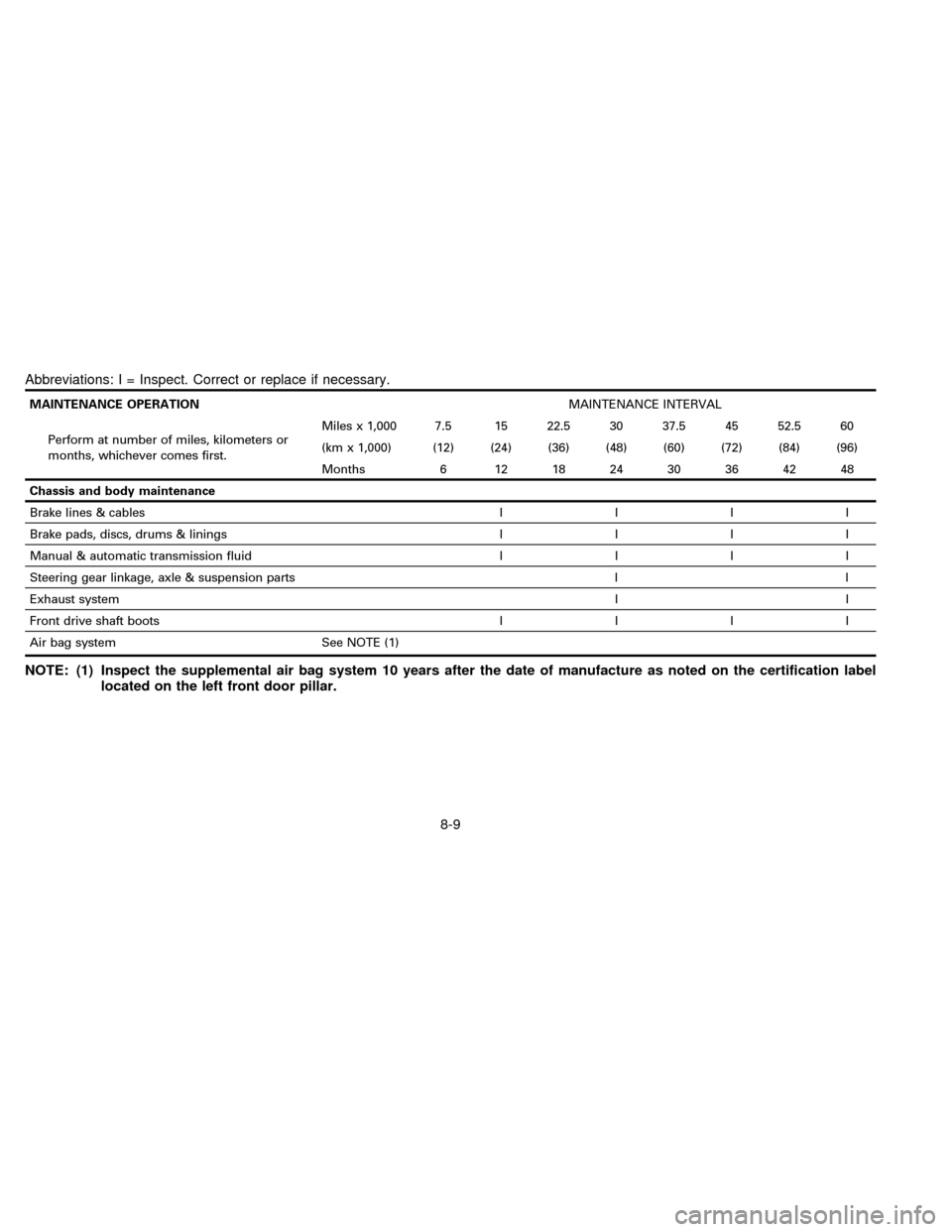
Abbreviations: I = Inspect. Correct or replace if necessary.
MAINTENANCE OPERATIONMAINTENANCE INTERVAL
Perform at number of miles, kilometers or
months, whichever comes first.Miles x 1,000 7.5 15 22.5 30 37.5 45 52.5 60
(km x 1,000) (12) (24) (36) (48) (60) (72) (84) (96)
Months 6 12 18 24 30 36 42 48
Chassis and body maintenance
Brake lines & cablesIIII
Brake pads, discs, drums & liningsIIII
Manual & automatic transmission fluidIIII
Steering gear linkage, axle & suspension parts I I
Exhaust systemII
Front drive shaft bootsIIII
Air bag system See NOTE (1)
NOTE: (1) Inspect the supplemental air bag system 10 years after the date of manufacture as noted on the certification label
located on the left front door pillar.
8-9
ZX
Page 157 of 183

EXPLANATION OF
MAINTENANCE ITEMS
Additional information on the following
items marked with ``*'' is found in the
``Do-it- yourself operations'' section.
Emission control system
maintenance
Drive belts*Ð Check drive belts for wear,
fraying or cracking and also for proper ten-
sion. Replace the drive belts if damaged.
Air cleaner filterÐ Under normal driving
conditions, the air cleaner filter should be
replaced in accordance with the mainte-
nance schedule. However, driving the ve-
hicle in dusty areas may cause more rapid
clogging of the element. Consequently, the
element may have to be replaced more
frequently.
Vapor linesÐ Check vapor lines and con-
nections for failure or looseness. If leaks are
found, replace them.
Fuel linesÐ Check the fuel hoses, piping
and connections for leaks, looseness or
deterioration. Replace any parts if they are
damaged.Fuel filterÐ If the vehicle is operated
under extremely adverse weather condi-
tions or in areas where ambient tempera-
tures are either extremely low or extremely
high, the filter might become clogged. In
such an event, replace the filter immedi-
ately.
Engine coolant*Ð Drain and flush the
cooling system.
Engine oil & oil filter*Ð Under normal
driving conditions, the engine oil and oil filter
should be replaced in accordance with the
maintenance schedule. However, under se-
vere driving conditions, they may have to be
replaced more frequently.
Spark plugs*Ð Replace with new plugs
having the correct heat range.
Intake & exhaust valve clearanceÐ
Check the valve clearance if valve noise
increases.
Chassis and body maintenance
Brake lines & cablesÐ Check the brake
lines and hoses (including brake booster
vacuum hoses, connections & check valve)
and parking brake cables for proper attach-
ment, leaks, cracks, chafing, abrasion, de-
terioration, etc.
Brake pads, discs, drums & liningsÐ
Check these and the other neighboring
brake components for wear, deteriorationand leaks. Under severe driving conditions,
they may have to be inspected more fre-
quently.
Manual & automatic transmission fluid*
Ð Check the fluid level and visually inspect
for signs of leakage.
Under severe driving conditions, the fluid
should be replaced at the specified interval.
Steering gear & linkage, axle & suspen-
sion parts, and drive shaft bootsÐ
Check for damage, looseness and leakage
of oil or grease. Under severe driving con-
ditions, more frequent inspection should be
performed.
Steering linkage ball joints & front sus-
pension ball jointsÐ Check the ball joints
for damage, looseness and grease leakage.
Exhaust systemÐ Visually check the ex-
haust pipes, muffler, and hangers for proper
attachment, leaks, cracks, chafing, abra-
sion, deterioration, etc. Under severe driv-
ing conditions, inspection should be per-
formed more frequently.
Air bag systemÐ Check the air bag
system components for proper attachment,
damage, deformities, cracks, rust, etc. Work
around and on the air bag system should be
done by an authorized NISSAN dealer.
8-10
ZX
Page 162 of 183

cannot be found.
Mineral based or synthetic type oils may be
used in your NISSAN vehicle. These oils
must however, meet the API quality and
SAE viscosity ratings specified for your ve-
hicle. Do not mix mineral based and syn-
thetic type oils in the engine at the same
time.
Oil additives
NISSAN does not recommend the use of oil
additives. The use of an oil additive is not
necessary when the proper oil type is used
and maintenance intervals are followed.
Oil which may contain foreign matter or has
been previously used should not be used.
Oil viscosity
The engine oil viscosity or thickness
changes with temperature. Because of this,
it is important that the engine oil viscosity be
selected based on the temperatures at
which the vehicle will be operated before
the next oil change. The chart ``Recom-
mended SAE viscosity number'' shows the
recommended oil viscosities for the ex-
pected ambient temperatures. Choosing an
oil viscosity other than that recommendedcould cause serious engine damage.
Selecting the correct oil filter
Your new vehicle is equipped with a high-
quality genuine NISSAN oil filter. When
replacing, use the genuine oil filter or its
equivalent for the reason described in
``Change intervals''.
Change intervals
The oil and oil filter change intervals for your
engine are based on the use of the specified
quality oils and filters. Oil and filter other
than the specified quality, or oil and filter
change intervals longer than recommended
could reduce engine life. Damage to en-
gines caused by improper maintenance or
use of incorrect oil and filter quality and/or
viscosity is not covered by the new NISSAN
vehicle warranties.
Your engine was filled with a high quality
engine oil when it was built. You do not have
to change the oil before the first recom-
mended change interval. Oil and filter
change intervals depend upon how you use
your vehicle. Operation under the following
conditions may require more frequent oil
and filter changes:Ð repeated short distance driving at cold
outside temperatures,
Ð driving in dusty conditions,
Ð extensive idling,
Ð towing a trailer.
9-5
ZX
Page 173 of 183

or other possible causes of either condi-
tion.
cAlways secure items in the trailer to
prevent load shifts while driving.
cBe certain your rear view mirrors conform
to all federal, state or local regulations. If
not, install any mirrors required for towing
before driving the vehicle.
Trailer towing tips
In order to gain skill and an understanding
of the vehicle's behavior, you should prac-
tice turning, stopping and backing up in an
area which is free from traffic. Steering
stability and braking performance will be
somewhat different than under normal driv-
ing conditions.
cAlways secure items in the trailer to
prevent load shift while driving.
cAvoid abrupt starts, acceleration or
stops.
cAvoid sharp turns or lane changes.
cAlways drive your vehicle at a moderate
speed.
cAlways block the wheels on both vehicle
and trailer when parking. Parking on a
slope is not recommended; however, ifyou must do so, and if your vehicle is
equipped with an automatic transmis-
sion, first block the wheels and apply the
parking brake, and then move the shift
lever into the ``P'' position. If you move
the shift lever to the ``P'' position before
blocking the wheels and applying the
parking brake, transmission damage
could occur.
cWhen going down a hill, shift into a lower
gear and use the engine braking effect.
When ascending a long grade, downshift
the transmission to a lower gear and
reduce speed to reduce chances of en-
gine overloading and/or overheating.
cIf the engine coolant rises to an ex-
tremely high temperature when the air
conditioning system is on, turn off the air
conditioner. Coolant heat can be addi-
tionally vented by opening the windows,
switching the fan control to high and
setting the temperature control to the
``HOT'' position.
cTrailer towing requires more fuel than
normal circumstances.
cAvoid towing a trailer for the first 500
miles (800 km).
cHave your vehicle serviced more oftenthan at intervals specified in the recom-
mended Maintenance Schedule.
cWhen making a turn, your trailer wheels
will be closer to the inside of the turn than
your vehicle wheels. To compensate for
this, make a larger than normal turning
radius during the turn.
cCrosswinds and rough roads will ad-
versely affect vehicle/trailer handling,
possibly causing vehicle sway. When
being passed by larger vehicles, be pre-
pared for possible changes in crosswinds
that could affect vehicle handling. If
swaying does occur, firmly grip the steer-
ing wheel, steer straight ahead, and im-
mediately (but gradually) reduce vehicle
speed. This combination will help stabi-
lize the vehicle. Never increase speed.
cBe careful when passing other vehicles.
Passing while towing a trailer requires
considerably more distance than normal
passing. Remember the length of the
trailer must also pass the other vehicle
before you can safely change lanes.
cTo maintain engine braking efficiency
and electrical charging performance, do
not use fifth gear (manual transmission)
9-16
ZX