1996 LINCOLN CONTINENTAL ESP
[x] Cancel search: ESPPage 166 of 320

Using the Automatic Memor.y Store feature
(“AUTOSET”)
If the memory buttons have been set, either by
using the Auto Memory Load feature or if you
have set them manually, the system is prepared to
let you use a convenient feature called
Automatic Memory Store.
With Auto Memory Store, you can continually
set strong stations into your memory buttons
without losing your originally set stations. Your
radio will automatically set your memory buttons
to the strong local stations.
Activate Auto Memory Store by pushing the
"AUTOSET" button once. Your radio will set
the first six strong stations of the band you are in
(AM, FMI or FM2) into the memory buttons.
The display will flash "AUTO" and display the
autoset icon "A" while the stations are being set
in the memory buttons.NOTE: If there are less than six strong
stations in the frequency band, the
remaining unfilled buttons will store the
last strong station detected on the band.
After all stations have been filled, the radio
will begin playing the station stored on
memory button 1.
To deactivate the Auto Memory Store mode and
return to the manually-set memory button stations,
simply push the "AUTOSET" button. Display will
show "AUTO" then "OFF". The next time Auto
Memory Store is activated on that band, the radio
will store the next set of six strong stations.
Adjusting the tone balance of your radio Increasing or decreasing bass and treble
response Push the "BASS/TREB" popout knob
to gain access to the bass and treble controls.
Bass control allows you to adjust the lower,
bass frequencies to your preference. The outer
ring of the "BASS/TREB" knob adjusts the
bass (turn clockwise to increase bass;
counterclockwise to decrease bass).
163
Page 174 of 320
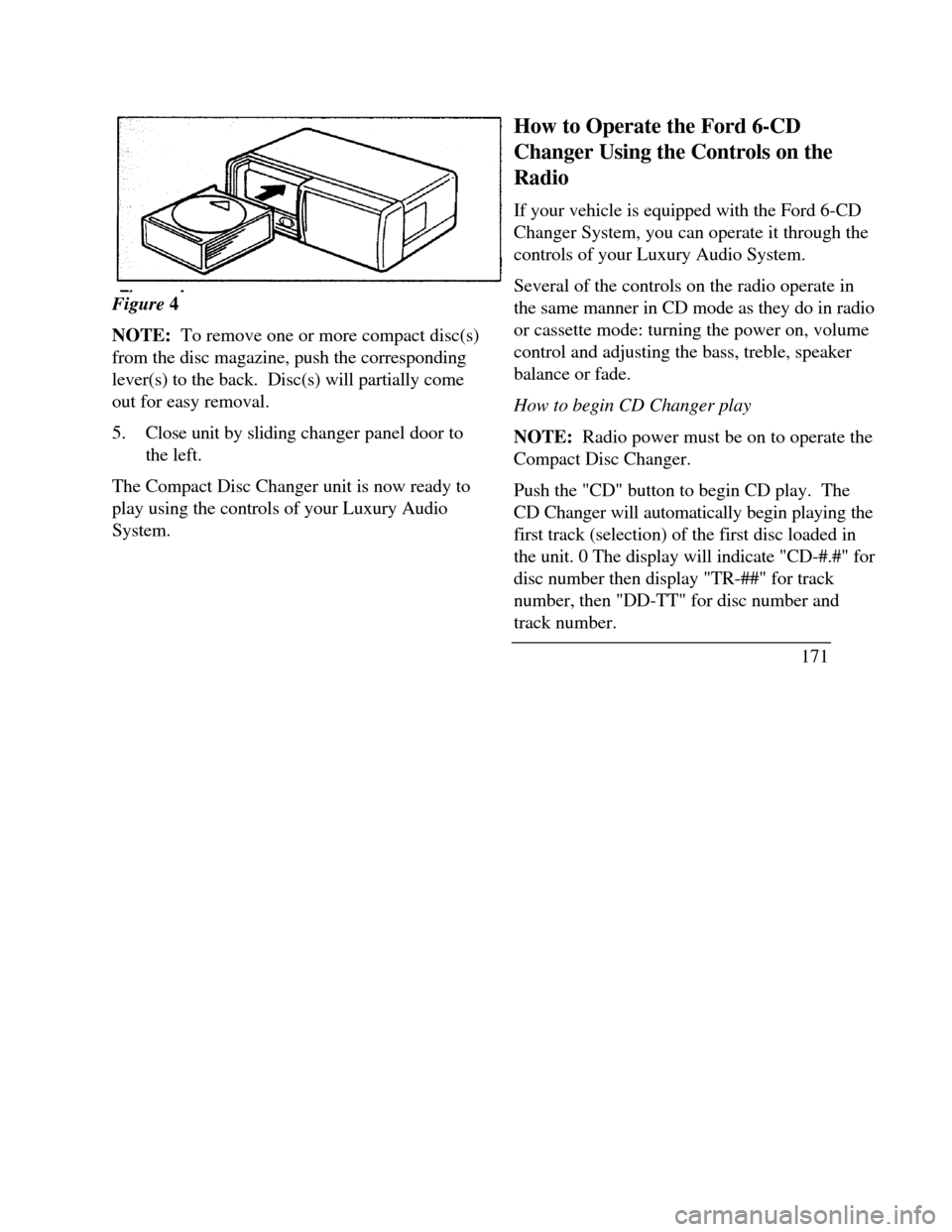
Figure 4
NOTE: To remove one or more compact disc(s)
from the disc magazine, push the corresponding
lever(s) to the back. Disc(s) will partially come
out for easy removal.
5.Close unit by sliding changer panel door to
the left.
The Compact Disc Changer unit is now ready to
play using the controls of your Luxury Audio
System.How to Operate the Ford 6-CD
Changer Using the Controls on the
Radio
If your vehicle is equipped with the Ford 6-CD
Changer System, you can operate it through the
controls of your Luxury Audio System.
Several of the controls on the radio operate in
the same manner in CD mode as they do in radio
or cassette mode: turning the power on, volume
control and adjusting the bass, treble, speaker
balance or fade.
How to begin CD Changer play
NOTE: Radio power must be on to operate the
Compact Disc Changer.
Push the "CD" button to begin CD play. The
CD Changer will automatically begin playing the
first track (selection) of the first disc loaded in
the unit. 0 The display will indicate "CD-#.#" for
disc number then display "TR-##" for track
number, then "DD-TT" for disc number and
track number.
171
Page 187 of 320

/!\ WARNINGAlways set the parking brake fully and makesure that the gearshift is securely latched in P(Park). Never leave your vehicle unattendedwhile it is running.You can tell a column-mounted gearshift is securely
latched in P (Park) if the lever is adjacent to the P
(Park) and you cannot move it without pulling it
toward you and rotating it downward.
You can tell a console-mounted gearshift is securely
latched in P (Park) if the lever is adjacent to the P
(Park) and you cannot move it without pushing in the
thumb button.
The gearshift will lock when you turn the key to the
LOCK position. When the gearshift is in any
position except P (Park), the ignition key cannot be
turned to the LOCK position or removed from the
steering column. To remove the key, the gearshift
lever must be in P (Park).
184Traction ControlÔ Ô (If equipped)
Your vehicle may be equipped with the
optional Traction ControlÔ, system. This
system helps prevent wheel spin in order to
improve tire traction and is an especially useful
feature when you drive in hilly areas or on
slippery, icy or snowy roads.
When the Traction Control system is
controlling wheelspin, an electric motor sound
may be heard from the engine compartment and
engine acceleration may seem slower. This is
normal.
Traction ControlÔ works automatically by
rapidly applying and releasing the brakes and
reducing engine torque to prevent one or both
of the front drive wheels from spinning during
acceleration.
During the Traction ControlÔ function, which
most often occurs during low speed
acceleration on slippery surfaces, a noise may
be heard coming from the engine compartment.
This is normal and may last for a few seconds
during the acceleration of the vehicle.
Page 195 of 320

/!\ WARNINGDo not spin the wheels at over 35 mph (55km/h). The tires may fail and injure apassenger or bystander.By moving the vehicle backward and forward, you
may gain enough momentum to move out of the
spot. Do not rock the vehicle for more than a few
minutes. This may overheat the engine, damage the
transaxle, or damage the tires. If you are still stuck
after a minute or two of rocking, call for a tow truck.
High water
Do not drive through flooded areas unless you are
sure that the water is below the bottom of the wheel
rims.
If you must drive through high water, drive slowly.
You may have limited traction or wet brakes, so
allow extra stopping distance because your vehicle
will not stop as quickly as usual.
192After you drive through the standing water,
apply your brakes gently several times as your
vehicle moves slowly. This helps to dry the
brakes.
Driving With a Heavy Load
There are limits to the amount of weight your
vehicle can carry or tow. The total weight of
your vehicle, plus the weight of the passengers
and cargo, should never be more than the
Gross Vehicle Weight Rating (GVWR). Also,
the weight that your vehicle carries over the
front axle and rear axle should never be more
than the Gross Axle Weight Rating (GAWR)
for the respective axle.
You can find your vehicle's GVWR and
GAWR on the Safety Compliance Certification
Label on the left front door lock facing or on
the door latch post pillar.
Page 197 of 320
3. Subtract the first reading from the second to
figure the total weight of the load.
After determining this load, you must also make sure
that the total weight of your vehicle, plus the load it
carries, is less than its GVWR. Also, make sure that
the weight your vehicle carries over each axle is less
than the GAWR for the respective axle.
If your vehicle exceeds the GVWR, remove cargo
from your vehicle accordingly. If your vehicle
exceeds the GAWR for either axle, shift the load or
remove cargo accordingly./!\ WARNINGImproper distribution of your vehicle's loador carrying weight in excess of the amountshown on the tire decal can cause rapid tirewear or loss of vehicle control.194Trailer Towing
Your vehicle is capable of towing a trailer of up
to a maximum of 2,000 lbs. (907 kg) gross
trailer weight with a maximum tongue load of
200 lbs. (91 kg).
Because towing a trailer puts extra strain on
your vehicle, you must follow certain
precautions for your safety and the good of
your vehicle: Stay within the load limits for towing your
vehicle. (See Trailer towing specifications
in this chapter.) Carefully and thoroughly prepare your
vehicle for towing, making sure to use the
right equipment and to attach it properly.
(See Preparing to Tow in this chapter.) Use extra caution when driving your vehicle
while you tow. (See Driving while you tow
in this chapter.)
Page 201 of 320

Driving While You Tow
Be especially careful when driving while you tow a
trailer. Never drive faster than 45 mph (70 km/h)
when you tow in hilly country on hot days. Also,
anticipate stops so that you can brake gradually.
Towing a trailer increases the load on the engine and
transaxle, particularly in hilly country and with
heavier trailers. Under these conditions you may
experience an excessive amount of shifting between
Overdrive and Third gears. Moving the shift selector
to D (Overdrive Lockout) will keep this from
happening and will provide better engine braking.
When driving in less hilly country or with a lighter
trailer load. you may move the gearshift selector
lever to (Overdrive) without experiencing
excessive shifting.
198When driving down steep hills, you should put
the gearshift selector lever in the I (First)
position to shift the transaxle into second gear.
This will provide additional engine braking.
The automatic transaxle will automatically
downshift to the proper gear for driving up a
grade.
If you use the speed control while you are
towing on very long, steep grades, the speed
control may shut off.
Servicing your vehicle if you tow
If you tow a trailer for a long distance, your
vehicle will need to be serviced more frequently
than usual. See the Maintenance Schedule and
Record booklet.
Page 224 of 320
Getting Help Outside the U.S. and
Canada
Before you export your vehicle to a foreign country,
contact the appropriate foreign embassy or consulate
to make sure local regulations do not prevent you
from registering your vehicle. Officials at the
embassy can also help you decide whether you
should import your vehicle to that country.
Officials at the embassy or consulate can tell you
where to get unleaded fuel. If you cannot get
unleaded fuel or can get only fuel with an anti-knock
index that is lower than your vehicle needs, contact
a district or owner relations office before you leave
the U.S. or Canada.
Use of leaded fuel in your vehicle without a proper
conversion may damage the effectiveness of your
emissions control system and may cause engine
knocking or serious engine damage. Ford Motor
Company is not responsible for any damage that is
caused by use of improper fuel.You may also have difficulty importing your vehicle
back into the U.S. if you use leaded fuel.
If your vehicle must be serviced while you are
traveling or living in Central or South America, the
Caribbean, or the Middle East, contact the nearest
Ford dealership. If the dealership cannot help you,
write to:Ford Motor CompanyExport Operations1555 Fairlane BusinessPark #3Allen Park, MI 481 olU.S.A.Phone: 313-317-4282Fax: 313-390-0804221
Page 228 of 320

NOTE: When adding accessories, equipment,
passengers, and luggage to your vehicle, do not
exceed the total weight capacity of the vehicle or of
the front or rear axle (GVWR, GAWR as shown on
the Safety Compliance Certification Label). Consult
your dealer for specific weight information.
NOTE: The Federal Communications Commission
(FCC) or in Canada the Canadian Radio
Telecommunications Commission (CRTC) regulates
the use of mobile communications systems - such as
two-way radios, telephones, and theft alarms that
are equipped with radio transmitters. Any such
equipment installed in your vehicle should comply
with FCC or in Canada the CRTC regulation and
should be installed only by a qualified technician.NOTE: Mobile communications systems may harm
the operation of your vehicle, particularly if they are
not properly designed for automotive use or are not
properly installed. For example, when operated, such
systems may cause the engine to stumble or stall. In
addition, such systems may themselves be damaged or
their operation affected by operating your vehicle.
(Citizens band CB transceivers, garage door openers,
and other transmitters whose power output is 5 watts
or less will not ordinarily affect your vehicle's
operation.)
NOTE: Because we have no control over the
installation, design, or manufacture of such systems,
Ford cannot assume responsibility for any adverse
effects or damage that may result if you use this
equipment.
225