1996 GMC SIERRA ECU
[x] Cancel search: ECUPage 200 of 404

Trailer Recommendations
You must subtract your hitch loads from the CWR for
your vehicle. Weigh your vehicle with
the trailer attached,
so that you won’t go over the GVWR or GAM.
You’ll get the best performance if you spread out the
weight
of your load the right way, and if you choose the
correct hitch and trailer brakes.
For more information, see “Trailer Towing” in the Index.
Camper Wiring Harness (Option)
A five-wire harness is stored in the front stake pocket on
the driver’s side of the bed. The harness has
no
connector and should be wired by a qualified electrical
technician.
It must be routed out. of your vehicle and
securely attached
so that it won’t be pulled or rubbed
while you’re using it. Store the harness in it’s original
position. Wrap the harness together and tie
it neatly so it
won’t be damaged.
Pickup Conversion to Chassis Cab
General Motors is aware that some vehicle owners may
consider having the pickup box removed and
a
commercial or recreational body installed. Before you
do so, first contact the GM Zone Office for your area for
information on such conversions specific to this vehicle. (See the
“Warranty and Owner Assistance” booklet for
Zone Office.) Owners should be aware that, as
manufactured, there are differences between
a chassis
cab and a pickup with
the box removed which may
affect vehicle
safety. The components necessary to adapt
a pickup to permit its safe use with a specialized body
should be installed by a body builder in accordance with
the information available from the Zone Office.
Towing a Trail-r
If you don’t use the correct equipment and drive
properly, you can lose control when you pull a
trailer. For example, if the trailer
is too heavy, the
brakes may not
work well -- or even at all. You
and your passengers could be seriously injured.
Pull a trailer only if you have followed all the
steps in this section. Ask your
GM dealer for
advice and information about towing a trailer
with your vehicle.
I
4-46
ProCarManuals.com
Page 209 of 404

Y
You should always attach chains between your vehicle
and your trailer. Cross
the safety chains under the tongue
of the trailer
so that the tongue will not drop to the road
if
it becomes separated from the hitch. Instructions
about safety chains may be provided by the hitch
manufacturer or by the trailer manufacturer. Follow
the
manufacturer’s recommendation for attaching safety
chains and do
not attach them to the bumper. Always
leave just enough slack
so you can turn with your rig.
And, never allow safety chains to drag on the ground.
If your trarler weighs more than
1,000 lbs. (450 kg)
loaded, then it needs its own brakes
-- and they must be
adequate. Be sure
to read and follow the instructions for
the trailer brakes
so you’ll be able to install, adjust and
maintain them properly.
Your trailer brake system can tap into
the vehicle’s
hydraulic brake system
only if:
The trailer parts can withstand 3,000 psi
(20 650 kPa) of pressure.
0 The trailer’s brake system will use less than
0.02 cubic inch (0.3 cc) of fluid from your vehicle’s
master cylinder. Otherwise, both braking systems
won’t work well. You could even lose your brakes. If
everything checks out this far, make the brake tap
at the port
on the master cylinder that sends the fluid to
the rear brakes. But don’t use copper tubing for this.
If
you do, it will bend and finally break off. Use steel
brake tubing.
rrailer
Towing a trailer requires a certain amount of experience.
Before setting
out for the open road, you’ll want to get
to know your rig. Acquaint yourself with the feel of
handling and braking with the added weight of the
trailer. And always keep in mind that
the vehicle you are
driving is now a good deal longer and
not nearly as
responsive
as your vehicle is by itself.
Before
you start, check the trailer hitch and platform
(and attachments), safety chains, electrical connector,
lamps, tires and mirror adjustment. If the trailer has
electric brakes, start your vehicle and trailer moving and
then apply the trailer brake controller by hand
to be sure
the brakes are working. This lets
you check your
electrical connection at the same time.
During your trip, check occasionally
to be sure that the
load is secure, and that
the lamps and any trailer brakes
are still working.
4-55
ProCarManuals.com
Page 213 of 404
When You Are Ready to Leave After
Parking on a Hill
1. Apply your regular brakes and hold the pedal down
while
you:
0 Start your engine;
Shift into a gear; and
0 Release the parking brake.
2. Let up on the brake pedal.
3. Drive slowly until the trailer is clear of the chocks.
4. Stop and have someone pick up and store the chocks.
Maintenance When Trailer Towing
Your vehicle will need service more often when you’re
pulling
a trailer. See the Maintenance Schedule for more
on this. Things
that are especially important in trailer
operation are automatic transmission fluid (don’t
overfill), engine oil, axle lubricant, belt, cooling system
and brake adjustment. Each of these is covered
in this
manual, and the Index will help you find them quickly.
If you’re trailering, it’s a good idea
to review these
sections before you start your trip.
Check periodically
to see that all hitch nuts and bolts
are tight.
Trailer Wiring Harness
A seven-wire harness is stored under the rear end of
your vehicle. between the frame rails. An electrical
connector
will need to be installed at the trailer end of
the harness, by a qualified electrical technician. For
additional trailer wiring and towing information please
consult your
GM dealer. Securely attach the harness to
the trailer, then tape or strap it to your vehicle’s frame
rail.
Be sure you leave it loose enough so the wiring
won’t bind or break when turning with the trailer, but
not so loose that it drags on the ground. Store the
harness in its original position. Wrap the harness
together and tie
it neatly so it won’t be damaged. If you
tow a trailer, your Center High-Mounted Stoplamp
(CHMSL) may not be properly visible from behind.
You should select a trailer with
a CHMSL on it or, if
one is not available, have one installed. See your GM
dealer about how to connect your vehicle’s wiring to
a trailer CHMSL.
4-59
ProCarManuals.com
Page 224 of 404

/A CAUTION:
To help avoid injury to you or others:
0
0
e
0
0
0
0
Never let passengers ride in a vehicle that is
being towed.
Never tow faster than safe
or posted speeds.
Never tow with damaged parts not
fully secured.
Never get under your vehicle after it has
been lifted by the tow truck.
Always use separate safety chains on each
side when towing a vehicle.
For pickups (except cab chassis models),
use T-hooks on front of vehicle, J-hooks
on rear.
For cab chassis models, use J-hooks on
front and rear of vehicle.
I A CAUTION:
A vehicle can fall from a car carrier if it isn’t
adequately secured. This can cause
a collision,
serious personal injury and vehicle damage. The
vehicle should be tightly secured with chains or
steel cables before it is transported.
Don’t use substitutes (ropes, leather straps,
canvas webbing, etc.) that can be cut by sharp
edges underneath the towed vehicle.
When your vehicle
is being towed, have the ignition
key in the OFF position. The steering wheel should be
clamped in a straight-ahead position,
with a clamping
device designed
for towing service. Do not use the
vehicle’s steering column lock for this. The transmission
and transfer case,
if you have one, should be in
NEUTRAL (N) and the parking brake released.
Don’t have your vehicle towed
on the drive wheels
unless
you must. If the vehicle must be towed on the
drive wheels, be sure to follow the speed and distance
restrictions later
in this section or your transmission will
be damaged.
If these limitations must be exceeded, then
the drive wheels have to be supported on
a dolly.
5-8
ProCarManuals.com
Page 230 of 404

NOTICE:
I
I
I
Engine damage from running your engine without coolant isn’t covered by your warranty.
If there seems to be no leak, start the engine again. See
if the fan speed increases when idle speed is doubled by
pushing the accelerator pedal down.
If it doesn’t, your
vehicle needs service. Turn
off the engine.
How to Add Coolant to the Coolant
Recovery Tank
If you haven’t found a problem yet, but the coolant level
isn’t at or above the
COLD mark, add a SO/SO mixture
of ciecu? wter (preferably distilled) and DEX-COOL”
(orange-colored, silicate-free) antifreeze at the coolant
recovery tank.
(See (‘Engine Coolant” in the Index for
more information.)
I A CAUTION:
Adding only plain water to your cooling system
can be dangerous. Plain water, or some other
liquid like
alcohol, can boil before the proper
coolant mix
will. Your vehicle’s coolant warning
system
is set for the proper coolant mix. With
plain water or the wrong mix, your engine could
get too hot but you wouldn’t get the overheat
warning. Your engine could catch fire and you or
others
could be burned. Use a 50/50 mix of clean
water and
DEX-COOL TM antifreeze.
I NOTICE:
In cold weather, water can freeze and crack
the engine, radiator, heater core and other parts.
Use the recommended coolant and the proper
coolant mix.
5- 14
ProCarManuals.com
Page 245 of 404

NOTICE:
Improperly tightened wheel nuts can lead to
brake pulsation and rotor damage. To avoid
expensive brake repairs, evenly tighten the wheel
nuts in the proper sequence and to the proper
torque specification.
9. Put the wheel trim back on. For vehicles with plastic
wheel
nut caps, tighten the caps until they are finger
tight, then tighten them an additional one-half turn
with the ratchet and wheel wrench.
Storing a Flat or Spare Tire aqd Tools
Storing a jack, a tire or other equipment in the
passenger compartment
of the vehicle could
cause injury. In a sudden stop or collision, loose
equipment could strike someone. Store all these
in the proper place.
Store the flat tire where the spare tire was stored.
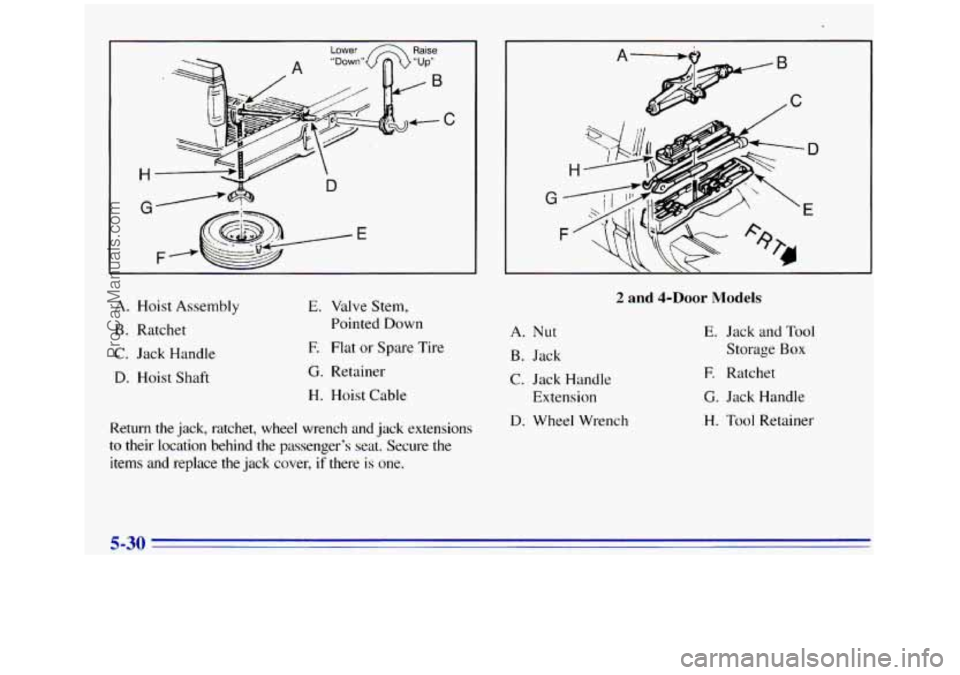
For an underbody spare tire carrier, stow
the tire under
the rear of the vehicle
in the spare tire carrier. To stow
the tire:
1.
2.
3.
4.
5.
Put the tire on the ground at the rear of the vehicle
with the valve stem pointed down and
to the rear.
Tilt
the retainer downward and through the wheel
opening. Make sure that the retainer is
fully seated
across the underside
of the wheel.
Attach the ratchet,
with the UP mark facing you,
near the hook at the end of the jack handle. Insert the
other end, on an angle, through the hole
in the rear
bumper and
into the hoist shaft.
Raise
the tire fully against the underslue 01 le
vehicle. Continue turning the ratchet
until mere are
two “clicks”
or “ratchets.” The spare tire hoist
cannot
be over-tightened.
Grasp and push against
the tire to be sure it is stored
securely and
does not move.
f 29
ProCarManuals.com
Page 246 of 404
Lower Raise
~~
H U
A. Hoist Assembly
B. Ratchet
C. Jack Handle
D. Hoist Shaft
E. Valve Stern,
Pointed Down
E Flat or Spare Tire
G. Retainer
H. Hoist Cable
Return the jack, ratchet, wheel wrench and jack extensions
to their location behind the passenger’s seat. Secure the
items and replace the jack cover, if there is one.
G
2 and 4-Door Models
A. Nut
B. Jack
C. Jack Handle
Extension
D. Wheel Wrench
E. Jack and Tool
Storage Box
E Ratchet
G. Jack Handle
H. Tool Retainer
5-30
ProCarManuals.com
Page 307 of 404
Used Replacement Wheels Tire Chains
1
-- 4
Putting a used wheel .on your vehicle is dangerous.
You can’t know how it’s been used or how many
miles it’s been driven.
It could fail suddenly and
cause an accident.
If you have to replace a wheel,
use a new
GM original equipment wheel.
NOTICE:
If your vehicle has dual wheels or P265/75R16
size tires, don’t use tire chains. They can damage
your vehicle.
If you don’t have dual wheels or if you have a tire
size other than P265/75R16, use tire chains only
where legal and only when you must. Use chains
that are the proper size for your tires. Install
them on the tires of the rear axle.
Don’t use chains on the tires of the front axle.
Tighten them as tightly as possible with the ends
,
securely fastened. Drive slowly and follow the chain
manufacturer’s instructions.
If you can. hear the
chains ‘contacting your vehicle, stop and retighten
them.
If the contact continues, slow dawn until it
stops. Driving too fast or spinning the wheels with
chains on
will damage your vehicle.
4
6-57
ProCarManuals.com