1996 CHRYSLER VOYAGER wheel
[x] Cancel search: wheelPage 97 of 1938

both the rotor and one wheel stud on the high side of
the runout. This will ensure that the original location
of the rotor in relation to the hub can be retained
(Fig. 14). Remove rotor from hub.
Thoroughly clean the front surface of the front
hub. Then install Dial Indicator, Special Tool C-3339
and Mounting Adaptor, Special Tool SP-1910 on
steering knuckle. Position stem so it contacts hub
face near outer diameter. Care must be taken to posi-
tion stem outside the stud circle but inside the cham-
fer on the hub face (Fig. 15).Clean hub surface
before checking.
Lateral runout should not exceed 0.08 mm (0.003
inch). If runout exceeds this specification, the hub
must be replaced. See Suspension Group 2. If lateral
runout of the hub does not exceed this specification,
install rotor on hub with chalk marks two wheel
studs apart (Fig. 16). Tighten nuts in the properse-
quence and torque to specification. Finally, check lat-eral runout of rotor to see if lateral runout is now
within specification.
If lateral runout is not within specification, install
a new rotor or reface rotor, being careful to remove
as little rotor material as possible from each side of
rotor. Remove equal amounts from each side of rotor.
Do not reduce thickness below minimum thickness
marking cast into the un-machined surface (Fig. 17)
of the rotor .
Thickness variation measurements of the rotor
should be made in conjunction with the lateral
runout measurements. Measure the thickness of the
rotor at 12 circumferentially equal points with a
Fig. 16 Indexing Rotor And Wheel Stud
Fig. 13 Checking Brake Rotor For Runout
Fig. 14 Marking Rotor And Wheel Stud
Fig. 15 Checking Disc Brake Rotor For Runout
NSBRAKES 5 - 15
DIAGNOSIS AND TESTING (Continued)
Page 98 of 1938

micrometer at a radius approximately 25.4 mm (1
inch) from outer edge of rotor (Fig. 18). If thickness
measurements vary by more than 0.013 mm (0.0005
inch), rotor should be removed and resurfaced, or a
new rotor installed. If cracks or burned spots are evi-
dent, rotor must be replaced.
Light scoring and/or wear is acceptable. If heavy
scoring or warping is evident, the rotor must be
refinished or replaced (See Refinishing/RefacingRotor). If cracks are evident in the rotor, replace the
rotor.
PROPORTIONING VALVES
FIXED PROPORTIONING VALVE TEST
PROCEDURE
On a vehicle equipped with ABS, premature or
excessive rear wheel ABS cycling may be an indica-
tion that the brake fluid pressure to the rear brakes
is above the desired output.
Prior to testing a proportioning valve for function,
check that all tire pressures are correct. Also, ensure
the front and rear brake linings are in satisfactory
condition.It is also necessary to verify that the
brakes shoe assemblies on a vehicle being
tested, are either original equipment manufac-
turers (OEM), or original replacement brake
shoe assemblies meeting the OEM lining mate-
rial specification. The vehicles brake system is
not balanced for after market brake shoe
assembly lining material.
If brake shoe assembly lining material is of satis-
factory condition, and of the correct material specifi-
cation, check for proper proportioning valve function
using the following procedure.
(1) Road test vehicle to be sure the vehicle is truly
exhibiting a condition of excessive rear wheel ABS
cycling. Since ABS cycles both rear brakes together
both proportioning valves of the assembly(Fig.
19) must be tested. Use the following procedure to
test the proportioning valve.
(2) Remove one of the chassis brake lines (Fig. 19)
coming from the ABS modulator, at
(3) the proportioning valve assembly. Remove the
hydraulic brake line going to one of the rear wheels
of the vehicle from the proportioning valve (Fig. 19)
Fig. 17 Minimum Rotor Thickness Markings
Fig. 18 Checking Rotor For Thickness Variation
Fig. 19 Rear Brake Proportioning Valve And Brake
Tube Locations
5 - 16 BRAKESNS
DIAGNOSIS AND TESTING (Continued)
Page 99 of 1938

(4) Remove the 2 bolts (Fig. 19) attaching the pro-
portioning valve to the frame rail.
CAUTION: When lowering the proportioning valve,
care must be taken not to kink any of the chassis
brake lines.
(5) Carefully lower the proportioning valve for
clearance to install the proportioning valve test fit-
tings.
(6) Install the required fitting from Pressure Test
Fittings, Special Tool 6833 (Fig. 20) into the inlet
port of the proportioning valve assembly, from which
the chassis brake line was removed. Install the
removed chassis brake line into the Pressure Test
Fitting (Fig. 20). Install the required fitting from
Pressure Test Fittings, Special Tool 6833 into the
required outlet port of the proportioning valve.
Install the required fitting from Pressure Test Fit-
tings, Special Tool 6833 into the required outlet port
of the proportioning valve (Fig. 20). Then install the
removed chassis brake line into the Pressure Test
Fitting (Fig. 20).
(7) Install a pressure gauge from Gauge Set, Spe-
cial Tool C-4007-A into each pressure test fitting (Fig.
21). Bleed air out of hose from pressure test fittings
to pressure gauges, at the pressure gauges (Fig. 21).
Then bleed air out of the brake line being tested, at
that rear wheel cylinder.
(8) With the aid of a helper, apply pressure to the
brake pedal until a pressure of 6895 kPa (1000 psi) is
obtained on the proportioning valve inlet gauge.
Then based on the type of brake system the vehicle is
equipped with and the pressure specification shown
on the following table, compare the pressure reading
on the outlet gauge to the specification. If outlet
pressure at the proportioning valve is not within
specification when required inlet pressure is
obtained, replace the proportioning valve.(9) Repeat steps 2 through 7 for the other propor-
tioning valve of the assembly.
CAUTION: When mounting the original or a
replacement proportion valve on the frame rail of
the vehicle install the mounting bolts in only the
two forward holes of the mounting bracket (Fig. 19).
HEIGHT SENSING PROPORTIONING VALVE
CAUTION: The use of after-market load leveling or
load capacity increasing devices on this vehicle are
prohibited. Using air shock absorbers or helper
springs on this vehicle will cause the height sens-
ing proportioning valve to inappropriately reduce
the hydraulic pressure to the rear brakes. This inap-
propriate reduction in hydraulic pressure potentially
could result in increased stopping distance of the
vehicle.
When a premature rear wheel skid is obtained on a
brake application, it may be an indication that the
hydraulic pressure to the rear brakes is above the
specified output from the proportioning valve. This
condition indicates a possible malfunction of the
height sensing proportioning valve, which will
require testing to verify that it is properly controlling
the hydraulic pressure allowed to the rear brakes.
Premature rear wheel skid may also be caused by an
incorrectly adjusted proportioning valve actuator
assembly, or contaminated front or rear brake lin-
ings.
Prior to testing a proportioning valve for function,
check that all tire pressures are correct. Also, ensure
the front and rear brake linings are in satisfactory
condition.It is also necessary to verify that the
brakes shoe assemblies on a vehicle being
tested, are either original equipment manufac-
turers (OEM), or original replacement brake
Fig. 20 Proportioning Valve Test Fitting Installation
Fig. 21 Pressure Gauges Installed On Pressure Test
Fittings
NSBRAKES 5 - 17
DIAGNOSIS AND TESTING (Continued)
Page 100 of 1938
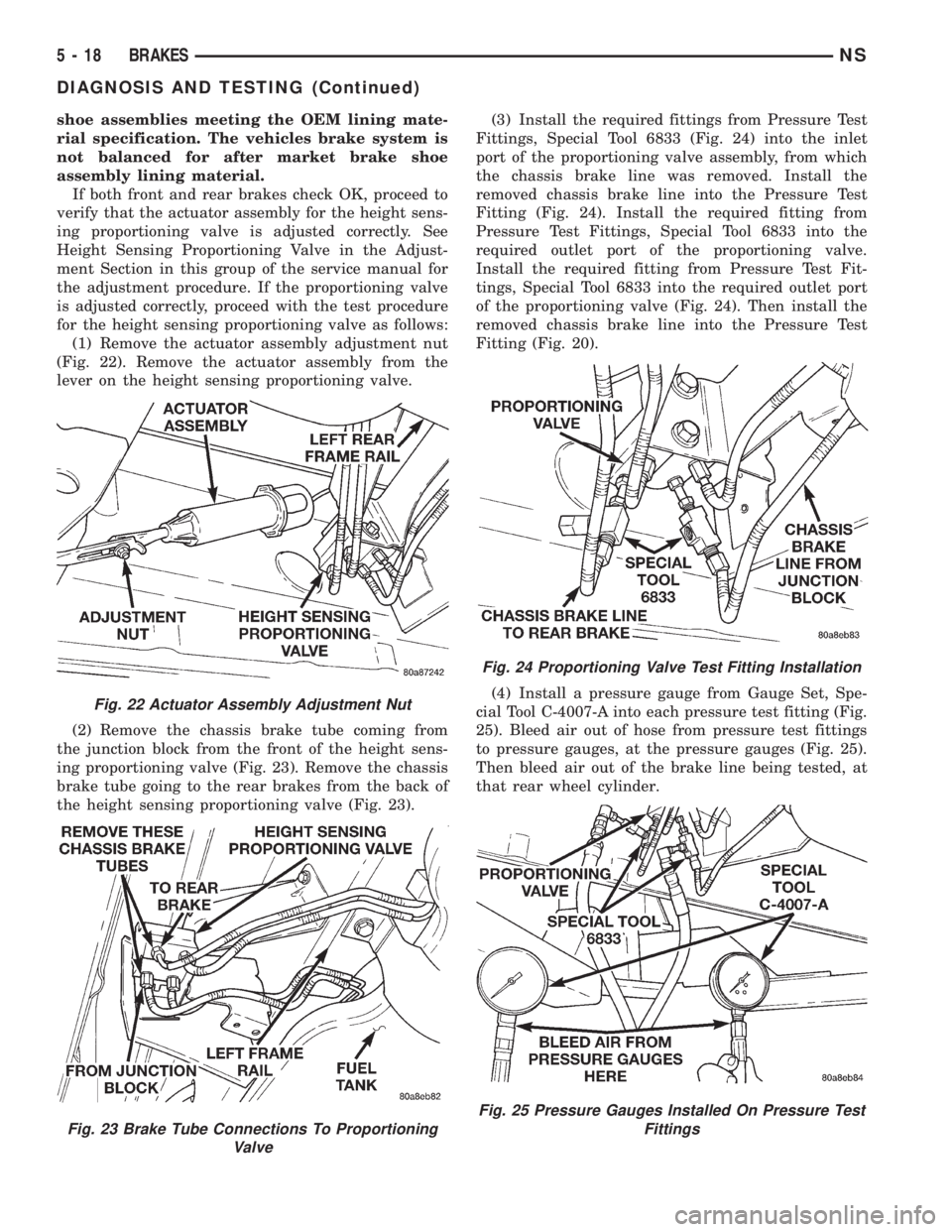
shoe assemblies meeting the OEM lining mate-
rial specification. The vehicles brake system is
not balanced for after market brake shoe
assembly lining material.
If both front and rear brakes check OK, proceed to
verify that the actuator assembly for the height sens-
ing proportioning valve is adjusted correctly. See
Height Sensing Proportioning Valve in the Adjust-
ment Section in this group of the service manual for
the adjustment procedure. If the proportioning valve
is adjusted correctly, proceed with the test procedure
for the height sensing proportioning valve as follows:
(1) Remove the actuator assembly adjustment nut
(Fig. 22). Remove the actuator assembly from the
lever on the height sensing proportioning valve.
(2) Remove the chassis brake tube coming from
the junction block from the front of the height sens-
ing proportioning valve (Fig. 23). Remove the chassis
brake tube going to the rear brakes from the back of
the height sensing proportioning valve (Fig. 23).(3) Install the required fittings from Pressure Test
Fittings, Special Tool 6833 (Fig. 24) into the inlet
port of the proportioning valve assembly, from which
the chassis brake line was removed. Install the
removed chassis brake line into the Pressure Test
Fitting (Fig. 24). Install the required fitting from
Pressure Test Fittings, Special Tool 6833 into the
required outlet port of the proportioning valve.
Install the required fitting from Pressure Test Fit-
tings, Special Tool 6833 into the required outlet port
of the proportioning valve (Fig. 24). Then install the
removed chassis brake line into the Pressure Test
Fitting (Fig. 20).
(4) Install a pressure gauge from Gauge Set, Spe-
cial Tool C-4007-A into each pressure test fitting (Fig.
25). Bleed air out of hose from pressure test fittings
to pressure gauges, at the pressure gauges (Fig. 25).
Then bleed air out of the brake line being tested, at
that rear wheel cylinder.
Fig. 22 Actuator Assembly Adjustment Nut
Fig. 23 Brake Tube Connections To Proportioning
Valve
Fig. 24 Proportioning Valve Test Fitting Installation
Fig. 25 Pressure Gauges Installed On Pressure Test
Fittings
5 - 18 BRAKESNS
DIAGNOSIS AND TESTING (Continued)
Page 101 of 1938
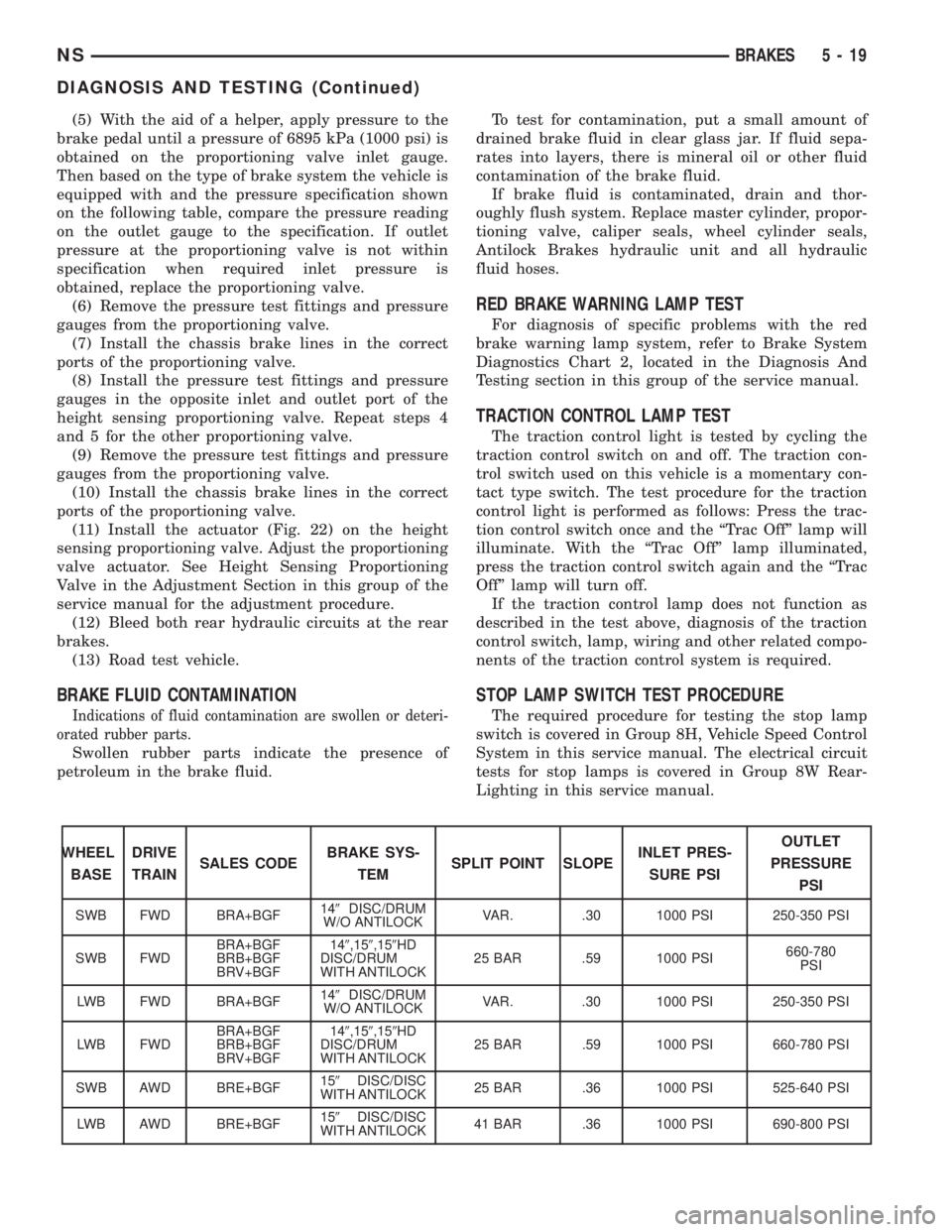
(5) With the aid of a helper, apply pressure to the
brake pedal until a pressure of 6895 kPa (1000 psi) is
obtained on the proportioning valve inlet gauge.
Then based on the type of brake system the vehicle is
equipped with and the pressure specification shown
on the following table, compare the pressure reading
on the outlet gauge to the specification. If outlet
pressure at the proportioning valve is not within
specification when required inlet pressure is
obtained, replace the proportioning valve.
(6) Remove the pressure test fittings and pressure
gauges from the proportioning valve.
(7) Install the chassis brake lines in the correct
ports of the proportioning valve.
(8) Install the pressure test fittings and pressure
gauges in the opposite inlet and outlet port of the
height sensing proportioning valve. Repeat steps 4
and 5 for the other proportioning valve.
(9) Remove the pressure test fittings and pressure
gauges from the proportioning valve.
(10) Install the chassis brake lines in the correct
ports of the proportioning valve.
(11) Install the actuator (Fig. 22) on the height
sensing proportioning valve. Adjust the proportioning
valve actuator. See Height Sensing Proportioning
Valve in the Adjustment Section in this group of the
service manual for the adjustment procedure.
(12) Bleed both rear hydraulic circuits at the rear
brakes.
(13) Road test vehicle.
BRAKE FLUID CONTAMINATION
Indications of fluid contamination are swollen or deteri-
orated rubber parts.
Swollen rubber parts indicate the presence of
petroleum in the brake fluid.To test for contamination, put a small amount of
drained brake fluid in clear glass jar. If fluid sepa-
rates into layers, there is mineral oil or other fluid
contamination of the brake fluid.
If brake fluid is contaminated, drain and thor-
oughly flush system. Replace master cylinder, propor-
tioning valve, caliper seals, wheel cylinder seals,
Antilock Brakes hydraulic unit and all hydraulic
fluid hoses.
RED BRAKE WARNING LAMP TEST
For diagnosis of specific problems with the red
brake warning lamp system, refer to Brake System
Diagnostics Chart 2, located in the Diagnosis And
Testing section in this group of the service manual.
TRACTION CONTROL LAMP TEST
The traction control light is tested by cycling the
traction control switch on and off. The traction con-
trol switch used on this vehicle is a momentary con-
tact type switch. The test procedure for the traction
control light is performed as follows: Press the trac-
tion control switch once and the ªTrac Offº lamp will
illuminate. With the ªTrac Offº lamp illuminated,
press the traction control switch again and the ªTrac
Offº lamp will turn off.
If the traction control lamp does not function as
described in the test above, diagnosis of the traction
control switch, lamp, wiring and other related compo-
nents of the traction control system is required.
STOP LAMP SWITCH TEST PROCEDURE
The required procedure for testing the stop lamp
switch is covered in Group 8H, Vehicle Speed Control
System in this service manual. The electrical circuit
tests for stop lamps is covered in Group 8W Rear-
Lighting in this service manual.
WHEEL
BASEDRIVE
TRAINSALES CODEBRAKE SYS-
TEMSPLIT POINT SLOPEINLET PRES-
SURE PSIOUTLET
PRESSURE
PSI
SWB FWD BRA+BGF149DISC/DRUM
W/O ANTILOCKVAR. .30 1000 PSI 250-350 PSI
SWB FWDBRA+BGF
BRB+BGF
BRV+BGF149,159,159HD
DISC/DRUM
WITH ANTILOCK25 BAR .59 1000 PSI660-780
PSI
LWB FWD BRA+BGF149DISC/DRUM
W/O ANTILOCKVAR. .30 1000 PSI 250-350 PSI
LWB FWDBRA+BGF
BRB+BGF
BRV+BGF149,159,159HD
DISC/DRUM
WITH ANTILOCK25 BAR .59 1000 PSI 660-780 PSI
SWB AWD BRE+BGF159DISC/DISC
WITH ANTILOCK25 BAR .36 1000 PSI 525-640 PSI
LWB AWD BRE+BGF159DISC/DISC
WITH ANTILOCK41 BAR .36 1000 PSI 690-800 PSI
NSBRAKES 5 - 19
DIAGNOSIS AND TESTING (Continued)
Page 102 of 1938

SERVICE PROCEDURES
MASTER CYLINDER FLUID LEVEL CHECK
Check master cylinder reservoir fluid level a mini-
mum of twice annually.
Master cylinder reservoirs are marked with the
words FULL and ADD to indicate proper brake fluid
fill level of the master cylinder (Fig. 26).
If necessary, add brake fluid to bring the level to
the bottom of the FULL mark on the side of the mas-
ter cylinder fluid reservoir.When filling master
cylinder fluid reservoir do not fill the filler
neck of the fluid reservoir (Fig. 26) with brake
fluid.
Use only Mopartbrake fluid or an equivalent from
a sealed container. Brake fluid must conform to DOT
3, specifications.
DO NOTuse brake fluid with a lower boiling
point, as brake failure could result during prolonged
hard braking.
Use only brake fluid that was stored in a tightly-
sealed container.
DO NOTuse petroleum-based fluid because seal
damage will result. Petroleum based fluids would be
items such as engine oil, transmission fluid, power
steering fluid ect.
BLEEDING BASE BRAKE HYDRAULIC SYSTEM
NOTE: This bleeding procedure is only for the vehi-
cle's base brakes hydraulic system. For bleeding
the antilock brakes hydraulic system, refer to the
ITT Teves Mark 20 Antilock Brake System bleeding
procedure in the antilock brakes section of this ser-
vice manual.
PRESSURE BLEEDING PROCEDURE
CAUTION: Before removing the master cylinder
cover, throughly clean the cover and master cylin-
der fluid reservoir to prevent dirt and other foreign
matter from dropping into the master cylinder fluid
reservoir.
CAUTION: Use bleeder tank Special Tool C-3496-B
with adapter Special Tool 6921 to pressurize the
hydraulic system for bleeding.
CAUTION: When pressure bleeding the brakes
hydraulic system the fluid reservoir filler neck must
be removed from the master cylinder fluid reservoir.
Failure to remove the filler neck from the fluid res-
ervoir, may result in the filler neck separating from
the fluid reservoir when the hydraulic system is
pressurized.
Follow pressure bleeder manufacturer's instruc-
tions, for use of pressure bleeding equipment.
When bleeding the brake system, some air may be
trapped in the brake lines or valves far upstream, as
much as ten feet from the bleeder screw (Fig. 27).
Therefore, it is essential to have a fast flow of a large
volume of brake fluid when bleeding the brakes to
ensure all the air gets out.
(1) Remove the filler neck from the master cylin-
der fluid reservoir.
(2) Install the Adapter Master Cylinder Pressure
Bleed Cap, Special Tool 6921 on the fluid reservoir of
the master cylinder (Fig. 28). Attach the fluid hose
from the pressure bleeder to the fitting on Special
Tool 6921.
(3) Attach a clear plastic hose to the bleeder screw
at one wheel and feed the hose into a clear jar con-
taining fresh brake fluid.
Fig. 26 Master Cylinder Fluid Level Marks
Fig. 27 Trapped Air In Brake Fluid Line
5 - 20 BRAKESNS
Page 103 of 1938

NOTE: The following wheel sequence should be
used when bleeding the brake hydraulic system.
The use of this wheel sequence will ensure ade-
quate removal of all trapped air from the brake
hydraulic system.
²Left Rear Wheel
²Right Front Wheel
²Right Rear Wheel
²Left Front Wheel
(4) Open the left rear wheel bleeder screw at least
one full turnor more to obtain an adequate flow of
brake fluid (Fig. 29).
CAUTION: Just cracking the bleeder screw often
restricts fluid flow, and a slow, weak fluid discharge
will NOT get all the air out.
(5) After 4 to 8 ounces of brake fluid has been bled
through the hydraulic system, and an air-free flow is
maintained in the hose and jar, this will indicate agood bleed of the hydraulic system has been
obtained.
(6) Repeat the procedure at all the other remain-
ing bleeder screws. Then check the pedal for travel.
If pedal travel is excessive or has not been improved,
enough fluid has not passed through the system to
expel all the trapped air. Be sure to monitor the fluid
level in the pressure bleeder, so it stays at a proper
level so air will not enter the brake system through
the master cylinder.
(7) Perform a final adjustment of the rear brake
shoes and then test drive vehicle to be sure brakes
are operating correctly and that pedal is solid.
BLEEDING WITHOUT A PRESSURE BLEEDER
NOTE: Correct manual bleeding of the brakes
hydraulic system will require the aid of a helper.
NOTE: To adequately bleed the brakes using the
manual bleeding procedure the rear brakes must be
correctly adjusted. Prior to the manual bleeding of
the brake hydraulic system, correctly adjust the
rear brakes.
NOTE: The following wheel sequence should be
used when bleeding the brake hydraulic system.
The use of this wheel sequence will ensure ade-
quate removal of all trapped air from the brake
hydraulic system.
²Left Rear Wheel
²Right Front Wheel
²Right Rear Wheel
²Left Front Wheel
(1) Pump the brake pedal three or four times and
hold it down before the bleeder screw is opened.
(2) Push the brake pedal toward the floor and hold
it down. Then open the left rear bleeder screw at
least 1 full turn. When the bleeder screw opens the
brake pedal will drop all the way to the floor.
(3) Release the brake pedal onlyafterthe bleeder
screw is closed.
(4) Repeat steps 1 through 3, four or five times, at
each bleeder screw in the required sequence. This
should pass a sufficient amount of fluid to expel all
the trapped air from the brake system. Be sure to
monitor the fluid level in the master cylinder, so it
stays at a proper level so air will not enter the brake
system through the master cylinder.
(5) Perform a final adjustment of the rear brake
shoes and then test drive vehicle to be sure brakes
are operating correctly and that pedal is solid.Fig. 28 Pressure Bleeding Cap Installed On Master
Cylinder
Fig. 29 Rear Wheel Cylinder Bleeder Screw
NSBRAKES 5 - 21
SERVICE PROCEDURES (Continued)
Page 109 of 1938

(4) Remove the locking pliers from the front park
brake cable. This will allow the adjuster in the park
brake pedal mechanism to rotate around to its stop.
This will remove the tension from the adjuster and
front park brake cable.
Use the following procedure to reset the auto
adjuster in the park brake pedal mechanism.
(5) Grasp the exposed section of the front park
brake cable and pull rearward on it. While holding
the park brake in this position, install a pair of lock-
ing pliers on the front park brake cable just rearward
of the second body outrigger bracket (Fig. 42).
(6) Install the equalizer on the front park brake
cable.
(7) Install the left rear and intermediate park
brake cable in the correct location on the park brake
cable equalizer (Fig. 43).
(8) Remove the locking pliers from the front park
brake cable. This will allow the adjuster in the park
brake pedal mechanism to tension the park brake
cables.
(9) Apply and release the park brake pedal one
time. This will seat the park brake cables and allow
the auto adjuster in the park brake pedal mechanism
to correctly tension the park brake cables.
REMOVAL AND INSTALLATION
WHEEL AND TIRE INSTALLATION
To install the wheel and tire assembly, first posi-
tion it properly on the mounting surface using the
hub pilot as a guide. Then progressively tighten thelug nuts in the proper sequence to half of the
required torque. Finally tighten the lug nuts in the
proper sequence to 129 N´m (95 ft. lbs.). Never use
oil or grease on studs or nuts.
FRONT DISC BRAKE CALIPER
SERVICE PRECAUTIONS
WARNING: ALTHOUGH FACTORY INSTALLED
BRAKE LININGS ARE MADE FROM ASBESTOS
FREE MATERIALS, SOME AFTER MARKET BRAKE
LINING MAY CONTAIN ASBESTOS. THIS SHOULD
BE TAKEN INTO ACCOUNT WHEN SERVICING A
VEHICLE'S BRAKE SYSTEM, WHEN AFTERMARKET
BRAKE LININGS MAY HAVE BEEN INSTALLED ON
THE VEHICLE. ALWAYS WEAR A RESPIRATOR
WHEN CLEANING BRAKE COMPONENTS AS
ASBESTOS CAN CAUSE SERIOUS BODILY HARM
SUCH AS ASBESTOSIS AND OR CANCER. NEVER
CLEAN BRAKE COMPONENTS BY USING COM-
PRESSED AIR, USE ONLY A VACUUM CLEANER
SPECIFICALLY DESIGNED FOR THE REMOVAL OF
BRAKE DUST. IF A VACUUM CLEANER IS NOT
AVAILABLE, CLEAN BRAKE PARTS USING ONLY
WATER±DAMPENED SHOP TOWELS. DO NOT CRE-
ATE BRAKELINING DUST BY SANDING BRAKE LIN-
INGS WHEN SERVICING A VEHICLE. DISPOSE OF
ALL DUST AND DIRT SUSPECTED OF CONTAINING
ASBESTOS FIBERS USING ONLY SEALED AIR-
TIGHT BAGS OR CONTAINERS. FOLLOW ALL REC-
OMMENDED SAFETY PRACTICES PRESCRIBED BY
THE OCCUPATIONAL SAFETY AND HEALTH ADMIN-
ISTRATION (OSHA) AND THE ENVIRONMENTAL
PROTECTION AGENCY (EPA), FOR HANDLING AND
DISPOSAL OF PRODUCTS CONTAINING ASBES-
TOS.
CAUTION: During service procedures, grease or
any other foreign material must be kept off brake
shoe assemblies, and braking surfaces of brake
drum and external surfaces of hub/bearing assem-
bly.
REMOVE
(1) Raise vehicle on jackstands or centered on a
hoist. See Hoisting in the Lubrication and Mainte-
nance group of this service manual.
(2) Remove front wheel and tire assemblies.
Fig. 43 Park Brake Cable Attachment To Equalizer
NSBRAKES 5 - 27
SERVICE PROCEDURES (Continued)