1996 CHRYSLER VOYAGER steering
[x] Cancel search: steeringPage 110 of 1938

(3) Remove the 2 caliper to steering knuckle guide
pin bolts (Fig. 44).
(4) Remove caliper from steering knuckle, by first
rotating free end of caliper away from steering
knuckle. Then slide opposite end of caliper out from
under machined abutment on steering knuckle (Fig.
45).
(5) Support caliper firmly to prevent weight of cal-
iper from being supported by the brake fluid flex
hose. Supporting weight of caliper by the brake fluid
flex hose, can damage the flexible brake hose (Fig.
46).
INSTALL
(1) Lubricate both steering knuckle abutments
with a liberal amount of MopartMultipurpose Lubri-
cant, or equivalent.CAUTION: Use care when installing the caliper
assembly onto the steering knuckle, so the seals on
the caliper guide pin bushings do not get damaged
by the steering knuckle bosses.
(2) Carefully position caliper and brake pad
assemblies over brake rotor by hooking lower or
upper end of caliper over the machined abutment on
steering knuckle (Fig. 45). Then rotate caliper into
position at the top of the steering knuckle (Fig. 45).
Make sure that caliper guide pin bolts, bushings and
sleeves are clear of the steering knuckle bosses.
(3) Install the caliper guide pin bolts (Fig. 44) and
tighten to a torque of 41 N´m (40 ft. lbs.).Extreme
caution should be taken not to cross thread the
caliper guide pin bolts.
(4) Install the wheel and tire assembly.
(5) Using a torque wrench, tighten the wheel
mounting stud nuts in proper sequence until all nuts
are torqued to half specification. Then repeat the
tightening sequence to the full specified torque of 135
N´m (100 ft. lbs.).
(6) Remove jackstands or lower hoist.
(7)Before moving vehicle, pump the brake
pedal several times to insure the vehicle has a
firm brake pedal.
REAR DISC BRAKE CALIPER
During service procedures, grease or any other for-
eign material must be kept off brake shoe assem-
blies, and braking surfaces of rotor.
Handling of the rotor and caliper, must be done in
such a way as to avoid damage to the rotor and
scratching or nicking of lining on the brake shoes.
If inspection reveals that the caliper piston seal is
leaking, itMUSTbe replaced immediately.
During removal and installation of a wheel and
tire assembly, use care not to strike the caliper.
Fig. 44 Removing Caliper Guide Pin Bolts
Fig. 45 Caliper Assembly Mounting On Steering
Knuckle (Typical)
Fig. 46 Storing Front Disc Brake Caliper
5 - 28 BRAKESNS
REMOVAL AND INSTALLATION (Continued)
Page 130 of 1938

drain hose (Fig. 107) from wiper module. Remove the
2 nuts attaching the master cylinder to the vacuum
booster (Fig. 107).
NOTE: It is not necessary to remove the brake
tubes from the master cylinder when removing the
master cylinder from the vacuum booster.
(11) Remove the master cylinder and brake tubes
as an assembly from the vacuum booster. When mas-
ter cylinder is removed, lay it out of the way on top
of the left motor mount
(12) Disconnect vacuum hose from check valve
located on vacuum booster.DO NOT REMOVE
CHECK VALVE FROM POWER BRAKE
BOOSTER.
(13) Locate the vacuum booster input rod to brake
pedal attachment under instrument panel. Position a
small screwdriver between the center tang on the
vacuum booster input rod to brake pedal pin retain-
ing clip (Fig. 108).(14) Rotate screwdriver enough to allow retaining
clip center tang to pass over end of brake pedal pin.
Then pull retaining clip off brake pedal pin.Discard
retaining clip. It is not to be reused. Replace
only with a new retaining clip when assembled.
(15) Remove the 4 nuts attaching the vacuum
booster to the dash panel. Nuts are accessible from
under dash panel in area of the steering column and
pedal bracket assembly.
(16) From outside the vehicle, slide vacuum
booster forward until its mounting studs clear dash
panel. Then tilt the booster up and toward the center
of vehicle to remove.
CAUTION: Do not attempt to disassemble the vac-
uum booster it is to be serviced ONLY as a com-
plete assembly.
INSTALL
CAUTION: When installing the vacuum booster in
the vehicle be sure the heater hoses do not become
trapped between the booster and the dash panel of
the vehicle.
(1) Position vacuum booster onto dash panel using
the reverse procedure for its removal.
(2) Install the 4 mounting nuts for the vacuum
booster. Tighten the 4 mounting nuts to a torque of
29 N´m (250 in. lbs.).
(3) Using lubriplate, or an equivalent, coat the sur-
face of the brake pedal pin where it contacts the vac-
uum booster input rod.
CAUTION: When installing the brake pedal pin on
the vacuum booster input rod, do not re-use the old
retaining clip.
(4) Connect the vacuum booster input rod on the
brake pedal pin and install aNEWretaining clip
(Fig. 109).
(5) Connect the vacuum hose on the check valve in
the vacuum booster.
CAUTION: The master cylinder is used to create
the seal for holding vacuum in the vacuum booster.
The vacuum seal on the master cylinder MUST be
replaced with a NEW seal whenever the master cyl-
inder is removed from the vacuum booster.
CAUTION: When removing the vacuum seal from
the master cylinder do not use a sharp tool.
(6) Using a soft tool such as a trim stick, remove
the vacuum seal from the master cylinder mounting
flange.
Fig. 107 Master Cylinder Attachment To Vacuum
Booster
Fig. 108 Input Rod Retaining Pin
5 - 48 BRAKESNS
REMOVAL AND INSTALLATION (Continued)
Page 132 of 1938

(10) Remove clip attaching drain hose to brake
tube at master cylinder. Remove drain hose (Fig. 114)
from wiper module. Remove the 2 nuts attaching the
master cylinder assembly to the power brake vacuum
booster (Fig. 114).
NOTE: It is not necessary to remove the brake
tubes from the master cylinder when removing the
master cylinder from the power brake vacuum
booster.
(11) Remove the master cylinder and the brake
tubes as an assembly from power brake vacuum
booster. When master cylinder is removed, lay it out
of the way on top of the left motor mount(12) Disconnect vacuum hose from check valve
located on power brake vacuum booster.DO NOT
REMOVE CHECK VALVE FROM POWER
BRAKE BOOSTER.
(13) Locate the power brake vacuum booster input
rod to brake pedal attachment under instrument
panel. Position a small screwdriver between the cen-
ter tang on the power brake booster input rod to
brake pedal pin retaining clip (Fig. 115).
(14) Rotate screwdriver enough to allow retaining
clip center tang to pass over end of brake pedal pin.
Then pull retaining clip off brake pedal pin.Discard
retaining clip. It is not to be reused. Replace
only with a new retaining clip when assembled.
(15) Remove the 4 nuts attaching the vacuum
booster to the dash panel. Nuts are accessible from
under dash panel in area of the steering column and
pedal bracket assembly.
(16) From outside the vehicle, slide power brake
vacuum booster forward until its mounting studs
Fig. 111 Air Inlet Resonator
Fig. 112 Battery Tray Mounting Locations
Fig. 113 Electrical Connection To Fluid Level Sensor
Fig. 114 Master Cylinder Attachment To Power
Brake Vacuum Booster
5 - 50 BRAKESNS
REMOVAL AND INSTALLATION (Continued)
Page 136 of 1938
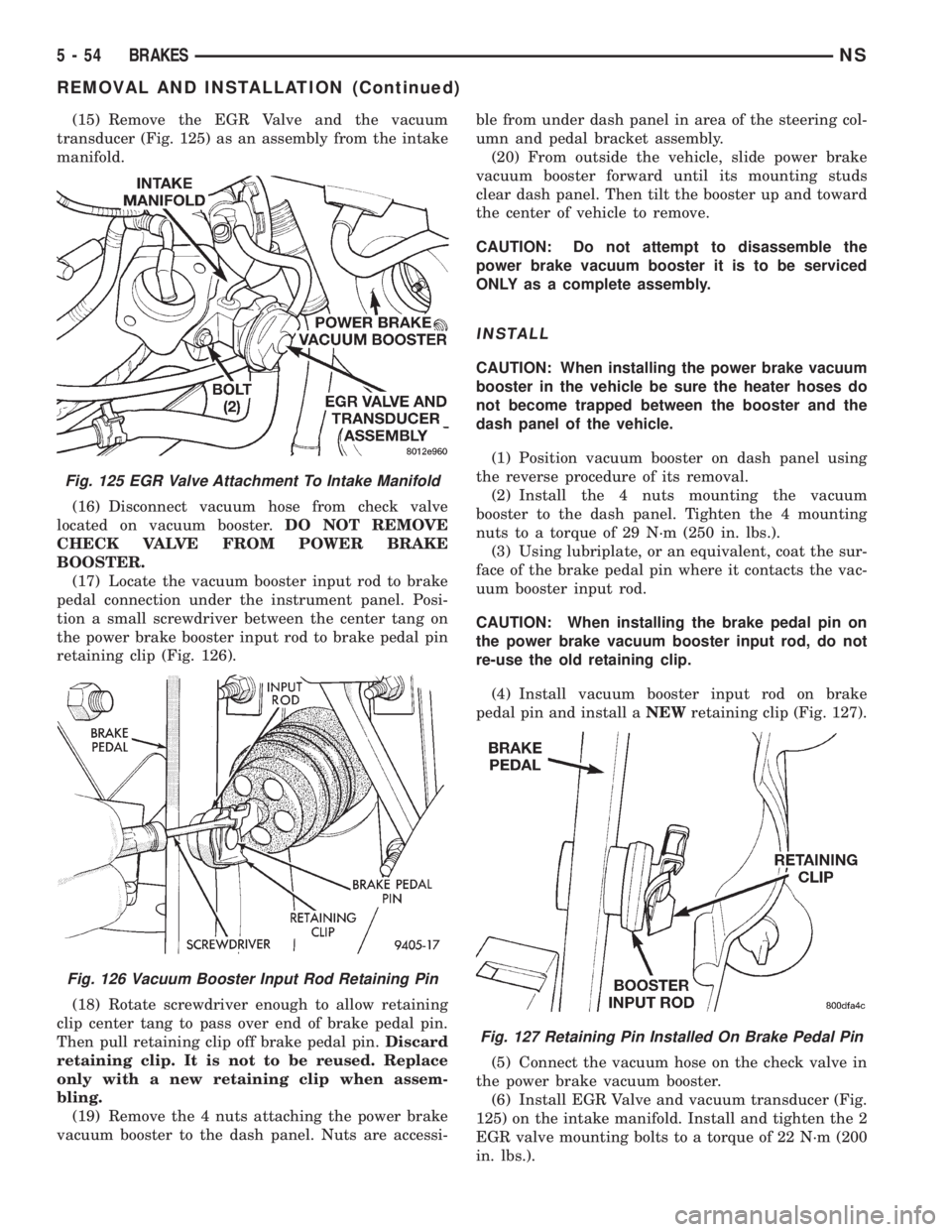
(15) Remove the EGR Valve and the vacuum
transducer (Fig. 125) as an assembly from the intake
manifold.
(16) Disconnect vacuum hose from check valve
located on vacuum booster.DO NOT REMOVE
CHECK VALVE FROM POWER BRAKE
BOOSTER.
(17) Locate the vacuum booster input rod to brake
pedal connection under the instrument panel. Posi-
tion a small screwdriver between the center tang on
the power brake booster input rod to brake pedal pin
retaining clip (Fig. 126).
(18) Rotate screwdriver enough to allow retaining
clip center tang to pass over end of brake pedal pin.
Then pull retaining clip off brake pedal pin.Discard
retaining clip. It is not to be reused. Replace
only with a new retaining clip when assem-
bling.
(19) Remove the 4 nuts attaching the power brake
vacuum booster to the dash panel. Nuts are accessi-ble from under dash panel in area of the steering col-
umn and pedal bracket assembly.
(20) From outside the vehicle, slide power brake
vacuum booster forward until its mounting studs
clear dash panel. Then tilt the booster up and toward
the center of vehicle to remove.
CAUTION: Do not attempt to disassemble the
power brake vacuum booster it is to be serviced
ONLY as a complete assembly.
INSTALL
CAUTION: When installing the power brake vacuum
booster in the vehicle be sure the heater hoses do
not become trapped between the booster and the
dash panel of the vehicle.
(1) Position vacuum booster on dash panel using
the reverse procedure of its removal.
(2) Install the 4 nuts mounting the vacuum
booster to the dash panel. Tighten the 4 mounting
nuts to a torque of 29 N´m (250 in. lbs.).
(3) Using lubriplate, or an equivalent, coat the sur-
face of the brake pedal pin where it contacts the vac-
uum booster input rod.
CAUTION: When installing the brake pedal pin on
the power brake vacuum booster input rod, do not
re-use the old retaining clip.
(4) Install vacuum booster input rod on brake
pedal pin and install aNEWretaining clip (Fig. 127).
(5) Connect the vacuum hose on the check valve in
the power brake vacuum booster.
(6) Install EGR Valve and vacuum transducer (Fig.
125) on the intake manifold. Install and tighten the 2
EGR valve mounting bolts to a torque of 22 N´m (200
in. lbs.).
Fig. 125 EGR Valve Attachment To Intake Manifold
Fig. 126 Vacuum Booster Input Rod Retaining Pin
Fig. 127 Retaining Pin Installed On Brake Pedal Pin
5 - 54 BRAKESNS
REMOVAL AND INSTALLATION (Continued)
Page 140 of 1938

INSTALL
(1) Install the hooked end of the actuator on the
proportioning valve lever (Fig. 136).Be sure isola-
tor bushing on lever of proportioning valve
(Fig. 136) is fully seated in hook of actuator.
NOTE: When installing height sensing proportion-
ing valve on mounting bracket be sure proportion-
ing valve shield (Fig. 135) is installed between the
proportioning valve and the mounting bracket.
(2) Install height sensing proportioning valve on
mounting bracket. Install the proportioning valve
attaching bolts (Fig. 135). Tighten the attaching bolts
to a torque of 23 N´m (200 in. lbs.).
(3) Install the 4 chassis brake lines (Fig. 134) into
the inlet and outlet ports of the proportioning valve.
Tighten all 4 line nuts to a torque of 16 N´m (142 in.
lbs.).
(4) Adjust the proportioning valve actuator. See
Height Sensing Proportioning Valve in the Adjust-
ment Section in this group of the service manual for
the adjustment procedure.
(5) Bleed the brake system thoroughly to ensure
that all air has been expelled from the hydraulic sys-
tem. See Bleeding Brake System in the Service
Adjustments section in this group of the service man-
ual for the proper bleeding procedure.
(6) Lower the vehicle to the ground.
(7) Road test the vehicle to verify proper operation
of the vehicles brake system.
HYDRAULIC BRAKE TUBES AND HOSES
CAUTION: When installing brake chassis lines or
flex hoses on the vehicle, the correct fasteners
must be used to attach the routing clips or hoses to
the front suspension cradle. The fasteners used toattach components to the front suspension cradle
have an antiÐcorrosion coating due to the suspen-
sion cradle being made of aluminum. Only Mopar
replacement fasteners with the required anti-corro-
sion coating are to be used if a replacement fas-
tener is required when installing a brake chassis
line or flex hose.
Only double wall 4.75mm (3/16 in.) steel tubing
with Al-rich/ZW-AC alloy coating and the correct tube
nuts are to be used for replacement of a hydraulic
brake tube.
NOTE: On vehicles equipped with traction control,
the primary and secondary hydraulic tubes between
the master cylinder and the hydraulic control unit
are 6 mm (15/64 in.). These tubes are also coated
with the Al-rich/ZW-AC alloy and must be replaced
with tubes having the same anti-corrosion coating.
Be sure that the correct tube nuts are used for the
replacement of these hydraulic brake tubes.
Care should be taken when replacing brake tubing,
to be sure the proper bending and flaring tools and
procedures are used, to avoid kinking. Do not route
the tubes against sharp edges, moving components or
into hot areas. All tubes should be properly attached
with recommended retaining clips.
If the primary or secondary brake tube from the
master cylinder to the ABS Hydraulic Control Unit
(HCU) or the brake tubes from the HCU to the pro-
portioing valve require replacement,onlythe origi-
nal factory brake line containing the flexible section
can be used as the replacement part. This is required
due to cradle movement while the vehicle is in
motion.
PARK BRAKE PEDAL MECHANISM
REMOVE
(1) Disconnect negative (ground) cable from the
battery and isolate cable from battery terminal.
(2) Remove sill scuff plate from left door sill.
(3) Remove the left side kick panel.
(4) Remove the steering column cover from the
lower instrument panel.
(5) Remove the reinforcement from the lower
instrument panel.
(6) Lock out front park brake cable using the fol-
lowing procedure. Grasp the exposed section of the
front park brake cable and pull rearward on it. While
holding the park brake in this position, install a pair
of locking pliers on the front park brake cable just
rearward of the second body outrigger bracket (Fig.
137).
(7) Remove the front park brake cable from the
park brake cable equalizer.
Fig. 136 Actuator Attachment To Proportioning
Valve
5 - 58 BRAKESNS
REMOVAL AND INSTALLATION (Continued)
Page 141 of 1938

(8) Remove tension from front park brake cable.
Tension is removed by releasing the locking pliers
from the front park brake cable.
(9) Remove the 3 bolts mounting the wiring junc-
tion block to the instrument panel.
NOTE: When removing the lower mounting bolt,
push the park brake pedal down 5 clicks to access
the lower mounting bolt.
(10) Remove the lower bolt mounting the park
brake pedal to the body.
(11) Remove the forward bolt mounting the park
brake pedal to the body.
(12) Remove the upper bolt mounting the park
brake pedal to the body.
(13) Disconnect the electrical connector for the
brake light switch (Fig. 138).
(14) Pull downward on front park brake cable
while rotating park brake pedal mechanism out from
behind junction block.
(15) Remove park brake pedal release cable (Fig.
138) from park brake mechanism.
(16) Remove the ground switch for the red brake
warning lamp from the park brake pedal mechanism.
(17) Remove front park brake cable button from
park brake pedal mechanism. Tap end housing of
front park brake cable out of park brake pedal mech-
anism (Fig. 138).
INSTALL
(1) Install the ground switch for the red brake
warning lamp on the park brake pedal mechanism
(2) Install park brake cable end housing (Fig. 138)
into park brake pedal mechanism.
(3) Install cable retainer (Fig. 138) onto the park
brake cable strand and then install retainer into
pedal bracket.(4) Install cable strand button into the clevis on
the park brake pedal mechanism.
(5) Install wiring harness connector on red brake
warning lamp ground switch.
(6) Install the park brake release cable on the
release mechanism of the park brake pedal.
(7) Position the park brake pedal mechanism into
its installed position on the body of the vehicle.
(8) Remove the lock-out pin from the park brake
pedal release mechanism.
(9) Loosely install the top bolt (Fig. 138) mounting
the park brake pedal mechanism to the body.
(10) Loosely install the forward bolt (Fig. 138)
mounting the park brake pedal mechanism to the
body.
(11) Loosely install the lower bolt (Fig. 138)
mounting the park brake pedal mechanism to the
body.
(12) Tighten pedal mechanism attaching bolts to
28 N´m (250 in. lbs.).
(13) Verify that the park brake pedal is in the fully
released (full up) position.
(14) Raise vehicle.
(15) Install the front park brake cable on the park
brake cable equalizer.
(16) Lower vehicle.
(17) Remove the lock-out pin (Fig. 138) from the
automatic cable adjuster on the park brake pedal
mechanism.
(18) Install the electrical junction block on the
instrument panel.
(19) Install the reinforcement on the lower instru-
ment panel.
(20) Install the steering column cover on the lower
instrument panel.
(21) Install the left side kick panel.
(22) Install the sill scuff plate on the lower sill of
the left door.
Fig. 137 Locking Out Automatic AdjusterFig. 138 Park Brake Pedal Mounting
NSBRAKES 5 - 59
REMOVAL AND INSTALLATION (Continued)
Page 164 of 1938

(13) Lower the vehicle to the ground.Be sure
that the suspension is supporting the full
weight of the vehicle.
(14) Tighten the spring to front hanger pivot bolts
to a torque of 156 N´m (115 ft. lbs.).
(15) Tighten the shock absorber mounting bolts to
a torque of 101 N´m (75 ft. lbs.).
(16) Tighten the track bar mounting bolt to a
torque of 95 N´m (70 ft. lbs.).
(17) Road test vehicle to ensure that the prema-
ture rear wheel lockup condition has been corrected.
SPECIFICATIONS
BRAKE FLUID
The brake fluid used in this vehicle must conform
to DOT 3 specifications and SAE J1703 standards.No other type of brake fluid is recommended or
approved for usage in the vehicle brake system. Use
only Mopar brake fluid or an equivalent from a
tightly sealed container.
CAUTION: Never use reclaimed brake fluid or fluid
from an container which has been left open. An
open container will absorb moisture from the air
and contaminate the fluid.
CAUTION: Never use any type of a petroleum-
based fluid in the brake hydraulic system. Use of
such type fluids will result in seal damage of the
vehicle brake hydraulic system causing a failure of
the vehicle brake system. Petroleum based fluids
would be items such as engine oil, transmission
fluid, power steering fluid ect.
VEHICLE BRAKE SYSTEM COMPONENT SPECIFICATIONS
Brake System Component Specifications
5 - 82 BRAKESNS
ADJUSTMENTS (Continued)
Page 165 of 1938

BRAKE ACTUATION SYSTEM
ACTUATION:
Vacuum Operated Power Brakes.........Standard
Hydraulic System...........Dual-Diagonally Split
Antilock Brake Sytem (Teves Mark-20)...........
MASTER CYLINDER ASSEMBLY:
Supplier..............................Bosch
Type For Non-ABSAnd
ABS Brakes. . . .Conventional Compensating Port
Type For ABS Brakes
With Traction Control . . .Dual Center Port Design
Body Material...............Anodized Aluminum
Reservoir Material................Polypropelene
MASTER CYLINDER BORE /
STROKE AND SPLIT:
ABS W/Disc/Drum Brakes......23.8 mm x 36 mm
(.937 in. x 1.47 in.)
AWD W/Disc/Disc Brakes........25.4 mm x 39 mm
(1.00 in. x 1.50 in.)
Displacement Split.....................50/50
MASTER CYLINDER FLUID OUTLET PORTS:
Non-ABS And ABS . . .Primary 7/16±24 Secondary 7/
16±24
ABS With Traction Control.......Primary M12 x 1
Secondary M12 x 1
Outlet Fitting Type Non-ABS
AndABS...........Double Wall Inverted Flare
Outlet Fitting Type ABS With
Traction Control...................ISO Flare
ABS HYDRAULIC CONTROL UNIT:
Hydraulic Tube Fitting Type............ISO Flare
BOOSTER:
Make/Type.................Bosch Vacuum Assist
Mounting Studs.....................M8x1.25
Type .........................270 ZLT RSMV
Boost At 20 inches Of
Manifold Vacuum...........3800 N´m (850 lbs.)
PROPORTIONING VALVE:
Material...........................Aluminum
Function....................Hydraulic Pressure
Proportioning To Rear Brakes
BRAKE PEDAL
Pedal Ratio.............................3.36
BRAKE FASTENER TORQUE SPECIFICATIONS
DESCRIPTION TORQUE
BRAKE TUBES:
Tube Nuts To Fittings And
Components..............17N´m(145 in. lbs.)
BRAKE HOSE:
To Caliper Banjo Bolt..........48N´m(35ft.lbs.)
Intermediate Bracket.........12N´m(105 in. lbs.)
MASTER CYLINDER:
To Vacuum Booster
Mounting Nut............25N´m(225 in. lbs.)
FIXED PROPORTIONING VALVE:
To Frame Rail Attaching
Bolts....................14N´m(125 in. lbs.)
HEIGHT SENSING PROPORTIONING VALVE:
To Mounting Bracket
Attaching Bolts...........23N´m(200 in. lbs.)
Actuator Assembly
Adjustment Nut.............5N´m(45in.lbs.)
Mounting Bracket To Frame
Rail Bolts................17N´m(150 in. lbs.)
JUNCTION BLOCK (NON-ABS BRAKES)
To Suspension Cradle
Mounting Bolt............28N´m(250 in. lbs.)
VACUUM BOOSTER:
To Dash Panel Mounting
Nuts....................28N´m(250 in. lbs.)
REAR WHEEL CYLINDER:
To Support Plate Mounting
Bolts.....................8N´m(75in.lbs.)
Bleeder Screw...............10N´m(80in.lbs.)
BRAKE SUPPORT PLATE:
To Rear Axle Mounting Bolts . . .130 N´m (95 ft. lbs.)
DISC BRAKE CALIPER:
Guide Pin Bolts..............41N´m(30ft.lbs.)
Bleeder Screw..............15N´m(125 in. lbs.)
ABS HYDRAULIC CONTROL UNIT:
Mounting Bracket To
Suspension Cradle Bolts.....28N´m(250 in. lbs.)
To Mounting Bracket Isolator
Attaching Bolts............11N´m(97in.lbs.)
CAB To HCU Mounting Screws . . .2 N´m (17 in. lbs.)
WHEEL SPEED SENSOR:
To Axle Or Steering Knuckle
Mounting Bolt............12N´m(105 in. lbs.)
PARKING BRAKE:
Pedal Assembly Mounting
Bolts....................28N´m(250 in. lbs.)
REAR HUB AND BEARING:
To Axle Mounting Bolts........129 N´m (95 ft. lbs.)
WHEEL:
Stud Lug Nut........115±156 N´m (84-115 ft. lbs.)
NSBRAKES 5 - 83
SPECIFICATIONS (Continued)