1996 CHRYSLER VOYAGER brake
[x] Cancel search: brakePage 1906 of 1938
cranking. Whenever the Powertrain Control Module
(PCM) sets a Diagnostic Trouble Code (DTC) that
affects vehicle emissions, it illuminates the MIL. If a
problem is detected, the PCM sends a message over
the CCD Bus to the instrument cluster to illuminate
the lamp. The PCM illuminates the MIL only for
DTC's that affect vehicle emissions. The MIL stays
on continuously when the PCM has entered a
Limp-In mode or identified a failed emission compo-
nent or system. The MIL remains on until the DTC
is erased. Refer to the Diagnostic Trouble Code
charts in this group for emission related codes.
Also, the MIL either flashes or illuminates contin-
uously when the PCM detects active engine misfire.
Refer to Misfire Monitoring in this section.
Additionally, the PCM may reset (turn off) the MIL
when one of the following occur:
²PCM does not detect the malfunction for 3 con-
secutive trips (except misfire and fuel system moni-
tors).
²PCM does not detect a malfunction while per-
forming three successive engine misfire or fuel sys-
tem tests. The PCM performs these tests while the
engine is operating within6375 RPM of and within
10 % of the load of the operating condition at which
the malfunction was first detected.
STATE DISPLAY TEST MODE
The switch inputs to the Powertrain Control Mod-
ule (PCM) have two recognized states; HIGH and
LOW. For this reason, the PCM cannot recognize the
difference between a selected switch position versus
an open circuit, a short circuit, or a defective switch.
If the State Display screen shows the change from
HIGH to LOW or LOW to HIGH, assume the entire
switch circuit to the PCM functions properly. From
the state display screen, access either State Display
Inputs and Outputs or State Display Sensors.
STATE DISPLAY INPUTS AND OUTPUTS
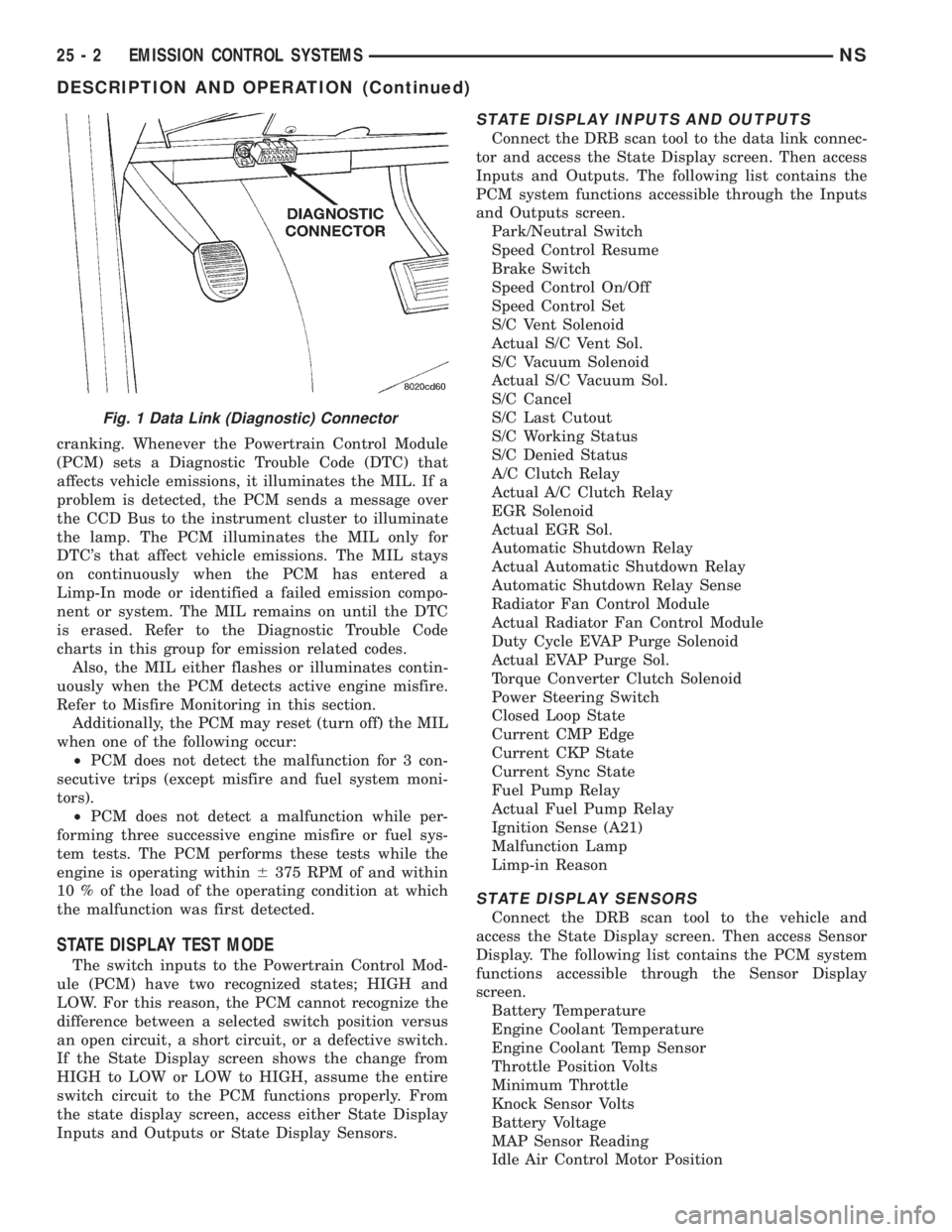
Connect the DRB scan tool to the data link connec-
tor and access the State Display screen. Then access
Inputs and Outputs. The following list contains the
PCM system functions accessible through the Inputs
and Outputs screen.
Park/Neutral Switch
Speed Control Resume
Brake Switch
Speed Control On/Off
Speed Control Set
S/C Vent Solenoid
Actual S/C Vent Sol.
S/C Vacuum Solenoid
Actual S/C Vacuum Sol.
S/C Cancel
S/C Last Cutout
S/C Working Status
S/C Denied Status
A/C Clutch Relay
Actual A/C Clutch Relay
EGR Solenoid
Actual EGR Sol.
Automatic Shutdown Relay
Actual Automatic Shutdown Relay
Automatic Shutdown Relay Sense
Radiator Fan Control Module
Actual Radiator Fan Control Module
Duty Cycle EVAP Purge Solenoid
Actual EVAP Purge Sol.
Torque Converter Clutch Solenoid
Power Steering Switch
Closed Loop State
Current CMP Edge
Current CKP State
Current Sync State
Fuel Pump Relay
Actual Fuel Pump Relay
Ignition Sense (A21)
Malfunction Lamp
Limp-in Reason
STATE DISPLAY SENSORS
Connect the DRB scan tool to the vehicle and
access the State Display screen. Then access Sensor
Display. The following list contains the PCM system
functions accessible through the Sensor Display
screen.
Battery Temperature
Engine Coolant Temperature
Engine Coolant Temp Sensor
Throttle Position Volts
Minimum Throttle
Knock Sensor Volts
Battery Voltage
MAP Sensor Reading
Idle Air Control Motor Position
Fig. 1 Data Link (Diagnostic) Connector
25 - 2 EMISSION CONTROL SYSTEMSNS
DESCRIPTION AND OPERATION (Continued)
Page 1911 of 1938
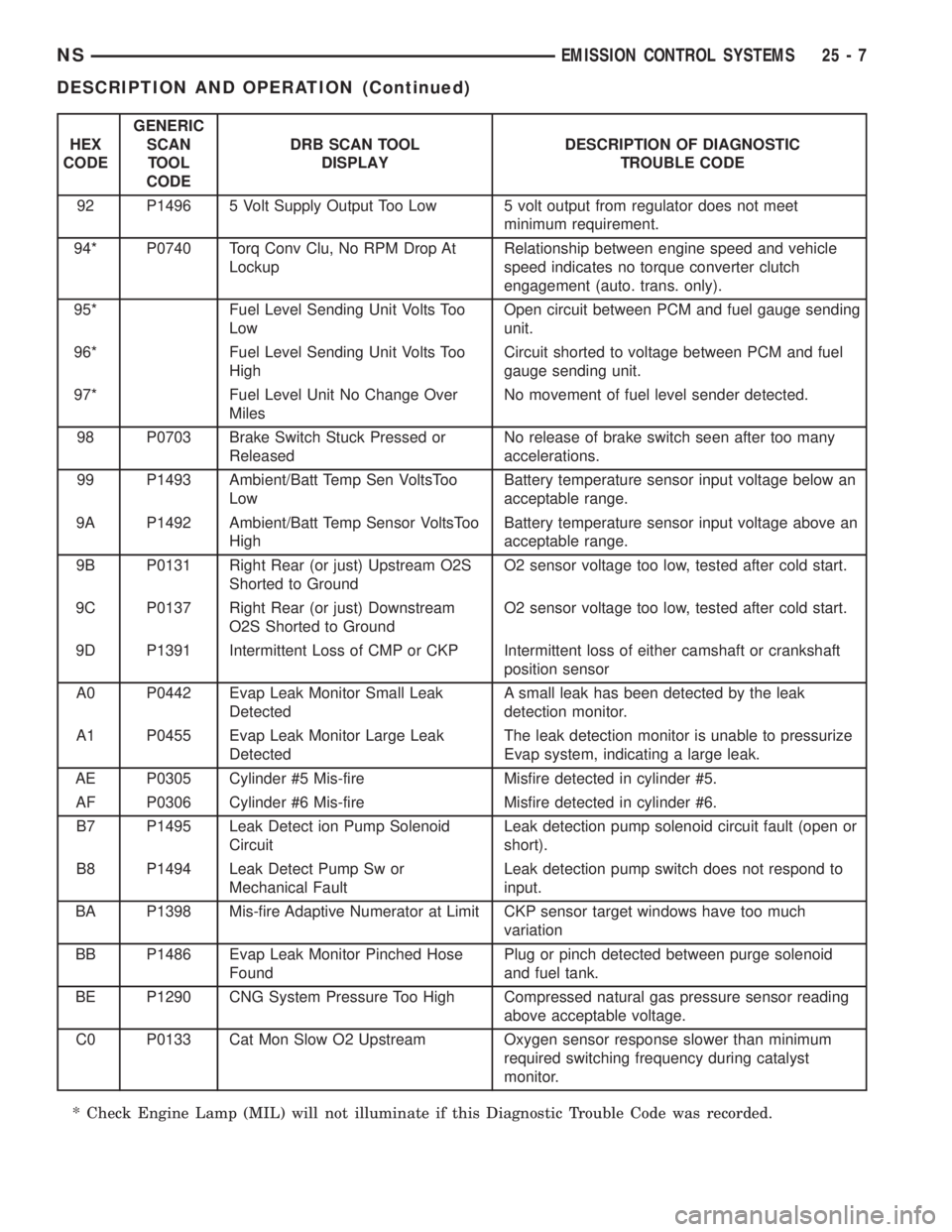
HEX
CODEGENERIC
SCAN
TOOL
CODEDRB SCAN TOOL
DISPLAYDESCRIPTION OF DIAGNOSTIC
TROUBLE CODE
92 P1496 5 Volt Supply Output Too Low 5 volt output from regulator does not meet
minimum requirement.
94* P0740 Torq Conv Clu, No RPM Drop At
LockupRelationship between engine speed and vehicle
speed indicates no torque converter clutch
engagement (auto. trans. only).
95* Fuel Level Sending Unit Volts Too
LowOpen circuit between PCM and fuel gauge sending
unit.
96* Fuel Level Sending Unit Volts Too
HighCircuit shorted to voltage between PCM and fuel
gauge sending unit.
97* Fuel Level Unit No Change Over
MilesNo movement of fuel level sender detected.
98 P0703 Brake Switch Stuck Pressed or
ReleasedNo release of brake switch seen after too many
accelerations.
99 P1493 Ambient/Batt Temp Sen VoltsToo
LowBattery temperature sensor input voltage below an
acceptable range.
9A P1492 Ambient/Batt Temp Sensor VoltsToo
HighBattery temperature sensor input voltage above an
acceptable range.
9B P0131 Right Rear (or just) Upstream O2S
Shorted to GroundO2 sensor voltage too low, tested after cold start.
9C P0137 Right Rear (or just) Downstream
O2S Shorted to GroundO2 sensor voltage too low, tested after cold start.
9D P1391 Intermittent Loss of CMP or CKP Intermittent loss of either camshaft or crankshaft
position sensor
A0 P0442 Evap Leak Monitor Small Leak
DetectedA small leak has been detected by the leak
detection monitor.
A1 P0455 Evap Leak Monitor Large Leak
DetectedThe leak detection monitor is unable to pressurize
Evap system, indicating a large leak.
AE P0305 Cylinder #5 Mis-fire Misfire detected in cylinder #5.
AF P0306 Cylinder #6 Mis-fire Misfire detected in cylinder #6.
B7 P1495 Leak Detect ion Pump Solenoid
CircuitLeak detection pump solenoid circuit fault (open or
short).
B8 P1494 Leak Detect Pump Sw or
Mechanical FaultLeak detection pump switch does not respond to
input.
BA P1398 Mis-fire Adaptive Numerator at Limit CKP sensor target windows have too much
variation
BB P1486 Evap Leak Monitor Pinched Hose
FoundPlug or pinch detected between purge solenoid
and fuel tank.
BE P1290 CNG System Pressure Too High Compressed natural gas pressure sensor reading
above acceptable voltage.
C0 P0133 Cat Mon Slow O2 Upstream Oxygen sensor response slower than minimum
required switching frequency during catalyst
monitor.
* Check Engine Lamp (MIL) will not illuminate if this Diagnostic Trouble Code was recorded.
NSEMISSION CONTROL SYSTEMS 25 - 7
DESCRIPTION AND OPERATION (Continued)
Page 1920 of 1938
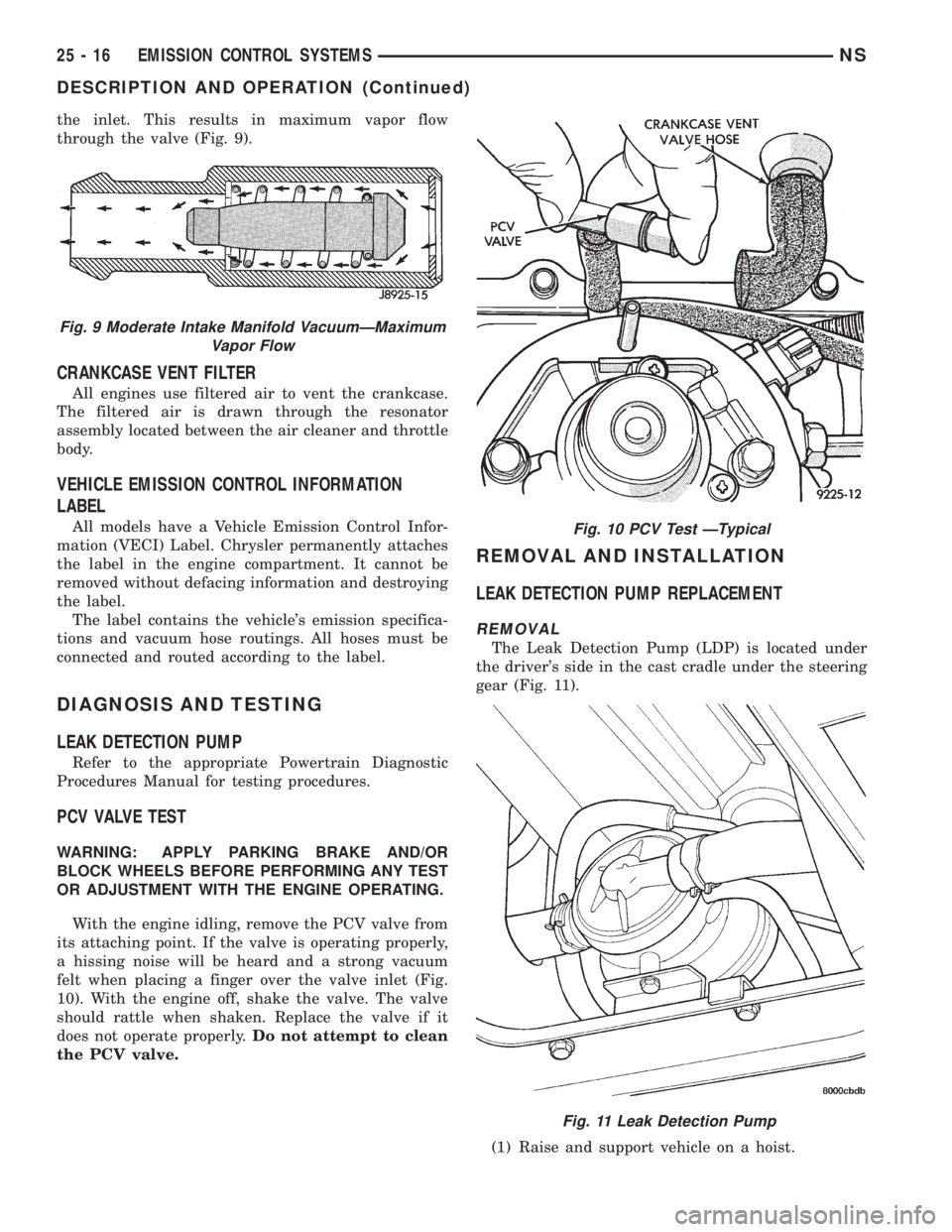
the inlet. This results in maximum vapor flow
through the valve (Fig. 9).
CRANKCASE VENT FILTER
All engines use filtered air to vent the crankcase.
The filtered air is drawn through the resonator
assembly located between the air cleaner and throttle
body.
VEHICLE EMISSION CONTROL INFORMATION
LABEL
All models have a Vehicle Emission Control Infor-
mation (VECI) Label. Chrysler permanently attaches
the label in the engine compartment. It cannot be
removed without defacing information and destroying
the label.
The label contains the vehicle's emission specifica-
tions and vacuum hose routings. All hoses must be
connected and routed according to the label.
DIAGNOSIS AND TESTING
LEAK DETECTION PUMP
Refer to the appropriate Powertrain Diagnostic
Procedures Manual for testing procedures.
PCV VALVE TEST
WARNING: APPLY PARKING BRAKE AND/OR
BLOCK WHEELS BEFORE PERFORMING ANY TEST
OR ADJUSTMENT WITH THE ENGINE OPERATING.
With the engine idling, remove the PCV valve from
its attaching point. If the valve is operating properly,
a hissing noise will be heard and a strong vacuum
felt when placing a finger over the valve inlet (Fig.
10). With the engine off, shake the valve. The valve
should rattle when shaken. Replace the valve if it
does not operate properly.Do not attempt to clean
the PCV valve.
REMOVAL AND INSTALLATION
LEAK DETECTION PUMP REPLACEMENT
REMOVAL
The Leak Detection Pump (LDP) is located under
the driver's side in the cast cradle under the steering
gear (Fig. 11).
(1) Raise and support vehicle on a hoist.
Fig. 9 Moderate Intake Manifold VacuumÐMaximum
Vapor Flow
Fig. 10 PCV Test ÐTypical
Fig. 11 Leak Detection Pump
25 - 16 EMISSION CONTROL SYSTEMSNS
DESCRIPTION AND OPERATION (Continued)
Page 1923 of 1938
the amount of EGR supplied to the engine. This pro-
vides the correct amount of exhaust gas recirculation
for different operating conditions.
This system does not allow EGR at idle. The EGR
systems can operate at all coolant temperatures
above 60ÉF as long as the battery ambient tempera-
ture is above 7ÉF.
DIAGNOSIS AND TESTING
EGR SYSTEM ON-BOARD DIAGNOSTICS
The PCM performs an on-board diagnostic check of
the EGR system. The diagnostic system uses the
electronic EGR transducer for the system tests.
The diagnostic check activates only during selected
engine/driving conditions. When the conditions are
met, the PCM energizes the transducer solenoid to
disable the EGR. The PCM checks for a change in
the heated oxygen sensor signal. If the air-fuel mix-
ture goes lean, the PCM will attempt to enrichen the
mixture. The PCM registers a Diagnostic Trouble
Code (DTC) if the EGR system is not operating cor-
rectly. After registering a DTC, the PCM turns on the
malfunction indicator (Check Engine) lamp after 2
consecutive trips. There are 2 types of failures sensed
by the PCM. The first is a short or open in the elec-
trical solenoid circuit. The second is a mechanical
failure or loss of vacuum. The Malfunction Indicator
Lamp (MIL) indicates the need for service.
If a problem is indicated by the MIL and a DTC for
the EGR system is set, check for proper operation of
the EGR system. Use the System Test, EGR Gas
Flow Test. If the EGR system tests properly, check
the system using the DRB scan tool. Refer to
On-Board Diagnosis sections in this Group. Also,
refer to the DRB scan tool and the appropriate Pow-
ertrain Diagnostics Procedure manual.
EGR SYSTEM TEST
WARNING: APPLY PARKING BRAKE AND/OR
BLOCK WHEELS BEFORE TESTING THE EGR SYS-
TEM.
(1) Check the condition of all EGR system hoses
and tubes for leaks, cracks, kinks and hardening of
rubber hoses. Repair and correct these conditions
before performing any tests.
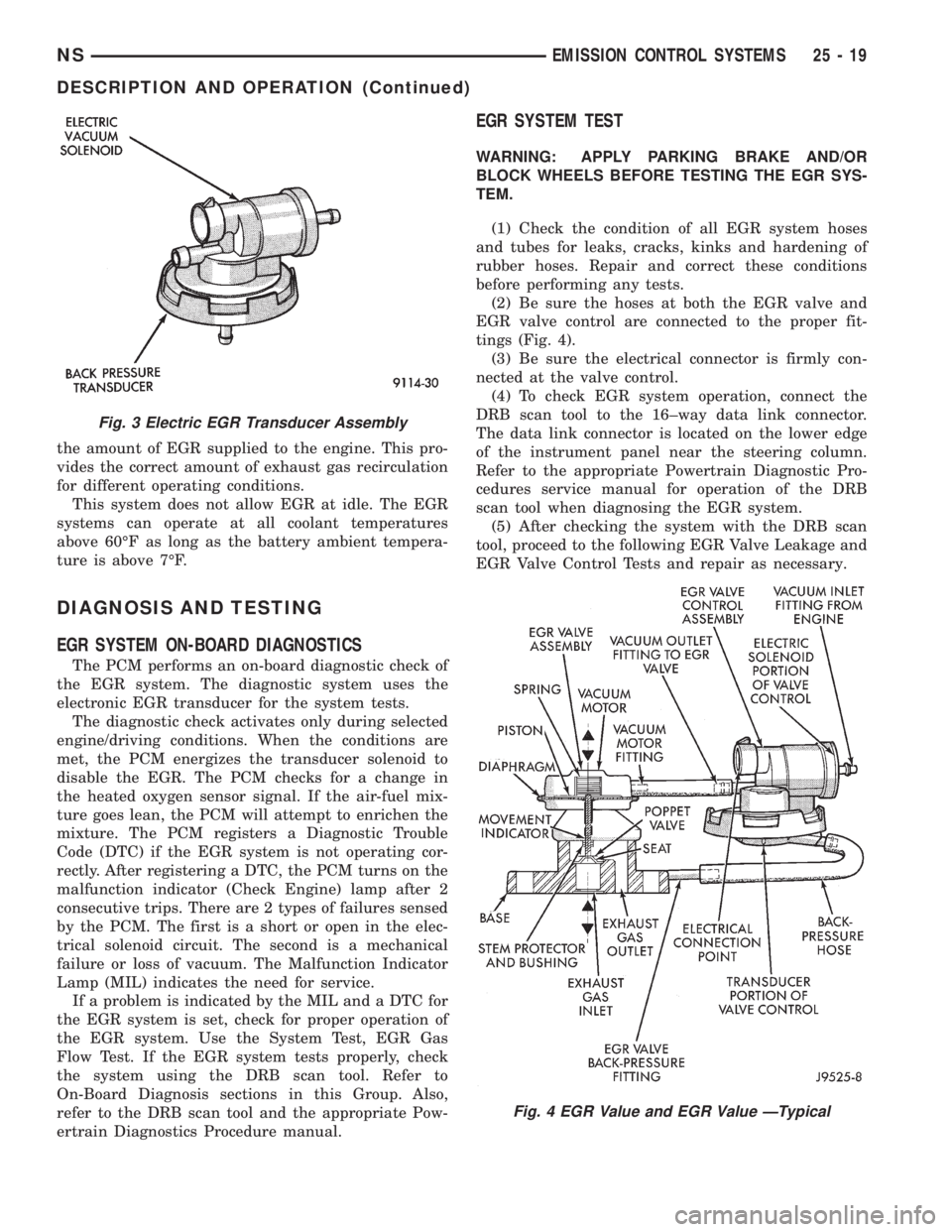
(2) Be sure the hoses at both the EGR valve and
EGR valve control are connected to the proper fit-
tings (Fig. 4).
(3) Be sure the electrical connector is firmly con-
nected at the valve control.
(4) To check EGR system operation, connect the
DRB scan tool to the 16±way data link connector.
The data link connector is located on the lower edge
of the instrument panel near the steering column.
Refer to the appropriate Powertrain Diagnostic Pro-
cedures service manual for operation of the DRB
scan tool when diagnosing the EGR system.
(5) After checking the system with the DRB scan
tool, proceed to the following EGR Valve Leakage and
EGR Valve Control Tests and repair as necessary.
Fig. 3 Electric EGR Transducer Assembly
Fig. 4 EGR Value and EGR Value ÐTypical
NSEMISSION CONTROL SYSTEMS 25 - 19
DESCRIPTION AND OPERATION (Continued)
Page 1932 of 1938
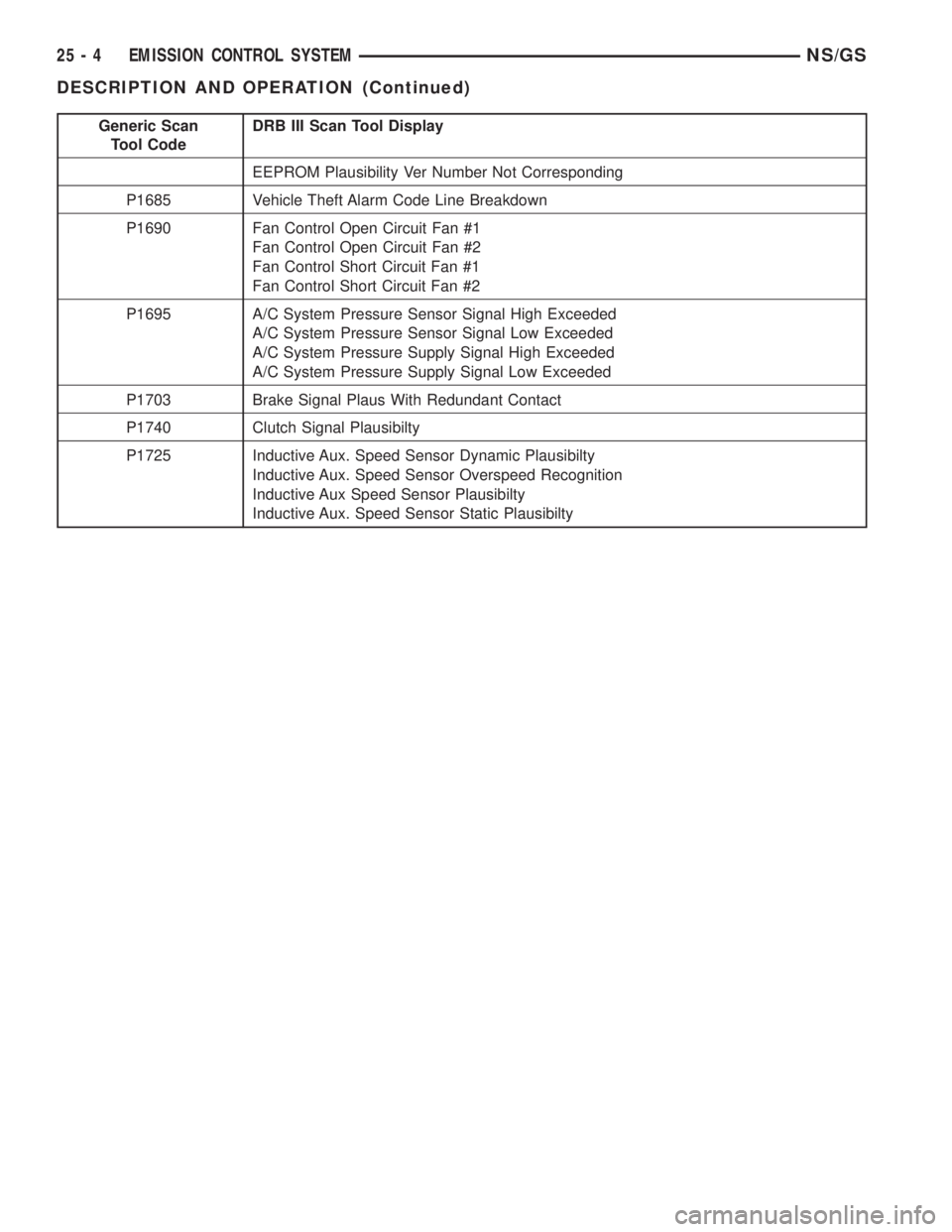
Generic Scan
Tool CodeDRB III Scan Tool Display
EEPROM Plausibility Ver Number Not Corresponding
P1685 Vehicle Theft Alarm Code Line Breakdown
P1690 Fan Control Open Circuit Fan #1
Fan Control Open Circuit Fan #2
Fan Control Short Circuit Fan #1
Fan Control Short Circuit Fan #2
P1695 A/C System Pressure Sensor Signal High Exceeded
A/C System Pressure Sensor Signal Low Exceeded
A/C System Pressure Supply Signal High Exceeded
A/C System Pressure Supply Signal Low Exceeded
P1703 Brake Signal Plaus With Redundant Contact
P1740 Clutch Signal Plausibilty
P1725 Inductive Aux. Speed Sensor Dynamic Plausibilty
Inductive Aux. Speed Sensor Overspeed Recognition
Inductive Aux Speed Sensor Plausibilty
Inductive Aux. Speed Sensor Static Plausibilty
25 - 4 EMISSION CONTROL SYSTEMNS/GS
DESCRIPTION AND OPERATION (Continued)
Page 1934 of 1938
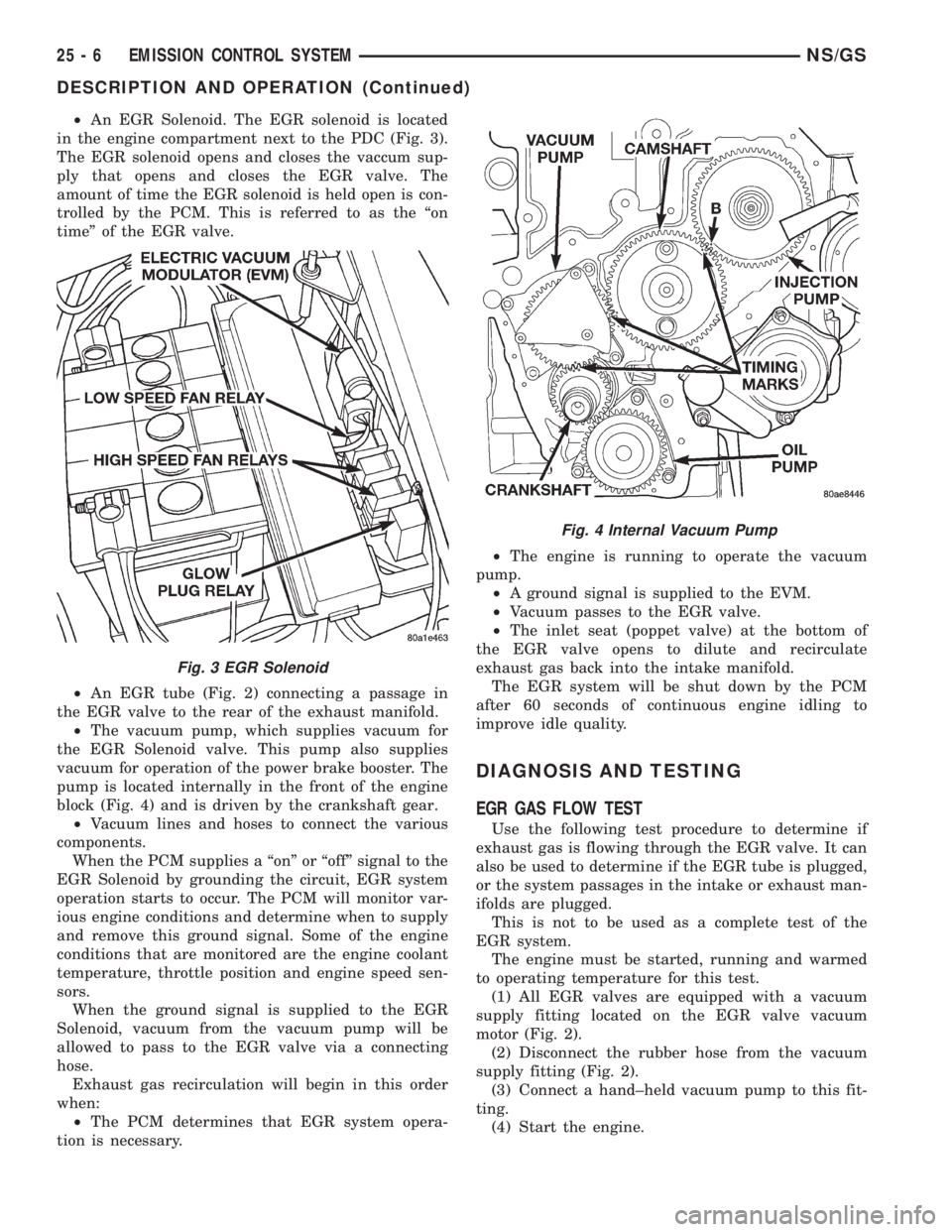
²An EGR Solenoid. The EGR solenoid is located
in the engine compartment next to the PDC (Fig. 3).
The EGR solenoid opens and closes the vaccum sup-
ply that opens and closes the EGR valve. The
amount of time the EGR solenoid is held open is con-
trolled by the PCM. This is referred to as the ªon
timeº of the EGR valve.
²An EGR tube (Fig. 2) connecting a passage in
the EGR valve to the rear of the exhaust manifold.
²The vacuum pump, which supplies vacuum for
the EGR Solenoid valve. This pump also supplies
vacuum for operation of the power brake booster. The
pump is located internally in the front of the engine
block (Fig. 4) and is driven by the crankshaft gear.
²Vacuum lines and hoses to connect the various
components.
When the PCM supplies a ªonº or ªoffº signal to the
EGR Solenoid by grounding the circuit, EGR system
operation starts to occur. The PCM will monitor var-
ious engine conditions and determine when to supply
and remove this ground signal. Some of the engine
conditions that are monitored are the engine coolant
temperature, throttle position and engine speed sen-
sors.
When the ground signal is supplied to the EGR
Solenoid, vacuum from the vacuum pump will be
allowed to pass to the EGR valve via a connecting
hose.
Exhaust gas recirculation will begin in this order
when:
²The PCM determines that EGR system opera-
tion is necessary.²The engine is running to operate the vacuum
pump.
²A ground signal is supplied to the EVM.
²Vacuum passes to the EGR valve.
²The inlet seat (poppet valve) at the bottom of
the EGR valve opens to dilute and recirculate
exhaust gas back into the intake manifold.
The EGR system will be shut down by the PCM
after 60 seconds of continuous engine idling to
improve idle quality.
DIAGNOSIS AND TESTING
EGR GAS FLOW TEST
Use the following test procedure to determine if
exhaust gas is flowing through the EGR valve. It can
also be used to determine if the EGR tube is plugged,
or the system passages in the intake or exhaust man-
ifolds are plugged.
This is not to be used as a complete test of the
EGR system.
The engine must be started, running and warmed
to operating temperature for this test.
(1) All EGR valves are equipped with a vacuum
supply fitting located on the EGR valve vacuum
motor (Fig. 2).
(2) Disconnect the rubber hose from the vacuum
supply fitting (Fig. 2).
(3) Connect a hand±held vacuum pump to this fit-
ting.
(4) Start the engine.
Fig. 3 EGR Solenoid
Fig. 4 Internal Vacuum Pump
25 - 6 EMISSION CONTROL SYSTEMNS/GS
DESCRIPTION AND OPERATION (Continued)
Page 1935 of 1938
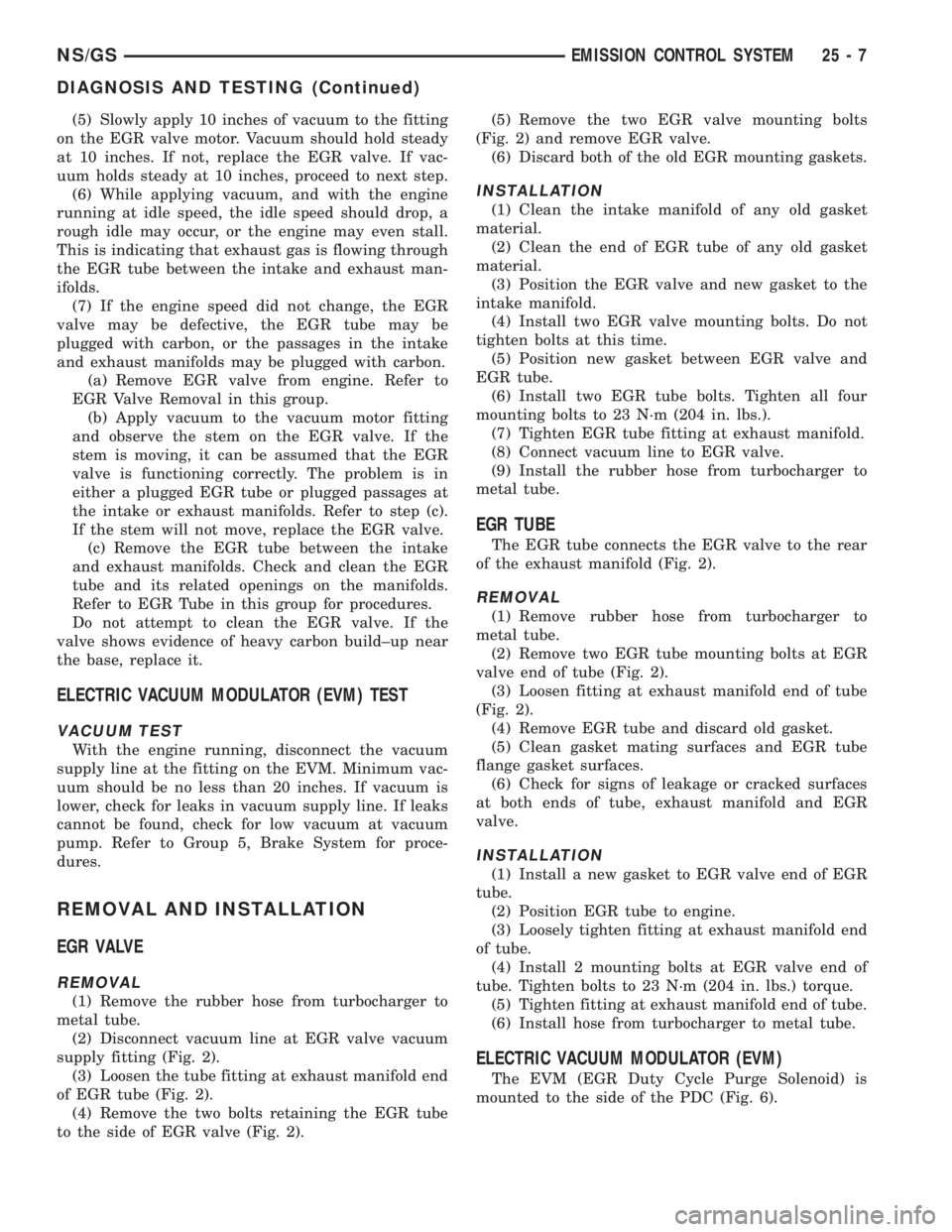
(5) Slowly apply 10 inches of vacuum to the fitting
on the EGR valve motor. Vacuum should hold steady
at 10 inches. If not, replace the EGR valve. If vac-
uum holds steady at 10 inches, proceed to next step.
(6) While applying vacuum, and with the engine
running at idle speed, the idle speed should drop, a
rough idle may occur, or the engine may even stall.
This is indicating that exhaust gas is flowing through
the EGR tube between the intake and exhaust man-
ifolds.
(7) If the engine speed did not change, the EGR
valve may be defective, the EGR tube may be
plugged with carbon, or the passages in the intake
and exhaust manifolds may be plugged with carbon.
(a) Remove EGR valve from engine. Refer to
EGR Valve Removal in this group.
(b) Apply vacuum to the vacuum motor fitting
and observe the stem on the EGR valve. If the
stem is moving, it can be assumed that the EGR
valve is functioning correctly. The problem is in
either a plugged EGR tube or plugged passages at
the intake or exhaust manifolds. Refer to step (c).
If the stem will not move, replace the EGR valve.
(c) Remove the EGR tube between the intake
and exhaust manifolds. Check and clean the EGR
tube and its related openings on the manifolds.
Refer to EGR Tube in this group for procedures.
Do not attempt to clean the EGR valve. If the
valve shows evidence of heavy carbon build±up near
the base, replace it.
ELECTRIC VACUUM MODULATOR (EVM) TEST
VACUUM TEST
With the engine running, disconnect the vacuum
supply line at the fitting on the EVM. Minimum vac-
uum should be no less than 20 inches. If vacuum is
lower, check for leaks in vacuum supply line. If leaks
cannot be found, check for low vacuum at vacuum
pump. Refer to Group 5, Brake System for proce-
dures.
REMOVAL AND INSTALLATION
EGR VALVE
REMOVAL
(1) Remove the rubber hose from turbocharger to
metal tube.
(2) Disconnect vacuum line at EGR valve vacuum
supply fitting (Fig. 2).
(3) Loosen the tube fitting at exhaust manifold end
of EGR tube (Fig. 2).
(4) Remove the two bolts retaining the EGR tube
to the side of EGR valve (Fig. 2).(5) Remove the two EGR valve mounting bolts
(Fig. 2) and remove EGR valve.
(6) Discard both of the old EGR mounting gaskets.
INSTALLATION
(1) Clean the intake manifold of any old gasket
material.
(2) Clean the end of EGR tube of any old gasket
material.
(3) Position the EGR valve and new gasket to the
intake manifold.
(4) Install two EGR valve mounting bolts. Do not
tighten bolts at this time.
(5) Position new gasket between EGR valve and
EGR tube.
(6) Install two EGR tube bolts. Tighten all four
mounting bolts to 23 N´m (204 in. lbs.).
(7) Tighten EGR tube fitting at exhaust manifold.
(8) Connect vacuum line to EGR valve.
(9) Install the rubber hose from turbocharger to
metal tube.
EGR TUBE
The EGR tube connects the EGR valve to the rear
of the exhaust manifold (Fig. 2).
REMOVAL
(1) Remove rubber hose from turbocharger to
metal tube.
(2) Remove two EGR tube mounting bolts at EGR
valve end of tube (Fig. 2).
(3) Loosen fitting at exhaust manifold end of tube
(Fig. 2).
(4) Remove EGR tube and discard old gasket.
(5) Clean gasket mating surfaces and EGR tube
flange gasket surfaces.
(6) Check for signs of leakage or cracked surfaces
at both ends of tube, exhaust manifold and EGR
valve.
INSTALLATION
(1) Install a new gasket to EGR valve end of EGR
tube.
(2) Position EGR tube to engine.
(3) Loosely tighten fitting at exhaust manifold end
of tube.
(4) Install 2 mounting bolts at EGR valve end of
tube. Tighten bolts to 23 N´m (204 in. lbs.) torque.
(5) Tighten fitting at exhaust manifold end of tube.
(6) Install hose from turbocharger to metal tube.
ELECTRIC VACUUM MODULATOR (EVM)
The EVM (EGR Duty Cycle Purge Solenoid) is
mounted to the side of the PDC (Fig. 6).
NS/GSEMISSION CONTROL SYSTEM 25 - 7
DIAGNOSIS AND TESTING (Continued)