1996 CHRYSLER VOYAGER torque
[x] Cancel search: torquePage 1390 of 1938
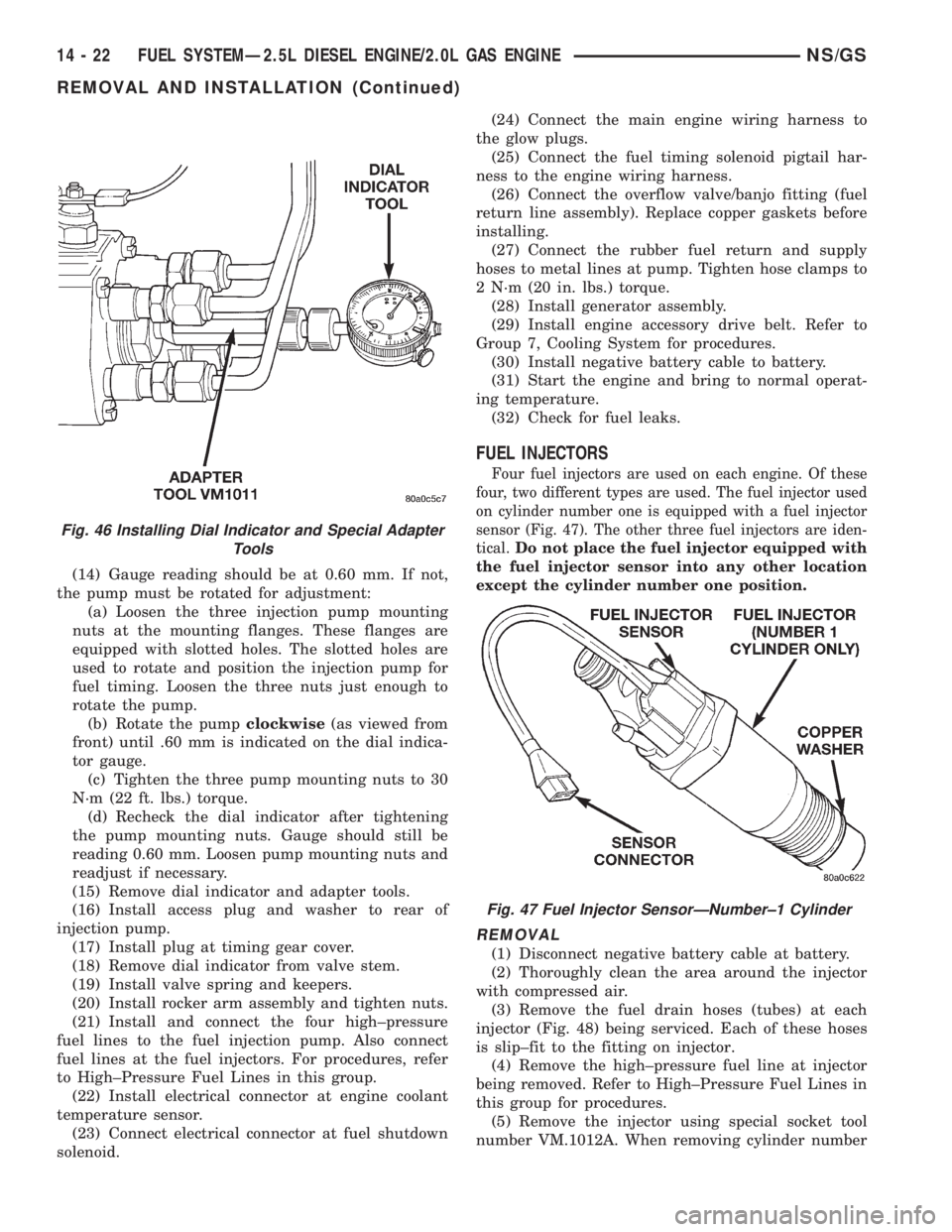
(14) Gauge reading should be at 0.60 mm. If not,
the pump must be rotated for adjustment:
(a) Loosen the three injection pump mounting
nuts at the mounting flanges. These flanges are
equipped with slotted holes. The slotted holes are
used to rotate and position the injection pump for
fuel timing. Loosen the three nuts just enough to
rotate the pump.
(b) Rotate the pumpclockwise(as viewed from
front) until .60 mm is indicated on the dial indica-
tor gauge.
(c) Tighten the three pump mounting nuts to 30
N´m (22 ft. lbs.) torque.
(d) Recheck the dial indicator after tightening
the pump mounting nuts. Gauge should still be
reading 0.60 mm. Loosen pump mounting nuts and
readjust if necessary.
(15) Remove dial indicator and adapter tools.
(16) Install access plug and washer to rear of
injection pump.
(17) Install plug at timing gear cover.
(18) Remove dial indicator from valve stem.
(19) Install valve spring and keepers.
(20) Install rocker arm assembly and tighten nuts.
(21) Install and connect the four high±pressure
fuel lines to the fuel injection pump. Also connect
fuel lines at the fuel injectors. For procedures, refer
to High±Pressure Fuel Lines in this group.
(22) Install electrical connector at engine coolant
temperature sensor.
(23) Connect electrical connector at fuel shutdown
solenoid.(24) Connect the main engine wiring harness to
the glow plugs.
(25) Connect the fuel timing solenoid pigtail har-
ness to the engine wiring harness.
(26) Connect the overflow valve/banjo fitting (fuel
return line assembly). Replace copper gaskets before
installing.
(27) Connect the rubber fuel return and supply
hoses to metal lines at pump. Tighten hose clamps to
2 N´m (20 in. lbs.) torque.
(28) Install generator assembly.
(29) Install engine accessory drive belt. Refer to
Group 7, Cooling System for procedures.
(30) Install negative battery cable to battery.
(31) Start the engine and bring to normal operat-
ing temperature.
(32) Check for fuel leaks.
FUEL INJECTORS
Four fuel injectors are used on each engine. Of these
four, two different types are used. The fuel injector used
on cylinder number one is equipped with a fuel injector
sensor (Fig. 47). The other three fuel injectors are iden-
tical.
Do not place the fuel injector equipped with
the fuel injector sensor into any other location
except the cylinder number one position.
REMOVAL
(1) Disconnect negative battery cable at battery.
(2) Thoroughly clean the area around the injector
with compressed air.
(3) Remove the fuel drain hoses (tubes) at each
injector (Fig. 48) being serviced. Each of these hoses
is slip±fit to the fitting on injector.
(4) Remove the high±pressure fuel line at injector
being removed. Refer to High±Pressure Fuel Lines in
this group for procedures.
(5) Remove the injector using special socket tool
number VM.1012A. When removing cylinder number
Fig. 46 Installing Dial Indicator and Special Adapter
Tools
Fig. 47 Fuel Injector SensorÐNumber±1 Cylinder
14 - 22 FUEL SYSTEMÐ2.5L DIESEL ENGINE/2.0L GAS ENGINENS/GS
REMOVAL AND INSTALLATION (Continued)
Page 1391 of 1938
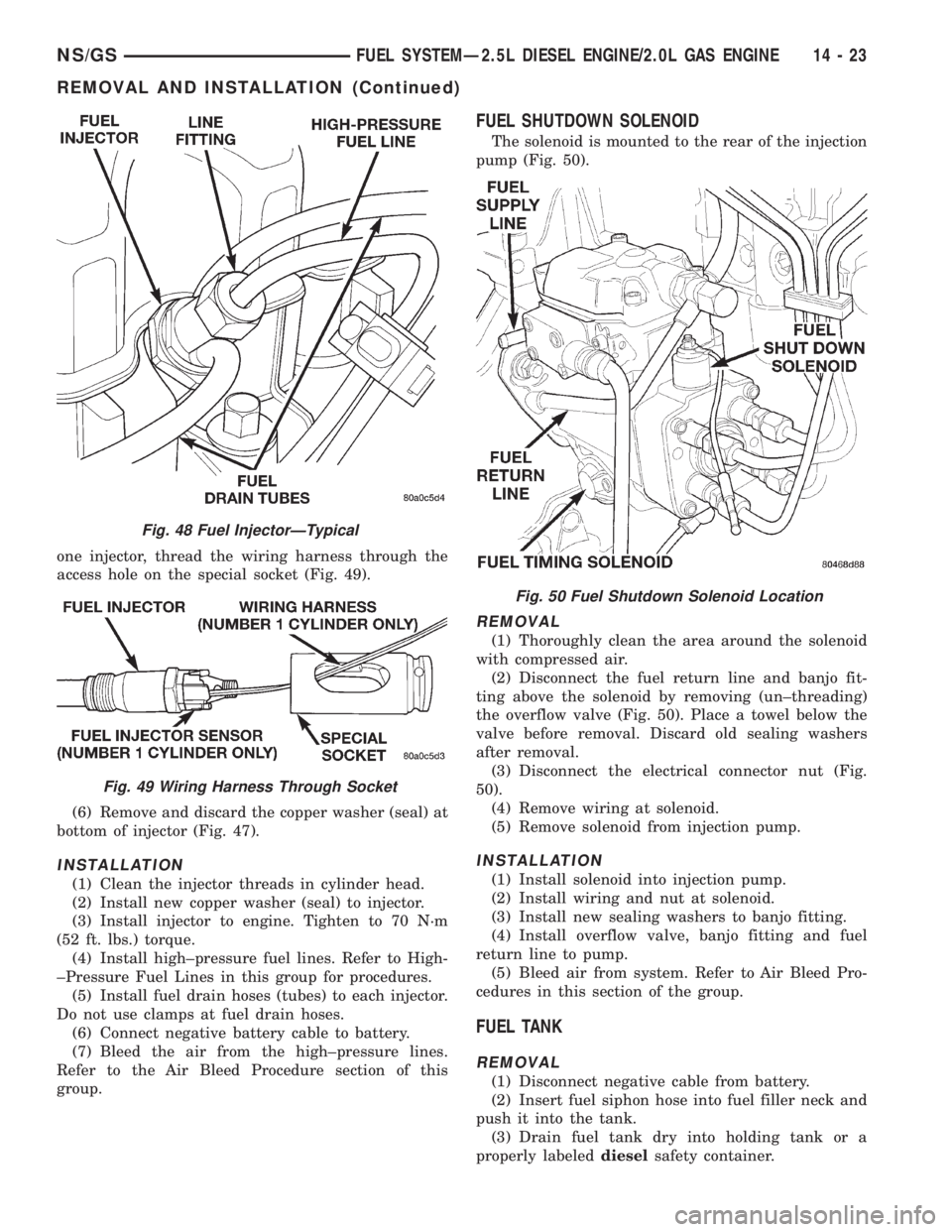
one injector, thread the wiring harness through the
access hole on the special socket (Fig. 49).
(6) Remove and discard the copper washer (seal) at
bottom of injector (Fig. 47).
INSTALLATION
(1) Clean the injector threads in cylinder head.
(2) Install new copper washer (seal) to injector.
(3) Install injector to engine. Tighten to 70 N´m
(52 ft. lbs.) torque.
(4) Install high±pressure fuel lines. Refer to High-
±Pressure Fuel Lines in this group for procedures.
(5) Install fuel drain hoses (tubes) to each injector.
Do not use clamps at fuel drain hoses.
(6) Connect negative battery cable to battery.
(7) Bleed the air from the high±pressure lines.
Refer to the Air Bleed Procedure section of this
group.
FUEL SHUTDOWN SOLENOID
The solenoid is mounted to the rear of the injection
pump (Fig. 50).
REMOVAL
(1) Thoroughly clean the area around the solenoid
with compressed air.
(2) Disconnect the fuel return line and banjo fit-
ting above the solenoid by removing (un±threading)
the overflow valve (Fig. 50). Place a towel below the
valve before removal. Discard old sealing washers
after removal.
(3) Disconnect the electrical connector nut (Fig.
50).
(4) Remove wiring at solenoid.
(5) Remove solenoid from injection pump.
INSTALLATION
(1) Install solenoid into injection pump.
(2) Install wiring and nut at solenoid.
(3) Install new sealing washers to banjo fitting.
(4) Install overflow valve, banjo fitting and fuel
return line to pump.
(5) Bleed air from system. Refer to Air Bleed Pro-
cedures in this section of the group.
FUEL TANK
REMOVAL
(1) Disconnect negative cable from battery.
(2) Insert fuel siphon hose into fuel filler neck and
push it into the tank.
(3) Drain fuel tank dry into holding tank or a
properly labeleddieselsafety container.
Fig. 48 Fuel InjectorÐTypical
Fig. 49 Wiring Harness Through Socket
Fig. 50 Fuel Shutdown Solenoid Location
NS/GSFUEL SYSTEMÐ2.5L DIESEL ENGINE/2.0L GAS ENGINE 14 - 23
REMOVAL AND INSTALLATION (Continued)
Page 1392 of 1938
(4) Raise vehicle on hoist.
(5) Disconnect both the fuel fill and fuel vent rub-
ber hoses at the fuel tank.
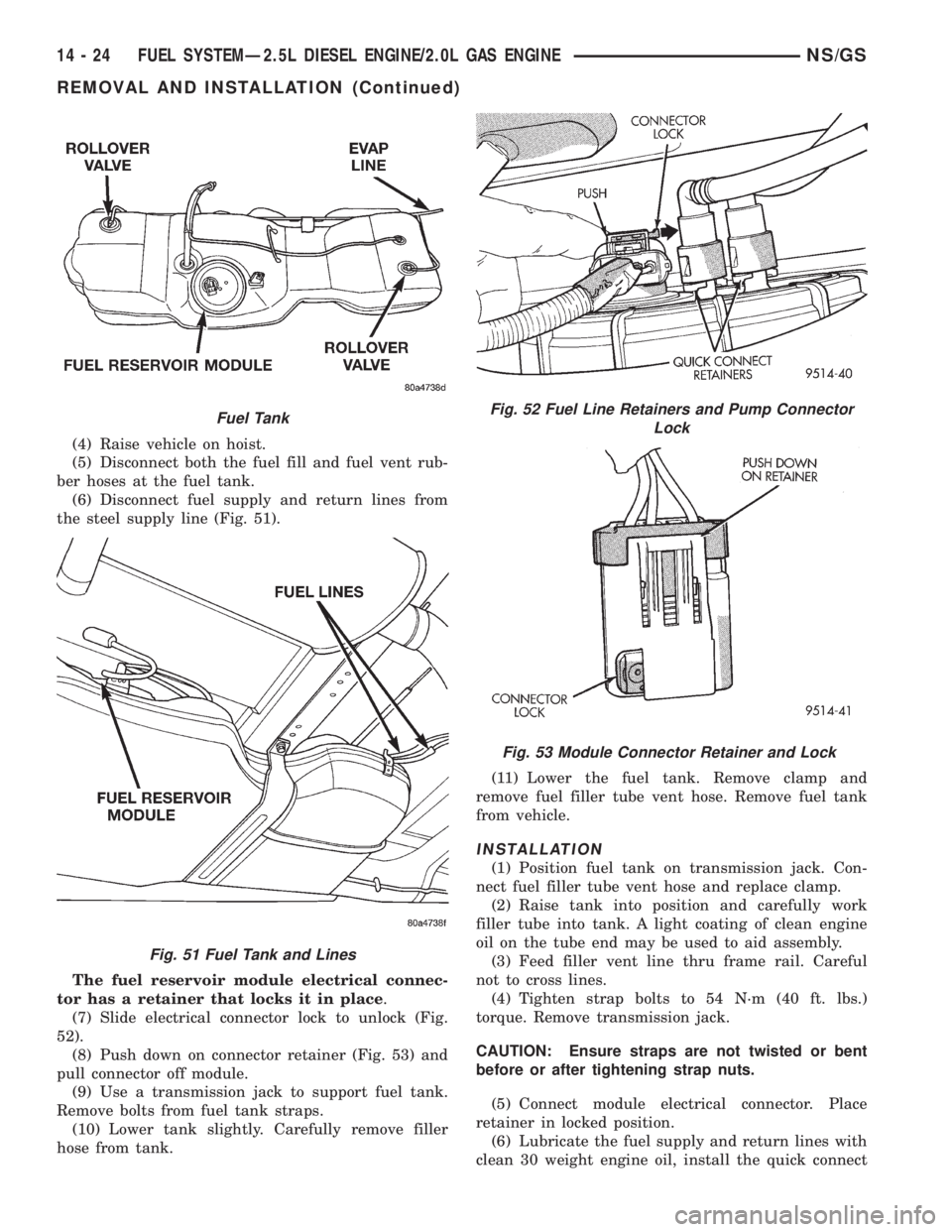
(6) Disconnect fuel supply and return lines from
the steel supply line (Fig. 51).
The fuel reservoir module electrical connec-
tor has a retainer that locks it in place.
(7) Slide electrical connector lock to unlock (Fig.
52).
(8) Push down on connector retainer (Fig. 53) and
pull connector off module.
(9) Use a transmission jack to support fuel tank.
Remove bolts from fuel tank straps.
(10) Lower tank slightly. Carefully remove filler
hose from tank.(11) Lower the fuel tank. Remove clamp and
remove fuel filler tube vent hose. Remove fuel tank
from vehicle.
INSTALLATION
(1) Position fuel tank on transmission jack. Con-
nect fuel filler tube vent hose and replace clamp.
(2) Raise tank into position and carefully work
filler tube into tank. A light coating of clean engine
oil on the tube end may be used to aid assembly.
(3) Feed filler vent line thru frame rail. Careful
not to cross lines.
(4) Tighten strap bolts to 54 N´m (40 ft. lbs.)
torque. Remove transmission jack.
CAUTION: Ensure straps are not twisted or bent
before or after tightening strap nuts.
(5) Connect module electrical connector. Place
retainer in locked position.
(6) Lubricate the fuel supply and return lines with
clean 30 weight engine oil, install the quick connect
Fuel Tank
Fig. 51 Fuel Tank and Lines
Fig. 52 Fuel Line Retainers and Pump Connector
Lock
Fig. 53 Module Connector Retainer and Lock
14 - 24 FUEL SYSTEMÐ2.5L DIESEL ENGINE/2.0L GAS ENGINENS/GS
REMOVAL AND INSTALLATION (Continued)
Page 1394 of 1938
HIGH-PRESSURE LINES
All high±pressure fuel lines are of the same length
and inside diameter. Correct high±pressure fuel line
usage and installation is critical to smooth engine
operation.
CAUTION: The high±pressure fuel lines must be
clamped securely in place in the holders. The lines
cannot contact each other or other components. Do
not attempt to weld high±pressure fuel lines or to
repair lines that are damaged. Only use the recom-
mended lines when replacement of high±pressure
fuel line is necessary.
REMOVAL
(1) Disconnect negative battery cable from battery.
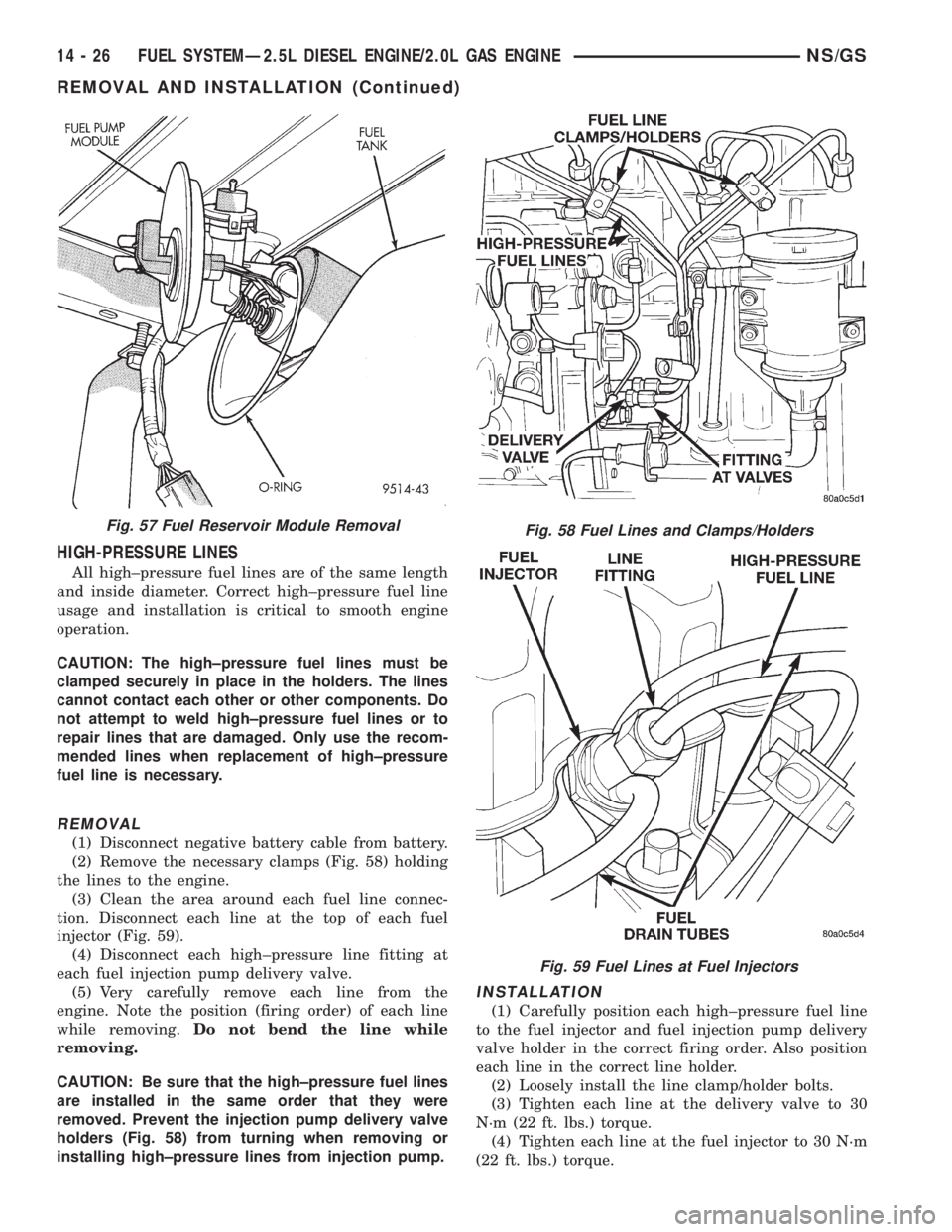
(2) Remove the necessary clamps (Fig. 58) holding
the lines to the engine.
(3) Clean the area around each fuel line connec-
tion. Disconnect each line at the top of each fuel
injector (Fig. 59).
(4) Disconnect each high±pressure line fitting at
each fuel injection pump delivery valve.
(5) Very carefully remove each line from the
engine. Note the position (firing order) of each line
while removing.Do not bend the line while
removing.
CAUTION: Be sure that the high±pressure fuel lines
are installed in the same order that they were
removed. Prevent the injection pump delivery valve
holders (Fig. 58) from turning when removing or
installing high±pressure lines from injection pump.
INSTALLATION
(1) Carefully position each high±pressure fuel line
to the fuel injector and fuel injection pump delivery
valve holder in the correct firing order. Also position
each line in the correct line holder.
(2) Loosely install the line clamp/holder bolts.
(3) Tighten each line at the delivery valve to 30
N´m (22 ft. lbs.) torque.
(4) Tighten each line at the fuel injector to 30 N´m
(22 ft. lbs.) torque.
Fig. 57 Fuel Reservoir Module RemovalFig. 58 Fuel Lines and Clamps/Holders
Fig. 59 Fuel Lines at Fuel Injectors
14 - 26 FUEL SYSTEMÐ2.5L DIESEL ENGINE/2.0L GAS ENGINENS/GS
REMOVAL AND INSTALLATION (Continued)
Page 1395 of 1938
Be sure the lines are not contacting each
other or any other component.
(5) Tighten the clamp bracket bolts to 24 N´m (18
ft. lbs.) torque.
(6) Bleed air from the fuel system. Refer to the Air
Bleed Procedure section of this group.
SPECIFICATIONS
FUEL TANK CAPACITY
75 Liters (20.0 Gals.)
Nominal refill capacities are shown. A variation
may be observed from vehicle to vehicle due to man-
ufacturing tolerances, ambient temperatures and
refill procedures.
IDLE SPEED
900 rpm625 rpmwith engine at normal operat-
ing temperature.
FUEL INJECTOR FIRING SEQUENCE
1±3±4±2
FUEL SYSTEM PRESSURE
Peak Injection Pressure/Fuel Injection Pump
Operating Pressure:40,000±45,000 kPa (5801±
6526 psi).
Opening Pressure of Fuel Injector:
15,000±15,800 kPa (2175±2291 psi).
NS/GSFUEL SYSTEMÐ2.5L DIESEL ENGINE/2.0L GAS ENGINE 14 - 27
REMOVAL AND INSTALLATION (Continued)
Page 1396 of 1938
FUEL DELIVERY SYSTEMÐ2.0L ENGINE
INDEX
page page
DESCRIPTION AND OPERATION
ELECTRIC FUEL PUMP.................. 28
FUEL DELIVERY SYSTEM................ 28
FUEL INJECTORS...................... 28
FUEL LEVEL SENSOR................... 28
FUEL PRESSURE REGULATOR........... 28
FUEL PUMP MODULE................... 28
FUEL TANK........................... 28
PRESSURE-VACUUM FILLER CAPÐ
2.0L ENGINE......................... 28
QUICK-CONNNECT FITTINGSÐ
2.0L ENGINE......................... 28
DIAGNOSIS AND TESTING
FUEL INJECTORSÐ2.0L ENGINE.......... 29
FUEL LEVEL SENSORÐ2.0L ENGINE....... 28
FUEL PUMP PRESSURE TESTÐ
2.0L ENGINE......................... 28SERVICE PROCEDURES
FUEL SYSTEM PRESSURE RELEASE
PROCEDUREÐ2.0L ENGINE............ 29
HOSES AND CLAMPSÐ2.0L ENGINE....... 29
QUICK-CONNNECT FITTINGSÐ2.0L ENGINE . 29
REMOVAL AND INSTALLATION
ACCELERATOR PEDAL.................. 31
FUEL FILTERÐ2.0L ENGINE.............. 29
FUEL INJECTORS...................... 30
FUEL LEVEL SENSORÐ2.0L ENGINE....... 30
FUEL PRESSURE REGULATORÐ
2.0L ENGINE......................... 29
FUEL PRESSURE REGULATORÐ
2.0L ENGINE......................... 29
FUEL PUMP MODULEÐ2.0L ENGINE....... 29
FUEL TANKÐ2.0L ENGINE............... 30
TORQUE SPECIFICATION................ 31
DESCRIPTION AND OPERATION
FUEL DELIVERY SYSTEM
Refer to the Fuel Delivery Sytem in the Fuel Deliv-
ery Section of group 14 for the 2.4/3.0/3.3/3.8L
engines for more information.
FUEL PUMP MODULE
Refer to the Fuel Pump Module for the 2.4/3.0/3.3/
3.8L engines in the Fuel Delivery System section of
group 14.
ELECTRIC FUEL PUMP
Refer to the Electric Fuel Pump for the 2.4/3.0/3.3/
3.8L engines in the Fuel Delivery System Section of
group 14 for more information.
FUEL LEVEL SENSOR
Refer to the Fuel Level Sensor for the 2.4/3.0/3.3/
3.8L engines in the Fuel Delivery System section of
group 14 for more information.
FUEL PRESSURE REGULATOR
Refer to the Fuel Pressure Regulator for the 2.4/
3.0/3.3/3.8L engines in the Fuel Delivery System sec-
tion of group 14 for more information.
FUEL INJECTORS
Refer to the Fuel Injectors for the 2.4/3.0/3.3/3.8L
engines in the Fuel Delivery System section of group
14 for more information.
FUEL TANK
Refer to the Fuel Tank for the 2.4/3.0/3.3/3.8L
engines in the Fuel Delivery System section of group
14 for more information.
PRESSURE-VACUUM FILLER CAPÐ2.0L ENGINE
Refer to the Pressure-Vacuum Filler Cap for the
2.4/3.0/3.3/3.8L engines in the Fuel Delivery System
section of group 14 for more information.
QUICK-CONNNECT FITTINGSÐ2.0L ENGINE
Refer to the Quick Connect Fittings for the 2.4/3.0/
3.3/3.8L engines in the Fuel Delivery System section
of group 14 for more information.
DIAGNOSIS AND TESTING
FUEL PUMP PRESSURE TESTÐ2.0L ENGINE
Refer to the Fuel Pressure Test for the 2.4/3.0/3.3/
3.8L engines in the Fuel Delivery System section of
group 14 for more information.
FUEL LEVEL SENSORÐ2.0L ENGINE
Refer to the Fuel Level Sensor for the 2.4/3.0/3.3/
3.8L engines in the Fuel Delivery System section of
group 14 for more information.
14 - 28 FUEL SYSTEMÐ2.5L DIESEL ENGINE/2.0L GAS ENGINENS/GS
Page 1399 of 1938
(7) Connect fuel supply tube to fuel rail. Refer to
Quick Connect Fittings in the Fuel Delivery Section
of this Group.
ACCELERATOR PEDAL
Refer to the Accelerator Pedal for the 2.4/3.0/.3.3/
3.8L engines under Removal and Installation in the
Fuel Delivery section of group 14 for more informa-
tion.
TORQUE SPECIFICATION
DESCRIPTION TORQUE
Accelerator Pedal to
Dash Nuts..............12N´m(105 in. lbs.)
Fuel Pump Module Locknut....58N´m(43ft.lbs.)
Fuel Tank Strap Bolts.........54N´m(40ftlbs.)
Fuel Rail Bolts.............23N´m(195 in. lbs.)
Ignition Coil Mounting Bolts . . . 11 N´m (95 in. lbs.)
Intake Manifold Bolts........11N´m(95in.lbs.)
Throttle Control Shield.......5.6N´m(50in.lbs.)
NS/GSFUEL SYSTEMÐ2.5L DIESEL ENGINE/2.0L GAS ENGINE 14 - 31
REMOVAL AND INSTALLATION (Continued)
Page 1400 of 1938
FUEL INJECTION SYSTEMÐ2.0L ENGINE
INDEX
page page
GENERAL INFORMATION
INTRODUCTIONÐ2.0L ENGINE............ 32
MODES OF OPERATIONÐ2.0L ENGINE..... 32
DESCRIPTION AND OPERATION
AIR CONDITIONING (A/C) RELAYÐPCM
OUTPUTÐ2.0L ENGINE................ 35
AIR CONDITIONING PRESSURE
TRANSDUCERÐPCM INPUTÐ
2.0L ENGINE......................... 33
AIR CONDITIONING SWITCH SENSEÐ
PCM INPUTÐ2.0L ENGINE.............. 33
AUTOMATIC SHUTDOWN (ASD) SENSEÐ
PCM INPUTÐ2.0L ENGINE.............. 33
AUTOMATIC SHUTDOWN RELAYÐ
PCM OUTPUTÐ2.0L ENGINE............ 35
BATTERY VOLTAGEÐPCM INPUTÐ
2.0L ENGINE......................... 33
CAMSHAFT POSITION SENSORÐ
PCM INPUTÐ2.0L ENGINE.............. 33
CRANKSHAFT POSITION SENSORÐ
PCM INPUTÐ2.0L ENGINE.............. 33
DATA LINK CONNECTORÐPCM OUTPUTÐ
2.0L ENGINE......................... 35
ELECTRONIC EGR TRANSDUCERÐ
PCM OUTPUTÐ2.0L ENGINE............ 35
ENGINE COOLANT TEMPERATURE SENSORÐ
PCM INPUTÐ2.0L ENGINE.............. 33
FUEL INJECTORSÐPCM OUTPUTÐ
2.0L ENGINE......................... 35
FUEL PUMP RELAYÐPCM OUTPUTÐ
2.0L ENGINE......................... 35
GENERATOR FIELDÐPCM OUTPUTÐ
2.0L ENGINE......................... 35
HEATED OXYGEN SENSORÐPCM INPUTÐ
2.0L ENGINE......................... 33
IDLE AIR CONTROL MOTORÐPCM OUTPUTÐ
2.0L ENGINE......................... 35
IGNITION COILÐPCM OUTPUTÐ
2.0L ENGINE......................... 36KNOCK SENSORÐPCM INPUTÐ
2.0L ENGINE......................... 34
MALFUNCTION INDICATOR (CHECK ENGINE)
LAMPÐPCM OUTPUTÐ2.0L ENGINE...... 36
MANIFOLD ABSOLUTE PRESSURE
(MAP SENSOR)ÐPCM INPUTÐ
2.0L ENGINE......................... 34
POWERTRAIN CONTROL MODULEÐ
2.0L ENGINE......................... 33
RADIATOR FAN CONTROL MODULEÐ
PCM OUTPUTÐ2.0L ENGINE............ 36
SPEED CONTROL SOLENOIDSÐ
PCM OUTPUTÐ2.0L ENGINE............ 36
SPEED CONTROLÐPCM INPUTÐ
2.0L ENGINE......................... 34
STARTER RELAYÐPCM OUTPUTÐ
2.0L ENGINE......................... 35
SYSTEM DIAGNOSISÐ2.0L ENGINE........ 33
TACHOMETERÐPCM OUTPUTÐ
2.0L ENGINE......................... 36
THROTTLE BODYÐ2.0L ENGINE.......... 36
THROTTLE POSITION SENSOR/ IDLE AIR
CONTROL MOTORÐPCM INPUTÐ
2.0L ENGINE......................... 35
DIAGNOSIS AND TESTING
ASD AND FUEL PUMP RELAYSÐ
2.0L ENGINE......................... 39
CAMSHAFT AND CRANKSHAFT
POSITION SENSOR................... 40
ENGINE COOLANT TEMPERATURE
SENSOR............................ 40
KNOCK SENSORÐ2.0L ENGINE........... 40
MANIFOLD ABSOLUTE PRESSURE
(MAP) SENSORÐ2.0L ENGINE........... 39
THROTTLE BODY MINIMUM AIR FLOW..... 41
THROTTLE POSITION SENSOR........... 40
VISUAL INSPECTIONÐSOHC............. 36
SPECIFICATIONS
TORQUE............................. 42
GENERAL INFORMATION
INTRODUCTIONÐ2.0L ENGINE
Refer to the Introduction for 2.4/3.0/3.3/3.8L
engines under General Information in the Fuel Injec-
tion System section of group 14 for more information.
MODES OF OPERATIONÐ2.0L ENGINE
Refer to the Modes of Operation for 2.4/3.0/3.3/3.8L
engines under General Information in the Fuel Injec-
tion System section of group 14 for more information.
14 - 32 FUEL SYSTEMÐ2.5L DIESEL ENGINE/2.0L GAS ENGINENS/GS