1996 CHRYSLER VOYAGER warning
[x] Cancel search: warningPage 429 of 1938

TURN SIGNAL AND FLASHERS
CONTENTS
page page
GENERAL INFORMATION
COMBINATION FLASHER.................. 1
INTRODUCTION......................... 1
DESCRIPTION AND OPERATION
COMBINATION FLASHER / DAYTIME
RUNNING LAMPS (DRL) MODULE......... 2
COMBINATION FLASHER FUNCTION......... 1DIAGNOSIS AND TESTING
COMBINATION FLASHER WITH / WITHOUT
DAYTIME RUNNING LAMPS MODULEÐ
CIRCUIT DIAGNOSTICS.................. 3
TURN SIGNAL MULTI-FUNCTION SWITCH.... 2
REMOVAL AND INSTALLATION
COMBINATION FLASHER WITH / WITHOUT
DRL MODULE........................ 11
MULTI-FUNCTION SWITCH............... 11
GENERAL INFORMATION
INTRODUCTION
The turn signals are actuated with a lever on the
left side of the steering column just ahead of the
steering wheel. The signals are automatically turned
off by a canceling cam (two lobes molded to the clock-
spring mechanism). The cam comes in contact with
the cancel actuator on the turn signal (multi-func-
tion) switch assembly. Either cam lobe, pushing on
the cancel actuator, returns the switch to the OFF
position.
Lane change signaling is actuated by applying par-
tial turn signal stalk movement toward the direction
desired until the indicator lamps flashes in the
instrument cluster. When the switch stalk is released
the stalk will spring back into the neutral position
turning OFF the turn signal.
With the ignition switch ON and the turn signal
switch stalk actuated left or right, current flows
through the:
²Combination flasher
²Multi-function switch
²Turn indicator lamp
²Front and rear turn signal bulbs.
A chime will sound after the vehicle has traveled a
distance of approximately 0.5 mile with the turn sig-
nal ON.
COMBINATION FLASHER
The Turn Signal/Hazard Warning Flasher is a
module providing the vehicle with turn signal and
hazard warning functions and has been designed
with internal relays to take advantage of low current
switching requirements in the vehicle. It is plugged
into the Junction Block at position 4 (Fig. 1), where
all wiring associated with its operation is terminated.The Junction Block is adjacent to and left of the
steering column of the vehicle.
To gain access to the flasher, remove the lower
steering column cover and knee blocker. Refer to
Group 8E, Instrument Panel and Systems for
removal procedures.
DESCRIPTION AND OPERATION
COMBINATION FLASHER FUNCTION
The Turn Signal/Hazard Warning Flasher is a
module providing turn signal, hazard warning func-
tions and has been designed with internal relays to
Fig. 1 Combination Flasher Location
NSTURN SIGNAL AND FLASHERS 8J - 1
Page 430 of 1938

take advantage of low current switching require-
ments in the vehicle. It is plugged into the Junction
Block at positions 4 (Fig. 1) where all wiring associ-
ated with its operation is terminated. The Junction
Block is adjacent to and left of the steering column of
the vehicle.
To gain access to the device, remove the lower
steering column cover and knee blocker, refer to
Group 8E, Instrument Panel and Systems.
The combination flasher may be operated in its
hazard warning mode either with or without the igni-
tion circuit being active. However, in order to operate
in the turn signal mode, the ignition circuit must be
completed to the module.
While the combination flasher is idle, there is no
current drawn through the module. The device does
not become active until a signal ground circuit is
supplied to either of the turn signal inputs or the
hazard warning input.
Typical flash rate for the flasher is 90 flashes per
minute.
When a lamp is burnt out for a given side of the
vehicle or a wire is open to a lamp, the flash rate will
increase to 180 flashes per minute when in the turn
signal mode. When in the hazard warning signal
mode the flash rate remains at 90 flashes per
minute.
Turn signal inputs that actuate the flasher are low
current grounds, each drawing a maximum of 300
mA., and are provided to the flasher through the
Junction Block from the multi-function switch that is
mounted to the steering column. The hazard warning
signal input is a low current ground drawing a max-
imum of 600 mA. through the multi-function switch.
COMBINATION FLASHER / DAYTIME RUNNING
LAMPS (DRL) MODULE
The Combination Flasher/DRL is a module provid-
ing turn signal, hazard warning, and daytime run-
ning light functions, and has been designed with
internal relays to take advantage of low current
switching requirements in the vehicle. It is plugged
into the junction block at positions 3 AND 4 (Fig. 2)
where all wiring associated with its operation is ter-
minated. The Junction Block is adjacent to and left of
the steering column of the vehicle.
To gain access to the device, remove the lower
steering column cover and knee blocker, refer to
Group 8E, Instrument Panel and Gauges.
The combination flasher/DRL may be operated in
its hazard warning mode either with or without the
ignition circuit being active. However, in order to
operate in the turn signal mode or the DRL mode,
the ignition circuit must be completed to the module.
While the combination flasher portion is idle, there
is no current drawn through the module. The devicedoes not become active in the turn signal or hazard
warning modes until a signal ground circuit is sup-
plied to either of the turn signal inputs or the hazard
warning input. With the ignition OFF, there is no
current drawn through the module.
While the ignition is ON, the front turn signal fil-
aments are illuminated steadily thus providing the
DRL function. The DRL function may be inhibited by
applying a signal ground input from either the park
brake circuit or the headlamp relay activation circuit.
Typical flash rate for the flasher is 90 flashes per
minute.
When a lamp is burnt out for a given side of the
vehicle or a wire is open to a lamp, the flash rate will
increase to 180 flashes per minute when in the turn
signal mode. When in the hazard warning signal
mode the flash rate remains at 90 flashes per
minute.
Turn signal inputs that actuate the flasher are low
current grounds, each could draw a maximum of 300
mA., and are provided to the flasher through the
Junction Block from the multi-function switch that is
mounted to the steering column. The hazard warning
signal input is a low current ground that could draw
a maximum of 600 mA. through the multi-function
switch.
DIAGNOSIS AND TESTING
TURN SIGNAL MULTI-FUNCTION SWITCH
To test turn signal, headlamp beam select and opti-
cal horn portion of the multi-function switch:
(1) Remove the multi-function switch, refer to
removal procedures.
(2) Using an ohmmeter check continuity reading
between multi-function switch pins. Refer to (Fig. 3)
for proper pin numbers and Turn Signal Multi-Func-
tion Switch Test chart.
Fig. 2 Junction Block Terminal Pins
8J - 2 TURN SIGNAL AND FLASHERSNS
DESCRIPTION AND OPERATION (Continued)
Page 434 of 1938
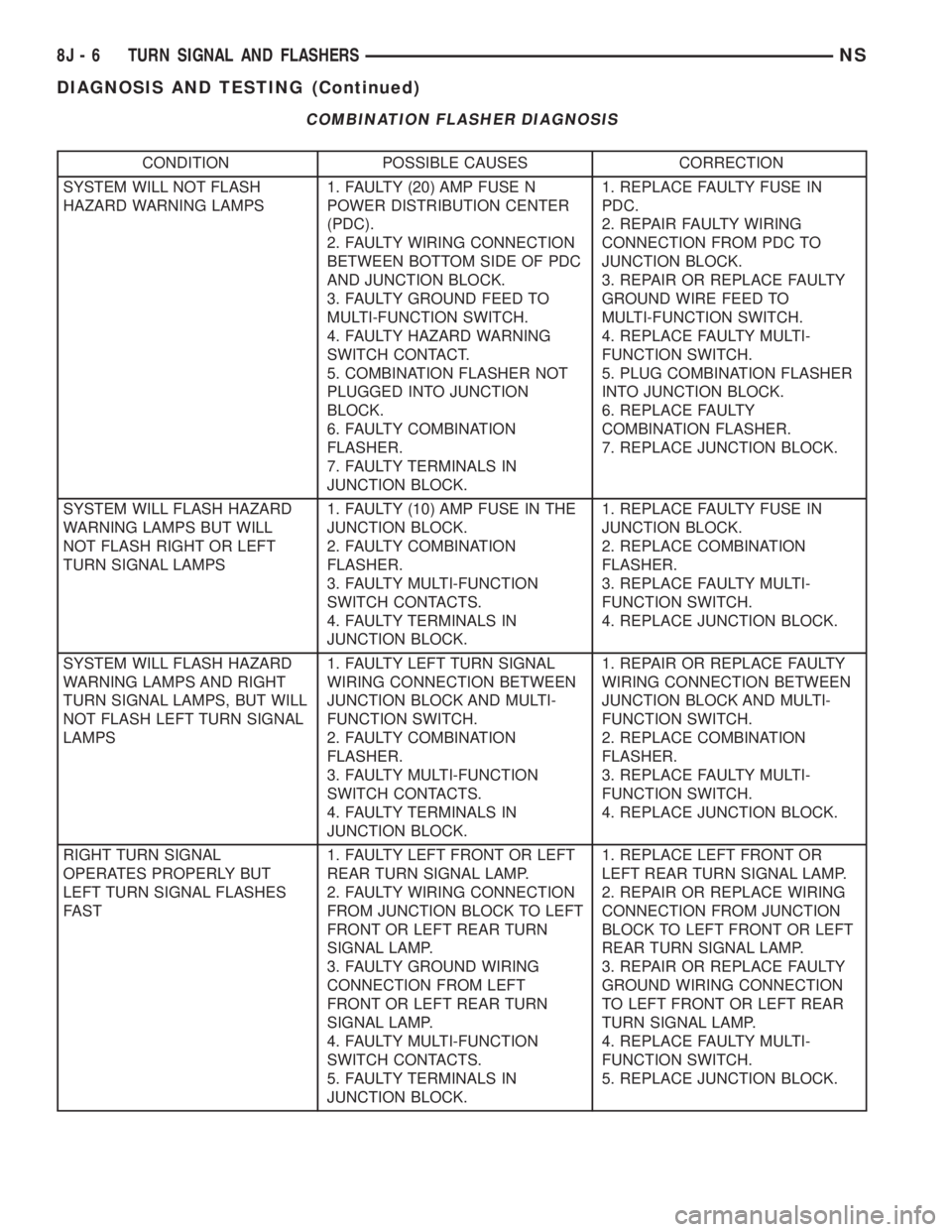
COMBINATION FLASHER DIAGNOSIS
CONDITION POSSIBLE CAUSES CORRECTION
SYSTEM WILL NOT FLASH
HAZARD WARNING LAMPS1. FAULTY (20) AMP FUSE N
POWER DISTRIBUTION CENTER
(PDC).
2. FAULTY WIRING CONNECTION
BETWEEN BOTTOM SIDE OF PDC
AND JUNCTION BLOCK.
3. FAULTY GROUND FEED TO
MULTI-FUNCTION SWITCH.
4. FAULTY HAZARD WARNING
SWITCH CONTACT.
5. COMBINATION FLASHER NOT
PLUGGED INTO JUNCTION
BLOCK.
6. FAULTY COMBINATION
FLASHER.
7. FAULTY TERMINALS IN
JUNCTION BLOCK.1. REPLACE FAULTY FUSE IN
PDC.
2. REPAIR FAULTY WIRING
CONNECTION FROM PDC TO
JUNCTION BLOCK.
3. REPAIR OR REPLACE FAULTY
GROUND WIRE FEED TO
MULTI-FUNCTION SWITCH.
4. REPLACE FAULTY MULTI-
FUNCTION SWITCH.
5. PLUG COMBINATION FLASHER
INTO JUNCTION BLOCK.
6. REPLACE FAULTY
COMBINATION FLASHER.
7. REPLACE JUNCTION BLOCK.
SYSTEM WILL FLASH HAZARD
WARNING LAMPS BUT WILL
NOT FLASH RIGHT OR LEFT
TURN SIGNAL LAMPS1. FAULTY (10) AMP FUSE IN THE
JUNCTION BLOCK.
2. FAULTY COMBINATION
FLASHER.
3. FAULTY MULTI-FUNCTION
SWITCH CONTACTS.
4. FAULTY TERMINALS IN
JUNCTION BLOCK.1. REPLACE FAULTY FUSE IN
JUNCTION BLOCK.
2. REPLACE COMBINATION
FLASHER.
3. REPLACE FAULTY MULTI-
FUNCTION SWITCH.
4. REPLACE JUNCTION BLOCK.
SYSTEM WILL FLASH HAZARD
WARNING LAMPS AND RIGHT
TURN SIGNAL LAMPS, BUT WILL
NOT FLASH LEFT TURN SIGNAL
LAMPS1. FAULTY LEFT TURN SIGNAL
WIRING CONNECTION BETWEEN
JUNCTION BLOCK AND MULTI-
FUNCTION SWITCH.
2. FAULTY COMBINATION
FLASHER.
3. FAULTY MULTI-FUNCTION
SWITCH CONTACTS.
4. FAULTY TERMINALS IN
JUNCTION BLOCK.1. REPAIR OR REPLACE FAULTY
WIRING CONNECTION BETWEEN
JUNCTION BLOCK AND MULTI-
FUNCTION SWITCH.
2. REPLACE COMBINATION
FLASHER.
3. REPLACE FAULTY MULTI-
FUNCTION SWITCH.
4. REPLACE JUNCTION BLOCK.
RIGHT TURN SIGNAL
OPERATES PROPERLY BUT
LEFT TURN SIGNAL FLASHES
FAST1. FAULTY LEFT FRONT OR LEFT
REAR TURN SIGNAL LAMP.
2. FAULTY WIRING CONNECTION
FROM JUNCTION BLOCK TO LEFT
FRONT OR LEFT REAR TURN
SIGNAL LAMP.
3. FAULTY GROUND WIRING
CONNECTION FROM LEFT
FRONT OR LEFT REAR TURN
SIGNAL LAMP.
4. FAULTY MULTI-FUNCTION
SWITCH CONTACTS.
5. FAULTY TERMINALS IN
JUNCTION BLOCK.1. REPLACE LEFT FRONT OR
LEFT REAR TURN SIGNAL LAMP.
2. REPAIR OR REPLACE WIRING
CONNECTION FROM JUNCTION
BLOCK TO LEFT FRONT OR LEFT
REAR TURN SIGNAL LAMP.
3. REPAIR OR REPLACE FAULTY
GROUND WIRING CONNECTION
TO LEFT FRONT OR LEFT REAR
TURN SIGNAL LAMP.
4. REPLACE FAULTY MULTI-
FUNCTION SWITCH.
5. REPLACE JUNCTION BLOCK.
8J - 6 TURN SIGNAL AND FLASHERSNS
DIAGNOSIS AND TESTING (Continued)
Page 436 of 1938

COMBINATION FLASHER DIAGNOSIS WITH DRL
CONDITION POSSIBLE CAUSES CORRECTION
SYSTEM WILL NOT FLASH
HAZARD WARNING LAMPS1. FAULTY (20) AMP FUSE N
POWER DISTRIBUTION CENTER
(PDC).
2. FAULTY WIRING CONNECTION
BETWEEN BOTTOM SIDE OF PDC
AND JUNCTION BLOCK.
3. FAULTY GROUND FEED TO
MULTI-FUNCTION SWITCH.
4. FAULTY HAZARD WARNING
SWITCH CONTACT.
5. COMBINATION FLASHER/DRL
MODULE NOT PLUGGED INTO
JUNCTION BLOCK.
6. FAULTY COMBINATION
FLASHER/DRL MODULE.
7. FAULTY TERMINALS IN
JUNCTION BLOCK.1. REPLACE FAULTY FUSE IN
PDC.
2. REPAIR FAULTY WIRING
CONNECTION FROM PDC TO
JUNCTION BLOCK.
3. REPAIR OR REPLACE FAULTY
GROUND WIRE FEED TO
MULTI-FUNCTION SWITCH.
4. REPLACE FAULTY MULTI-
FUNCTION SWITCH.
5. PLUG COMBINATION FLASHER/
DRL MODULE INTO JUNCTION
BLOCK.
6. REPLACE FAULTY
COMBINATION FLASHER/DRL
MODULE.
7. REPLACE JUNCTION BLOCK.
SYSTEM WILL FLASH HAZARD
WARNING LAMPS BUT WILL
NOT FLASH RIGHT OR LEFT
TURN SIGNAL LAMPS1. FAULTY (10) AMP FUSE IN THE
JUNCTION BLOCK.
2. FAULTY COMBINATION
FLASHER/DRL MODULE.
3. FAULTY MULTI-FUNCTION
SWITCH CONTACTS.
4. FAULTY TERMINALS IN
JUNCTION BLOCK.1. REPLACE FAULTY FUSE IN
JUNCTION BLOCK.
2. REPLACE COMBINATION
FLASHER/DRL MODULE.
3. REPLACE FAULTY MULTI-
FUNCTION SWITCH.
4. REPLACE JUNCTION BLOCK.
RIGHT TURN SIGNAL
OPERATES PROPERLY BUT
LEFT TURN SIGNAL FLASHES
FAST
(Hazard mode can be used for a
system check)1. FAULTY LEFT FRONT OR LEFT
REAR TURN SIGNAL LAMP.
2. FAULTY WIRING CONNECTION
FROM JUNCTION BLOCK TO LEFT
FRONT OR LEFT REAR TURN
SIGNAL LAMP.
3. FAULTY GROUND WIRING
CONNECTION FROM LEFT
FRONT OR LEFT REAR TURN
SIGNAL LAMP.
4. FAULTY MULTI-FUNCTION
SWITCH CONTACTS.
5. FAULTY TERMINALS IN
JUNCTION BLOCK.1. REPLACE LEFT FRONT OR
LEFT REAR TURN SIGNAL LAMP.
2. REPAIR OR REPLACE WIRING
CONNECTION FROM JUNCTION
BLOCK TO LEFT FRONT OR LEFT
REAR TURN SIGNAL LAMP.
3. REPAIR OR REPLACE FAULTY
GROUND WIRING CONNECTION
TO LEFT FRONT OR LEFT REAR
TURN SIGNAL LAMP.
4. REPLACE FAULTY MULTI-
FUNCTION SWITCH.
5. REPLACE JUNCTION BLOCK.
8J - 8 TURN SIGNAL AND FLASHERSNS
DIAGNOSIS AND TESTING (Continued)
Page 438 of 1938

CONDITION POSSIBLE CAUSES CORRECTION
TURN SIGNAL AND HAZARD
WARNING FLASHERS
FUNCTION PROPERLY BUT
DAYTIME RUNNING LIGHTS
(DRL) DO NOT COME ON WHILE
DRIVING
(The brake lamp in the message
center remains illuminated under
the circumstances noted to the
right in step #3.0 through 3.5
unless the lamp is burned out.)
(Headlamps, either low or high
beam, remain illuminated under
the circumstances noted to the
right in step #4.0 through 4.3 even
though the headlamp switch is
OFF.)1. FAULTY GROUND FEED TO
JUNCTION BLOCK FROM
GROUND STUD CONNECTOR
THROUGH I/P HARNESS.
2. FAULTY GROUND FEED
THROUGH JUNCTION BLOCK TO
CAVITY #11 IN POSITION #3 OF
THE JUNCTION BLOCK.
3.0. FAULTY PARK BRAKE
SWITCH.
3.1. PARK BRAKE INPUT CIRCUIT
FALSELY GROUNDED. COULD BE
THE G09 CIRCUIT WHICH IS A
(20) GA. GY/BK WIRE BETWEEN
THE MESSAGE CENTER AND THE
JUNCTION BLOCK,
3.2. OR BETWEEN THE PARK
BRAKE SWITCH AND THE
JUNCTION BLOCK,
3.3. OR BETWEEN THE BRAKE
PRESSURE SWITCH AND THE
JUNCTION BLOCK,
3.4. OR BETWEEN THE IGNITION
SWITCH AND THE JUNCTION
BLOCK,
3.5. OR A SHORTED IGNITION
SWITCH (CONTACT SHOULD
ONLY BE MADE WHEN IN START
POSITION).
4.0. L93 CIRCUIT FALSELY
GROUNDED BETWEEN JUNCTION
BLOCK AND MULTI-FUNCTION
SWITCH.
4.1. L307 CIRCUIT FALSELY
GROUNDED BETWEEN
HEADLAMP SWITCH AND BODY
CONTROL MODULE.
4.2. HEADLAMP SWITCH
SHORTED.
4.3. HEADLAMP CONTROL
OUTPUT FALSELY GROUNDED BY
BODY CONTROL MODULE.1. REPLACE GROUND CIRCUIT TO
JUNCTION BLOCK.
2. REPLACE JUNCTION BLOCK.
3.0. REPLACE THE PARK BRAKE
SWITCH.
3.1-3.4. REPAIR THE G09 CIRCUIT
TO ELIMINATE THE FALSE
GROUND SOURCE.
3.5. REPLACE IGNITION SWITCH.
4.0. REPAIR OR REPLACE FAULTY
WIRING CONNECTION BETWEEN
JUNCTION BLOCK AND MULTI-
FUNCTION SWITCH.
4.1. REPAIR OR REPLACE FAULTY
WIRING CONNECTION BETWEEN
HEADLAMP SWITCH AND BODY
CONTROL MODULE.
4.2. REPLACE SHORTED
HEADLAMP SWITCH.
4.3. REPLACE BODY CONTROL
MODULE.
8J - 10 TURN SIGNAL AND FLASHERSNS
DIAGNOSIS AND TESTING (Continued)
Page 439 of 1938

REMOVAL AND INSTALLATION
MULTI-FUNCTION SWITCH
WARNING: BEFORE SERVICING A STEERING COL-
UMN EQUIPPED WITH AN AIRBAG REFER TO
GROUP 8M, RESTRAINT SYSTEMS FOR PROPER
AND SAFE SERVICE PROCEDURES.
REMOVAL
(1) Release hood latch and open hood.
(2) Disconnect and isolate battery negative cable.
(3) Remove upper and lower steering column
shrouds, refer to Group 19, Steering for proper pro-
cedures.
(4) Disconnect wire connector from back of turn
signal multi-function switch (Fig. 6).
(5) Remove screws holding turn signal switch to
steering column adapter collar.
(6) Remove turn signal switch.
INSTALLATION
For installation, reverse the above procedures. Ver-
ify switch operation by placing the control stalk in
either the right or left position and turning the steer-
ing wheel to ensure the automatic cancellation of the
switch.
COMBINATION FLASHER WITH / WITHOUT DRL
MODULE
REMOVAL
(1) Remove lower steering column cover.
(2) Remove knee blocker.(3) Pull combination flasher from junction block.
INSTALLATION
For installation, reverse the above procedures.
Fig. 6 Turn Signal Multi-Function Switch
NSTURN SIGNAL AND FLASHERS 8J - 11
Page 441 of 1938

WINDSHIELD WIPERS AND WASHERS
CONTENTS
page page
REAR WIPER AND WASHER................ 9WINDSHIELD WIPERS AND WASHER......... 1
WINDSHIELD WIPERS AND WASHER
INDEX
page page
GENERAL INFORMATION
INTRODUCTION......................... 1
DIAGNOSIS AND TESTING
DIAGNOSTIC PROCEDURES................ 1
FAILED PARK SWITCH.................... 2
MULTI-FUNCTION SWITCH................. 4
REMOVAL AND INSTALLATION
MULTI-FUNCTION SWITCH................. 4
WINDSHIELD WASHER BOTTLE............. 4
WINDSHIELD WIPER BLADE ELEMENT....... 6WINDSHIELD WIPER BLADE................ 5
WINDSHIELD WIPER MOTOR............... 6
WIPER ARM............................. 7
WIPER LINKAGE......................... 7
WIPER UNIT............................ 7
CLEANING AND INSPECTION
WIPER BLADES.......................... 8
ADJUSTMENTS
WIPER ARM ALIGNMENT.................. 8
GENERAL INFORMATION
INTRODUCTION
WARNING: ON VEHICLES EQUIPPED WITH AIR-
BAG, SEE GROUP 8M, RESTRAINT SYSTEMS FOR
SAFETY PRECAUTIONS. DISCONNECT THE NEGA-
TIVE CABLE FROM THE BATTERY BEFORE SER-
VICING COMPONENTS INVOLVING THE AIRBAG
SYSTEM. ACCIDENTAL DEPLOYMENT OF AIRBAG
AND PERSONAL INJURY CAN RESULT.
The windshield wipers can be operated with the
windshield wiper switch when the ignition switch is
in the RUN or ACCESSORY positions. The wind-
shield wiper system is protected by a 40 amp fuse (9)
located in the Power Distribution Center (PDC) in
the engine compartment. The windshield washer cir-
cuit is protected by a 6 amp fuse (9) located in the
Junction Block. The wiper motor has permanent
magnetic fields. The speeds are determined by cur-
rent flow to the appropriate set of brushes inside the
motor. The current flow is controlled by the multi-
function switch stalk mounted wiper switch, high
speed/low speed relays located in the PDC. The speed
sensitive intermittent wiper is controlled by the BodyControl Module (BCM). The intermittent mode, with
the vehicle traveling greater than 10.4 mph, has a
range of 0.5 to 18 seconds. With the vehicle traveling
less than 10.4 mph, and the time delay is not
adjusted, time delay doubles to a range of 1 to 36
seconds. The wiper arms will park at the base of the
windshield just above the cowl cover after the wiper
switch is turned OFF.
The windshield wiper motor and linkage is located
in an integral wiper unit at the rear of the engine
compartment. The wiper unit must be removed to
gain access to the wiper motor.
DIAGNOSIS AND TESTING
DIAGNOSTIC PROCEDURES
The windshield wiper system operates in several
modes:
²Low and high speed normal wipe
²Speed sensitive intermittent wipe
²Wipe after wash
²Pulse wipe
²Park (switch OFF)
The windshield wiper circuits are continuously
monitored and controlled by the Body Control Mod-
NSWINDSHIELD WIPERS AND WASHERS 8K - 1
Page 444 of 1938

MULTI-FUNCTION SWITCH
To test the windshield wiper and washer portion of
the multi-function switch:
(1) Remove the multi-function switch, refer to
removal procedures.
(2) Using an ohmmeter check continuity reading
between switch pins, refer to (Fig. 1) for proper pin
numbers.
REMOVAL AND INSTALLATION
MULTI-FUNCTION SWITCH
WARNING: BEFORE SERVICING A STEERING COL-
UMN EQUIPPED WITH AN AIRBAG REFER TO
GROUP 8M, RESTRAINT SYSTEMS FOR PROPER
AND SAFE SERVICE PROCEDURES.
REMOVAL
(1) Release hood latch and open hood.
(2) Disconnect and isolate battery negative cable.
(3) Remove upper and lower steering column
shrouds, refer to Group 19, Steering for proper pro-
cedures.
(4) Disconnect wire connector from back of turn
signal multi-function switch (Fig. 2).
(5) Remove screws holding turn signal switch to
steering column adapter collar.
(6) Remove turn signal switch.
INSTALLATION
For installation, reverse the above procedures. Ver-
ify switch operation by placing the control stalk ineither the right or left position and turning the steer-
ing wheel to ensure the automatic cancellation of the
switch.
WINDSHIELD WASHER BOTTLE
REMOVAL
(1) Hoist and support vehicle on safety stands.
(2) Remove right front wheel, refer to Group 22,
Wheels and Tires for proper procedures and tighten-
ing sequences.
(3) Remove front wheelhouse splash shield.
(4) Disconnect wire connectors from the windshield
and rear window washer pumps (Fig. 3).
(5) If washer bottle has fluid in it place a suitable
drain pan under the hose connections.
Fig. 1 Windshield Wiper and Washer±Multi-Function
Switch Test
Fig. 2 Turn Signal Multi-Function Switch
Fig. 3 Windshield Washer Bottle
8K - 4 WINDSHIELD WIPERS AND WASHERSNS
DIAGNOSIS AND TESTING (Continued)