Page 281 of 387
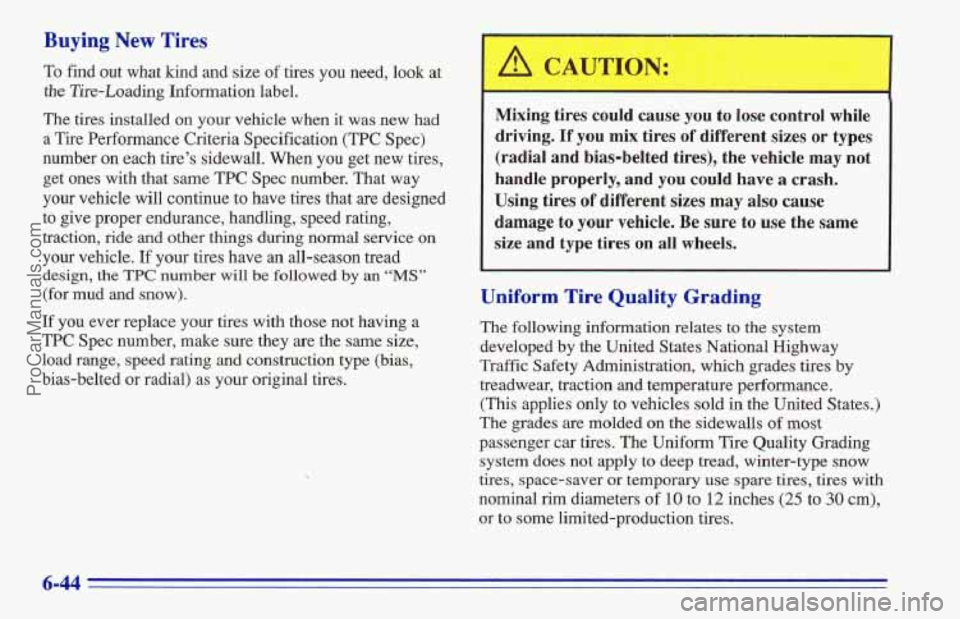
Buying New Tires
To find out what kind and .size of tires you need, look at
the Tire-Loading Information label.
The tires installed on your vehicle when it was new had
a Tire Performance Criteria Specification
(TPC Spec)
number on each tire’s sidewall. When you get new tires,
get ones with that same
TPC Spec number. That way
your vehicle will continue to have tires that are designed
to give proper endurance, handling, speed rating,
traction, ride and other things during normal service
on
your vehicle. If your tires have an all-season tread
design, the TPC number will be followed by an “MS”
(for mud and snow).
If you ever replace your tires with those not having a
TPC Spec number, make sure they are the same size,
load range, speed rating and construction type (bias,
bias-belted or radial)
as your original tires.
Mixing tires could cause you to lose control while
driving. If
you mix tires of different sizes or types
(radial and bias-belted tires), the vehicle
may not
handle properly, and
you could have a crash.
Using tires of different sizes may also cause
damage
to your vehicle. Be sure to use the same
size and type tires on all wheels.
Uniform Tire Quality Grading
The following information relates to the system
developed by the United States National Highway
Traffic Safety Administration, which grades tires
by
treadwear, traction and temperature performance.
(This applies only to vehicles sold
in the United States.)
The grades are molded on the sidewalls
of most
passenger car tires. The Uniform Tire Quality Grading
system does not apply to deep tread, winter-type snow
tires, space-saver or temporary use spare tires, tires with
nominal
rim diameters of 10 to 12 inches (25 to 30 cm),
or to some limited-production tires.
6-44
ProCarManuals.com
Page 288 of 387

Cleaning the Top of the Instrument Panel
Use only mild soap and water to clean the top surfaces
of the instrument panel. Sprays containing silicones or
waxes may cause annoying reflections in the windshield
and even make it difficult to see through the windshield
under certain conditions.
Care of Safety Belts
Keep belts clean and dry.
- J not bleach or dye safety belts. If you do, i
Glass
Glass should be cleaned often. GM Glass Cleaner (GM
Part No. 1050427) or a liquid household glass cleaner
will remove normal tobacco smoke and dust films.
Don’t use abrasive cleaners
on glass, because they may
cause scratches. Avoid placing decals on the inside rear
window, since they may have to be scraped off later. If
abrasive cleaners
are used on the inside of the rear
window, an electric defogger element may be damaged.
Any temporary license should not be attached across the
defogger grid.
1
Cleaning the Outside of
the Windshield, Backglass
may severely weaken them. In a crash, they
might not be able to provide adequate protection. and Wiper Blades
lukewarm water. Clean safety belts only with mild
soap and
If the windshield is not clear after using the windshield
washer, or
if the wiper blade chatters when running, wax
or other material
may be on the blade or windshield.
Clean the outside of the windshield with
GM Windshield
Cleaner, Bon-Ami Powder@ (GM
Part No. 1050011).
The windshield is clean if beads do not form when you
rinse it with water.
ProCarManuals.com
Page 299 of 387

Capacities and Specifications
Engine
Type ....................... . . L4
Compression Ratio ........ . . 9.5:l
Firing Order .......................... 1-3-4-2
Horsepower
.............................. 95
Fuel Delivery .................... Fuel Injection
Piston Displacement
............... 97 CID (I .6L)
Valve Arrangement ............ ~n-~ead T? Type
AC Belt Tension ....... Deflect Belt 0.24-0.3 inch
(6-9 mm) @ 22 lbs. (10 kg) Pressure
Fan Belt Tension
Inspection
........... Deflect Belt 0.24-0.32 inch
Replacement
.......... Deflect Belt 0.20-0.28 inch
(4-8 mm)'@ 22 lbs. (10 kg) Pressure
(5-7 mm) @ 22 lbs. (10 kg) Pressure
Specification
........... , . 180°F (82°C)
Thermostat Temperature,
Replacement Parts
Air Cleaner Filter ................. 13780-58B20
GM Part No. 96068629 or equivalent
Engine Oil Filter
.......... GM Part No. 25014441
GM Part No. 96058022 or equivalent
PCV Valve .... GM Part No. 96058079 or equivalent
Radiator Pressure Cap
............ 13 psi (90 kPa)
0.028-0.032 inch gap
(0.7 to 9.8 mm)
Battery ............................. 26R-50s
Fuel Filter
..................... AC Type GF571
Spark Plug ................... AC Type R43XLS
ProCarManuals.com
Page 307 of 387

Maintenance Schedule
I Short TriplCity Definition
Follow the Short. Trip/City Maintenance Schedule if any
one of these conditions is true for your vehicle:
Most trips are less than 5 to 10 miles (8 to 16 km).
This is particularly important when outside
temperatures are below freezing.
Most trips include extensive idling (such as frequent
driving in stop-and-go traffic).
your vehicle.
You frequently tow a trailer or use a carrier on top of
If the vehicle is used for delivery service, police, taxi
or other commercial application.
One of the reasons you should follow this schedule if ,
you operate your vehicle under any of these conditions
is that these conditions cause engine oil to break
down sooner.
Short TriplCity Intervals
Every 3,000 Miles (5 000 km): Engine Oil and Filter
Change
(or 3 months, whichever occurs first).
Free-Wheeling
Hubs Inspection (if equipped)
(or
3 months, whichever occurs first).
Every 6,000 Miles (10 000 km): Tire Rotation.
Every 15,000 Miles (25 000 km): Air Cleaner Filter
Inspection, if driving in dusty conditions. Front
Wheel Bearing Repack (or at each brake relining,
whichever occurs first). Manual Transmission Fluid
Change
(or every 15 months, whichever occurs first).
Engine
Idle Speed Check. Valve Lash (Clearance),
Adjustment. Propeller Shafts
and U-Joints Inspection
(or every
15 months, whichever occurs first).
Every 30,000 Miles (50 000 km): Air Cleaner Filter
Replacement. Spark Plug Replacement. Engine
Accessory Drive Belt Inspection (or every
24 months,
whichever occurs
first). C.ooling System Service
(or every 30 months, whichever occurs first). Fuel
Filter Replacement (or every
30 months, whichever
occurs
first).
7-4
ProCarManuals.com
Page 308 of 387
Maintenance Schedule
I Short Trip/City Intervals I
Every 50,000 Miles (83 000 km): Automatic
Transmission Service (severe conditions only). Positive Crankcase Ventilation (PCV) Valve Replacement.
Every 60,000 Miles (100 000 km): Engine Timing
and Distributor Check. Fuel Tank Cap Gasket
Replacement. Emission System Hoses Inspection. Camshaft Timing Belt Replacement. Brake Fluid
Service. Spark Plug Wire Replacement (or every
60 months, whichever occurs first). Wiring Harness
and Connectors Inspection (or every 60 months,
whichever occurs
first).
Short Trip/City Intervals
At 90,000 Miles (150 000 km): Camshaft Timing
Every 100,000 Miles (166 000 km): Fuel Injector
Belt Inspection.
Inspection. Evaporative Emissions Canister
Replacement.
These intervals only summarize maintenance services.
Be sure to
follow the complete maintenance schedule
on the following pages.
7-5
ProCarManuals.com
Page 309 of 387

Maintenance Schedule
Lo'ng Trip/Highway Definition I
Follow this maintenance schedule only if none of the
conditions from the
Short TripjCity Maintenance
Schedule
is true.
Driving a vehicle with a fully warmed engine under
highway conditions causes engine oil to break
down slower.
Long Trip/Highway Intervals
Every 7,500 Miles (12 500 km): Engine Oil and Filter
Change (or every
7.5 months, whichever occurs first).
Free-Wheeling Hubs Inspection
(if equipped)
(or every 3 months, whichever occurs first).
Tire Rotation.
Every 15,000 Miles (25 000 km): Engine Idle Speed
Check. Valve Lash (Clearance) Adjustment. Propeller
Shafts
and U-Joints Inspection (or every 15 months,
whichever occurs first).
Every 30,000 Miles (50 000 km): Engine Accessory
Drive Belt Inspection
(or every 24 months, whichever
occurs first). Cooling System Service (or every
30 months, whichever occurs first). Spark Plug
Replacement. Air Cleaner Filter Replacement.
Fuel
Tank, Cap and Lines Inspection. Manual
Transmission Fluid Change
(or every 30 months,
whichever occurs first). Fuel
Filter Replacement
(or every
30 months, whichever occurs first).
7-6
ProCarManuals.com
Page 310 of 387
Maintenance Schedule
.I
Long TriplHighway Intervals Long Trip/Highway Intervals
Every 50,000 Miles (83 000 km): Automatic
Transmission Service (severe conditions only).
Positive Crankcase Ventilation
(PCV)
Valve Replacement.
Every 60,000 Miles (100 000 km): Engine Timing
and Distributor Check. Fuel Tank Cap Gasket
Replacement. Emission System Hoses Inspection.
Camshaft Timing Belt Replacement. Spark
Plug Wire
Replacement (or every 60 months, whichever occurs
first). Wiring Harness and Connectors Inspection
(or every 60 months, whichever occurs first). Brake
Fluid Service.
At 90,000 Miles (150 000 km): Camshaft Timing
Belt Inspection.
Every 100,000 Miles (166 000 km): Fuel Injector
Inspection. Evaporative Emissions Canister
Replacement.
These intervals only summarize maintenance services.
Be
sure to follow the complete maintenance schedule
on the following pages.
r
7-7
ProCarManuals.com
Page 316 of 387

)p/City Maintenance Schedule I
27,000 Miles (45 000 km)
0 Change engine oil and filter (or every
3 months, whichever occurs first).
An Emission Control Service.
0 Inspect the locking front hubs (if equipped)
for correct operation (or every
3 months,
whichever occurs first). Repair or replace
if necessary.
DATE
SERVICED BY: ACTUAL MILEAGE
30,000 Miles (50 000 km)
0 Change engine oil and filter (or every
3 months, whichever occurs first).
An Emission Control Service.
I7 Inspect engine accessory drive belts (or
every
24 months, whichever occurs first).
An Emission Control Service.
I7 Drain, flush and refill cooling system (or
every 30 months, whichever occurs first).
See “Engine Coolant”
in the Index for what
to use. Inspect hoses. Clean radiator, condenser, pressure cap and neck. Pressure
test the cooling system
and pressure cap.
An Emission Control Service.
0 Clean and repack the front wheel bearings
(or at each brake relining, whichever
occurs first).
(Continued)
7-13
ProCarManuals.com

