1996 CHEVROLET S10 heating
[x] Cancel search: heatingPage 97 of 375
Downloaded from www.Manualslib.com manuals search engine Ashtrays and Cigarette Lighter
The front ashtray must be completely pulled out to open
position before the ashtray cover opens and smoking material can be deposited.
NOTICE:
Don’t put papers and other things that burn
into your ashtray.
If you do, cigarettes or other
smoking materials could set them on fire
causing damage.
To remove the front ashtray, lift the release tab as high
as possible, then remove the tray.
To use the lighter, press it in all the way, and let go.
When it’s ready, it will pop back by itself.
NOTICE:
Don’t hold a cigarette lighter in with your hand
while it is heating.
If you do, it won’t be able to
back away from the heating element when it’s
ready. That can make it overload, damaging the
lighter and the heating element.
Sun Visors
To block out glare, you can swing down the top and
bottom visors.
You can also swing the bottom visor from
side
to side. Your visors may have an extension that can
be pulled out for additional glare protection and
a strap
for holding small items, such as maps.
Visor Vanity Mirror
Pull the sun visor down and lift the cover to expose the
vanity mirror.
2-46
Page 108 of 375
Downloaded from www.Manualslib.com manuals search engine Engine Coolant Temperature Gage
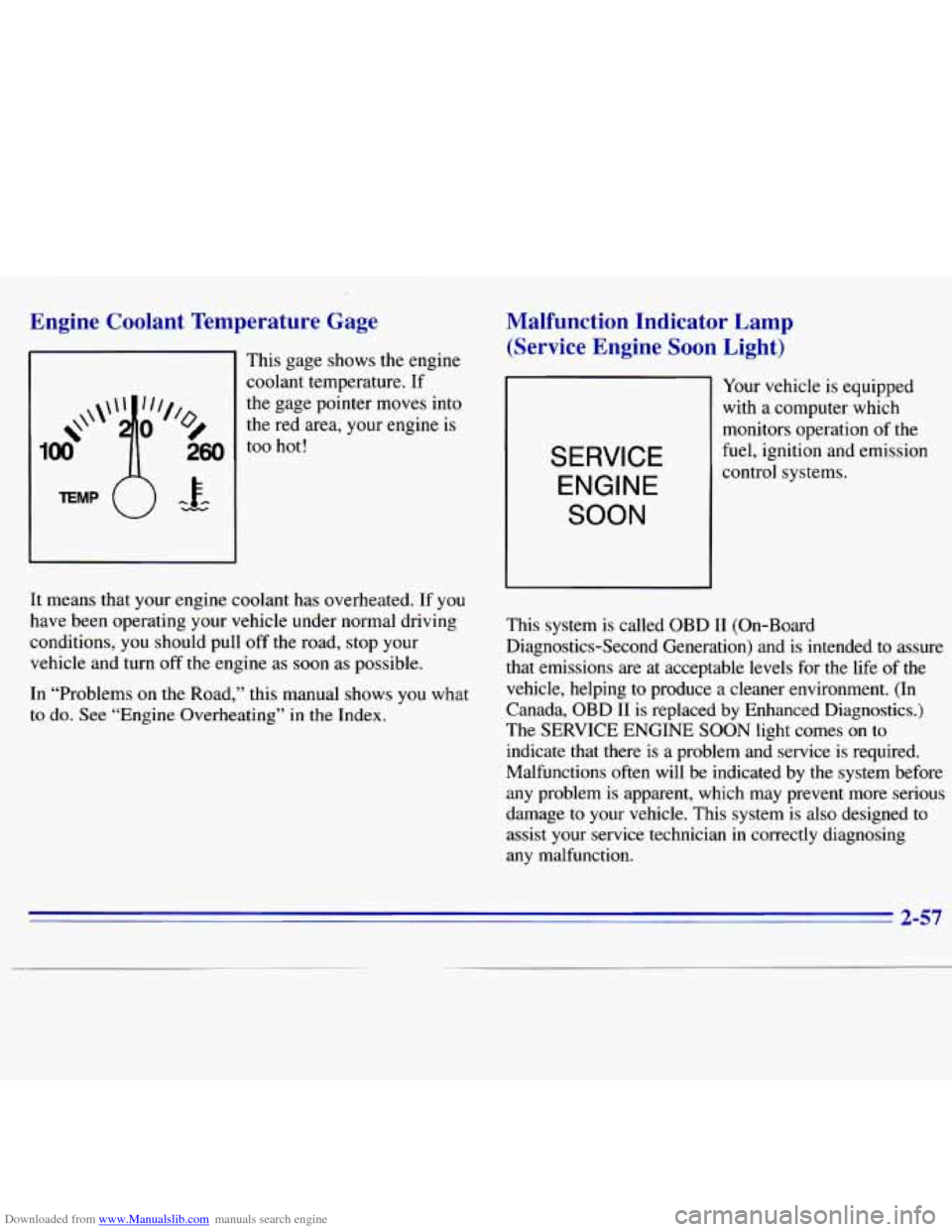
This gage shows the engine
coolant temperature.
If
the gage pointer moves into
the red area, your engine is
260 too hot!
TEMP
Malfunction Indicator Lamp
(Service Engine Soon Light)
Your vehicle is equipped
with a computer which
monitors operation of the
fuel, ignition and emission
SERVICE
ENGINE
SOON
control systems.
It means that your engine coolant has overheated. If you
have been operating your vehicle under normal driving
conditions, you should pull off the road, stop your
vehicle and turn off
the engine as soon as possible.
In “Problems on the Road,” this manual shows you
what
to do. See “Engine Overheating” in the Index. This
system is called
OBD I1 (On-Board
Diagnostics-Second Generation) and is intended
to assure
that emissions are at acceptable levels for the life of the
vehicle, helping to produce a cleaner environment.
(In
Canada, OBD I1 is replaced by Enhanced Diagnostics.)
The SERVICE ENGINE SOON light comes on to
indicate that there is a problem and service
is required.
Malfunctions often will be indicated by the system before
any problem is apparent, which may prevent more serious
damage to your vehicle. This system
is also designed to
assist your service technician
in correctly diagnosing
any malfunction.
2-57
Page 114 of 375
Downloaded from www.Manualslib.com manuals search engine Section 3 Comfort, Controls and Audio Systems
In this section you’ll find out how to operate the comfort
control and audio systems offered with your vehicle. Be
sure to read about the particular systems supplied with
your vehicle.
Comfort Controls
With these systems- you can control the heating, cooling
and ventilation in your vehicle.
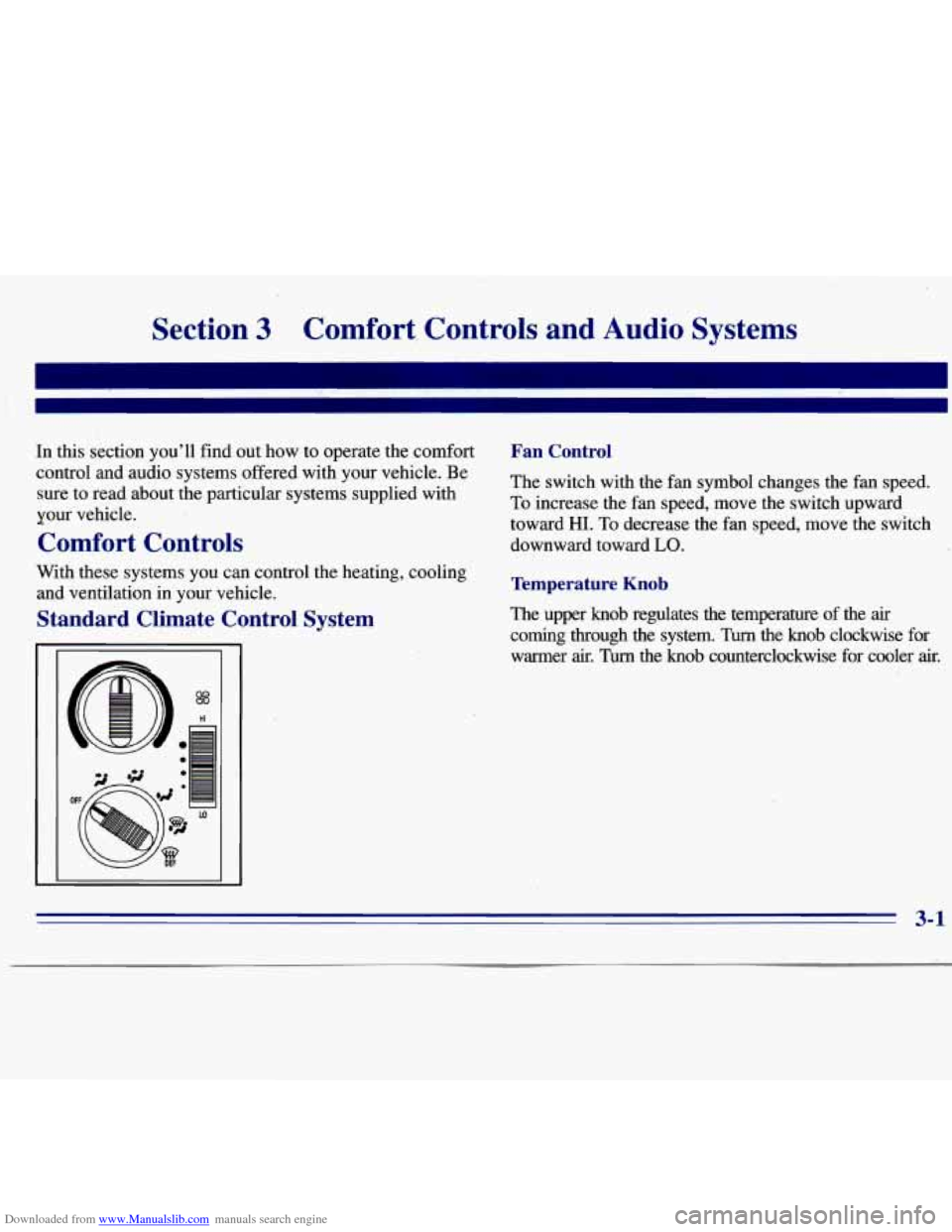
Standard Climate Control System
Fan Control
The switch with the fan symbol changes the fan speed.
To increase the fan speed, move the switch upward
toward HI. To decrease the fan speed, move the switch
downward toward
LO.
Temperature Knob
The upper knob regulates the temperature of the air
coming through the system. Turn the knob clockwise for
warmer
air. Turn the knob counterclockwise for cooler air.
3-1
Page 115 of 375
Downloaded from www.Manualslib.com manuals search engine Mode Knob
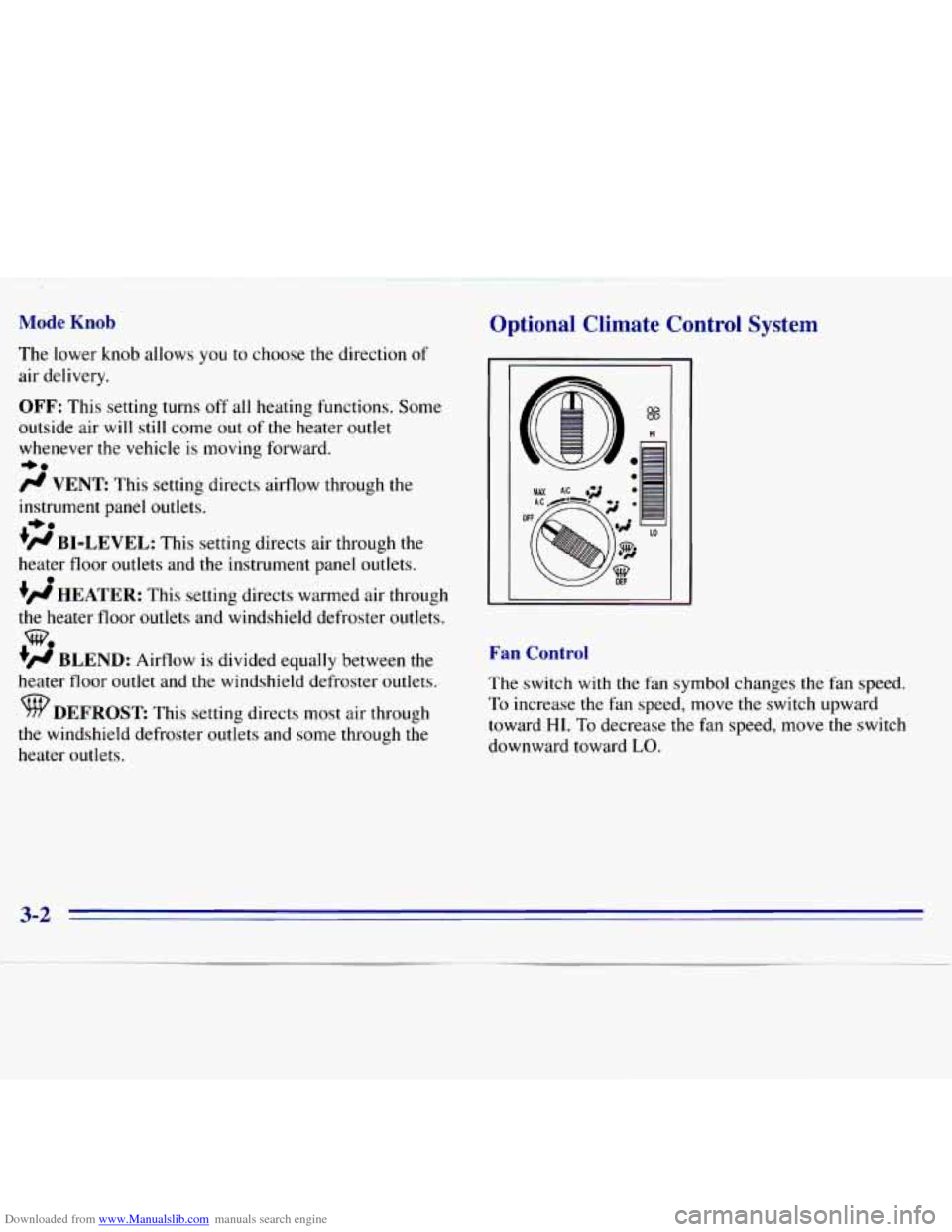
The lower knob allows you to choose the direction of
air delivery.
OFF: This setting turns off all heating functions. Some
outside
air will still come out of the heater outlet
whenever the vehicle is moving forward.
/J VENT: This setting directs airflow through the
instrument panel outlets.
+/J BI-LEVEL: This setting directs air through the
heater floor outlets and the instrument panel outlets.
+’ HEATER: This setting directs warmed air through
the heater floor outlets and windshield defroster outlets.
+# BLEND: Airflow is divided equally between the
heater floor outlet and the windshield defroster outlets.
=be
+.
0
w.
WDEFROST This setting directs most air through
the windshield defroster outlets and some through the
heater outlets.
Optional Climate Control System
i
0
OF
%
HI
Fan Control
The switch with the fan symbol changes the fan speed.
To increase the
fan speed, move the switch upward
toward
HI. To decrease the fan speed, move the switch
downward toward
LO.
3-2
Page 117 of 375
Downloaded from www.Manualslib.com manuals search engine Heating
The heater works best if you keep your windows closed
while using it. On cold days, use
HEATER with the
temperature knob turned clockwise.
BLEND is useful in
cool weather when you have fog or ice on the
windshield or side windows.
If you use the optional engine coolant heater before
starting your engine, your heating system will produce
warmer air faster
to heat the passenger compartment in
cold weather. See “Engine Coolant Heater” in the Index.
Ventilation System
For mild outside temperatures when little heating or
cooling is needed, use
VENT to direct outside air
through your vehicle. Airflow is through the instrument
panel outlets.
Your vehicle’s ventilation system supplies outside air
to
the inside of your vehicle when it is moving. When the
vehicle
is not moving, you can get outside air to flow
through by selecting any mode. and any fan speed.
.. ..
You will find air outlets in the center and on the sides of
your instrument panel.
You can move the outlets to direct the flow of air, or
close the outlets altogether. When you close an outlet, it
will increase the flow of air coming out of any outlets
that are open.
3-4
Page 185 of 375
Downloaded from www.Manualslib.com manuals search engine Turn Signals When Towing a Trailer
When you tow a trailer, your vehicle has to have extra
wiring and a heavy-duty turn signal flasher (included
in
the optional trailering package).
The green arrows on your instrument panel will flash
whenever you signal a turn or lane change. Properly
hooked up, the trailer lamps will also flash, telling other
drivers you’re about to turn, change lanes or stop.
When towing a trailer, the green arrows on your
instrument panel will flash for turns even if the bulbs on
the trailer are burned out. Thus, you may think drivers
behind
you are seeing your signal when they are not. It’s
important
to check occasionally to be sure the trailer
bulbs are still working.
Driving On Grades
Reduce speed and shift to a lower gear before you start
down a long or steep downgrade. If you don’t shift
down,
you might have to use your brakes so much that
they would get hot and no longer work well, On
a long uphill grade, shift down and reduce your
speed to around
45 mph (70 kdh) to reduce the
possibility of engine
and transmission overheating.
If you have an automatic transmission, you should use
DRIVE (D) when towing a trailer. Operating your
vehicle in DRIVE (D) when towing a trailer will
minimize heat buildup and extend the life of your
transmission. Or, if you have a manual transmission, it’s
better not to use FIFTH
(5), just drive in FOURTH (4)
(or, as you need to, a lower gear).
When towing at high altitude on steep uphill grades,
consider the following: Engine coolant will boil
at a
lower temperature than at normal altitudes. If you turn
your engine off immediately after towing at high altitude
on steep
uphill grades, your vehicle may show signs
similar to engine overheating. To avoid this, let the
engine run while parked (preferably on level ground)
with the automatic transmission in PARK
(P) (or the
manual transmission out of gear and the parking brake
applied) for
a few minutes before turning the engine off.
If you do get the overheat warning, see “Engine
Overheating’’
in the Index.
4-54
Page 201 of 375
Downloaded from www.Manualslib.com manuals search engine Engine Overheating
You will find a coolant temperature gage on your
vehicle’s instrument panel.
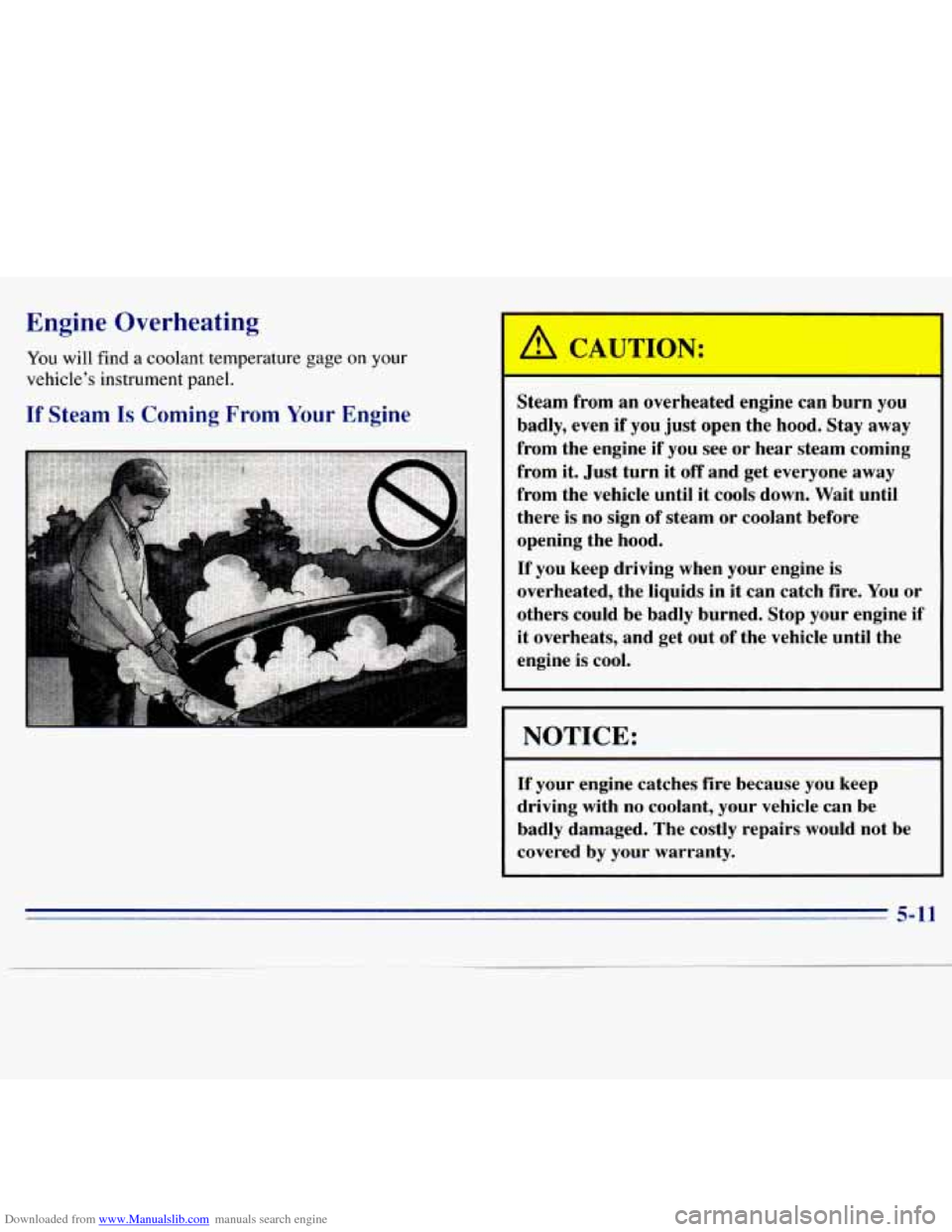
If Steam Is Coming From Your Engine
Steam from an overheated engine can burn you
badly, even if you just open the hood. Stay away
from the engine if you see or hear steam coming
from it. Just turn it
off and get everyone away
from the vehicle until it cools down. Wait until
there is
no sign of steam or coolant before
opening the hood.
If you keep driving when your engine is
overheated, the liquids in it can catch fire. You or
others could be badly burned. Stop your engine if
it overheats, and get out of the vehicle until the
engine is cool.
I NOTICE:
If your engine catches fire because you keep
driving with
no coolant, your vehicle can be
badly damaged. The costly repairs would not be
covered by your warranty.
5-11
Page 250 of 375
Downloaded from www.Manualslib.com manuals search engine How to Check Lubricant
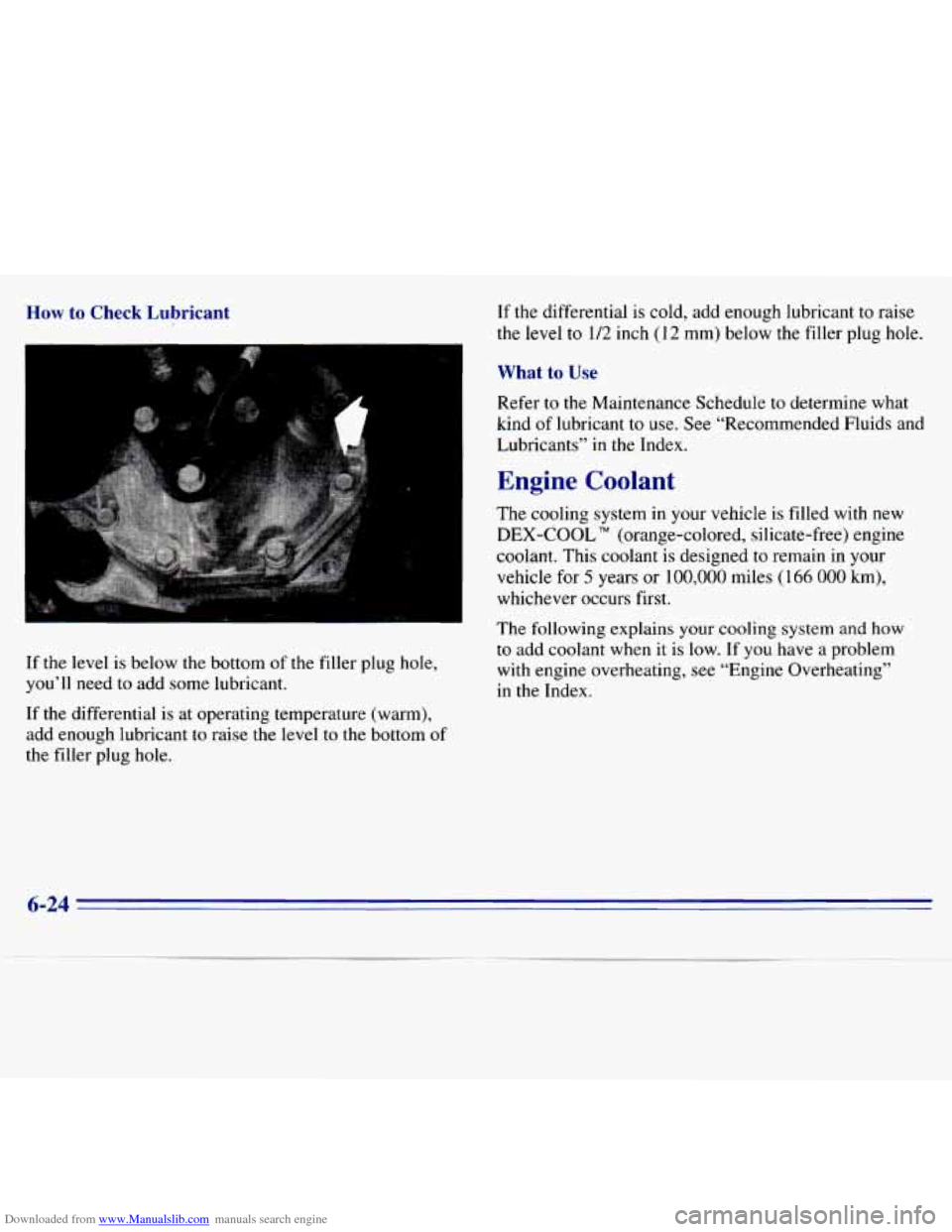
If the level is below the bottom of the filler plug hole,
you’ll need to add some lubricant.
If the differential is at operating temperature (warm),
add enough lubricant
to raise the level to the bottom of
the filler plug hole. If
the differential is cold, add enough lubricant to raise
the level
to 1/2 inch (12 mm) below the filler plug hole.
What to Use
Refer to the Maintenance Schedule to determine what
kind of lubricant to use. See “Recommended Fluids
and
Lubricants’’ in the Index.
Engine Coolant
The cooling system in your vehicle is filled with new
DEX-COOL R’l (orange-colored, silicate-free) engine
coolant. This coolant is designed to remain in your
vehicle for
5 years or 100,000 miles ( 166 000 km),
whichever occurs first.
The following explains your cooling system and
how
to add coolant when it is low. If you have a problem
with engine overheating, see “Engine Overheating”
in the Index.
6-24