Page 244 of 375
Downloaded from www.Manualslib.com manuals search engine Then, without shutting off the engine, follow
these steps:
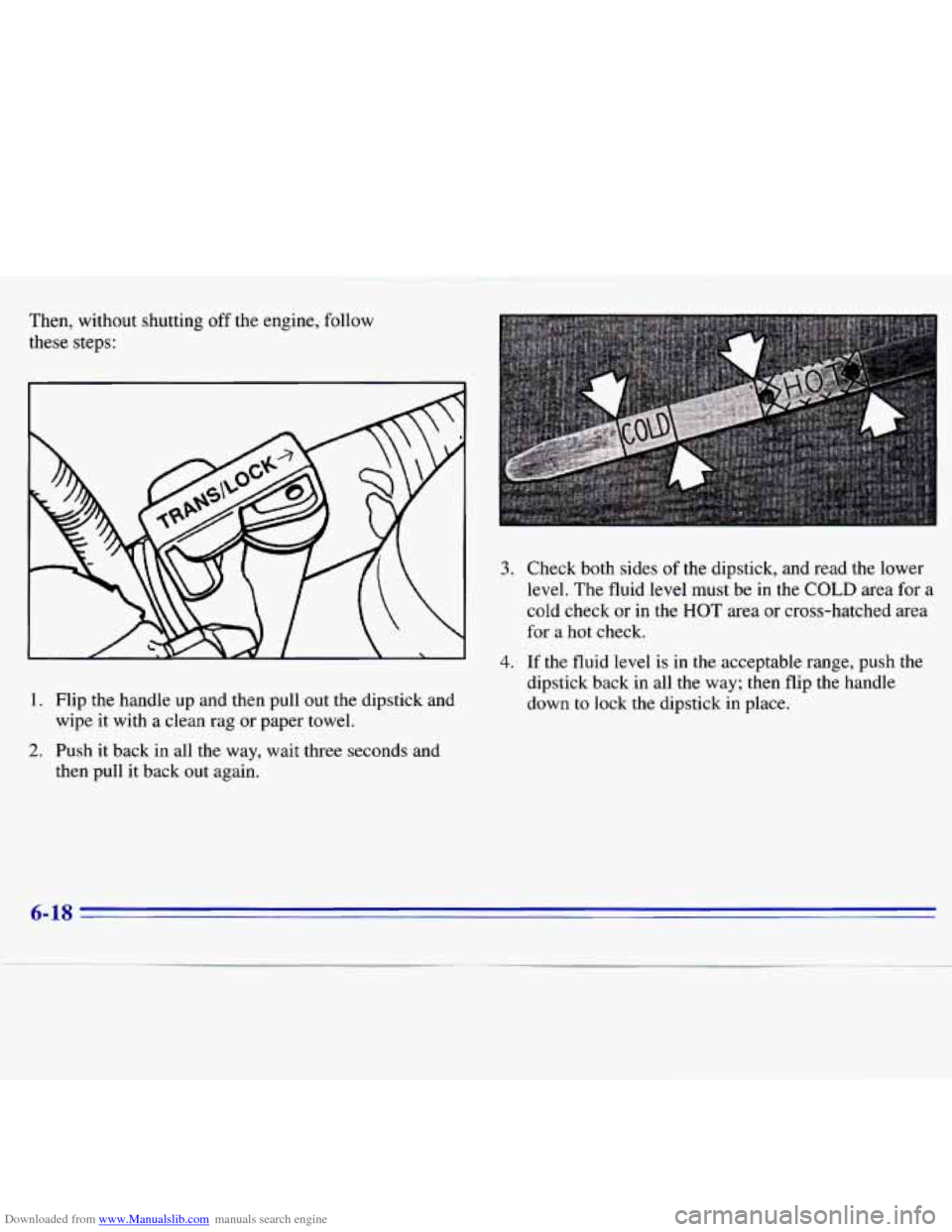
1. Flip the handle up and then pull out the dipstick and
wipe it with
a clean rag or paper towel.
2. Push it back in all the way, wait three seconds and
then pull
it back out again.
6
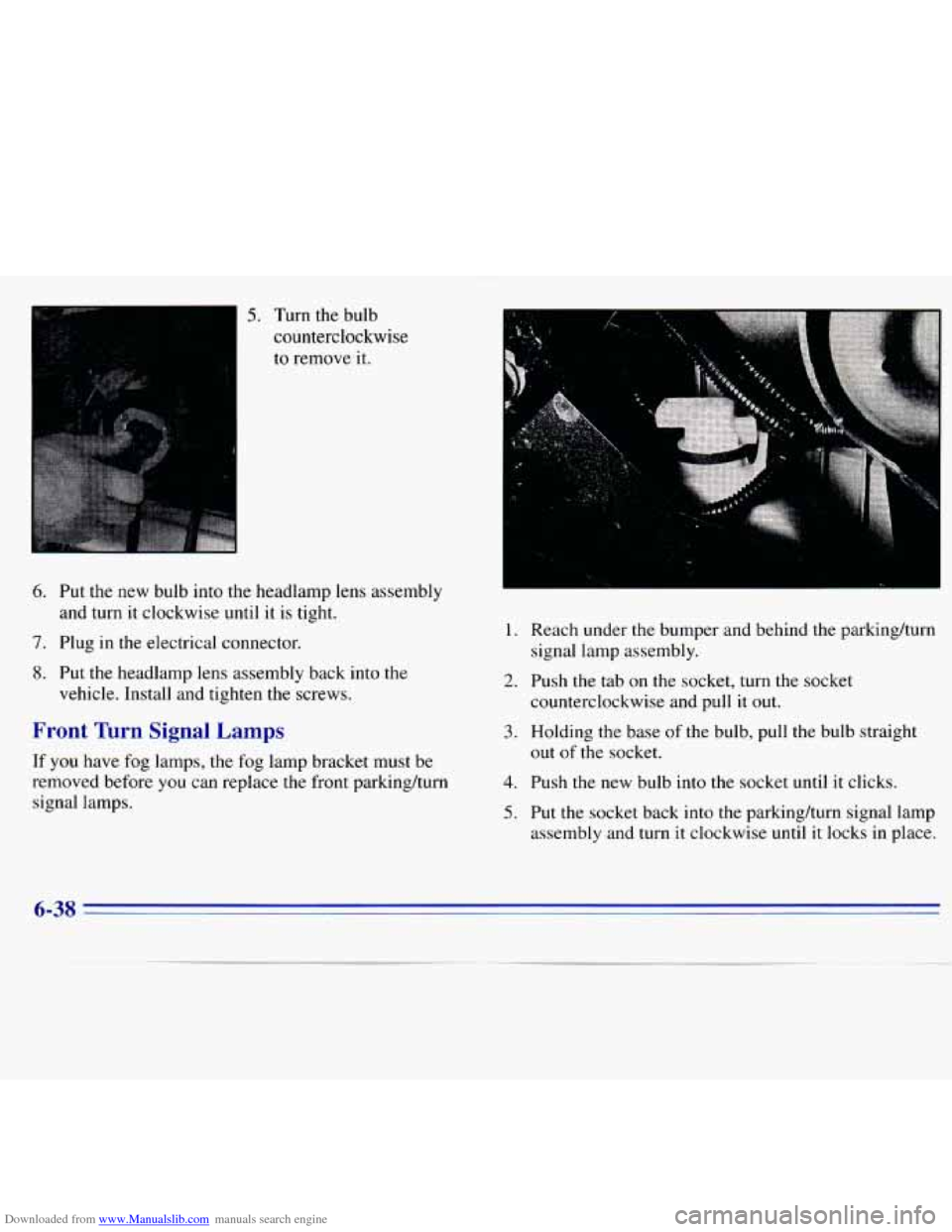
3. Check both sides of the dipstick, and read the lower
level. The fluid level must be in the
COLD area for a
cold check or in the HOT area or cross-hatched area
for a
hot check.
4. If the fluid level is in the acceptable range, push the
dipstick back in all the way; then flip the handle
down to lock the dipstick in place.
6-18
Page 245 of 375
Downloaded from www.Manualslib.com manuals search engine How to Add Fluid
Refer to the Maintenance Schedule to determine what
kind
of transmission fluid to use. See “Recommended
Fluids and Lubricants” in the Index.
Add fluid only after checking the transmission fluid
HOT. (A COLD check is used only as a reference.) If
the fluid level is low, add only enough of the proper
fluid to bring
the level up to the HOT area for a hot
check. It doesn’t take much fluid, generally less than a
pint.
Don’t over-ZZ. We recommend you use only fluid
labeled DEXRON@-111, because fluid with that label
is
made especially for your automatic transmission.
Damage caused by fluid other than DEXRON@-I11 is
not covered by your new vehicle warranty.
After adding fluid, recheck the fluid level as
described under “How to Check.”
When the correct fluid level is obtained, push the
dipstick back
in all the way; then flip the handle
down to
lock the dipstick in place.
Manual Transmission Fluid
When to Check
A good time to have it checked is when the engine oil is
changed. However, the fluid in your manual
transmission doesn’t require changing.
How to Check
Because this operation can be a little difficult, you
may choose to
have this done at your GM dealer’s
Service Department.
If you do it yourself, be sure to follow all the
instructions here, or you could get a false reading.
I NOTICE:
Too much or too little fluid can damage your
transmission.
Too much can mean that some of
the fluid could come out and fall on hot engine
parts or exhaust system parts, starting a fire. Be
sure to get an accurate reading if you check your
transmission fluid.
Page 264 of 375
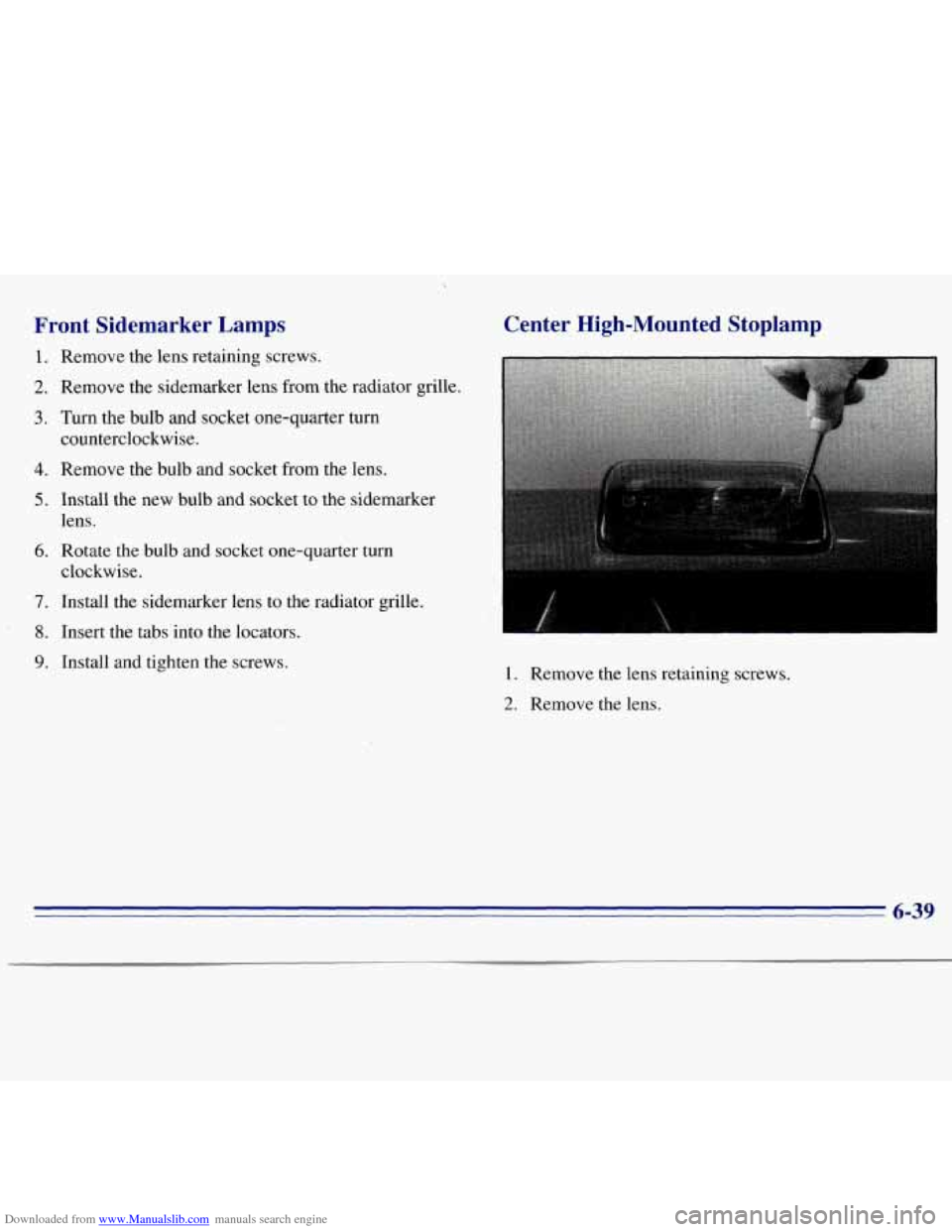
Downloaded from www.Manualslib.com manuals search engine 5. Turn the bulb
counterclockwise
to remove it.
6. Put the new bulb into the headlamp lens assembly
and turn it clockwise until
it is tight.
7. Plug in the electrical connector.
8. Put the headlamp lens assembly back into the
vehicle. Install and tighten the screws.
Front Turn Signal Lamps
If you have fog lamps, the fog lamp bracket must be
removed before
you can replace the front parkinghum
signal lamps.
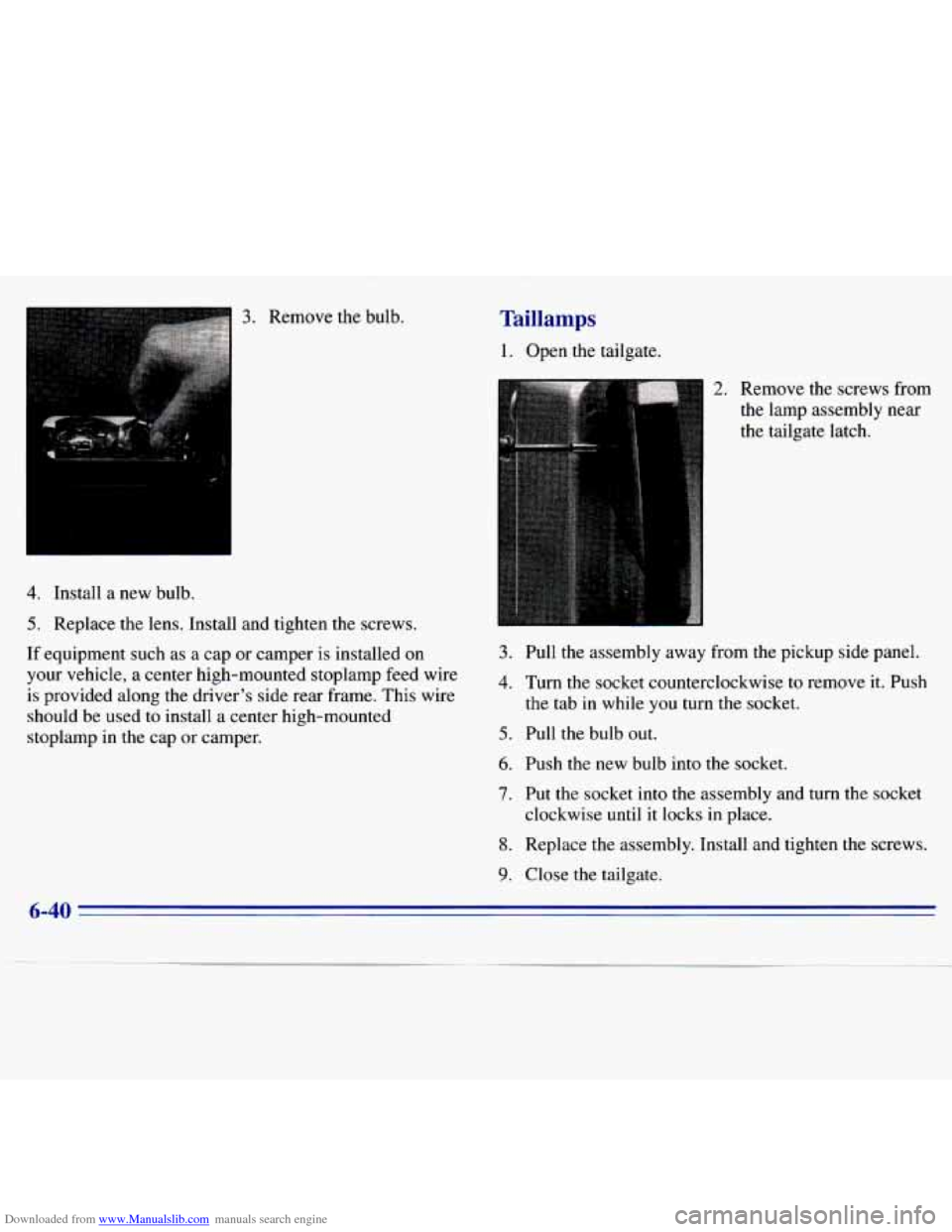
1. Reach under the bumper and behind the parkinghrn
signal lamp assembly.
2. Push the tab on the socket, turn the socket
counterclockwise and pull
it out.
3. Holding the base of the bulb, pull the bulb straight
out
of the socket.
4. Push the new bulb into the socket until it clicks.
5. Put the socket back into the parkinghrn signal lamp
assembly and
turn it clockwise until it locks in place.
6-38
Page 265 of 375
Downloaded from www.Manualslib.com manuals search engine Front Sidemarker Lamps
1.
2.
3.
4.
5.
6.
7.
8.
9.
Remove the lens retaining screws.
Remove the sidemarker lens from the radiator grille.
Turn the bulb and socket one-quarter turn counterclockwise.
Remove the bulb and socket from the lens. Install the new bulb and socket to the sidemarker
lens.
Rotate the bulb and socket one-quarter turn
clockwise.
Install the sidemarker lens to the radiator grille.
Insert the tabs into the locators.
Install and tighten the screws.
Center High-Mounted Stoplamp
1. Remove the lens retaining screws.
2. Remove the lens.
6-39
Page 266 of 375
Downloaded from www.Manualslib.com manuals search engine 4. Install a new bulb.
5. Replace the lens. Install and tighten the screws.
If equipment such as a cap
or camper is installed on
your vehicle, a center high-mounted stoplamp feed wire
is provided along the driver's side rear frame. This wire
should be used
to install a center high-mounted
stoplamp in the cap or camper.
Taillamps
1. Open the tailgate.
2. Remove the screws from
3.
4.
5.
6.
7.
8.
9.
the lamp assembly near
the tailgate latch.
Pull the assembly away from the pickup side panel.
Turn the socket counterclockwise
to remove it. Push
the tab in while you turn the socket.
Pull the bulb out.
Push the new bulb into the socket.
Put the socket
into the assembly and turn the socket
clockwise until it locks in place.
Replace the assembly. Install and tighten the screws.
Close the tailgate.
6-40
Page 268 of 375
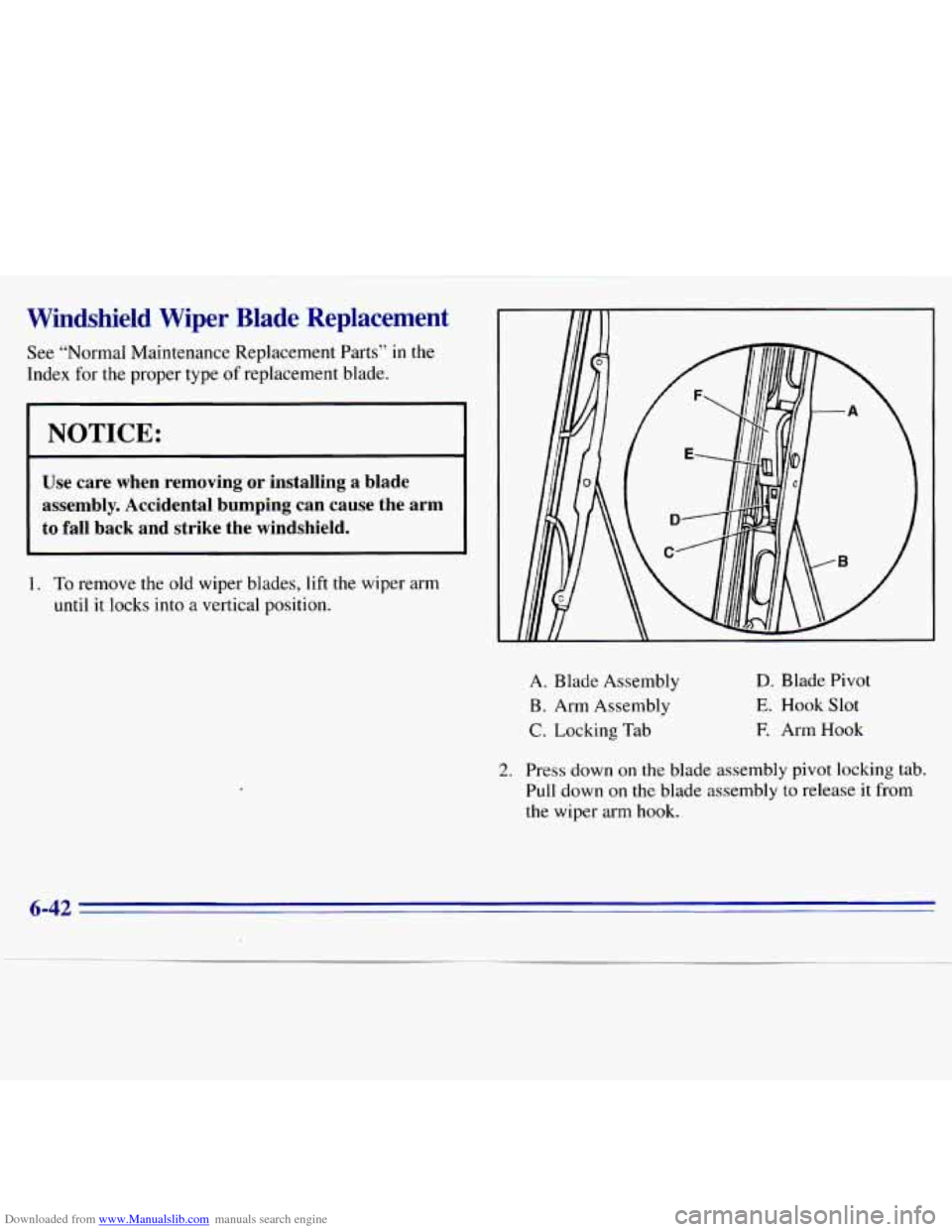
Downloaded from www.Manualslib.com manuals search engine Windshield Wiper Blade Replacement
See “Normal Maintenance Replacement Parts” in the
Index for the proper type
of replacement blade.
NOTICE:
Use care when removing or installing a blade
assembly. Accidental bumping can cause the arm
to fall back and strike the windshield.
1. To remove the old wiper blades, lift the wiper arm
until it locks into a vertical position.
A. Blade Assembly
B. Arm Assembly
C. Locking Tab
D. Blade Pivot
E. Hook Slot
E Arm Hook
2. Press down on the blade assembly pivot locking tab.
Pull down on
the blade assembly to release it from
the wiper arm hook.
6-42
Page 269 of 375
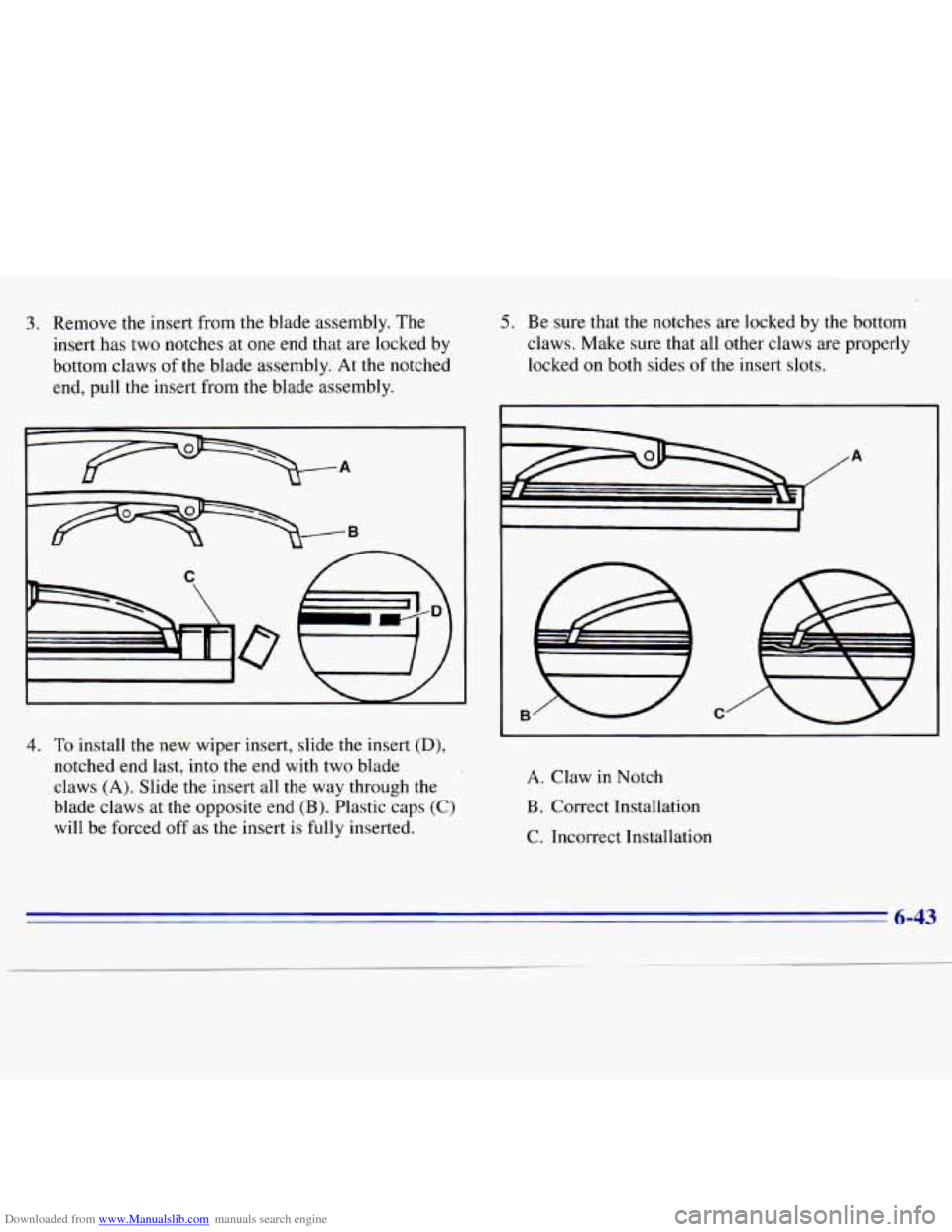
Downloaded from www.Manualslib.com manuals search engine 3. Remove the insert from the blade assembly. The
insert has two notches at one end that are locked by
bottom claws of the blade assembly. At
the notched
end, pull the insert from the blade assembly.
F
-A u
0 I/
4. To install the new wiper insert, slide the insert (D),
notched end last, into the end with two blade
claws
(A). Slide the insert all the way through the
blade claws at the opposite end
(B). Plastic caps (C)
will be forced off as the insert is fully inserted.
5. Be sure that the notches are locked by the bottom
claws. Make sure that all other claws are properly
locked
on both sides of the insert slots.
I
B C
A. Claw in Notch
B. Correct Installation
C. Incorrect Installation
6-43
Page 270 of 375
Downloaded from www.Manualslib.com manuals search engine 6. Put the blade assembly pivot in the wiper arm
hook. Pull up until the pivot locking tab locks in
the hook
slot.
7. Carefully lower the wiper arm and blade assembly
onto the windshield.
Tires
We don’t make tires. Your new vehicle comes with
high-quality tires made
by a leading tire manufacturer.
If you ever have questions about your tire warranty
and where to obtain service, see
your warranty booklet
for details.
I A CAUTION:
Poorly maintained and improperly used tires are
dangerous.
0 Overloading your tires can cause
overheating as a result of too much friction.
You could have an air-out and a serious
accident. See “Loading Your Vehicle” in
the Index.
CAUTION: (Continued)
0
0
Underinflated tires pose the same danger as
overloaded tires. The resulting accident
could cause serious injury. Check all tires
frequently to maintain the recommended pressure. Tire pressure should be checked
when your tires are cold.
Overinflated tires are more likely to be
cut, punctured or broken by a sudden
impact
-- such as when you hit a pothole.
Keep tires at the recommended pressure.
Worn, old tires can cause accidents.
If your
tread is badly worn,
or if your tires have
been damaged, replace them.
6-44